
应用化学 ›› 2025, Vol. 42 ›› Issue (4): 522-532.DOI: 10.19894/j.issn.1000-0518.240417
彭文琪, 周锐, 程旺兴, 张自品( )
)
收稿日期:2024-12-17
接受日期:2025-03-17
出版日期:2025-04-01
发布日期:2025-05-14
通讯作者:
张自品
作者简介:zpzhang@ahtcm.edu.cn
Wen-Qi PENG, Rui ZHOU, Wang-Xin CHENG, Zi-Pin ZHANG()
Received:2024-12-17
Accepted:2025-03-17
Published:2025-04-01
Online:2025-05-14
Contact:
Zi-Pin ZHANG
Supported by:摘要:
基于1,3,6-三磺酸8-氨基萘(ANTS)与小檗碱分子间的非共价作用,利用ANTS的荧光性质和电化学活性,以ANTS同时作为小檗碱的识别元件和电化学-荧光双模响应探针,建立了小檗碱的电化学-荧光双模传感器。 利用ANTS与单壁碳纳米管(SWNTs)之间的π-π堆积作用,构建了基于ANTS/SWNTs修饰玻碳(GC)电极的电化学传感器,电化学传感分析采用差分脉冲(DPV)技术、利用ANTS/SWNTs/GC电极在-0.003和+0.074 V的氧化峰电流的下降率之和对小檗碱进行定量分析; 荧光传感分析基于ANTS溶液在517 nm处的荧光强度下降率对小檗碱进行定量分析。 在最优化条件下,电化学传感器对小檗碱的电流响应在0.05~2 μmol/L和2~1000 μmol/L浓度范围内呈现良好的线性关系,检测限为0.013 μmol/L; 荧光传感器对小檗碱的荧光强度响应在1~100 μmol/L浓度范围内呈现良好的线性关系,检测限为0.325 μmol/L。 实际样品测定表明,大鼠血浆和肝脏匀浆中内源性物质对双模传感器的测定均无明显干扰。 电化学传感分析对小檗碱灌胃模型大鼠的血浆和肝脏匀浆测定的相对标准偏差(RSD)分别为3.0%(n=3)和4.0%(n=3); 荧光传感分析对大鼠血浆和肝脏匀浆的加标回收率分别为99.8%~100.2%(n=3)和95.5%~99.9%(n=3)。 该方法有望应用于小檗碱相关的生理和病理事件研究。
中图分类号:
彭文琪, 周锐, 程旺兴, 张自品. 面向生物样品分析的小檗碱的电化学-荧光双模传感器[J]. 应用化学, 2025, 42(4): 522-532.
Wen-Qi PENG, Rui ZHOU, Wang-Xin CHENG, Zi-Pin ZHANG. An Electrochemical-Fluorescence Dual-Mode Chemosensor for Berberine Detection in Biological Samples[J]. Chinese Journal of Applied Chemistry, 2025, 42(4): 522-532.
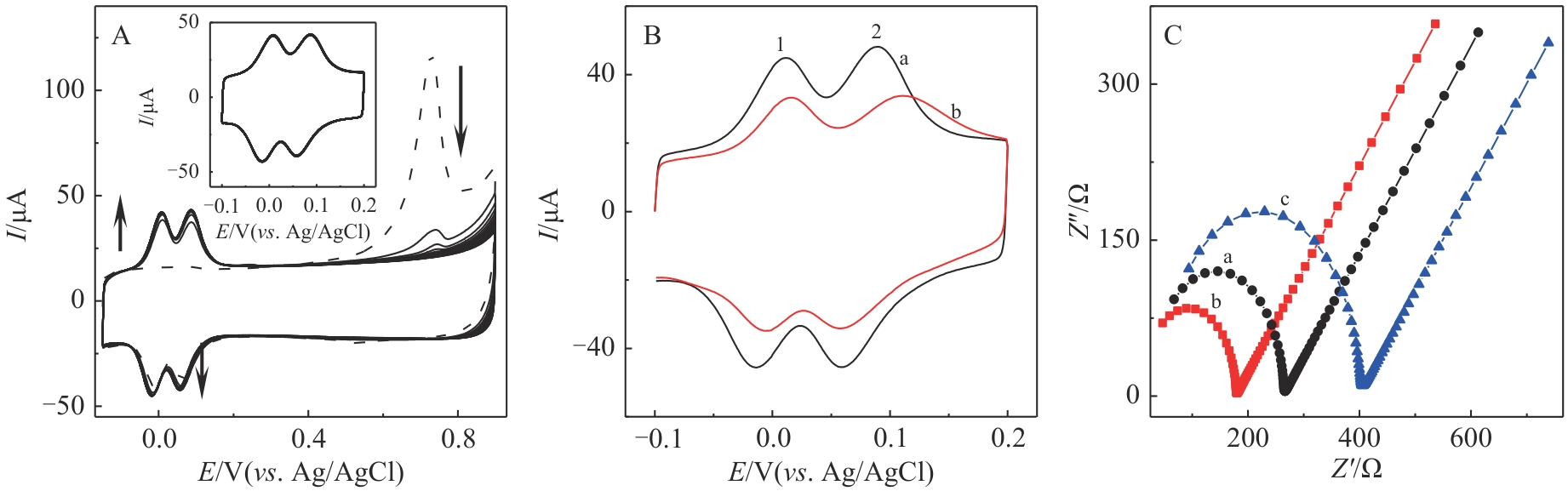
图1 (A) ANTS/SWNTs/GC电极在0.1 mol/L Tris-HCL缓冲溶液(pH=7.4)中扫描8圈的循环伏安图。 插图为ANTS/SWNTs/GC电极在0.1 mol/L Tris-HCL(pH=7.4)空白缓冲溶液中扫描50圈的循环伏安图。 扫速: 50 mV/s。 (B) ANTS/SWNTs/GC电极在0.1 mol/L Tris-HCL缓冲溶液(pH=7.4)中浸泡小檗碱前(a)与浸泡500 μmol/L小檗碱10 min后(b)的循环伏安图。 扫速: 50 mV/s。 (C) SWNTs/GC电极(a)、ANTS/SWNTs/GC电极浸泡小檗碱前(b)与浸泡500 μmol/L小檗碱10 min后(c)在含0.1 mol/L KCl的等摩尔(5.0×10⁻³ mol/L) K3[Fe(CN)6]和K4[Fe(CN)6]混合溶液中的Nyquist图
Fig.1 (A) Typical 8-cycle repetitive CV obtained at the ANTS/SWNTs/GC electrode in 0.1 mol/L Tris-HCL at pH=7.4. The dashed curve represent the first cycles of the CV. Inset, CVs obtained at the ANTS/SWNTs-modified GC electrode in 0.1 mol/L Tris-HCL of pH=7.4 for 50 cycles. Scan rate, 50 mV/s. (B) Typical CVs obtained at the ANTS/SWNTs/GC electrode in 0.1 mol/L Tris-HCL at pH=7.4 in the absence (a) and presence (b) of 500 μmol/L berberine after 10 min incubation, Scan rate, 50 mV/s. (C) Typical Nyquist plots obtained in 0.1 mol/L KCl containing an equimolar (5.0×10⁻³ mol/L) mixture of K3[Fe(CN)6] and K4[Fe(CN)6] for SWNTs/GC electrode (a), ANTS/SWNT/GC electrode before (b), and after 10-min of incubation with 500 μmol/L berberine (c)
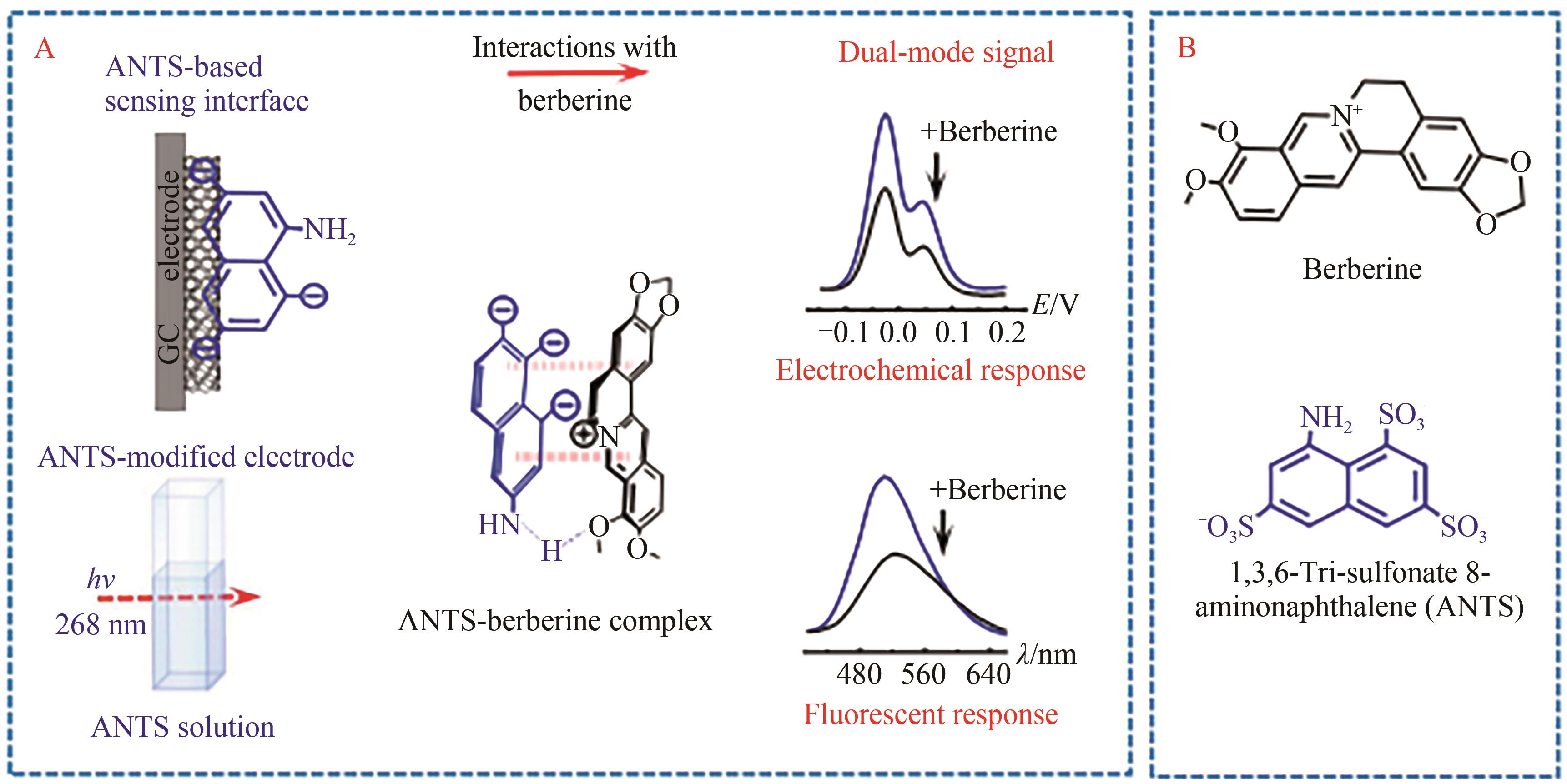
图示1 基于ANTS的小檗碱电化学-荧光双模分析策略示意图以及小檗碱(A),ANTS和小檗碱化学结构式(B)(说明: 图A中ANTS结构被简化,以便更清楚表示ANTS与小檗碱的相互作用)
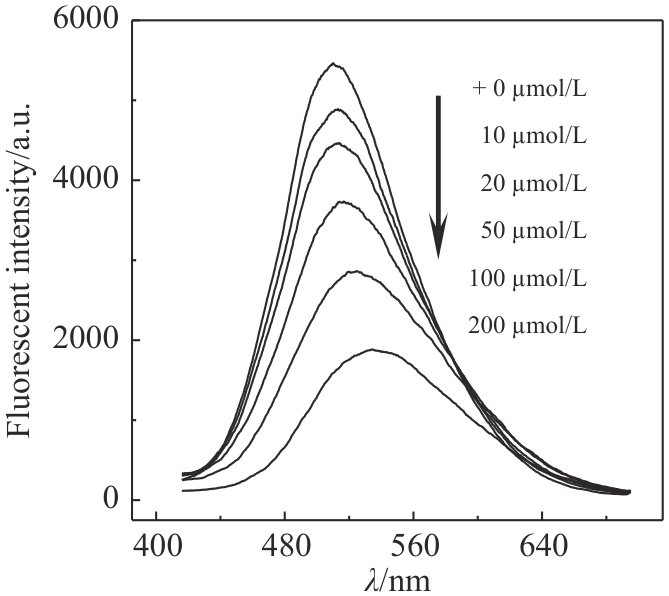
图2 1 μmol/L ANTS在0.01 mol/L Tris-HCL (pH=7.4)溶液中加入不同浓度小檗碱(10~200 μmol/L)的荧光光谱
Fig.2 Emission spectra of 1 μmol/L ANTS in 0.01 mol/L Tris-HCL (pH=7.4) after addition of berberine (10~200 μmol/L)
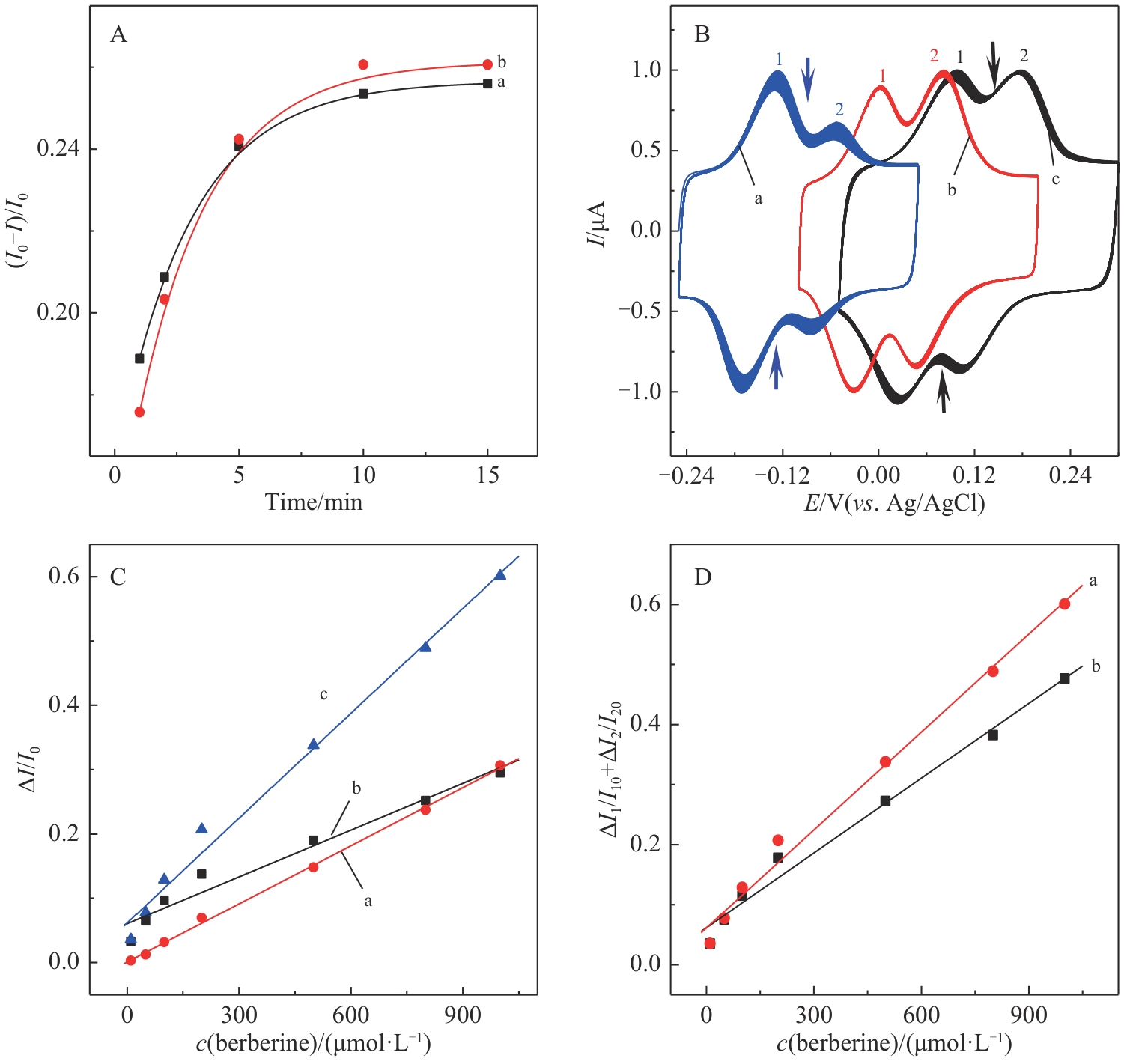
图3 (A) ANTS/SWNTs/GC电极与500 μmol/L小檗碱作用后峰1 (a)和峰2 (b)在0.1 mol/L Tris-HCL (pH=7.4)中的电流下降率与浸泡时间的关系曲线; (B) ANTS/SWNTs/GC电极分别在pH=6.0 (a)、pH=7.4 (b)和pH=10.0 (c)的B-R缓冲溶液中扫描50圈的循环伏安图。 扫速: 50 mV/s; (C) ANTS/SWNTs/GC浸泡500 μmol/L小檗碱后峰1电流下降率ΔI1/I10 (a),峰2电流下降率ΔI2/I20 (b)以及峰1和峰2电流下降率之和ΔI1/I10+ ΔI2/I20 (c)与小檗碱浓度间的拟合线性; (D) ANTS/SWNTs/GC电极与小檗碱作用后峰1和峰2电流下降率之和ΔI1/I10+ΔI2/I20在pH=7.4的0.1 mol/L Tris-HCL (a)和0.1 mol/L PBS (b)中对不同浓度小檗碱响应的拟合线性
Fig.3 (A) Linear plots of the current decrease ratio for peak 1 (a) and peak 2 (b) of the ANTS/SWNTs/GC electrode in 0.1 mol/L Tris-HCL (pH=7.4) after immersing into 500 μmol/L berberine versus incubation time; (B) 50-Cycle repetitive CVs obtained at ANTS/SWNTs/GC electrode in 0.1 mol/L B-R solution at pH=6.0 (a), pH=7.4 (b), and pH=10.0 (c); (C) The linear relationships between ΔI1/I10 (a),ΔI2/I20 (b) and ΔI1/I10+ΔI2/I20 (c) andberberine concentration; (D) The linear relationships between ΔI1/I10+ΔI2/I20 of ANTS/SWNTs/GC electrode in responses to berberine in 0.1 mol/L of Tris-HCL (a) and PBS (b) at pH=7.4
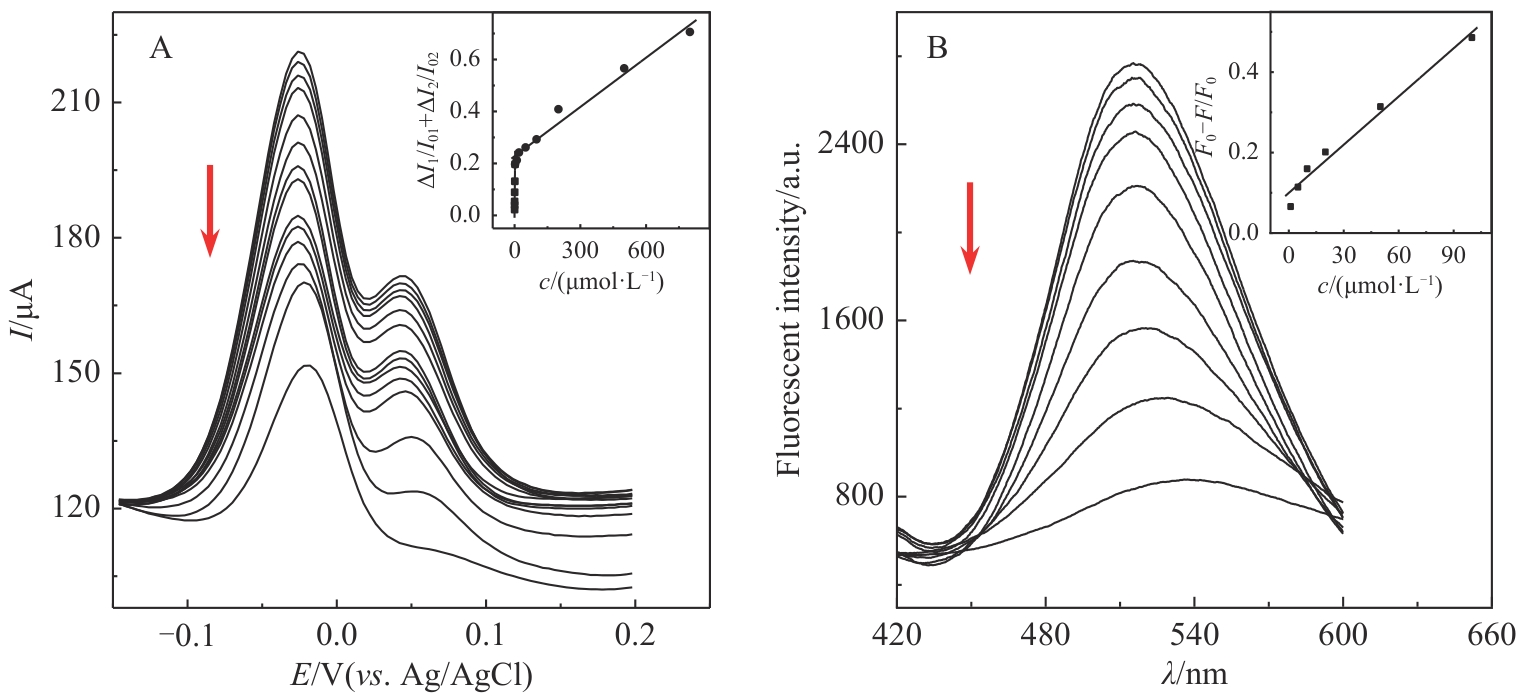
图4 (A) ANTS/SWNTs/GC电极在0.1 mol/L Tris-HCL(pH=7.4)中对0.05~1000 μmol/L小檗碱电流响应的差分脉冲伏安曲线。 插图为ANTS/SWNTs/GC电极电流的下降率之和与小檗碱浓度在0.05~2 μmol/L和2~1000 μmol/L之间的线性拟合曲线; (B) 1 μmol/L ANTS在0.01 mol/L Tris-HCL(pH=7.4)中与1~400 μmol/L小檗碱混合后的荧光光谱图。 插图为ANTS与1~100 μmol/L小檗碱混合后小檗碱浓度与荧光强度下降率之间的线性图。 图4A和4B箭头方向均为小檗碱浓度增加方向
Fig.4 (A) Typical DPVs of the ANTS/SWNTs-modified GC electrode in 0.1 mol/L Tris-HCL (pH=7.4) after immersing with 0.05~1000 μmol/L berberine for 10 min. Inset: Linear plots of current response versus concentration of berberine from 0.05 to 2 μmol/L and 2 to 1000 μmol/L; (B) Emission spectra of 1 μmol/L ANTS in 0.01 mol/L Tris-HCL (pH=7.4) upon addition of 1~400 μmol/L berberine. Inset: Linear plot of the ratio of fluorescence intensity decrease versus concentration of berberine from 1 to 100 μmol/L. In Fig.4A and 4B, the arrows indicate the direction of increase in berberine concentration
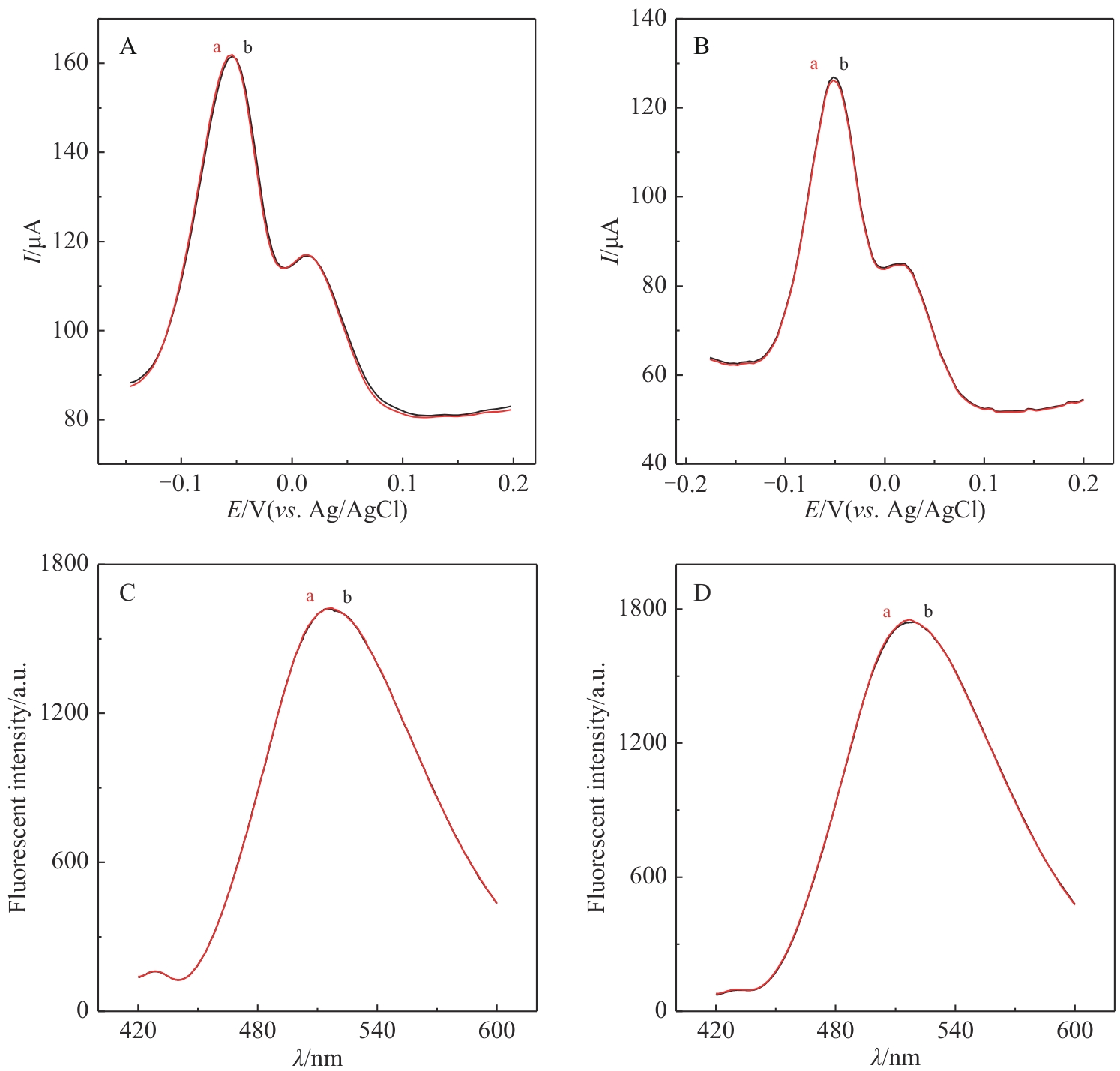
图5 ANTS/SWNTs/GC电极(a)在2 mL 0.1 mol/L Tris-HCL(pH=7.4)中加入10 μL空白大鼠血浆(b)(A)和肝脏匀浆(b)(B)的差分脉冲曲线; 分别向2 mL含有1 μmol/L ANTS的0.01 mol/L Tris-HCL(pH=7.4)溶液(a)中加入2 μL大鼠血浆(b)(C)和2 μL肝脏匀浆(b)(D)的荧光发射图谱
Fig.5 Typical DPVs recorded at the ANTS/SWNTs/GC electrode (a) in 2 mL of 0.1 mol/L Tris-HCL (pH=7.4) upon the addition of 10 μL rat plasma (b) (A) and 10 μL liver homogenates (b) (B); The Emission spectra of 2 mL of 0.01 mol/L Tris-HCL (pH=7.4) containing 1 μmol/L ANTS (a) upon addition of 2 μL rat plasma (b) (C) and 2 μL liver homogenates (b) (D)
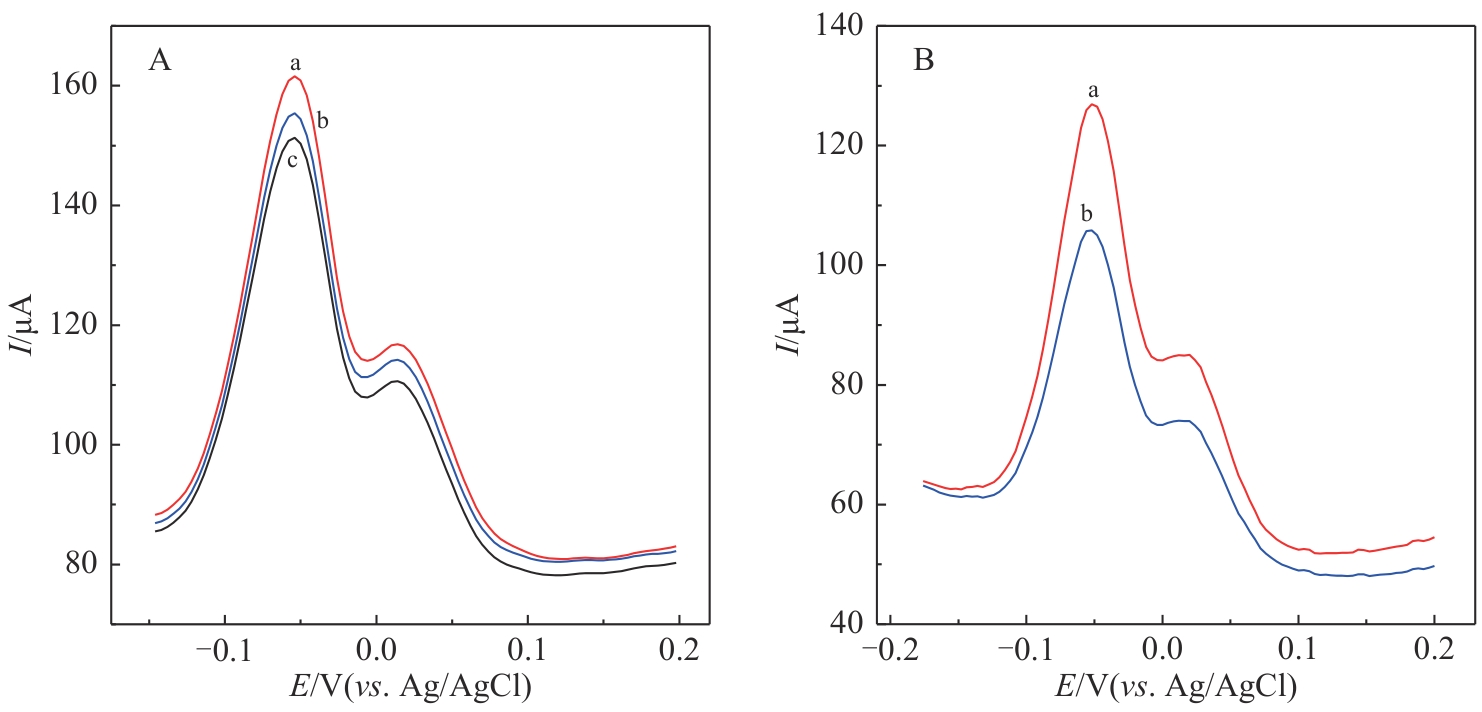
图6 (A) ANTS/SWNTs/GC电极在2 mL 0.1 mol/L Tris-HCL缓冲溶液(pH=7.4)(a)和分别加入10 μL灌胃1 h后(b)以及10 μL灌胃2 h后(c)的模型血浆的差分脉冲曲线; (B) ANTS/SWNTs/GC电极在2 mL 0.1 mol/L Tris-HCL缓冲溶液(pH=7.4)(a)、10 μL 3 h(b)的模型肝脏匀浆的差分脉冲曲线
Fig.6 (A) Typical DPVs recorded at the ANTS/SWNTs/GC electrode in 2 mL of 0.1 mol/L Tris-HCL (pH=7.4) (a) upon the addition of 10 μL model plasma of rats after dosing of berberine for 1 h (b) and 2 h (c); (B) Typical DPVs recorded at the ANTS/SWNTs/GC electrode in 2 mL of 0.1 mol/L Tris-HCL (pH=7.4) (a) upon the addition of 10 μL model liver homogenate after dosing of berberine for 3 h (b)
| Sample | Spiked/(μmol·L-1) | Found/(μmol·L-1) | Recovery/% | RSD/% |
|---|---|---|---|---|
| Liver homogenate | 2 | 1.997 | 99.8 | 0.54 |
| 15 | 14.46 | 96.4 | 2.6 | |
| 80 | 76.40 | 95.5 | 3.2 | |
| Plasma | 2 | 2.004 | 100.2 | 1.06 |
| 15 | 14.54 | 96.9 | 2.11 | |
| 80 | 79.84 | 99.8 | 3.17 |
表1 大鼠空白血浆和肝脏匀浆中小檗碱的加标回收结果(n=3)
Table 1 Spike-and-recovery in rat plasma and liver homogenate(n=3)
| Sample | Spiked/(μmol·L-1) | Found/(μmol·L-1) | Recovery/% | RSD/% |
|---|---|---|---|---|
| Liver homogenate | 2 | 1.997 | 99.8 | 0.54 |
| 15 | 14.46 | 96.4 | 2.6 | |
| 80 | 76.40 | 95.5 | 3.2 | |
| Plasma | 2 | 2.004 | 100.2 | 1.06 |
| 15 | 14.54 | 96.9 | 2.11 | |
| 80 | 79.84 | 99.8 | 3.17 |
| 1 | IMENSHAHIDI M, HOSSEINZADEH H. Berberis vulgaris and berberine: an update review[J]. Phytother Res, 2016, 30(11): 1745-1764. |
| 2 | QIN Z, TA R, LIANG J, et al. Berberine, a natural alkaloid: advances in its pharmacological effects and mechanisms in the treatment of autoimmune diseases[J]. Int Immunopharmacol, 2024, 137: 112422. |
| 3 | LIU L, CHEN Z. Analysis of four alkaloids of Coptis chinensis in rat plasma by high performance liquid chromatography with electrochemical detection[J]. Anal Chim Acta, 2012, 737: 99-104. |
| 4 | CHEN J, ZHAO H, WANG X, et al. Analysis of major alkaloids in Rhizoma coptidis by capillary electrophoresis-electrospray-time of flight mass spectrometry with different background electrolytes[J]. Electrophoresis, 2008, 29(10): 2135-2147. |
| 5 | ALAM S D, BEG M A, BAGADI M, et al. Facile extraction of berberine from different plants, separation, and identification by thin-layer chromatography, high-performance liquid chromatography, and biological evaluation against Leishmaniosis[J]. J Sep Sci, 2023, 46(21): 2300582. |
| 6 | WANG X Y, XIAO S Y, JIANG Z W, et al. An ultrathin 2D Yb(Ⅲ) metal-organic frameworks with strong electrochemiluminescence as a “on-off-on” platform for detection of picric acid and berberine chloride form[J]. Talanta, 2021, 234: 122625. |
| 7 | HU Z, XIE M, YANG D, et al. A simple, fast, and sensitive colorimetric assay for visual detection of berberine in human plasma by NaHSO4-optimized gold nanoparticles[J]. RSC Adv, 2017, 7(55): 34746-34754. |
| 8 | QI L, GAO Y, PEI S, et al. Fluorescence “light-up” sensor based on ligand/SiO2@NH2@cyanuric chloride nanoparticle interactions in alliance with salt dehydration for berberine detection[J]. Spectrochim Acta Part A, 2024, 304: 123330. |
| 9 | CHANG J, LV W, LI Q, et al. One-step synthesis of methylene blue-encapsulated zeolitic imidazolate framework for dual-signal fluorescent and homogeneous electrochemical biosensing[J]. Anal Chem, 2020, 92(13): 8959-8964. |
| 10 | LI J, PENG Z, WANG E. Tackling grand challenges of the 21st century with electroanalytical chemistry[J]. J Am Chem Soc, 2018, 140(34): 10629-10638. |
| 11 | WU D, SEDGWICK A C, GUNNLAUGSSON T, et al. Fluorescent chemosensors: the past, present and future[J]. Chem Soc Rev, 2017, 46(23): 7105-7123. |
| 12 | DICULESCU V C, ENACHE T A, OLIVEIRA P J, et al. Electrochemical oxidation of berberine and of its oxidation products at a glassy carbon electrode[J]. Electroanalysis, 2009, 21(9): 1027-1034. |
| 13 | GETO A, PITA M, DE LACEY A L, et al. Electrochemical determination of berberine at a multi-walled carbon nanotubes-modified glassy carbon electrode[J]. Sens Actuators B Chem, 2013, 183: 96-101. |
| 14 | 周锐, 张自品. 生物样品中小檗碱的电化学分析新方法[J]. 应用化学, 2023, 40(4): 518-526. |
| ZHOU R, ZHANG Z P. A novel electrochemical method for berberine detection in biological fluids[J]. Chin J Appl Chem, 40(4): 518-526. | |
| 15 | ĆIRIĆ-MARJANOVIĆ G, TRCHOVÁ M, MATĚJKA P, et al. Electrochemical oxidative polymerization of sodium 4-amino-3-hydroxynaphthalene-1-sulfonate and structural characterization of polymeric products[J]. React Funct Polym, 2006, 66(12): 1670-1683. |
| 16 | AYINLA R T, SHIRI M, SONG B, et al. The pivotal role of non-covalent interactions in single-molecule charge transport[J]. Mater Chem Front, 2023, 7(17): 3524-3542. |
| 17 | ZHAO Y J, MIAO K, ZHU Z, et al. Fluorescence quenching of a conjugated polymer by synergistic amine-carboxylic acid and π-π interactions for selective detection of aromatic amines in aqueous solution[J]. ACS Sens, 2017, 2(6): 842-847. |
| 18 | RODRIGO A C, LAURINI E, VIEIRA V M P, et al. Effect of buffer at nanoscale molecular recognition interfaces-electrostatic binding of biological polyanions[J]. Chem Commun, 2017, 53(84): 11580-11583. |
| [1] | 李玲, 唐俐婷, 杨君洁, 闫力强, 李建平. 有机小分子荧光探针对肼检测的研究进展[J]. 应用化学, 2025, 42(4): 453-465. |
| [2] | 王松柏, 李天宇, 魏梦姝, 郭炘明, 李俊芬, 周影, 彭秀英, 董川. 基于硅量子点荧光法和比色法双模式检测绿原酸[J]. 应用化学, 2025, 42(4): 511-521. |
| [3] | 王丹, 王亮. 酸性低共熔溶剂中Biginelli反应的克级合成[J]. 应用化学, 2025, 42(4): 533-541. |
| [4] | 李云扬, 郑睿哲, 周延, 海热古·吐逊, 董彪. 单颗粒上转换荧光光谱性质调控[J]. 应用化学, 2025, 42(3): 365-374. |
| [5] | 肖巨颖, 赵霞, 林园, 苏朝晖. 功能型聚乙二醇化壳聚糖纳米颗粒的制备和表征[J]. 应用化学, 2025, 42(3): 386-395. |
| [6] | 王旭, 李晋雨, 张彩红. 1,3-交替杯[4]芳烃衍生物的制备及其氢键聚合[J]. 应用化学, 2025, 42(3): 396-405. |
| [7] | 高长江, 黄鑫, 田亚洋, 余海峰, 王小波. 一种近红外快速响应型硫化氢荧光探针的合成及细胞成像[J]. 应用化学, 2025, 42(2): 192-200. |
| [8] | 张傲天, 史俊杰, 陈前火, 李红周. 氮磷阻燃剂的合成及其在环氧树脂中的阻燃应用[J]. 应用化学, 2025, 42(2): 212-221. |
| [9] | 伍佳豪, 杨骏. 镧系离子掺杂CsLu(MoO4)2荧光粉的多色发光及其防伪应用[J]. 应用化学, 2025, 42(2): 222-229. |
| [10] | 许良, 刘健鹏, 青建. 有机八极分子双光子激发荧光材料的设计合成与性能的研究进展[J]. 应用化学, 2025, 42(1): 29-41. |
| [11] | 王莹, 武瑞平. 高精度X射线荧光光谱法在含铜污泥Cu离子测定中的应用[J]. 应用化学, 2024, 41(9): 1307-1314. |
| [12] | 刘炳芹, 王艳华. 温控相转移催化新体系中α,β-不饱和酮的常压加氢反应[J]. 应用化学, 2024, 41(9): 1350-1356. |
| [13] | 杨雪艳, 史俊杰, 周勇军, 戴玉梅, 李红周. 磷系阻燃剂插层镁铝水滑石增强环氧树脂的阻燃性能[J]. 应用化学, 2024, 41(8): 1154-1167. |
| [14] | 苑晓冬, 陈金平, 于天君, 曾毅, 李嫕. 具有双重显影特性的多用途单分子树脂化学放大光刻胶[J]. 应用化学, 2024, 41(7): 1024-1034. |
| [15] | 任艳娇, 徐荣声, 王萍, 孙冬, 耿万东, 张海永. 乙二酸四乙酸二钠盐改性枸杞杆生物炭对亚甲基蓝吸附性能[J]. 应用化学, 2024, 41(7): 1035-1046. |
| 阅读次数 | ||||||
|
全文 |
|
|||||
|
摘要 |
|
|||||
