
应用化学 ›› 2025, Vol. 42 ›› Issue (7): 901-913.DOI: 10.19894/j.issn.1000-0518.250089
韩子姗, 邹亢, 杨雪( )
)
收稿日期:2025-03-04
接受日期:2025-06-19
出版日期:2025-07-01
发布日期:2025-07-23
通讯作者:
杨雪
基金资助:
Zi-Shan HAN, Kang ZOU, Xue YANG()
Received:2025-03-04
Accepted:2025-06-19
Published:2025-07-01
Online:2025-07-23
Contact:
Xue YANG
About author:yangx.ripp@sinopec.comSupported by:摘要:
电催化二氧化碳还原反应(CO2RR)可高效合成高值化学品与燃料,为缓解大气CO2浓度上升及可再生能源存储提供重要技术途径。 本综述系统梳理了电催化CO2RR中构建稳定三相界面的研究进展,重点关注增强CO2传质的调控策略以及影响膜电极/气体扩散电极体系稳定性的解决方案,并探讨了这些策略的适用范围以及对电催化CO2RR性能的影响。 最后,基于三相界面,进一步指出了CO2RR在面向工业化应用过程中所面临的科学与技术挑战。
中图分类号:
韩子姗, 邹亢, 杨雪. 三相界面调控在电催化二氧化碳还原反应中的研究进展[J]. 应用化学, 2025, 42(7): 901-913.
Zi-Shan HAN, Kang ZOU, Xue YANG. Research Progress on Triple-Phase Interface Engineering in Electrocatalytic CO2 Reduction Reaction[J]. Chinese Journal of Applied Chemistry, 2025, 42(7): 901-913.
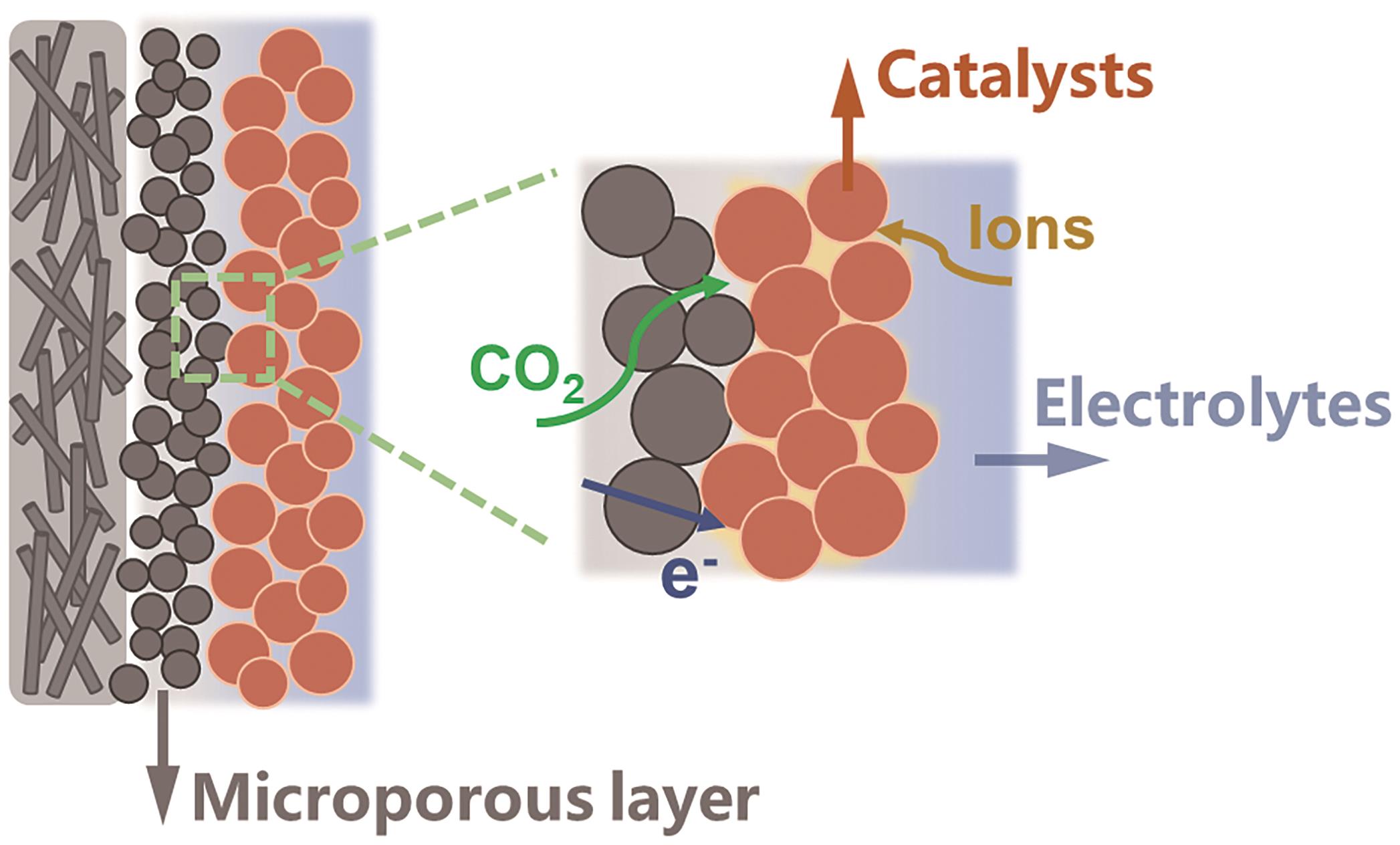
图1 电催化CO2RR的三相界面示意图
Fig.1 Schematic diagram of the three-phase interface in electrocatalytic CO2RR

图2 (A)在催化剂层中分散PTFE纳米颗粒后构建的气液固三相界面示意图[20]; (B) Au/C-F催化剂(Cassie态,上)、Au/C-P-0.5催化剂(Cassie-Wenzel态,中)、和Au/C-P-2.5催化剂(Wenzel态,下)的界面结构示意图[21]; (C) PFSA离聚物层的亲疏水结构示意图[23]
Fig.2 (A) Schematic picture of the constructed solid-liquid-gas TPI by dispersing PTFE nanoparticles inside the catalyst layer[20]; (B) Schematic illustration of three interfacial states represented by Au/C-F (Cassie state, top), Au/C-P-0.5 (Cassie-Wenzel state, middle) and Au/C-P-2.5 (Wenzel state, bottom) catalyst, respectively[21]; (C) Hydrophilic and hydrophobic characteristics of PFSA ionomers[23]

图3 (A)无CTAB(左)和有CTAB(右)时水的ν-OH振动峰[26]; (B) IPN-PFSA异质催化剂复合层对微环境调控作用的示意图[29]
Fig.3 (A) v-OH vibrational region of H2O without (left) and with (right) CTAB[26]; (B) Schematics of interfacial microenvironment regulation of IPN-PFSA heterogeneous catalyst adlayer[29]

图4 (A)全金属气体扩散增强铜电极示意图[33]; (B)碳纤维结构中孔体和孔喉内CO2浓度分布模拟图[34]
Fig.4 (A) Schematic of an all-metal gas diffusion enhanced Cu electrode[33]; (B) Modelled CO2 volume fraction in the pore body and the pore throat of carbon fabrics[34]

图5 (A) CO2加湿和(B)CO2干燥时,不同气体流速下阴极侧水通量组成[41]; 不同厚度低吸水性膜的(C)阴极水积累量和(D)CO选择性[43]
Fig.5 Calculated composition of water flux on the cathode side at different gas flow rates for (A) wet CO2 feeds and (B) dry CO2 feeds[41]; (C) The excess flux of water at cathode and (D) the CO faradaic efficiencies of low water uptake membranes with different thicknesses[43]

图6 (A)再生电位条件下,碳酸根离子向阳极发生电迁移过程[54]; (B)反向偏压双极膜电极示意图[55]
Fig.6 (A) Carbonate migration occurs during cell operation at the regeneration voltage[54]; (B) Schematic of a BPM electrode assembly in reverse-bias configuration[55]

图7 (A)示意图显示,极化后石墨烯可作为铜纳米晶的保护层[65]; (B) -0.61 V(vs.RHE)电位下,计算得到的Cu+/Cu0比值随时间变化图[66]
Fig.7 (A) Schematic picture showing graphene could act as a protective barrier of the CuNCs after polarization[65]; (B) Calculated Cu+/Cu0 ratio as a function of reaction time at -0.61 V(vs.RHE)[66]
| Product | Conventional process | Conventional unit cost (USD/ton) | CO2RR cost (USD/ton) | Outlook |
|---|---|---|---|---|
| Carbon monoxide (CO)[ | Steam methane reforming, partial oxidation of methane | 150~600 | 200~600 | Near commercial viability; Competitive with some conventional processes |
| Formic acid (HCOOH)[ | Methanol carbonylation, hydrolysis of methyl formate | 200~600 | 550~1 200 | Requires improved catalyst stability and energy efficiency |
| Ethylene (C2H4)[ | Naphtha steam cracking | 600~1 300 | 2 300~7 000 | High cost limits short-term viability; Long-term potential depends on scale and policy support (e.g., carbon pricing) |
| Ethanol (C2H5OH)[ | Biological fermentation, ethylene hydration | 600~1 000 | 1 600~4 500 | Currently costly; Tandem CO pathways may reduce costs over time |
表1 CO2电还原的主要产物与传统工艺路线的成本对比
Table 1 Cost comparison of primary products in CO2 electroreduction versus conventional process pathways
| Product | Conventional process | Conventional unit cost (USD/ton) | CO2RR cost (USD/ton) | Outlook |
|---|---|---|---|---|
| Carbon monoxide (CO)[ | Steam methane reforming, partial oxidation of methane | 150~600 | 200~600 | Near commercial viability; Competitive with some conventional processes |
| Formic acid (HCOOH)[ | Methanol carbonylation, hydrolysis of methyl formate | 200~600 | 550~1 200 | Requires improved catalyst stability and energy efficiency |
| Ethylene (C2H4)[ | Naphtha steam cracking | 600~1 300 | 2 300~7 000 | High cost limits short-term viability; Long-term potential depends on scale and policy support (e.g., carbon pricing) |
| Ethanol (C2H5OH)[ | Biological fermentation, ethylene hydration | 600~1 000 | 1 600~4 500 | Currently costly; Tandem CO pathways may reduce costs over time |
| [1] | 刘旭升, 李泽洋, 杨宇森, 等. 电催化二氧化碳还原制备气态产物的研究进展[J]. 化工学报, 2024, 75(7): 2385-2408. |
| LIU X S, LI Z Y, YANG Y S, et al. Research progress on electrocatalytic carbon dioxide reduction for gaseous product preparation[J]. Chin J Chem Eng, 2024, 75(7): 2385-2408. | |
| [2] | 黄修淞, 王淑娟, 许俊杰. CO2捕集与电化学还原利用集成系统研究综述[J]. 燃烧科学与技术, 2022, 28(6): 679-686. |
| HUANG X S, WANG S J, XU J J. A review of integrated systems for CO2 capture coupled with electrochemical reduction and utilization[J]. Combust Sci Technol, 2022, 28(6): 679-686. | |
| [3] | LAI W, QIAO Y, WANG Y, et al. Stability issues in electrochemical CO2 reduction: recent advances in fundamental understanding and design strategies[J]. Adv Mater, 2023, 35(51): 2306288. |
| [4] | SHIN H, HANSEN K U, JIAO F. Techno-economic assessment of low-temperature carbon dioxide electrolysis[J]. Nat Sustain, 2021, 4(10): 911-919. |
| [5] | MASEL R I, LIU Z, YANG H, et al. An industrial perspective on catalysts for low-temperature CO2 electrolysis[J]. Nat Nanotechnol, 2021, 16(2): 118-128. |
| [6] | STEPHENS I E L, CHAN K, BAGGER A, et al. 2022 roadmap on low temperature electrochemical CO2 reduction[J]. J Phys Energy, 2022, 4(4): 042003. |
| [7] | 马一宁, 施润, 张铁锐. 三相界面电催化二氧化碳还原研究进展[J]. 化学学报, 2021, 79(4): 369-377. |
| MA Y N, SHI R, ZHANG T R. Advances in three-phase interface for electrocatalysis carbon dioxide reduction[J]. Acta Chim Sin, 2021, 79(4): 369-377. | |
| [8] | DENG B, HUANG M, ZHAO X, et al. Interfacial electrolyte effects on electrocatalytic CO2 reduction[J]. ACS Catal, 2022, 12(1): 331-362. |
| [9] | HE Y, LIU S, WANG M, et al. Deciphering engineering principle of three-phase interface for advanced gas-involved electrochemical reactions[J]. J Energy Chem, 2023, 80: 302-323. |
| [10] | YANG P P, GAO M R. Enrichment of reactants and intermediates for electrocatalytic CO2 reduction[J]. Chem Soc Rev, 2023, 52(13): 4343-4380. |
| [11] | WANG J, TAN H Y, QI M Y, et al. Spatially and temporally understanding dynamic solid-electrolyte interfaces in carbon dioxide electroreduction[J]. Chem Soc Rev, 2023, 52(15): 5013-5050. |
| [12] | RYU J, LEE D W. Tailoring hydrophilic and hydrophobic microenvironments for gas-liquid-solid triphase electrochemical reactions[J]. J Mater Chem A, 2024, 12(17): 10012-10043. |
| [13] | WANG P, HAYASHI T, MENG Q A, et al. Highly boosted oxygen reduction reaction activity by tuning the underwater wetting state of the superhydrophobic electrode[J]. Small, 2017, 13(4): 201601250. |
| [14] | LIANG Y, HAN Y, LI J S, et al. Wettability control in electrocatalyst: a mini review[J]. J Energy Chem, 2022, 70: 643-655. |
| [15] | WAKERLEY D, LAMAISON S, OZANAM F, et al. Bio-inspired hydrophobicity promotes CO2 reduction on a Cu surface[J]. Nat Mater, 2019, 18(11): 1222-1227. |
| [16] | LIANG H Q, ZHAO S, HU X M, et al. Hydrophobic copper interfaces boost electroreduction of carbon dioxide to ethylene in water[J]. ACS Catal, 2021, 11(2): 958-966. |
| [17] | WANG Y, ZHANG J, ZHAO J, et al. Strong hydrogen-bonded interfacial water inhibiting hydrogen evolution kinetics to promote electrochemical CO2 reduction to C2+[J]. ACS Catal, 2024, 14(5): 3457-3465. |
| [18] | LIN Y, WANG T, ZHANG L, et al. Tunable CO2 electroreduction to ethanol and ethylene with controllable interfacial wettability[J]. Nat Commun, 2023, 14(1): 3575. |
| [19] | LIU Z Z, LV X M, KONG S Y, et al. Interfacial water tuning by intermolecular spacing for stable CO electroreduction to C2+ products[J]. Angew Chem Int Ed, 2023, 62(43): e202309319. |
| [20] | XING Z, HU L, RIPATTI D S, et al. Enhancing carbon dioxide gas-diffusion electrolysis by creating a hydrophobic catalyst microenvironment[J]. Nat Commun, 2021, 12(1): 136. |
| [21] | SHI R, GUO J, ZHANG X, et al. Efficient wettability-controlled electroreduction of CO2 to CO at Au/C interfaces[J]. Nat Commun, 2020, 11(1): 3028. |
| [22] | HUANG J E, LI F, OZDEN A, et al. CO2 electrolysis to multicarbon products in strong acid[J]. Science, 2021, 372(6546): 1074-1078. |
| [23] | GARCIA DE ARQUER F P, DINH C T, OZDEN A, et al. CO2 electrolysis to multicarbon products at activities greater than 1 A cm-2[J]. Science, 2020, 367(6478): 661-666. |
| [24] | KIM C, EOM T, JEE M S, et al. Insight into electrochemical CO2 reduction on surface-molecule-mediated Ag nanoparticles[J]. ACS Catal, 2017, 7(1): 779-785. |
| [25] | ZHANG Z Q, BANERJEE S, THOI V S, et al. Reorganization of interfacial water by an amphiphilic cationic surfactant promotes CO2 reduction[J]. J Phys Chem Lett, 2020, 11(14): 5457-5463. |
| [26] | BANERJEE S, GERKE C S, THOI V S. Guiding CO2RR selectivity by compositional tuning in the electrochemical double layer[J]. Acc Chem Res, 2022, 55(4): 504-515. |
| [27] | MOHANDAS N, NARAYANAN T N, CUESTA A. Tailoring the interfacial water structure by electrolyte engineering for selective electrocatalytic reduction of carbon dioxide[J]. ACS Catal, 2023, 13(13): 8384-8393. |
| [28] | QIN X, VEGGE T, HANSEN H A. Cation-coordinated inner-sphere CO2 electroreduction at Au-water interfaces[J]. J Am Chem Soc, 2023, 145(3): 1897-1905. |
| [29] | ZHAO Y, HAO L, OZDEN A, et al. Conversion of CO2 to multicarbon products in strong acid by controlling the catalyst microenvironment[J]. Nat Synth, 2023, 2(5): 403-412. |
| [30] | FAN M, HUANG J E, MIAO R K, et al. Cationic-group-functionalized electrocatalysts enable stable acidic CO2 electrolysis[J]. Nat Catal, 2023, 6(9): 763-772. |
| [31] | WANG Q, LIU Y, TAN Y, et al. Enhanced acidic CO2‐to‐C2+ reduction via ionic liquid layer modification[J]. Small, 2025, 21(12): 2412293. |
| [32] | THEVENON A, ROSAS-HERNÁNDEZ A, FONTANI HERREROS A M, et al. Dramatic HER suppression on Ag electrodes via molecular films for highly selective CO2 to CO reduction[J]. ACS Catal, 2021, 11(8): 4530-4537. |
| [33] | SUN M, CHENG J, YAMAUCHI M. Gas diffusion enhanced electrode with ultrathin superhydrophobic macropore structure for acidic CO2 electroreduction[J]. Nat Commun, 2024, 15(1): 491. |
| [34] | WEN G, REN B, WANG X, et al. Continuous CO2 electrolysis using a CO2 exsolution-induced flow cell[J]. Nat Energy, 2022, 7(10): 978-988. |
| [35] | RABIEE H, GE L, ZHANG X, et al. Stand-alone asymmetric hollow fiber gas-diffusion electrodes with distinguished bronze phases for high-efficiency CO2 electrochemical reduction[J]. Appl Catal B: Environ, 2021, 298: 120538. |
| [36] | ZHANG Z, XIA Y, XU K, et al. Heterogenizing molecular electrocatalysts on a carbon nanotube-based hollow fiber as selective and efficient CO2 penetrable electrodes for high-current-density CO electrosynthesis[J]. ACS Appl Energy Mater, 2025, 8(1): 276-285. |
| [37] | WANG M, LIN L, ZHENG Z, et al. Hydrophobized electrospun nanofibers of hierarchical porosity as the integral gas diffusion electrode for full-pH CO2 electroreduction in membrane electrode assemblies[J]. Energy Environ Sci, 2023, 16(10): 4423-4431. |
| [38] | KAS R, HUMMADI K K, KORTLEVER R, et al. Three-dimensional porous hollow fibre copper electrodes for efficient and high-rate electrochemical carbon dioxide reduction[J]. Nat Commun, 2016, 7(1): 10748. |
| [39] | LI Y X, PEI Z H, LUAN D Y, et al. Superhydrophobic and conductive wire membrane for enhanced CO electroreduction to multicarbon products[J]. Angew Chem Int Ed, 2023, 62(19): e202302128. |
| [40] | O'BRIEN C P, MIAO R K, SHAYESTEH ZERAATI A, et al. CO2 electrolyzers[J]. Chem Rev, 2024, 124(7): 3648-3693. |
| [41] | WHEELER D G, MOWBRAY B A W, REYES A, et al. Quantification of water transport in a CO2 electrolyzer[J]. Energy Environ Sci, 2020, 13(12): 5126-5134. |
| [42] | PARK J, KIM E D, KIM S, et al. Deriving an efficient and stable microenvironment for a CO2 MEA electrolyzer by reverse osmosis[J]. ACS Energy Lett, 2024, 9(7): 3342-3350. |
| [43] | REYES A, JANSONIUS R P, MOWBRAY B A W, et al. Managing hydration at the cathode enables efficient CO2 electrolysis at commercially relevant current densities[J]. ACS Energy Lett, 2020, 5(5): 1612-1618. |
| [44] | YANG K, KAS R, SMITH W A, et al. Role of the carbon-based gas diffusion layer on flooding in a gas diffusion electrode cell for electrochemical CO2 reduction[J]. ACS Energy Lett, 2021, 6(1): 33-40. |
| [45] | LEONARD M E, ORELLA M J, AIELLO N, et al. Editors′ choice-flooded by success: on the role of electrode wettability in CO2 electrolyzers that generate liquid products[J]. J Electrochem Soc, 2020, 167(12): 124521. |
| [46] | SASSENBURG M, KELLY M, SUBRAMANIAN S, et al. Zero-gap electrochemical CO2 reduction cells: challenges and operational strategies for prevention of salt precipitation[J]. ACS Energy Lett, 2023, 8(1): 321-331. |
| [47] | LIU Z, YANG H, KUTZ R, et al. CO2 electrolysis to CO and O2 at high selectivity, stability and efficiency using Sustainion membranes[J]. J Electrochem Soc, 2018, 165(15): J3371. |
| [48] | XUE L, GAO Z, NING T, et al. Dual-role of polyelectrolyte-tethered benzimidazolium cation in promoting CO2/pure water co-electrolysis to ethylene[J]. Angew Chem Int Ed, 2023, 62(46): e202309519. |
| [49] | QIN H G, DU Y F, BAI Y Y, et al. Surface-immobilized cross-linked cationic polyelectrolyte enables CO2 reduction with metal cation-free acidic electrolyte[J]. Nat Commun, 2023, 14(1): 5640. |
| [50] | LI W, YIN Z, GAO Z, et al. Bifunctional ionomers for efficient co-electrolysis of CO2 and pure water towards ethylene production at industrial-scale current densities[J]. Nat Energy, 2022, 7(9): 835-843. |
| [51] | BAUMGARTNER L M, KOOPMAN C I, FORNER-CUENCA A, et al. Narrow pressure stability window of gas diffusion electrodes limits the scale-up of CO2 electrolyzers[J]. ACS Sustainable Chem Eng, 2022, 10(14): 4683-4693. |
| [52] | ENDRŐDI B, KECSENOVITY E, SAMU A, et al. Multilayer electrolyzer stack converts carbon dioxide to gas products at high pressure with high efficiency[J]. ACS Energy Lett, 2019, 4(7): 1770-1777. |
| [53] | ENDRŐDI B, SAMU A, KECSENOVITY E, et al. Operando cathode activation with alkali metal cations for high current density operation of water-fed zero-gap carbon dioxide electrolysers[J]. Nat Energy, 2021, 6(4): 439-448. |
| [54] | XU Y, EDWARDS J P, LIU S, et al. Self-cleaning CO2 reduction systems: unsteady electrochemical forcing enables stability[J]. ACS Energy Lett, 2021, 6(2): 809-815. |
| [55] | PETROV K V, KOOPMAN C I, SUBRAMANIAN S, et al. Bipolar membranes for intrinsically stable and scalable CO2 electrolysis[J]. Nat Energy, 2024, 9(8): 932-938. |
| [56] | BLOMMAERT M A, VERDONK J A H, BLOMMAERT H C B, et al. Reduced ion crossover in bipolar membrane electrolysis via increased current density, molecular size, and valence[J]. ACS Appl Energy Mater, 2020, 3(6): 5804-5812. |
| [57] | XIE K, MIAO R K, OZDEN A, et al. Bipolar membrane electrolyzers enable high single-pass CO2 electroreduction to multicarbon products[J]. Nat Commun, 2022, 13(1): 3609. |
| [58] | ZENG M, FANG W, CEN Y, et al. Reaction environment regulation for electrocatalytic CO2 reduction in acids[J]. Angew Chem Int Ed, 2024: e202404574. |
| [59] | PAN B, FAN J, ZHANG J, et al. Close to 90% single-pass conversion efficiency for CO2 electroreduction in an acid-fed membrane electrode assembly[J]. ACS Energy Lett, 2022, 7(12): 4224-4231. |
| [60] | HAN Z, HAN D, CHEN Z, et al. Steering surface reconstruction of copper with electrolyte additives for CO2 electroreduction[J]. Nat Commun, 2022, 13(1): 3158. |
| [61] | LI Y, CUI F, ROSS M B, et al. Structure-sensitive CO2 electroreduction to hydrocarbons on ultrathin 5-fold twinned copper nanowires[J]. Nano Lett, 2017, 17(2): 1312-1317. |
| [62] | GROSSE P, GAO D F, SCHOLTEN F, et al. Dynamic changes in the structure, chemical state and catalytic selectivity of Cu nanocubes during CO electroreduction: size and support effects[J]. Angew Chem Int Ed, 2018, 57(21): 6192-6197. |
| [63] | ZHOU X, SHAN J, CHEN L, et al. Stabilizing Cu2+ ions by solid solutions to promote CO2 electroreduction to methane[J]. J Am Chem Soc, 2022, 144(5): 2079-2084. |
| [64] | ZHANG L, WEI Z C, THANNEERU S, et al. A polymer solution to prevent nanoclustering and improve the selectivity of metal nanoparticles for electrocatalytic CO2 reduction[J]. Angew Chem Int Ed, 2019, 58(44): 15834-15840. |
| [65] | PHAN T H, BANJAC K, COMETTO F P, et al. Emergence of potential-controlled Cu-nanocuboids and graphene-covered Cu-nanocuboids under operando CO2 electroreduction[J]. Nano Lett, 2021, 21(5): 2059-2065. |
| [66] | YANG P P, ZHANG X L, GAO F Y, et al. Protecting copper oxidation state via intermediate confinement for selective CO2 electroreduction to C2+ fuels[J]. J Am Chem Soc, 2020, 142(13): 6400-6408. |
| [67] | JOVANOV Z P, FERREIRA DE ARAUJO J, LI S, et al. Catalyst preoxidation and EDTA electrolyte additive remedy activity and selectivity declines during electrochemical CO2 reduction[J]. J Phys Chem C, 2019, 123(4): 2165-2174. |
| [68] | THEVENON A, ROSAS-HERNANDEZ A, PETERS J C, et al. In-situ nanostructuring and stabilization of polycrystalline copper by an organic salt additive promotes electrocatalytic CO reduction to ethylene[J]. Angew Chem Int Ed, 2019, 58(47): 16952-16958. |
| [69] | LEONZIO G, HANKIN A, SHAH N. CO2 electrochemical reduction: a state-of-the-art review with economic and environmental analyses[J]. Chem Eng Res Des, 2024, 208: 934-955. |
| [70] | KUMAR B, MUCHHARLA B, DIKSHIT M, et al. Electrochemical CO2 conversion commercialization pathways: a concise review on experimental frontiers and technoeconomic analysis[J]. Environ Sci Technol Lett, 2024, 11(11): 1161-1174. |
| [71] | DE LUNA P, HAHN C, HIGGINS D, et al. What would it take for renewably powered electrosynthesis to displace petrochemical processes?[J]. Science, 2019, 364(6438): eaav3506. |
| [72] | ALERTE T, GAONA A, EDWARDS J P, et al. Scale-dependent techno-economic analysis of CO2 capture and electroreduction to ethylene[J]. ACS Sustainable Chem Eng, 2023, 11(43): 15651-15662. |
| [73] | JOUNY M, LUC W, JIAO F. General techno-economic analysis of CO2 electrolysis systems[J]. Ind Eng Chem Res, 2018, 57(6): 2165-2177. |
| [74] | XU C, HONG P, DONG Y, et al. Toward complete CO2 electroconversion: status, challenges, and perspectives[J]. Adv Energy Mater, 2025: 2406146. |
| [75] | WU D, JIAO F, LU Q. Progress and understanding of CO2/CO electroreduction in flow electrolyzers[J]. ACS Catal, 2022, 12(20): 12993-13020. |
| [76] | LIU W, LV Z, WANG C, et al. Industrial‐level modulation of catalyst‐electrolyte microenvironment for electrocatalytic CO2 reduction: challenges and advancements[J]. Adv Energy Mater, 2024, 14(44): 2402942. |
| [77] | SUN J W, FU H Q, LIU P F, et al. Advances and challenges in scalable carbon dioxide electrolysis[J]. EES Catal, 2023, 1(6): 934-949. |
| [78] | EDWARDS J P, ALERTE T, O′BRIEN C P, et al. Pilot-scale CO2 electrolysis enables a semi-empirical electrolyzer model[J]. ACS Energy Lett, 2023, 8(6): 2576-2584. |
| [79] | LEE H, KWON S, PARK N, et al. Scalable low-temperature CO2 electrolysis: current status and outlook[J]. JACS Au, 2024, 4(9): 3383-3399. |
| [80] | SALVATORE D A, GABARDO C M, REYES A, et al. Designing anion exchange membranes for CO2 electrolysers[J]. Nat Energy, 2021, 6(4): 339-348. |
| [1] | 曹学强, 曾佳敏, 石瑶, 袁颖菁, 方向, 杜广, 邓龙辉, 蒋佳宁. 热障涂层在大气环境下的腐蚀[J]. 应用化学, 2025, 42(7): 930-944. |
| [2] | 郑立辉, 杜博澳. 火炬树叶衍生多孔碳材料的制备及其电化学性能[J]. 应用化学, 2025, 42(7): 945-954. |
| [3] | 李阳, 赵兴旺, 丁芳, 王显, 葛君杰, 方川. 质子交换膜燃料电池高效主动喷雾增湿器的设计[J]. 应用化学, 2025, 42(7): 982-992. |
| [4] | 陈飞, 翟飞飞, 宋昊鑫, 吕盼. FeP纳米晶催化活化Li2S构建长寿命锂硫电池[J]. 应用化学, 2025, 42(5): 668-674. |
| [5] | 龙海鑫, 周舟, 陈晓倩, 任习蓉, 孟爽. 基于模块化设计的《无机化学》课程思政教学探索[J]. 应用化学, 2025, 42(2): 264-272. |
| [6] | 胡生隆, 雷振隆, 陈德军. 超交联聚萘基微孔炭的制备及其电化学性能[J]. 应用化学, 2024, 41(12): 1742-1750. |
| [7] | 林韦珂, 向莹, 王芳. 基于太阳能光电转化的污水治理研究进展[J]. 应用化学, 2024, 41(9): 1227-1237. |
| [8] | 韩照徽, 孟良, 秦晨, 曹海亮, 侯莹. 多孔碳微球的可控构筑及其在钠离子电池中的应用[J]. 应用化学, 2024, 41(9): 1333-1341. |
| [9] | 张冬玉, 王春丽, 程勇, 王立民. 钠/钾离子电池用锑基负极研究进展:失效分析及解决方案[J]. 应用化学, 2024, 41(5): 616-636. |
| [10] | 吴厚燃, 侯春明, 段体岗, 马力, 张海兵, 王金涛. Al-Ga-In-Sn-Si合金阳极及海水溶解氧电池的电化学性能[J]. 应用化学, 2024, 41(5): 703-711. |
| [11] | 吴芮瑶, 欧阳丹丹, 艾礼莉, 刘岸杰, 朱慧, 高晓鑫, 殷娇. 钠离子电池用生物质基硬碳的研究进展[J]. 应用化学, 2024, 41(4): 496-511. |
| [12] | 陈胜, 胡祖飞, 曹洪美, 赵振华, 张宇栋. 镁掺杂高镍三元正极材料LiNi0.90Co0.05Mn0.05O2的合成与性能[J]. 应用化学, 2024, 41(4): 568-576. |
| [13] | 程羽, 何灵均, 林楚园, 林慧, 肖富玉, 赖文斌, 钱庆荣, 黄晓霞, 陈庆华, 曾令兴. 水系锌离子电池宽温域性能的电解质改性策略研究进展[J]. 应用化学, 2024, 41(3): 349-364. |
| [14] | 顾婷婷, 张科, 张心周, 刘阳, 孙伟才, 谭爱东, 刘建国. 质子交换膜电解池阳极钛基气体扩散层研究进展[J]. 应用化学, 2024, 41(3): 365-376. |
| [15] | 李远杰, 范冰冰, 张君丽, 周艳梅. 氨基酸离子液体在能量存储和生物质资源化中的研究进展[J]. 应用化学, 2024, 41(3): 391-404. |
| 阅读次数 | ||||||
|
全文 |
|
|||||
|
摘要 |
|
|||||
