
Chinese Journal of Applied Chemistry ›› 2026, Vol. 43 ›› Issue (2): 275-285.DOI: 10.19894/j.issn.1000-0518.240327
• Chemistry Teaching and Experiment Innovation • Previous Articles
Meng ZHANG1, Hao-Lun WANG1,2, Bo QUAN1, Xing ZHENG1, Ying-Jun PIAO1, Cheng-Jin AN1( )
)
Received:2024-10-19
Accepted:2025-11-22
Published:2026-02-01
Online:2026-03-06
Contact:
Cheng-Jin AN
About author:chengjin@ybu.edu.cnSupported by:CLC Number:
Meng ZHANG, Hao-Lun WANG, Bo QUAN, Xing ZHENG, Ying-Jun PIAO, Cheng-Jin AN. Teaching of Nanocomposite Materials: Preparation and Performance Study of Ni-Cu Sulfide/Polyaniline Composite Electrodes[J]. Chinese Journal of Applied Chemistry, 2026, 43(2): 275-285.
Add to citation manager EndNote|Ris|BibTeX
URL: http://yyhx.ciac.jl.cn/EN/10.19894/j.issn.1000-0518.240327
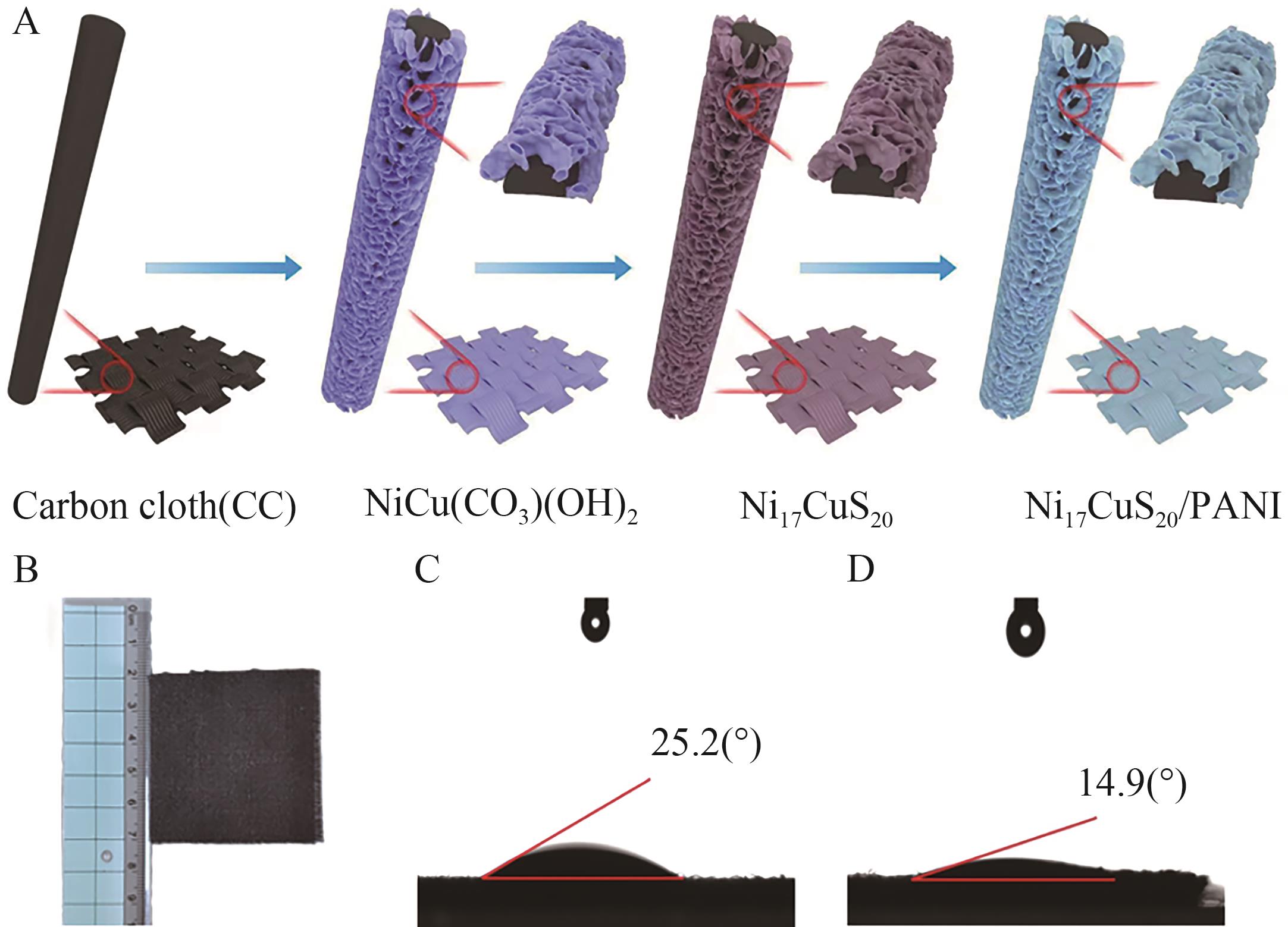
Fig.1 (A) Schematic illustration of the formation processes of Ni17CuS20/PANI nanostructures on the carbon cloth; (B) Optical image of carbon cloth (CC); Static contact angle measurements for (C) Ni17CuS20 and (D) Ni17CuS20/PANI
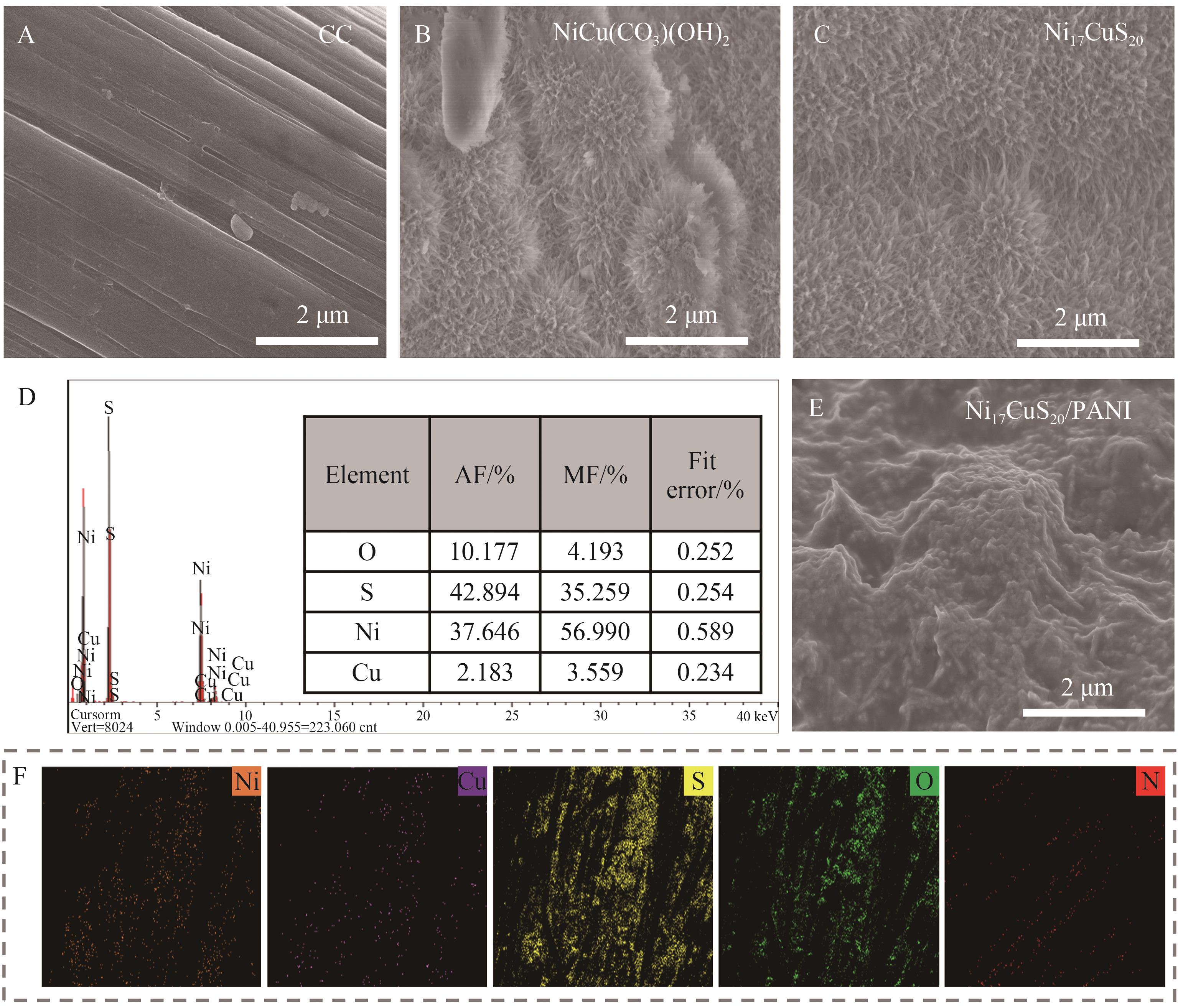
Fig.2 SEM images of CC (A); SEM images of (B) NiCu(CO3)(OH)2, (C) Ni17CuS20 nanosheets and (D) Ni17CuS20/PANI; (E) Elemental mapping images of Ni17CuS20/PANI
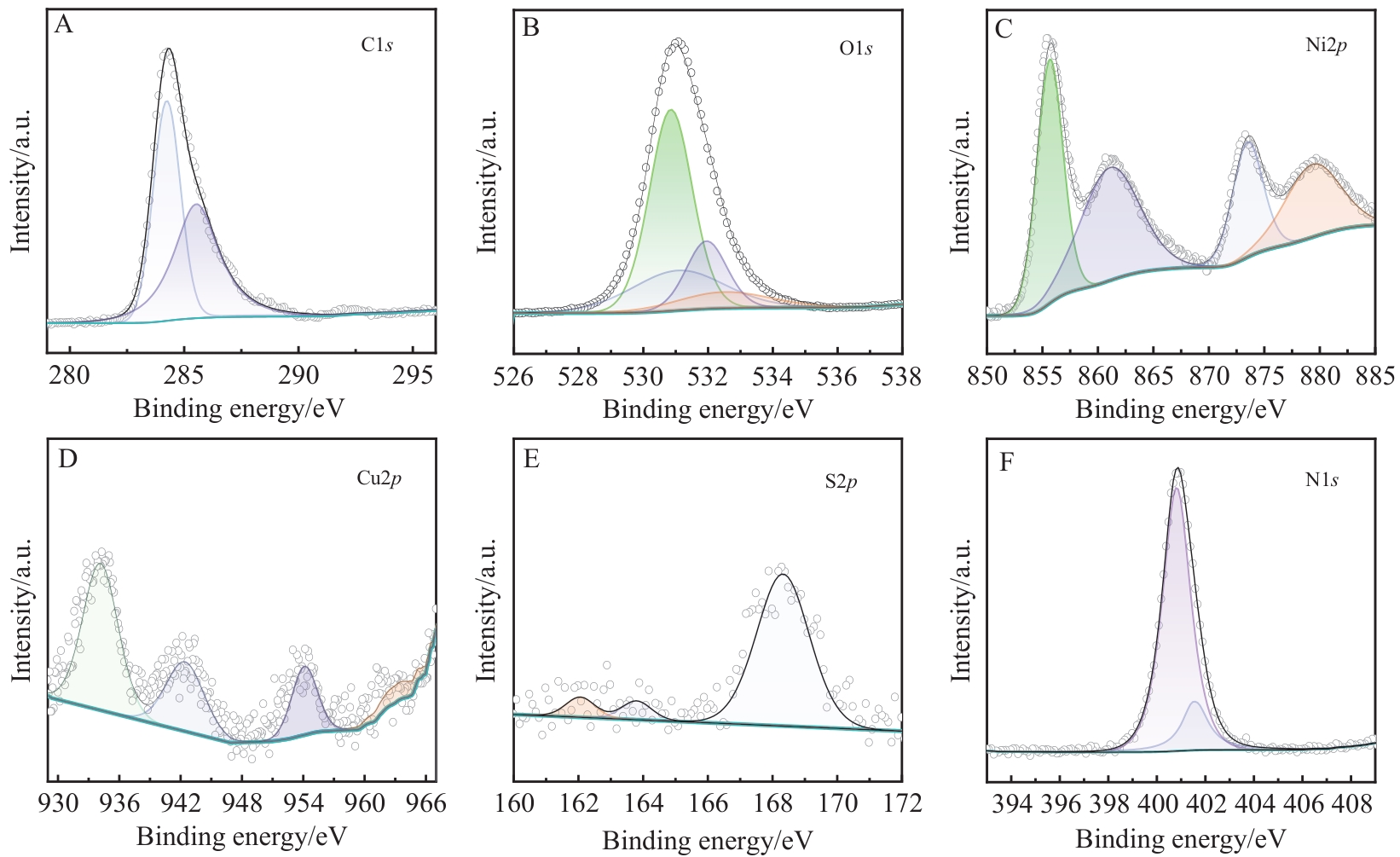
Fig.3 XPS spectra of (A) C1s, (B) O1s, (C) Ni2p, (D) Cu2p, (E) S2p and (F) N1s for Ni17CuS20/PANI
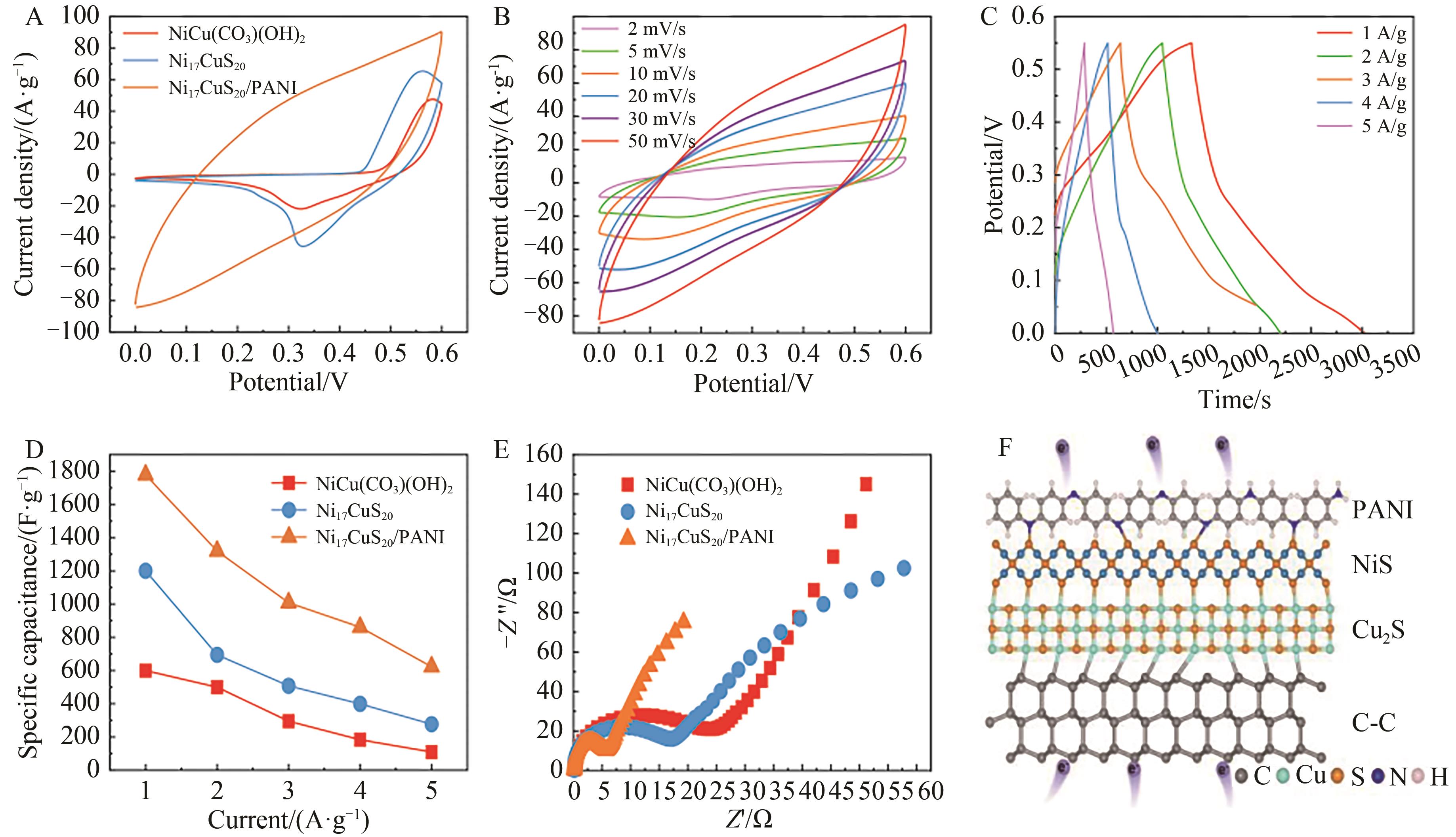
Fig.4 (A) CV curves of NiCu(CO3)(OH)2, Ni17CuS20 and Ni17CuS20/PANI at 50 mV/s; (B) CV curves and (C) GCD curves of Ni17CuS20/PANI at different scan rates and current densities, respectively; (D) Corresponding specific capacitances at different current densities; (E) EIS spectrum of NiCu(CO3)(OH)2, Ni17CuS20 and Ni17CuS20/PANI; (F) Energy storage characteristics of Ni17CuS20/PANI
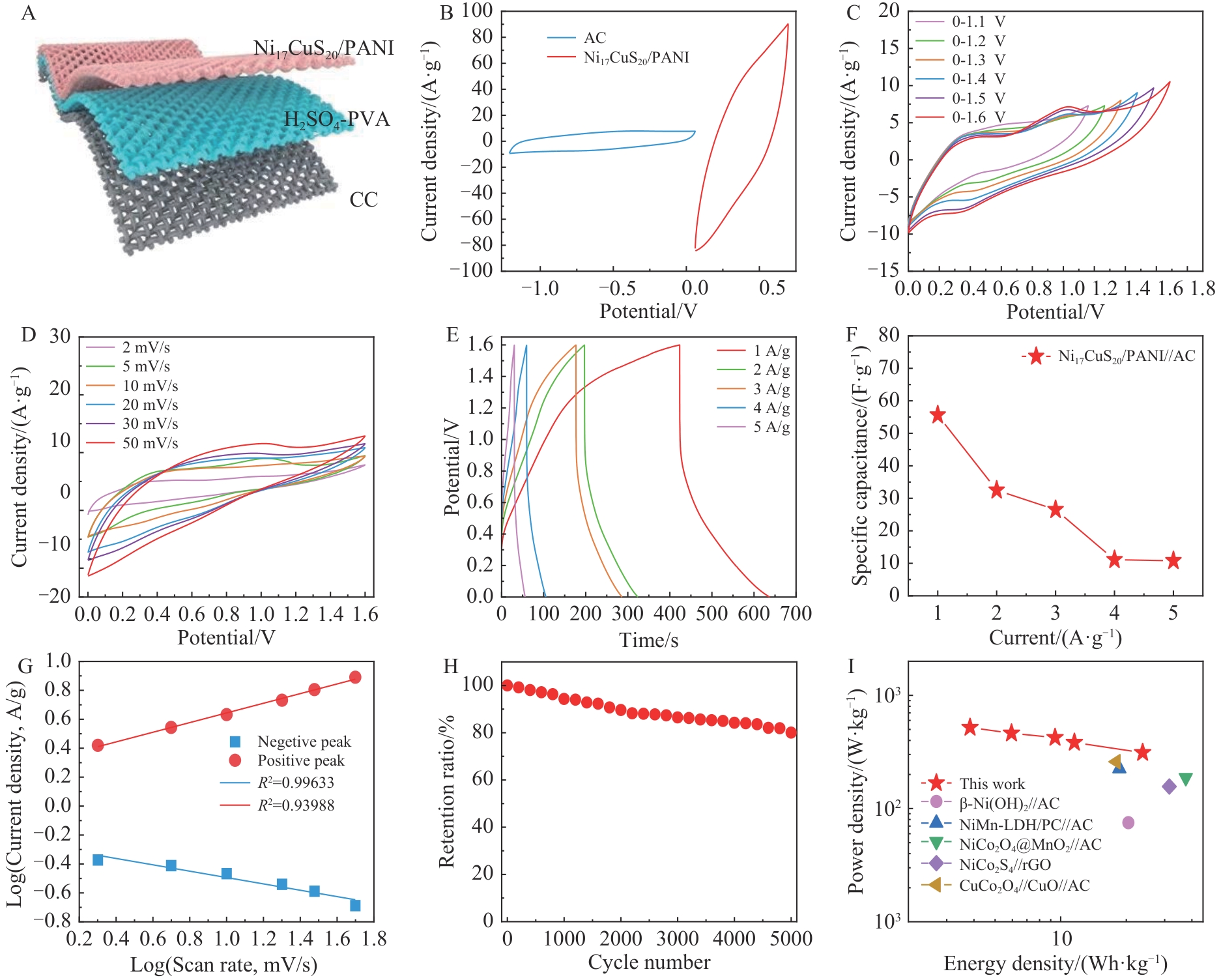
Fig.5 (A) Schematic illustration of the Ni17CuS20/PANI//AC ASC configuration; (B) CV curves of AC and Ni17CuS20/PANI at a scan rate of 50 mV/s; CV curves of the ASC at different (C) potential windows and (D) scan rates; (E) GCD curves of the ASC at different current densities; (F) Corresponding speci?c capacitances at different current densities; (G) Relationship between the square root of scan rate and the cathodic and anodic peak currents of Ni17CuS20/PANI assembled in ASC; (H) Cycling performance of the ASC at a current density of 5 A/g for 5000 cycles; (I) Ragone plot (energy density vs. power density) of the ASC
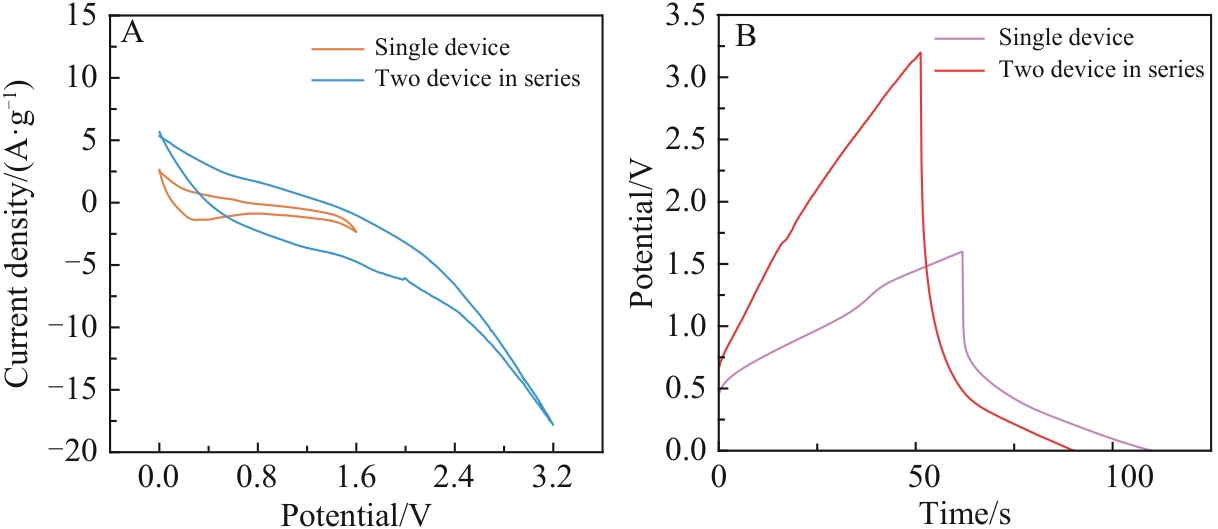
Fig.6 (A) CV and (B) GCD curves of two AS devices connected in series
| 教学环节 | 实验的具体内容及学时数(h) | 总学时数/h |
|---|---|---|
| 教师讲解 | 1.新能源器件发展趋势与超级电容器原理(0.1 h) 2.纳米复合材料设计策略与协同效应(0.2 h) 3.水热合成与电化学沉积技术原理(0.2 h) | 0.5 |
| 学生实验操作 | 1.NiCu(CO3)(OH)2纳米材料制备(6.0 h) 2.Ni17CuS20纳米材料制备(4.0 h) 3.PANI电化学沉积(1.0 h) | 11.0 |
| 教师演示与分析 | 1.SEM、XPS表征技术操作示范(1.0 h) 2.电化学工作站数据分析(1.0 h) | 2.0 |
| 结果讨论与总结 | 1.形貌与结构分析(1.0 h) 2.电化学性能对比与机理讨论(1.0 h) 3.柔性器件设计与应用展望(0.5 h) | 2.5 |
Table 1 Teaching and experimentation schedule
| 教学环节 | 实验的具体内容及学时数(h) | 总学时数/h |
|---|---|---|
| 教师讲解 | 1.新能源器件发展趋势与超级电容器原理(0.1 h) 2.纳米复合材料设计策略与协同效应(0.2 h) 3.水热合成与电化学沉积技术原理(0.2 h) | 0.5 |
| 学生实验操作 | 1.NiCu(CO3)(OH)2纳米材料制备(6.0 h) 2.Ni17CuS20纳米材料制备(4.0 h) 3.PANI电化学沉积(1.0 h) | 11.0 |
| 教师演示与分析 | 1.SEM、XPS表征技术操作示范(1.0 h) 2.电化学工作站数据分析(1.0 h) | 2.0 |
| 结果讨论与总结 | 1.形貌与结构分析(1.0 h) 2.电化学性能对比与机理讨论(1.0 h) 3.柔性器件设计与应用展望(0.5 h) | 2.5 |
| [1] | 杨锡运, 李新利, 吕游, 等. “双碳”目标下新能源领域自动化专业人才培养模式改革研究[J]. 高教学刊, 2025, 11(6): 39-42. |
| YANG X Y, LI X L, LV Y, et al. Research on the reform of talent training mode for automation majors in the new energy field under the “dual carbon” goals[J]. J Higher Educ, 2025, 11(6): 39-42. | |
| [2] | 段俊新, 余奥, 李全华, 等. 基于OBE理念设计一个综合化学实验:“ MOF衍生的多孔碳材料制备及其电容性能研究”[J]. 大学化学, 2025, 40(2): 297-305. |
| DUAN J X, YU A, LI Q H, et al. Preparation of porous carbon materials derived from MOF and their capacitance performance: design of a comprehensive chemistry experiment based on the OBE concept[J]. Univ Chem, 2025, 40(2): 297-305. | |
| [3] | 常静, 张立兵, 李轶, 等. 铜纳米修饰电极的制备及电化学葡萄糖和亚硝酸盐的测定[J]. 实验技术与管理, 2024, 41(4): 170-176. |
| CHANG J, ZHANG L B, LI Y, et al. Preparation of copper nano-modified electrodes and electrochemical determination of glucose and nitrite[J]. Experimental Technol Manage, 2024, 41(4): 170-176. | |
| [4] | 张曼, 王盈雪, 韩继续, 等. 蜂窝结构NiCo2S4@MnO2电极材料的制备及储能效果研究[J]. 化工新型材料, 2024, 6(1): 1-10. |
| ZHANG M, WANG Y X, HAN J X, et al. Preparation of electrode materials with honeycomb structure NiCo2S4@MnO2 and energy storage effect[J]. New Chem Mater, 2024, 6(1): 1-10. | |
| [5] | YU G, XIE X, PAN L, et al. Hybrid nanostructured materials for high-performance electrochemical capacitors[J]. Nano Energy, 2013, 2(2): 213-234. |
| [6] | YU Z, TETARD L, ZHAI L, et al. Recent progress in the development of anodes for asymmetric supercapacitors[J]. Energy Environ Sci, 2015, 8: 702-730. |
| [7] | LI H, TAO Y, ZHENG X, et al. Ultra-thick graphene bulk supercapacitor electrodes for compact energy storage[J]. Energy Environ Sci, 2016, 9: 3135-3142. |
| [8] | KUMAR M, SUBRAMANIA A, BALAKRISHNAN K. Preparation of electrospun Co3O4 nanofibers as electrode material for high performance asymmetric supercapacitors[J]. Electrochim Acta,2014, 149(10): 152-158. |
| [9] | ARADILLA D, ESTRANY F, ALEMAN C. Symmetric supercapacitors based on multilayers of conducting polymers[J]. J Phys Chem C, 2011, 115(16): 8430-8438. |
| [10] | RUI X, TAN H, YAN Q. Nanostructured metal sulfides for energy storage[J]. Nanoscale, 2014, 6: 9889-9924. |
| [11] | GUO J, ZHU H, SUN Y, et al. Pie-like free-standing paper of graphene paper@Fe3O4 nanorod array@carbon as integrated anode for robust lithium storage[J]. Chem Eng J, 2017, 309(1): 272-277. |
| [12] | 王晓亮, 高靖淞, 宋晓琦, 等. 水滑石超级电容器电极材料层间距调控研究进展[J]. 硅酸盐学报, 2024, 6(1): 1-13. |
| WANG X L, GAO J S, SONG X Q, et al. Research progress on layer spacing regulation of electrode materials for hydrotalcite supercapacitors[J]. J Chin Ceramic Soc, 2024, 6(1): 1-13. | |
| [13] | 雷钢, 卢海峰, 张财志, 等. 高温质子交换膜燃料电池动态性能测试教学实验设计[J]. 实验技术与管理, 2024, 41(4): 209-214. |
| LEI G, LU H F, ZHANG C Z, et al. Experimental design for dynamic performance testing of high temperature proton exchange membrane fuel cells[J]. Experimental Technol Manage, 2024, 41(4): 209-214. | |
| [14] | KIM M, LEE C, JANG J. Fabrication of highly flexible, scalable, and high-performance supercapacitors using polyaniline/reduced graphene oxide film with enhanced electrical conductivity and crystallinity[J]. Adv Funct Mater, 2014, 24(17): 2489-2499. |
| [15] | 李娟, 朱继平, 覃玲. “储能材料与技术”课程建设探索[J]. 科技风, 2025(2): 11-13. |
| LI J, ZHU J P, QIN L, et al. Exploration of curriculum construction of “Energy Storage Materials and Technology” [J]. 2025(2): 11-13. | |
| [16] | HE X Y, LIU Q, LIU J Y, et al. High-performance all-solid-state asymmetrical supercapacitors based on petal-like NiCo2S4/polyaniline nanosheets[J]. Chem Eng J, 2017, 325: 134-143. |
| [17] | MAO Y, LI T, GUO C, et al. Cycling stability of ultrafine β-Ni(OH)2 nanosheets for high capacity energy storage device via a multilayer nickel foam electrode[J]. Electrochim Acta, 2016, 211(1): 44-51. |
| [18] | YU M, LIU R, LIU J, et al. Polyhedral-like NiMn-layered double hydroxide/porous carbon as electrode for enhanced electrochemical performance supercapacitors[J]. Small, 2017, 13(44): 170261. |
| [19] | ZHANG Y, WANG B, LIU F, et al. Full synergistic contribution of electrodeposited three-dimensional NiCo2O4@MnO2 nanosheet networks electrode for asymmetric supercapacitors[J]. Nano Energy, 2016, 27: 627-637. |
| [20] | CHEN H, JIANG J, ZHANG L, et al. In situ growth of NiCo2S4 nanotube arrays on Ni foam for supercapacitors: maximizing utilization efficiency at high mass loading to achieve ultrahigh areal pseudocapacitance[J]. J Power Sources, 2014, 254(15): 249-257. |
| [21] | ARULKUMAR C, GANDHI R, ALSHGARI R A, et al. Improved electrochemical performances of CuCo2O4/CuO-based asymmetric device with ultra high capacitance and attractive cycling performance[J]. J Energy Storage, 2024, 92: 112202. |
| [22] | 吴岩. 建设中国“金课”[J]. 中国大学教学, 2018(12): 4-9. |
| WU Y. Building China's golden courses[J]. China Univ Teach, 2018(12): 4-9. |
| [1] | Li-Hui ZHENG, Bo-Ao DU. Preparation of Porous Carbon Materials Derived from Rhus typhina Leaves and Their Electrochemical Properties [J]. Chinese Journal of Applied Chemistry, 2025, 42(7): 945-954. |
| [2] | Yuan-Jie LI, Bing-Bing FAN, Jun-Li ZHANG, Yan-Mei ZHOU. Research Progress in the Application of Amino Acid Ionic Liquids to Energy Storage and Biomass Resource Utilization [J]. Chinese Journal of Applied Chemistry, 2024, 41(3): 391-404. |
| [3] | Sheng-Long HU, Zhen-Long LEI, De-Jun CHEN. Preparation of Hypercrosslinked Poly(Naphthalene-based) Microporous Carbon and Its Electrochemical Properties [J]. Chinese Journal of Applied Chemistry, 2024, 41(12): 1742-1750. |
| [4] | Man TIAN, Jiang-An YOU, Zhi-Wei JIANG, Tao TANG. Carbon Nanotube Modified Styrene-Acrylonitrile Copolymer/Polyurea Nanocomposite Foams [J]. Chinese Journal of Applied Chemistry, 2023, 40(9): 1267-1276. |
| [5] | XING Yayan, SHI Yuzhe, DENG Shixian, ZHAO Baihan, LIU Zhiguo. Preparation and Application of Catechin-Silver Nanocomposites [J]. Chinese Journal of Applied Chemistry, 2020, 37(9): 1062-1068. |
| [6] | ZHANG Yanhui, WANG Lin, MUSLIM Arzugul, LAN Haidie. Influence of the Core Forming Block Length of Polystyrene-b-Poly(acrylic acid) Template on the Size and Properties of Polyaniline [J]. Chinese Journal of Applied Chemistry, 2020, 37(7): 764-771. |
| [7] | AN Lulu, MI Jie. Synthesis of Nickel Cobalt Hydroxide and Its Electrochemical Properties [J]. Chinese Journal of Applied Chemistry, 2020, 37(5): 579-586. |
| [8] | ZHANG Xiaobo, XIN Haiying, XU Shuang, ZHANG Xinghai, WANG Liqiu. Cellulose Gel Polymer Electrolytes and Its Application in Supercapacitors [J]. Chinese Journal of Applied Chemistry, 2020, 37(5): 0-. |
| [9] | FAN Zhe,ZHANG Shengsheng,TANG Jiahao,FAN Ping. Structure, Preparation and Application of Graded Nanomaterials [J]. Chinese Journal of Applied Chemistry, 2020, 37(5): 489-501. |
| [10] | SHE Xiaohong, DU Juan, WANG Lupei, ZHU Wenli, YANG Qiaoling, ZOU Chihui. Preparation and Properties of Tough Polyvinyl/Polyaniline/Polypyrrole/TiO2 Conductive Hybrid Hydrogel [J]. Chinese Journal of Applied Chemistry, 2020, 37(5): 541-546. |
| [11] | ZHANG Xiaobo, XIN Haiying, XU Shuang, ZHANG Xinghai, WANG Liqiu. Cellulose Gel Polymer Electrolytes and Its Application in Supercapacitors [J]. Chinese Journal of Applied Chemistry, 2020, 37(5): 547-554. |
| [12] | ZHAO Liu, SONG Shengjie, MA Kangfu, WANG Hong, FU Lihua, LIU Xinyang, CHEN Lidong, CHENG Weiguo. Adsorption-Oxidative Desulfurization Performance of Core-Shell Polyoxometalate/Magnetic Cerium-Iron Nanocomposite Oxide@SiO2 [J]. Chinese Journal of Applied Chemistry, 2020, 37(12): 1457-1464. |
| [13] | CHEN Jiaqi, ZHOU Yan, SUN Jingwen, ZHU Junwu, WANG Xin, FU Yongsheng. Recent Progress of Metal Organic Frameworks-Based Hollow Materials [J]. Chinese Journal of Applied Chemistry, 2020, 37(11): 1221-1235. |
| [14] | XIE Yaqiao, ZHAO Jiaxin, LI Jielan, XU Zidi, QU Jiangying, TIAN Yunqi, GAO Feng. Synthesis of Sodium Chloride Induced Lignin-Based Porous Carbon and Their Supercapacitor Performances [J]. Chinese Journal of Applied Chemistry, 2019, 36(4): 482-488. |
| [15] | GAO Shan,SUN Haijun,DU Mengmeng,GUO Fen,YE Xiaoli,QIAO Lei. Capacitive Performance Comparison of Carbon Fiber Cloth Supported Three-Dimensional Polyaniline Networks in RCl(R=H,Li,Na,K) Aqueous Solution [J]. Chinese Journal of Applied Chemistry, 2019, 36(2): 236-244. |
| Viewed | ||||||
|
Full text |
|
|||||
|
Abstract |
|
|||||
