
Chinese Journal of Applied Chemistry ›› 2025, Vol. 42 ›› Issue (5): 712-722.DOI: 10.19894/j.issn.1000-0518.240280
• Chemistry Teaching and Experiment Innovation • Previous Articles
Dan-Dan ZHANG, Wei-Han HUANG, Xin HUANG( ), Shao-Bo WANG, Hai-Juan DU, Ke-Qian HAO, Qing WANG
Received:2024-08-29
Accepted:2025-04-05
Published:2025-05-01
Online:2025-06-05
Contact:
Xin HUANG
About author:xinhuang@zut.edu.cnSupported by:CLC Number:
Dan-Dan ZHANG, Wei-Han HUANG, Xin HUANG, Shao-Bo WANG, Hai-Juan DU, Ke-Qian HAO, Qing WANG. Innovation and Practice of the Basic Chemistry Experiment Courses with “Integration of Course Ideological and Political Education, Highlighting Characteristics and Emphasizing Process”[J]. Chinese Journal of Applied Chemistry, 2025, 42(5): 712-722.
Add to citation manager EndNote|Ris|BibTeX
URL: http://yyhx.ciac.jl.cn/EN/10.19894/j.issn.1000-0518.240280
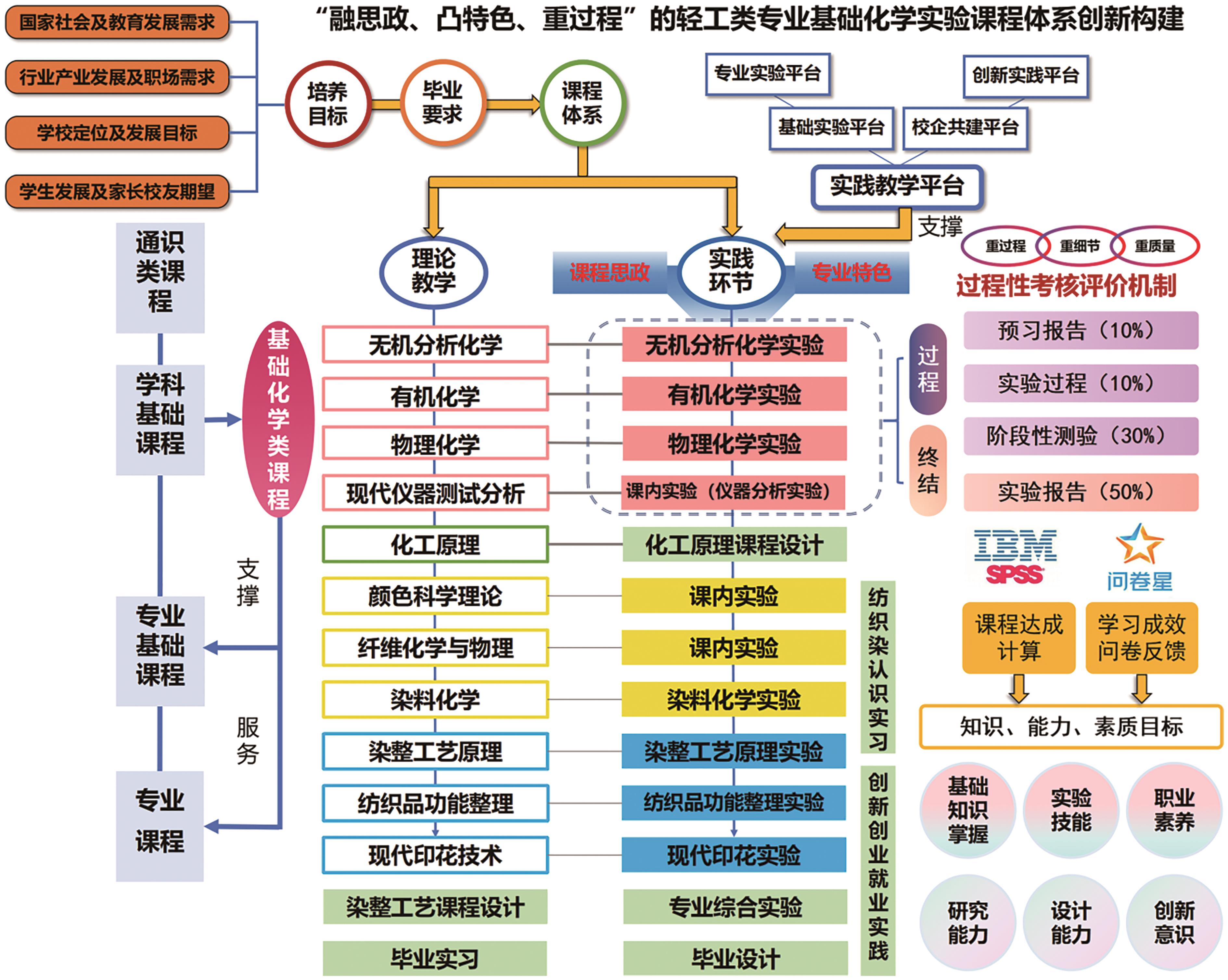
Fig.1 Innovation construction of basic chemistry laboratory curriculum system for light chemical engineering
| 课程名称 | 调整前内容 | 调整后内容 | 目标 |
|---|---|---|---|
| 无机化学实验 | · 基础操作练习 · 溶液的配置 · 氯化钠的提纯 · 化学反应摩尔焓变的测定 · 化学反应速率与活化能 | · 化学实验基础基本操作 · 磺基水杨酸合铁(Ⅲ)配合物的组成 及稳定常数的测定 · 醋酸解离度及解离常数的测定 · 铜银锌元素化学实验 · EDTA标准溶液的配制与标定 · 水中钙、镁含量的测定* · 纳米SiO2的制备及其吸附实验* · 植物中某些元素的分离与鉴定 · 过氧化氢含量的测定 · 含铬(Ⅵ)废液的处理与比色测定* | · 无机分析化学基础知识和实验操作技能* · 获得有效结论及独立工作能力 |
| 分析化学实验 | · 安全教育、实验数据处理 · 碱标准溶液的配置与标定 · 酸标准溶液的配置与标定 · 碱液中NaOH及Na2CO3含量的测定 · EDTA标准溶液的配置与标定 | ||
| 有机化学实验 | · 安全教育、实验数据处理 · 基础操作练习 · 酒精的蒸馏 · 乙酰苯胺的重结晶 · 萘胺和萘酚的萃取 · 乙酸乙酯的制备 · 己二酸的制备 | · 蒸馏实验 · 烯烃、炔烃、卤代烃的鉴别 · 环己烯合成实验 · 茶叶中茶多酚的提取 · 乙酸乙酯的合成 · 己二酸的合成 · 苯甲醇和苯甲酸的制备 · 甲基橙的制备及其染色实验* · 肥皂的制备* · 酸性蓝黑的合成* · 乙酰水杨酸(阿司匹林)的合成 | · 有机化学基础知识和实验操作技能 · 安全意识 · 数据处理分析能力 · 社会责任感 |
| 物理化学实验 | · 凝固点下降法测定摩尔质量 · 电解质溶液的电导测定 · 氟离子选择电极测氢氟酸解离常数 · 表面张力的测定 · 溶液吸附法测定固体比表面 · 黏度法测定高聚物的相对分子质量 · 旋光法测定蔗糖转化反应的速率常数 · 液体饱和蒸汽压的测定 | · 凝固点降低法测定分子的摩尔质量 · 溶液吸附法测固体的比表面积 · 最大气泡法测定表面张力* · 电导法测定表面活性剂临界胶束浓度* · 黏度法测定浆料聚乙烯醇的相对分子质量* | · 物理化学基础知识和实验操作技能 · 数据处理能力和严谨的科学态度 · 环境保护及可持续发展意识 |
| 现代仪器测试分析课内实验 | —— | · 未知染料的浓度及结构分析* · 纤维的热重分析实验* | · 仪器分析基础知识和实验操作技能 · 职业规范习惯、专业认同感 · 终身学习意识 |
Table 1 Teaching content design for basic chemical experiment courses oriented to professional characteristics
| 课程名称 | 调整前内容 | 调整后内容 | 目标 |
|---|---|---|---|
| 无机化学实验 | · 基础操作练习 · 溶液的配置 · 氯化钠的提纯 · 化学反应摩尔焓变的测定 · 化学反应速率与活化能 | · 化学实验基础基本操作 · 磺基水杨酸合铁(Ⅲ)配合物的组成 及稳定常数的测定 · 醋酸解离度及解离常数的测定 · 铜银锌元素化学实验 · EDTA标准溶液的配制与标定 · 水中钙、镁含量的测定* · 纳米SiO2的制备及其吸附实验* · 植物中某些元素的分离与鉴定 · 过氧化氢含量的测定 · 含铬(Ⅵ)废液的处理与比色测定* | · 无机分析化学基础知识和实验操作技能* · 获得有效结论及独立工作能力 |
| 分析化学实验 | · 安全教育、实验数据处理 · 碱标准溶液的配置与标定 · 酸标准溶液的配置与标定 · 碱液中NaOH及Na2CO3含量的测定 · EDTA标准溶液的配置与标定 | ||
| 有机化学实验 | · 安全教育、实验数据处理 · 基础操作练习 · 酒精的蒸馏 · 乙酰苯胺的重结晶 · 萘胺和萘酚的萃取 · 乙酸乙酯的制备 · 己二酸的制备 | · 蒸馏实验 · 烯烃、炔烃、卤代烃的鉴别 · 环己烯合成实验 · 茶叶中茶多酚的提取 · 乙酸乙酯的合成 · 己二酸的合成 · 苯甲醇和苯甲酸的制备 · 甲基橙的制备及其染色实验* · 肥皂的制备* · 酸性蓝黑的合成* · 乙酰水杨酸(阿司匹林)的合成 | · 有机化学基础知识和实验操作技能 · 安全意识 · 数据处理分析能力 · 社会责任感 |
| 物理化学实验 | · 凝固点下降法测定摩尔质量 · 电解质溶液的电导测定 · 氟离子选择电极测氢氟酸解离常数 · 表面张力的测定 · 溶液吸附法测定固体比表面 · 黏度法测定高聚物的相对分子质量 · 旋光法测定蔗糖转化反应的速率常数 · 液体饱和蒸汽压的测定 | · 凝固点降低法测定分子的摩尔质量 · 溶液吸附法测固体的比表面积 · 最大气泡法测定表面张力* · 电导法测定表面活性剂临界胶束浓度* · 黏度法测定浆料聚乙烯醇的相对分子质量* | · 物理化学基础知识和实验操作技能 · 数据处理能力和严谨的科学态度 · 环境保护及可持续发展意识 |
| 现代仪器测试分析课内实验 | —— | · 未知染料的浓度及结构分析* · 纤维的热重分析实验* | · 仪器分析基础知识和实验操作技能 · 职业规范习惯、专业认同感 · 终身学习意识 |
| 课程名称 | 课程思政教学目标 | 课程思政融入点 |
|---|---|---|
| 无机分析化学实验 | 能够正确使用各种基本的化学仪器,总结与分析物质的制备、分离、提纯方法,物质的定性和定量的分析方法,并能观察实验现象,准确记录并正确处理实验数据,通过分析判断获得合理有效的结论,具备求真务实的科学理念。 | 1.通过数据处理异常导致重大损失等实例,培养学生诚实守信的科学研究观念。 2.通过实验废弃物处理,培养学生职业道德,关注环保及人体健康。 3.通过水中钙、镁含量的测定培养学生关注环境对人体健康影响的思维意识。 4.通过吸附实验培养学生独立自主开展实验和获取有效结论的能力,以及环境保护意识。 |
| 有机化学实验 | 识记轻工及相关领域涉及有机化合物的合成方法和操作技能,观察并如实记录实验现象,采集、整理实验数据,对有机产物的产率进行分析和解释,并通过信息综合得到合理的结论;能够基于实验过程中产生的废弃物进行规范处理,了解有机试剂的操作方法及注意事项,正确使用化学试剂和化学废弃物对公众的安全健康和福祉以及环境保护的社会责任,并自觉践行。 | 1.通过讲解实验室安全规定和注意事项,培养学生在实验过程中理解并自觉践行职业精神和职业规范。 2.通过环己醇制备环己烯实验的数据处理过程,培养学生求真务实的科学态度。 3.通过对茶多酚提取的染料与有害合成染料进行对比,培养学生对公众的安全健康和福祉,以及环境保护的社会责任感。 4.天然产物中色素提取方法众多,索氏提取器提取法只是其中一种方法,柱层析、旋蒸等方法在染整领域亦有广泛应用,通过实验总结和反思,培养学生的辩证思维。 5.合成染料甲基橙或酸性蓝染色实验中,鼓励学生通过了解织物结构和染料性质,自主选择织物染色,培养学生敢于探索的科学精神。 |
| 物理化学实验 | 识记实验室规则,危险品的使用规则,意外事故的预防和处理。通过试剂使用、实验操作、废弃物处理和数据分析培养学生具备人身安全和生产安全等意识、诚实守信的科学研究观点和职业精神。 | 1.实验过程中正确佩戴手套的重要性与生命健康的关系。 2.表面张力在前沿课题研究中的重要性,培养严谨的科学态度。 3.实验过程中正确收集实验数据的重要性与科学诚信的关系。 4.应用新型浆料取代聚乙烯醇与改善环境减少污染的关系。 |
| 现代仪器测试分析课内实验 | 识记紫外-可见吸收光谱、红外吸收光谱、热重分析的基本原理、基本应用,培养学生使用现代测试工具能力和职业道德观念。 | 1.由红外光谱分析确定可致癌染料的结构方面的实例,培养学生使用现代分析工具能力和环境保护和关注人体健康的意识。 2.通过热重分析实验培养学生对于专业加工对象纤维材料选择合适热性能分析仪器的能力,培养学生专业认同感和职业规范习惯。 |
Table 2 Ideological and political teaching design for basic chemical experiment course
| 课程名称 | 课程思政教学目标 | 课程思政融入点 |
|---|---|---|
| 无机分析化学实验 | 能够正确使用各种基本的化学仪器,总结与分析物质的制备、分离、提纯方法,物质的定性和定量的分析方法,并能观察实验现象,准确记录并正确处理实验数据,通过分析判断获得合理有效的结论,具备求真务实的科学理念。 | 1.通过数据处理异常导致重大损失等实例,培养学生诚实守信的科学研究观念。 2.通过实验废弃物处理,培养学生职业道德,关注环保及人体健康。 3.通过水中钙、镁含量的测定培养学生关注环境对人体健康影响的思维意识。 4.通过吸附实验培养学生独立自主开展实验和获取有效结论的能力,以及环境保护意识。 |
| 有机化学实验 | 识记轻工及相关领域涉及有机化合物的合成方法和操作技能,观察并如实记录实验现象,采集、整理实验数据,对有机产物的产率进行分析和解释,并通过信息综合得到合理的结论;能够基于实验过程中产生的废弃物进行规范处理,了解有机试剂的操作方法及注意事项,正确使用化学试剂和化学废弃物对公众的安全健康和福祉以及环境保护的社会责任,并自觉践行。 | 1.通过讲解实验室安全规定和注意事项,培养学生在实验过程中理解并自觉践行职业精神和职业规范。 2.通过环己醇制备环己烯实验的数据处理过程,培养学生求真务实的科学态度。 3.通过对茶多酚提取的染料与有害合成染料进行对比,培养学生对公众的安全健康和福祉,以及环境保护的社会责任感。 4.天然产物中色素提取方法众多,索氏提取器提取法只是其中一种方法,柱层析、旋蒸等方法在染整领域亦有广泛应用,通过实验总结和反思,培养学生的辩证思维。 5.合成染料甲基橙或酸性蓝染色实验中,鼓励学生通过了解织物结构和染料性质,自主选择织物染色,培养学生敢于探索的科学精神。 |
| 物理化学实验 | 识记实验室规则,危险品的使用规则,意外事故的预防和处理。通过试剂使用、实验操作、废弃物处理和数据分析培养学生具备人身安全和生产安全等意识、诚实守信的科学研究观点和职业精神。 | 1.实验过程中正确佩戴手套的重要性与生命健康的关系。 2.表面张力在前沿课题研究中的重要性,培养严谨的科学态度。 3.实验过程中正确收集实验数据的重要性与科学诚信的关系。 4.应用新型浆料取代聚乙烯醇与改善环境减少污染的关系。 |
| 现代仪器测试分析课内实验 | 识记紫外-可见吸收光谱、红外吸收光谱、热重分析的基本原理、基本应用,培养学生使用现代测试工具能力和职业道德观念。 | 1.由红外光谱分析确定可致癌染料的结构方面的实例,培养学生使用现代分析工具能力和环境保护和关注人体健康的意识。 2.通过热重分析实验培养学生对于专业加工对象纤维材料选择合适热性能分析仪器的能力,培养学生专业认同感和职业规范习惯。 |
| 课程名称 | 最高分 | 最低分 | 平均分 |
|---|---|---|---|
| 无机分析化学实验 | 94 | 83 | 88 |
| 有机化学实验 | 94 | 75 | 87 |
| 物理化学实验 | 91 | 76 | 84 |
| 92 | 78 | 85 |
Table 3 The overall evaluation results of inorganic analytical chemistry experiment, organic chemistry experiment Ⅰ, organic chemistry experiment Ⅱ, physical chemistry experiment, and instrument analytical experiment of 2019 students
| 课程名称 | 最高分 | 最低分 | 平均分 |
|---|---|---|---|
| 无机分析化学实验 | 94 | 83 | 88 |
| 有机化学实验 | 94 | 75 | 87 |
| 物理化学实验 | 91 | 76 | 84 |
| 92 | 78 | 85 |
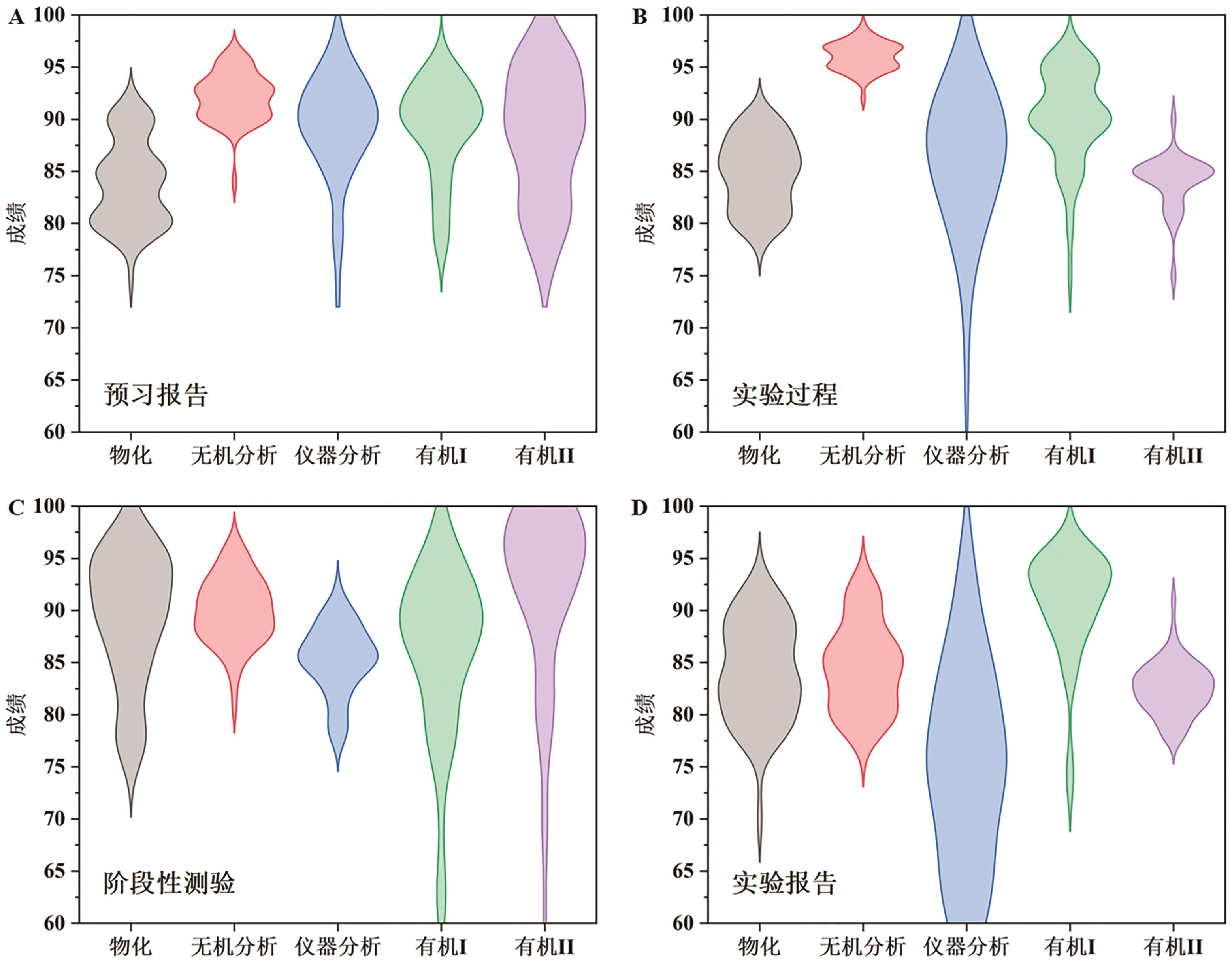
Fig.2 The 2019 students' inorganic analytical chemistry experiment, organic chemistry experiment Ⅰ, organic chemistry experiment Ⅱ, physical chemistry experiment and instrument analytical experiment of the four-process assessment of the in-class experiment (A) preview report, (B) experimental process, (C) periodic test and (D) experimental report score distribution violin diagram
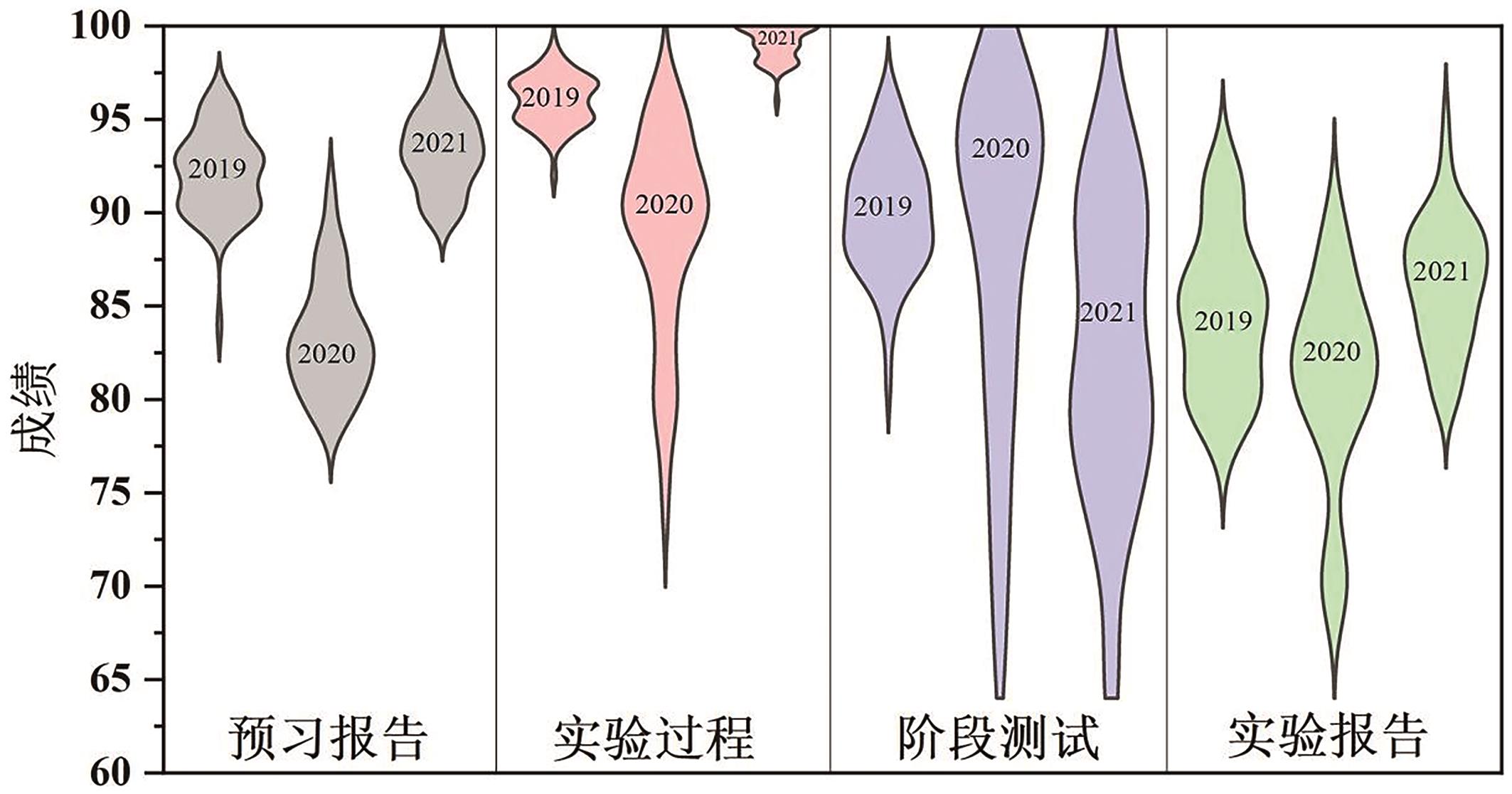
Fig.3 Violin diagram of the distribution of four-process assessment scores of inorganic analytical chemistry experiments for students in 2019, 2020 and 2021
| 实验课程名称能力观测项 | 无机分析化学实验 | 有机化学实验 | 物理化学实验 | |
|---|---|---|---|---|
| 查阅资料能力 | 56.33% | 53.28% | 48.91% | 42.79% |
| 收集和记录数据能力 | 62.45% | 48.03% | 44.98% | 44.98% |
| 数据处理能力 | 69.43% | 54.59% | 48.91% | 58.08% |
| 获得有效结论 | 43.23% | 46.72% | 48.47% | 48.03% |
| 分析问题能力 | 49.34% | 44.54% | 43.23% | 44.98% |
| 解决问题能力 | 31.00% | 38.86% | 37.12% | 37.12% |
| 工程社会意识 | 13.54% | 16.59% | 19.21% | 18.34% |
| 职业道德观念 | 6.55% | 13.54% | 15.28% | 12.23% |
| 专业认知和认同 | 6.55% | 12.66% | 14.41% | 12.23% |
| 社会责任感 | 4.37% | 7.42% | 6.99% | 7.42% |
| 环境保护和可持续发展观念 | 10.48% | 10.92% | 13.00% | 8.73% |
| 自主学习意识和能力 | 14.85% | 10.92% | 13.54% | 14.41% |
Table 4 Statistics of the proportion of basic chemistry laboratory courses for ability improvement
| 实验课程名称能力观测项 | 无机分析化学实验 | 有机化学实验 | 物理化学实验 | |
|---|---|---|---|---|
| 查阅资料能力 | 56.33% | 53.28% | 48.91% | 42.79% |
| 收集和记录数据能力 | 62.45% | 48.03% | 44.98% | 44.98% |
| 数据处理能力 | 69.43% | 54.59% | 48.91% | 58.08% |
| 获得有效结论 | 43.23% | 46.72% | 48.47% | 48.03% |
| 分析问题能力 | 49.34% | 44.54% | 43.23% | 44.98% |
| 解决问题能力 | 31.00% | 38.86% | 37.12% | 37.12% |
| 工程社会意识 | 13.54% | 16.59% | 19.21% | 18.34% |
| 职业道德观念 | 6.55% | 13.54% | 15.28% | 12.23% |
| 专业认知和认同 | 6.55% | 12.66% | 14.41% | 12.23% |
| 社会责任感 | 4.37% | 7.42% | 6.99% | 7.42% |
| 环境保护和可持续发展观念 | 10.48% | 10.92% | 13.00% | 8.73% |
| 自主学习意识和能力 | 14.85% | 10.92% | 13.54% | 14.41% |
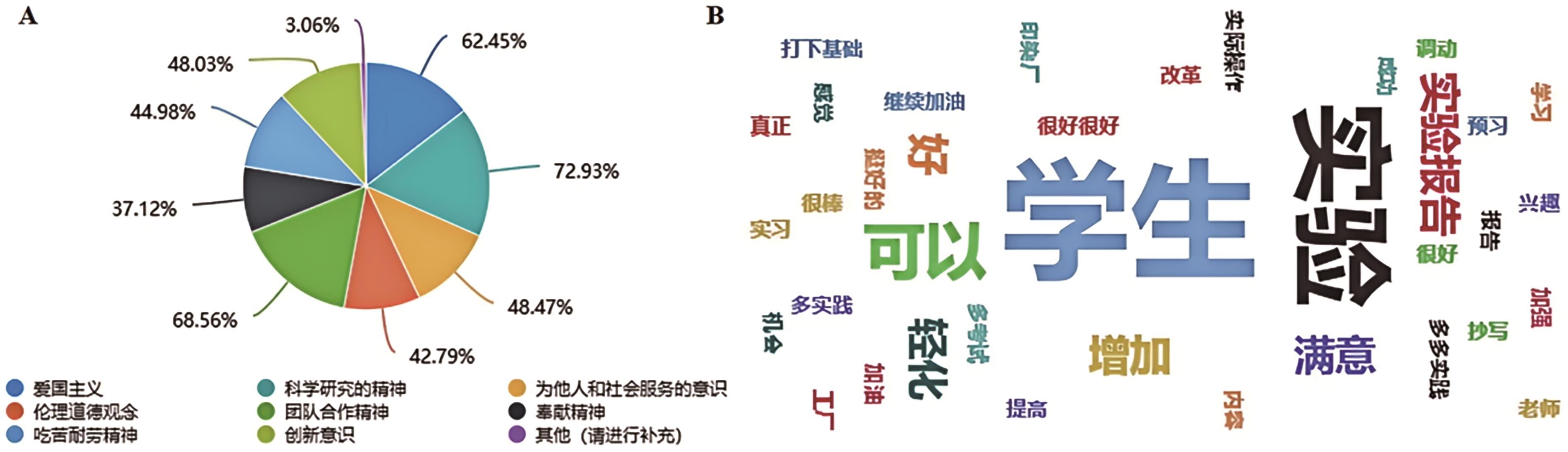
Fig.4 (A) Students' belief that ideological and political elements should be integrated into the basic chemistry laboratory course, and (B) word frequency analysis of students' views on the teaching reform of the basic chemistry laboratory series courses of light chemical engineering
| 1 | 李志义. 对我国工程教育专业认证十年的回顾与反思之二: 我们应该防止和摒弃什么[J]. 中国大学教学, 2017(1): 8-14. |
| LI Z Y. Review and reflection on the ten years of engineering education accreditation in China (Ⅱ): what should we prevent and abandon[J]. China Univ Teaching, 2017(1): 8-14. | |
| 2 | 林健. 工程教育认证与工程教育改革和发展[J]. 高等工程教育研究, 2015(2): 10-19. |
| LIN J. The accreditation, reformation and development of engineering education[J]. Res Higher Educ Eng, 2015(2): 10-19. | |
| 3 | 孙晶, 张伟, 任宗金, 等. 工程教育专业认证毕业要求达成度的成果导向评价[J]. 清华大学教育研究, 2017, 38(4): 117-124. |
| SUN J, ZHANG W, REN Z J, et al. Practice on OBE evaluation architecture for the achievement of graduation requirements based on the engineering education accreditation system[J]. Tsinghua J Educ, 2017, 38(4): 117-124. | |
| 4 | 顾晓薇, 王青, 邱景平, 等. 工程教育认证“毕业要求”达成度的认识与思考[J]. 教育教学论坛, 2016(14): 24-26. |
| GU X W, WANG Q, QIU J P, et al. Understanding and thinking on the achievement degree of “graduation requirements” of engineering education certification[J]. Educ Teaching Forum, 2016(14): 24-26. | |
| 5 | 唐艳, 陈红祥, 邱江华,等. 工科高校基础化学实验课程体系重构与实践[J]. 广州化工, 2022, 50(7): 249-250, 262. |
| TANG Y, CHEN H X, QIU J H, et al. Reconstruction and practice of basic chemistry experiment curriculum system in engineering colleges[J]. Guangzhou Chem Ind, 2022, 50(7): 249-250, 262. | |
| 6 | 靳涛, 田健, 孙海清. 建设一流学科,培养创新型人才——统筹基础化学理论和实验教学[J]. 化工高等教育, 2019, 36(2): 89-92. |
| JIN T, TIAN J, SUN H Q. Build a first-class discipline and cultivate innovative talents coordinate basic chemistry theory and experiment teaching[J]. Higher Educ Chem Eng, 2019, 36(2): 89-92. | |
| 7 | 强根荣, 施仁信, 王海滨, 等. 有机化学实验教学中融入思政教育的研究与实践[J]. 实验技术与管理, 2021, 38(11): 243-246. |
| QIANG G R, SHI R X, WANG H B, et al. Research and practice of integrating ideological and political education into organic chemistry experiment teaching[J]. Exp Technol Manage, 2021, 38(11): 243-246. | |
| 8 | 王薇, 任家强, 周宝晗, 等. 工科基础化学实验课程过程性评价体系的构建与实践[J]. 化学教育(中英文), 2024, 45(6): 23-29. |
| WANG W, REN J Q, ZHOU B H, et al. Construction and practice of process evaluation system for engineering basie chemistry experiment courses[J]. Chin J Chem Educ, 2024, 45(6): 23-29. | |
| 9 | 李志义. 成果导向的教学设计[J]. 中国大学教学, 2015(3): 32-39. |
| LI Z Y, Outcome-based teaching design[J]. China Univ Teaching, 2015(3): 32-39. | |
| 10 | 教育部高等学校教学指导委员会. 普通高等学校本科专业类教学质量国家标准 上[M]. 北京: 高等教育出版社, 2018. |
| The Ministry of Education Higher Education Teaching Guidance Committee. National standards for teaching quality of undergraduate majors in colleges and universities[M]. Beijing: Higher Education Press, 2018. |
| [1] | Xian-Zhi CHU, Ran PANG, Song-Lin HAN, Li-Hong JIANG, Hui-Min LI, Xiao-Dong LI, Su ZHANG, Hong-Jie ZHANG. Luminous Efficacy of Light Emitting Diode with SrS∶Eu2+ and SrAl2O4∶Eu2+,Dy3+ Long Afterglow Phosphors [J]. Chinese Journal of Applied Chemistry, 2025, 42(5): 701-711. |
| [2] | Yun-Yang LI, Rui-Zhe ZHENG, Yan ZHOU, Tu-Xun HAIREGU, Biao DONG. Research on the Regulation of Upconversion Fluorescence Spectral Properties on Single Particles [J]. Chinese Journal of Applied Chemistry, 2025, 42(3): 365-374. |
| [3] | Feng WU, Ying-Hui WANG, Hong-Jie ZHANG. Tumor Microenvironment Responsive Degradable Smart Nanomedicine for Photodynamic/Photothermal/Gas Combination Therapy [J]. Chinese Journal of Applied Chemistry, 2025, 42(3): 375-385. |
| [4] | Jia-Hao WU, Jun YANG. Multicolor Luminescence Lanthanide Ions Doped CsLu(MoO4)2 Phosphor and Its Anti-Counterfeiting Application [J]. Chinese Journal of Applied Chemistry, 2025, 42(2): 222-229. |
| [5] | Shuang LIU, Si-Ying TENG, Peng HUI, Ya-Bin SUN. Research Progress on Nanozymes in the Treatment of Ophthalmic Diseases [J]. Chinese Journal of Applied Chemistry, 2024, 41(12): 1679-1696. |
| [6] | Hong BI, Heng-Xing XIE. Structured Teaching Practice in Real-Life Contexts Guided by Major Concepts of Disciplines [J]. Chinese Journal of Applied Chemistry, 2024, 41(12): 1804-1812. |
| [7] | Dong SUN, Rong-Sheng XU, Wei XU, Ping WANG, Xiao-Hong SHI, Mei LI. Melting Behavior of Mixed Ash of High Ash Coal and Sunflower Straw in Ningxia [J]. Chinese Journal of Applied Chemistry, 2024, 41(10): 1457-1468. |
| [8] | Yu ZUO, Yue-Jin ZHOU, Wen-Yu YAN, Su-Fen LIU, Yan LUO, Zhen-Guo XIANG. Research on the Penetration and Application of Educational Resources for Career Planning in Chemistry Teaching Under the New Curriculum Reform——Take the Compulsory Period of High School as An Example [J]. Chinese Journal of Applied Chemistry, 2024, 41(9): 1365-1372. |
| [9] | Zhen-Jian JIA, Xi HAN, Jie ZHANG. Preparation and Photocatalytic Performance of Bismuth Modified TiO2 Photocatalyst [J]. Chinese Journal of Applied Chemistry, 2024, 41(8): 1116-1125. |
| [10] | Xin REN, Hui-Ling LIU, Wei HUANG, Yong-Quan LU, Le-Xi DENG, Wei-Yi FENG, Mei-Ling NIE, Rong XIAO, Hai XU. Combining Animation Teaching and Promoting Socialist Core Values, Carry out Innovation and Demonstration of Curriculum Ideology and Politics ——《Finding Chemistry in Detective Conan》 [J]. Chinese Journal of Applied Chemistry, 2024, 41(7): 1056-1066. |
| [11] | Ying-Wei LI, Ji HAN, Bu-Yuan GUAN. Research Progress on the Synthesis and Application of Two-Dimensional Mesoporous Materials [J]. Chinese Journal of Applied Chemistry, 2024, 41(6): 767-782. |
| [12] | Guan-Zhong WANG, Shi-Ping SONG, Hong-Zhen PENG, Yu ZHANG, Ying ZHU, Jing CHEN. Research Progress in OLEDs Emissive Materials Based on Cu(Ⅰ) Complexes [J]. Chinese Journal of Applied Chemistry, 2024, 41(6): 783-799. |
| [13] | Yuan WANG, Huan-Rong LI. Preparation and Properties of Europium(Ⅲ) Tetrakis(Hexafluoroacetylacetone) Complex with Tetraphenylphosphonium as Counter Ion Doped into Polymethyl Methacrylate Films [J]. Chinese Journal of Applied Chemistry, 2024, 41(5): 607-615. |
| [14] | Yan-Li ZU, Wan-Lu LI, Jia LIU, Shan LIN, Sen LI, Chun-Ying HE. Third‑Order Nonlinear Optical Properties of Molybdenum Diselenide/Graphene Composite [J]. Chinese Journal of Applied Chemistry, 2024, 41(5): 659-667. |
| [15] | Biao HU, Hui WANG, Zhen-Ying ZHANG, Dao-Rong XUE, Qiang LIU. Dehydration Process of Ammonium Aluminum Sulfate Dodecahydrate and Its Thermodynamics and Kinetics Research [J]. Chinese Journal of Applied Chemistry, 2024, 41(5): 668-676. |
| Viewed | ||||||
|
Full text |
|
|||||
|
Abstract |
|
|||||
