
Chinese Journal of Applied Chemistry ›› 2025, Vol. 42 ›› Issue (9): 1196-1208.DOI: 10.19894/j.issn.1000-0518.240289
• Full Papers • Previous Articles Next Articles
Hao-Ying ZHAI, Qin YANG, Yi WU, Hong-Yang JIANG, Wen-Jun ZHOU( )
)
Received:2024-09-04
Accepted:2025-07-16
Published:2025-09-01
Online:2025-09-28
Contact:
Wen-Jun ZHOU
About author:zhwj84@126.comSupported by:CLC Number:
Hao-Ying ZHAI, Qin YANG, Yi WU, Hong-Yang JIANG, Wen-Jun ZHOU. Preparation and Photocatalytic Properties of Zn-CdS/g-C3N4 Composites[J]. Chinese Journal of Applied Chemistry, 2025, 42(9): 1196-1208.
Add to citation manager EndNote|Ris|BibTeX
URL: http://yyhx.ciac.jl.cn/EN/10.19894/j.issn.1000-0518.240289
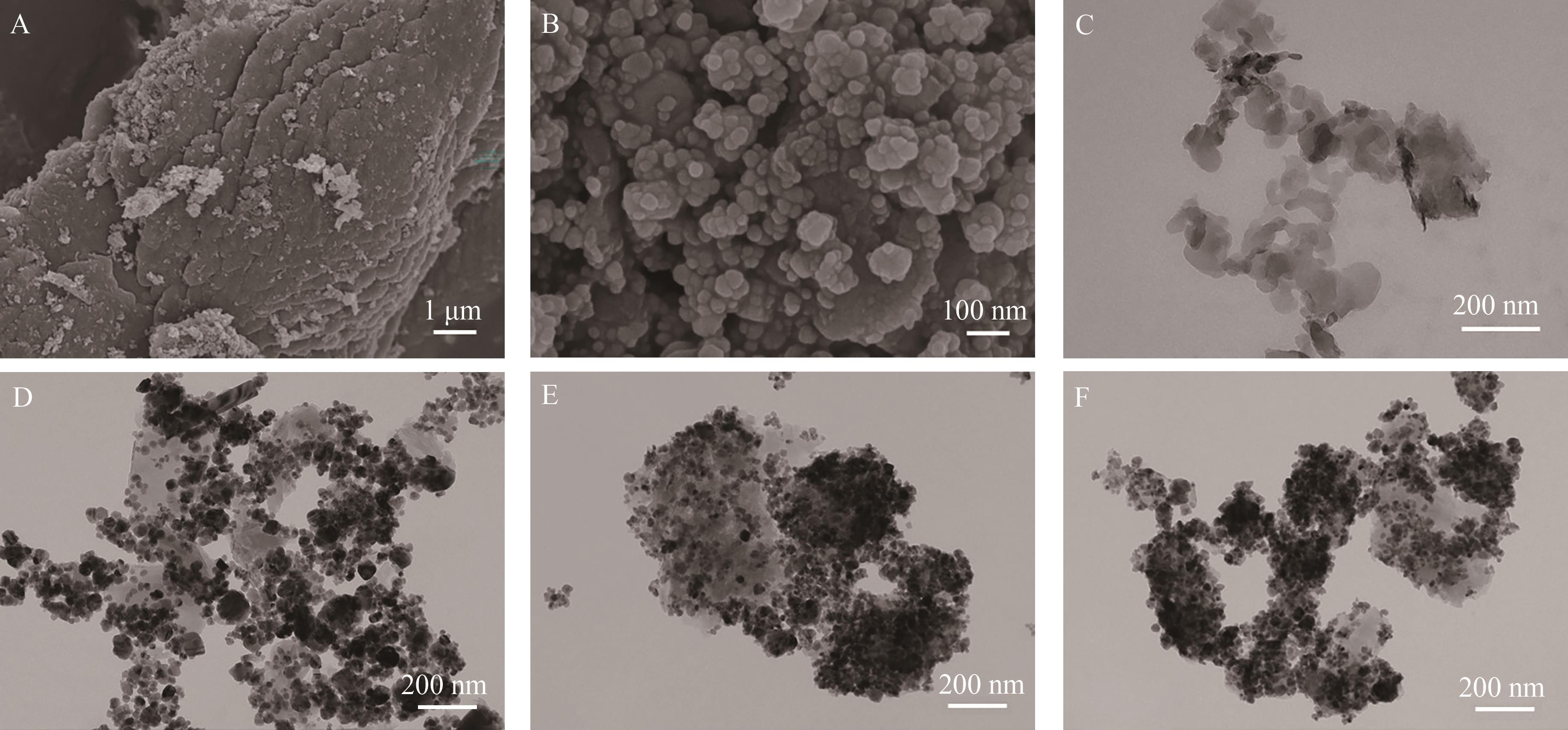
Fig.1 SEM images of g-C3N4 (A) and Zn-CdS/g-C3N4 (B); TEM images of g-C3N4 (C), Zn-CdS/g-C3N4 (D), Zn-CdS/g-C3N4 after one (E) and four cycles (F)
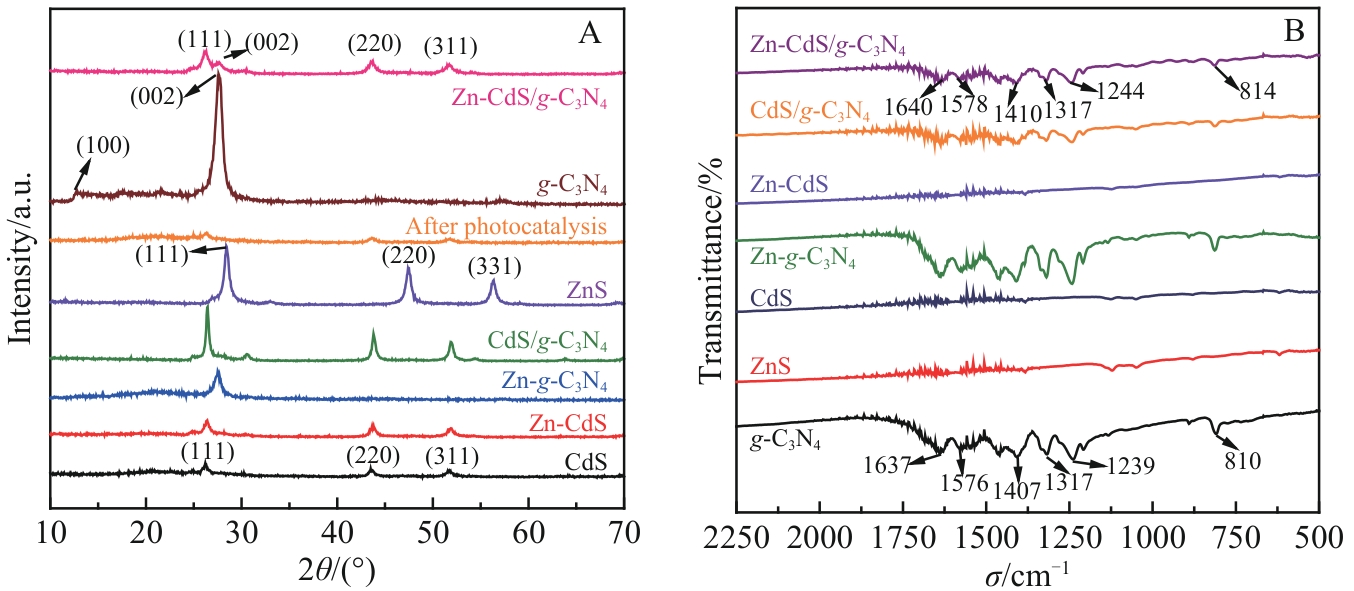
Fig.2 XRD (A) and FT-IR (B) patterns of different photocatalytic materials
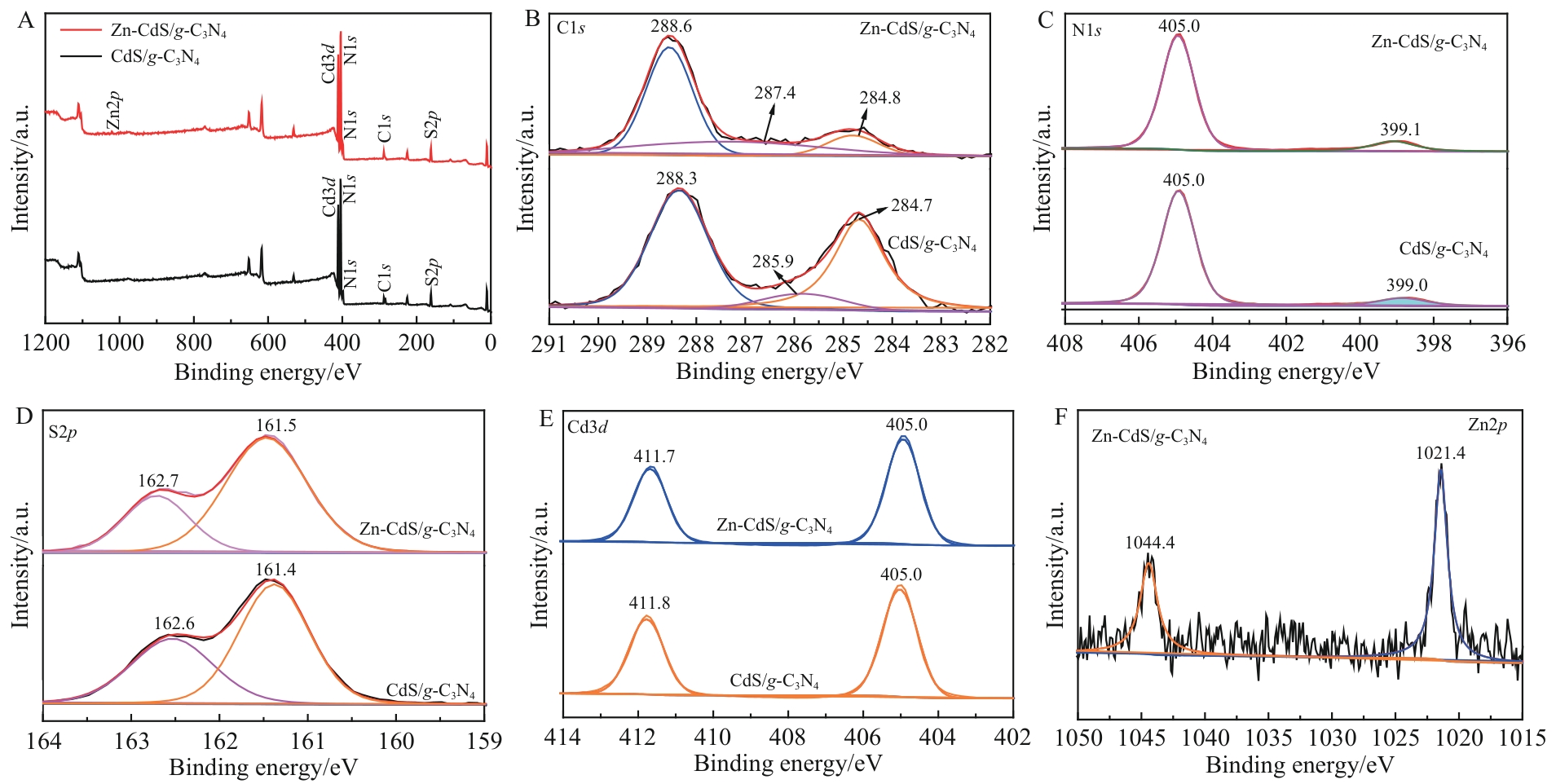
Fig.3 XPS images of overall (A), C1s (B), N1s (C), S2p (D), Cd3d (E) and Zn2p (F) of Zn-CdS/g-C3N4 and CdS/g-C3N4
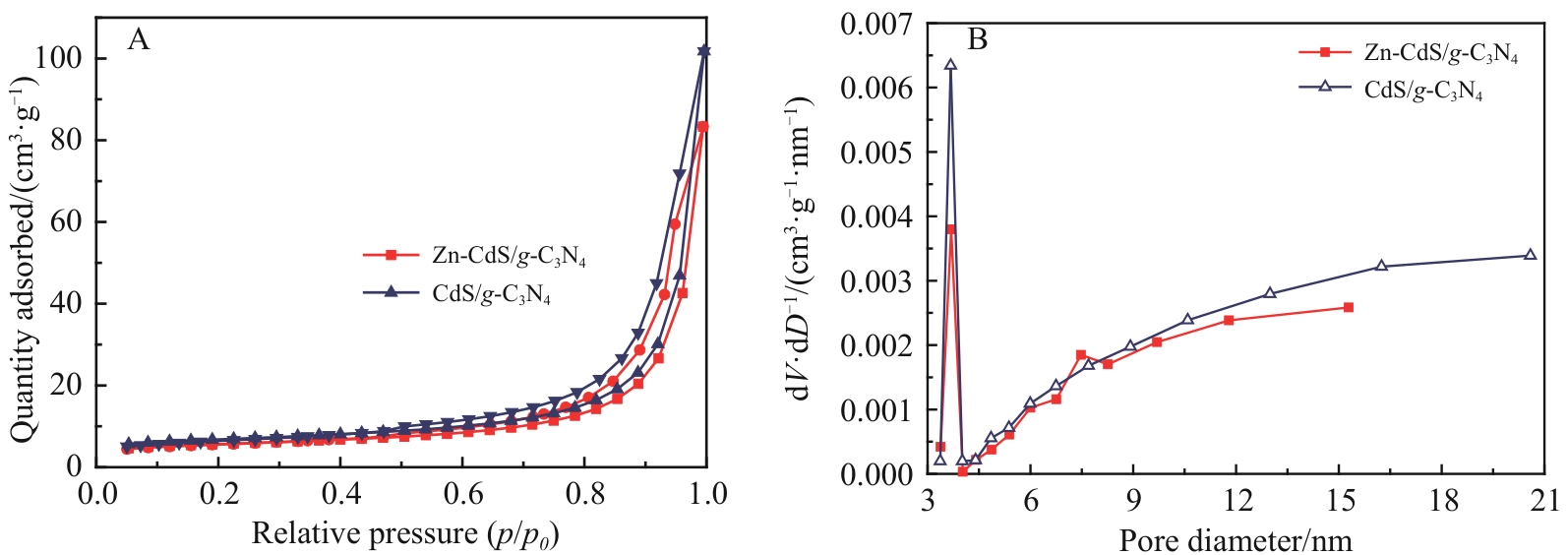
Fig.4 N2 adsorption-desorption isotherms (A) and pore size distribution curves (B)
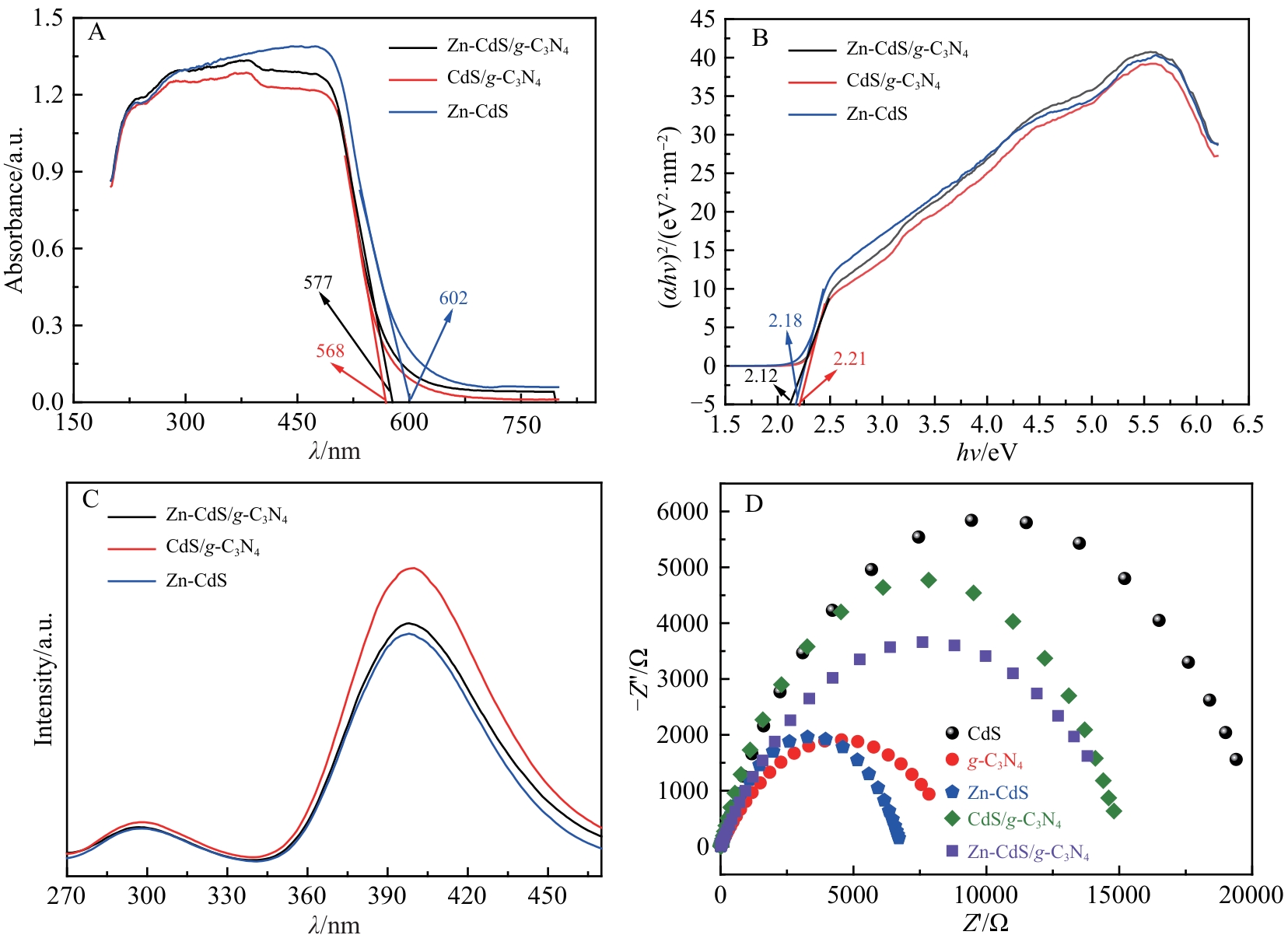
Fig.5 UV-Vis absorption spectra (A), the plot of (αhv)2 and photon energy (hv) (B), PL spectra (C) and EIS spectra (D) of Zn-CdS/g-C3N4, CdS/g-C3N4 and Zn-CdS
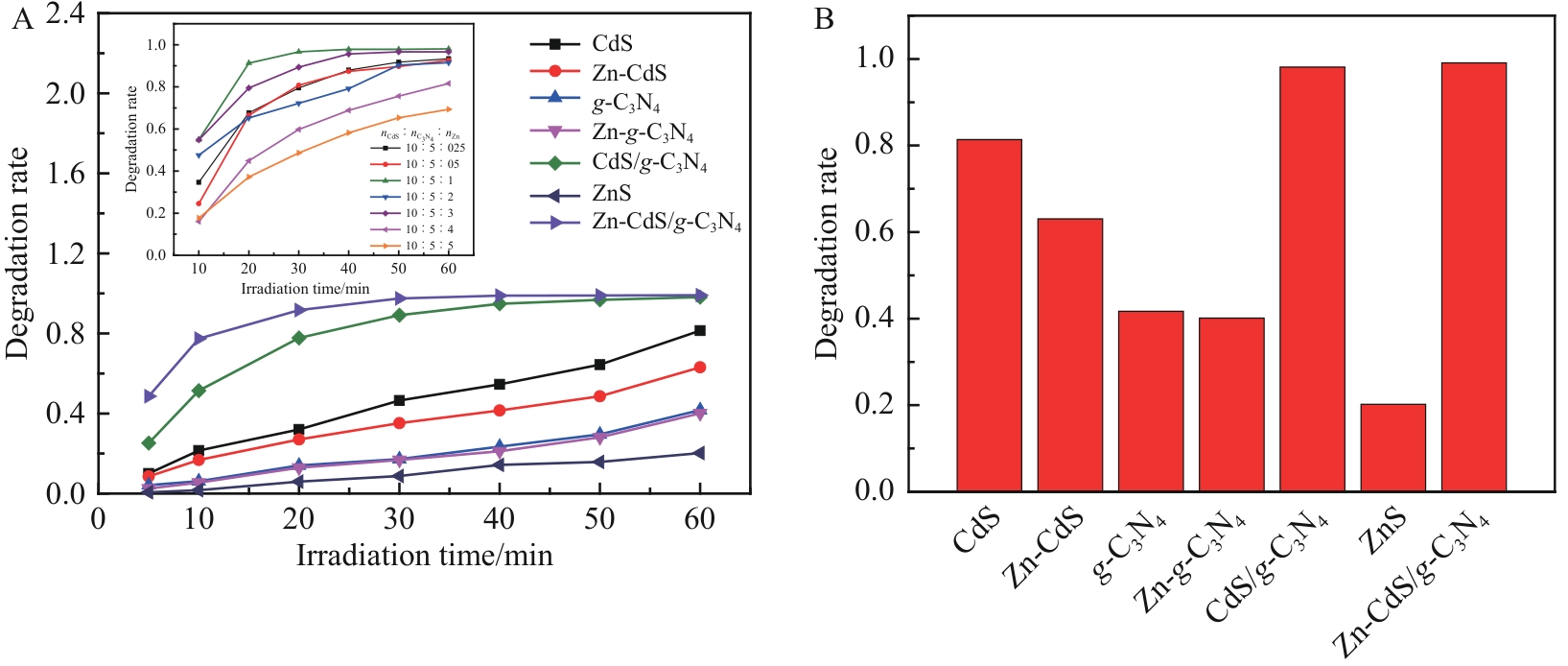
Fig.6 Degradation of RhB by the different photocatalysts (A) (Inset: influence of Zn2+ doping amount) and degradation of RhB after 60 min irradiation (B)
| Material | Degradation efficiency/% | Time/min | Dye | Source light | Ref. |
|---|---|---|---|---|---|
| CdS/g-C3N4/MOF | 90.2 | 90 | RhB | Visible | [ |
| Zn doped CdS | 93 | 135 | RhB | Visible | [ |
| CdS/ZnS | 83 | 60 | MO | UV | [ |
| CdS/g-C3N4 | 95 | 150 | RhB | Visible | [ |
| CdS-ZnS-BiPO4 | 95 | 150 | MB | Visible | [ |
| CuS@ZnS | 65 | 90 | MB | UV | [ |
| T-CN/CdS | 100 | 60 | RhB | Visible | [ |
| P25/Zn0.15Cd0.85S 1-5 | 100 | 60 | RhB | Visible | [ |
| Zn-CdS/g-C3N4 | 99 | 40 | RhB | Visible | This work |
Table 1 Comparison of the results of the present study with those of related literatures
| Material | Degradation efficiency/% | Time/min | Dye | Source light | Ref. |
|---|---|---|---|---|---|
| CdS/g-C3N4/MOF | 90.2 | 90 | RhB | Visible | [ |
| Zn doped CdS | 93 | 135 | RhB | Visible | [ |
| CdS/ZnS | 83 | 60 | MO | UV | [ |
| CdS/g-C3N4 | 95 | 150 | RhB | Visible | [ |
| CdS-ZnS-BiPO4 | 95 | 150 | MB | Visible | [ |
| CuS@ZnS | 65 | 90 | MB | UV | [ |
| T-CN/CdS | 100 | 60 | RhB | Visible | [ |
| P25/Zn0.15Cd0.85S 1-5 | 100 | 60 | RhB | Visible | [ |
| Zn-CdS/g-C3N4 | 99 | 40 | RhB | Visible | This work |
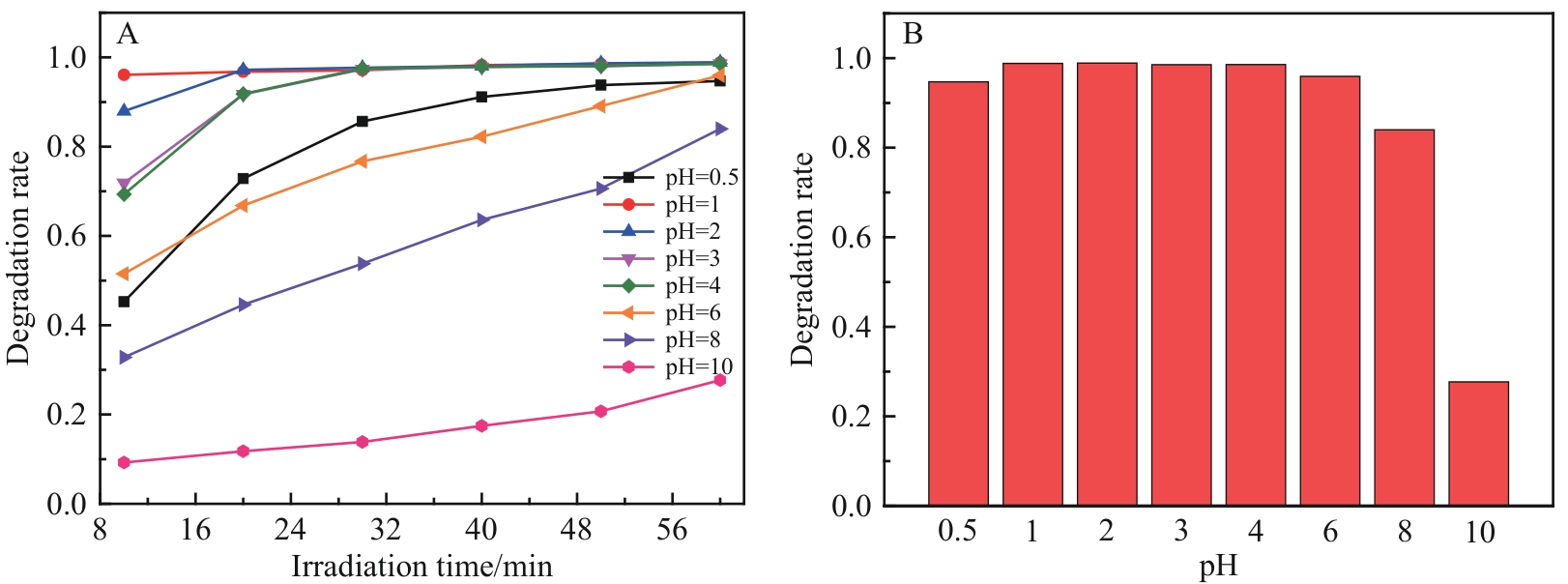
Fig.7 Influence of pH values on the degradation of RhB by Zn-CdS/g-C3N4 (A) and degradation of RhB by Zn-CdS/g-C3N4 after 60 min irradiation at different pH values (B)
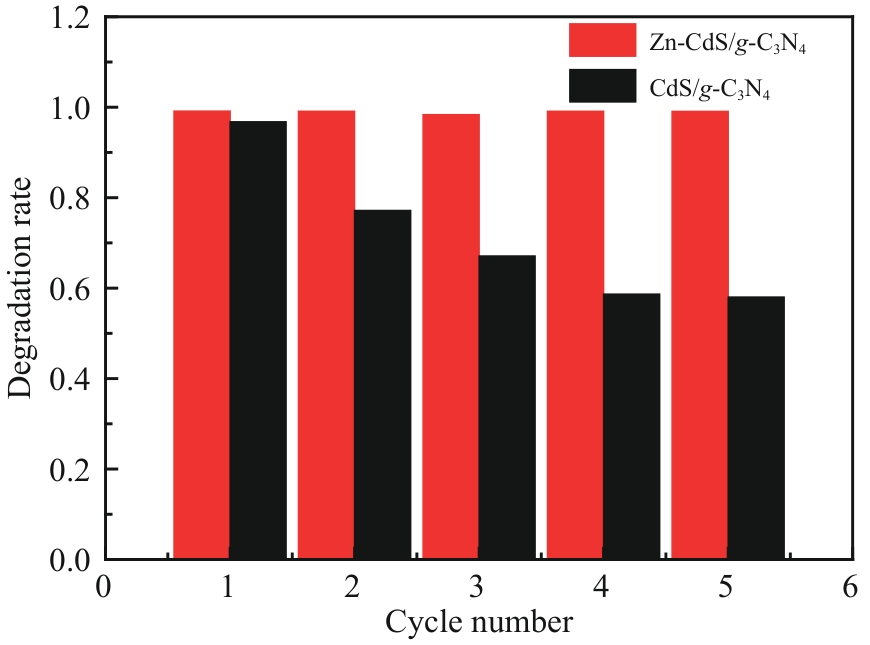
Fig.8 Cyclability of Zn-CdS/g-C3N4 and CdS/g-C3N4
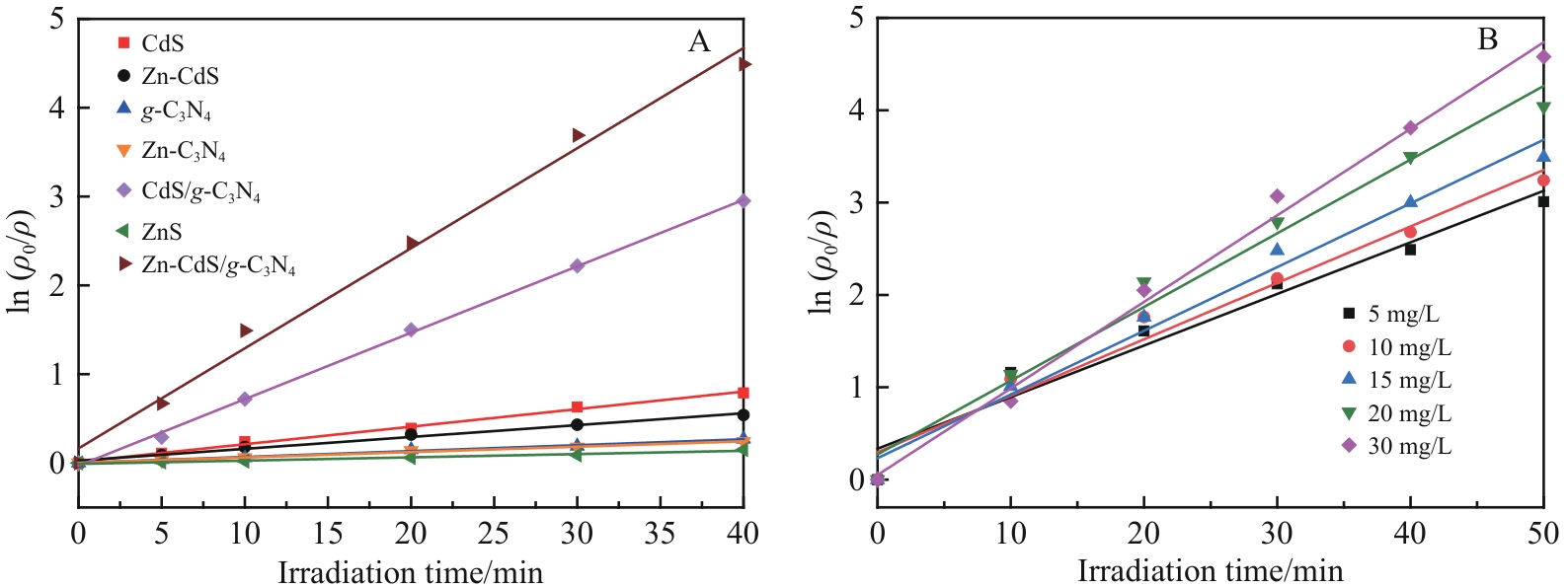
Fig.9 Photocatalytic kinetics of photocatalytic degradation of RhB by different photocatalytic materials (A) and RhB at different concentrations by Zn-CdS/g-C3N4 (B)
| Material | Kinetic equation | Apparent rate constant(k)/min-1 | Correlation coefficient(R2) |
|---|---|---|---|
| CdS | ln (ρ0/ρ)=0.01975t+0.01442 | 0.019 75 | 0.995 43 |
| Zn-CdS | ln (ρ0/ρ)=0.01335t+0.02642 | 0.013 35 | 0.989 50 |
| g-C3N4 | ln (ρ0/ρ)=0.00663t+0.00228 | 0.006 63 | 0.991 28 |
| Zn-g-C3N4 | ln (ρ0/ρ)=0.00604t+0.0026 | 0.006 04 | 0.992 42 |
| CdS/g-C3N4 | ln (ρ0/ρ)=0.07482t-0.02937 | 0.074 82 | 0.999 23 |
| ZnS | ln (ρ0/ρ)=0.00368t-0.00947 | 0.003 68 | 0.973 92 |
| Zn-CdS/g-C3N4 | ln (ρ0/ρ)=0.11267t+0.16488 | 0.112 67 | 0.991 59 |
Table 2 Kinetic equations and apparent rate constants of photodegradation RhB by different materials
| Material | Kinetic equation | Apparent rate constant(k)/min-1 | Correlation coefficient(R2) |
|---|---|---|---|
| CdS | ln (ρ0/ρ)=0.01975t+0.01442 | 0.019 75 | 0.995 43 |
| Zn-CdS | ln (ρ0/ρ)=0.01335t+0.02642 | 0.013 35 | 0.989 50 |
| g-C3N4 | ln (ρ0/ρ)=0.00663t+0.00228 | 0.006 63 | 0.991 28 |
| Zn-g-C3N4 | ln (ρ0/ρ)=0.00604t+0.0026 | 0.006 04 | 0.992 42 |
| CdS/g-C3N4 | ln (ρ0/ρ)=0.07482t-0.02937 | 0.074 82 | 0.999 23 |
| ZnS | ln (ρ0/ρ)=0.00368t-0.00947 | 0.003 68 | 0.973 92 |
| Zn-CdS/g-C3N4 | ln (ρ0/ρ)=0.11267t+0.16488 | 0.112 67 | 0.991 59 |
| ρ(RhB)/(mg?L-1) | Kinetic equation | Apparent rate constant(k)/min-1 | Correlation coefficient(R2) |
|---|---|---|---|
| 5 | ln (ρ0/ρ)=0.05586t+0.33524 | 0.055 86 | 0.957 85 |
| 10 | ln (ρ0/ρ)=0.06111t+0.29714 | 0.061 11 | 0.970 57 |
| 15 | ln (ρ0/ρ)=0.06897t+0.23238 | 0.068 97 | 0.982 06 |
| 20 | ln (ρ0/ρ)=0.07980t+0.27333 | 0.079 80 | 0.980 74 |
| 30 | ln (ρ0/ρ)=0.09371t+0.05048 | 0.093 71 | 0.993 22 |
Table 3 Kinetic equations and apparent rate constants of photodegradation RhB at different concentrations
| ρ(RhB)/(mg?L-1) | Kinetic equation | Apparent rate constant(k)/min-1 | Correlation coefficient(R2) |
|---|---|---|---|
| 5 | ln (ρ0/ρ)=0.05586t+0.33524 | 0.055 86 | 0.957 85 |
| 10 | ln (ρ0/ρ)=0.06111t+0.29714 | 0.061 11 | 0.970 57 |
| 15 | ln (ρ0/ρ)=0.06897t+0.23238 | 0.068 97 | 0.982 06 |
| 20 | ln (ρ0/ρ)=0.07980t+0.27333 | 0.079 80 | 0.980 74 |
| 30 | ln (ρ0/ρ)=0.09371t+0.05048 | 0.093 71 | 0.993 22 |
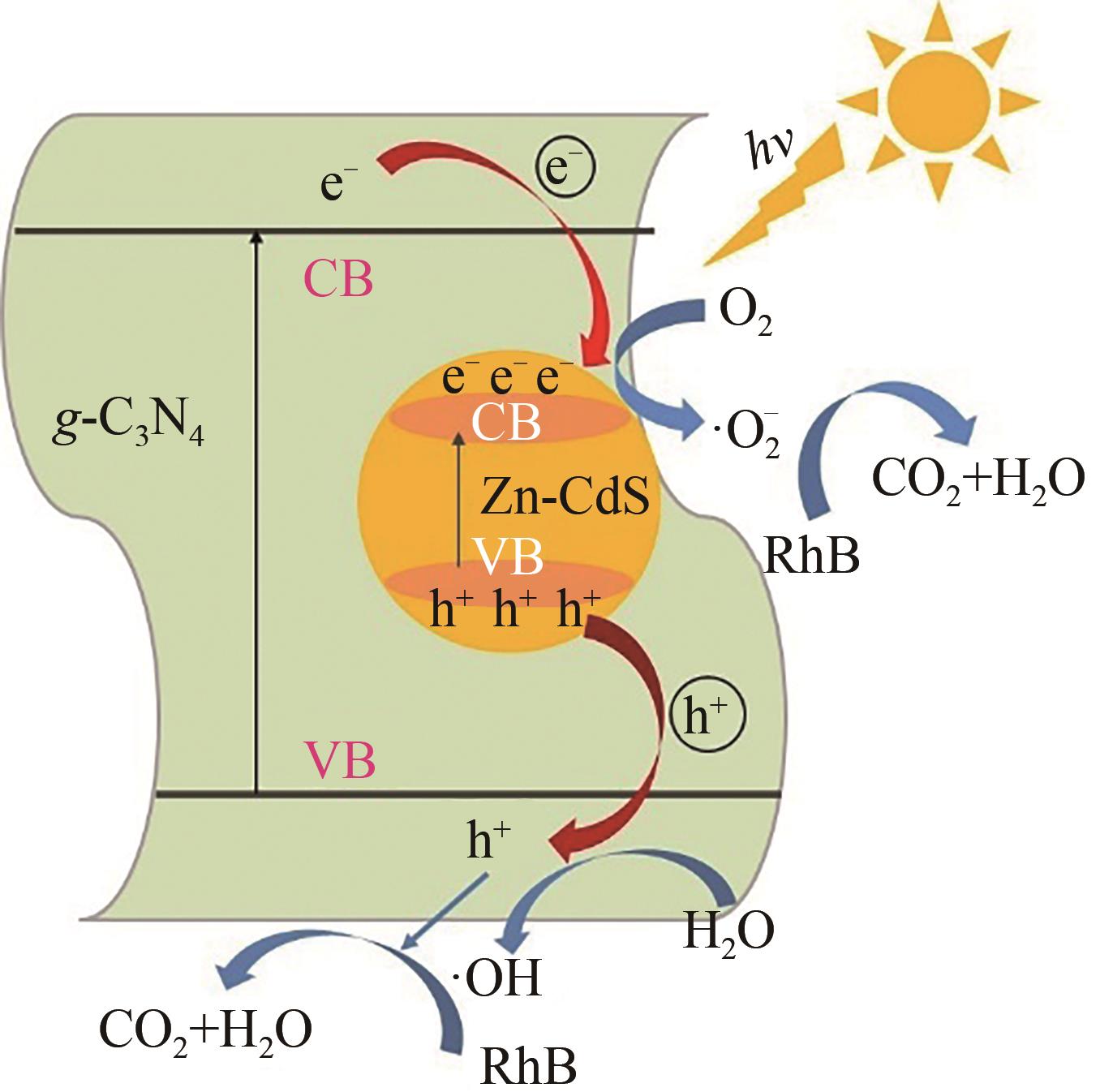
Fig.10 Proposed mechanism for photocatalytic degradation of RhB in water by Zn-CdS/g-C3N4
| [1] | AMEEN S, MURTAZE M, ARSHAD M, et al. Perovskite LaNiO3/Ag3PO4 heterojunction photocatalyst for the degradation of dyes[J]. Front Chem, 2022, 10: 969698. |
| [2] | 邹明, 丁颖, 刘海涛, 等. 纳米CdS/rGO的表征与光催化性能研究[J]. 化工新型材料, 2024, 52(7): 148-152, 156. |
| ZOU M, DING Y, LIU H T, et al. Characterization of nano CdS/rGO and its photocatalytic performance[J]. New Chem Mater, 2024, 52(7): 148-152, 156. | |
| [3] | SHARMA R, THAKUR P, KUMAR M, et al. Nanomaterials for high frequency device and photocatalytic applications: Mg-Zn-Ni ferrites[J]. J Alloy Compd, 2018, 746: 532-539. |
| [4] | CUI H, DONG S Y, WANG K K, et al. Synthesis of a novel type-Ⅱ In2S3/Bi2MoO6 heterojunction photocatalyst: excellent photocatalytic performance and degradation mechanism for rhodamine B[J]. Sep Purif Technol, 2020, 255: 117758. |
| [5] | ALI A, AHMED A, USMAN M, et al. Synthesis of visible light responsive Ce0.2Co0.8Fe2O4/g-C3N4 composites for efficient photocatalytic degradation of rhodamine B[J]. Diam Relat Mater, 2023, 133: 109721. |
| [6] | LIU T Q, ANIAGOR C O, EJIMOFOR M I, et al. Recent developments in the utilization of modified graphene oxide to adsorb dyes from water: a review[J]. J Ind Eng Chem, 2023, 117: 21-37. |
| [7] | LUO X H, CHEN L, HU Y Y. Comparison of different enhanced coagulation methods for azo dye removal from wastewater[J]. Sustainability, 2019, 11(17): 4760. |
| [8] | LONG J, XIE Z F, XUE S S, et al. Highly stable and permeable graphene oxide membrane modified by carbohydrazide for efficient dyes separation[J]. Sep Purif Technol, 2022, 298: 121586. |
| [9] | KUMAR V, THAKUR C, CHAUDHARI P K. Anaerobic biological treatment of dye bearing water in anaerobic sequencing batch reactor: performance and kinetics studies[J]. J Indian Chem Soc, 2022, 99(10): 100673. |
| [10] | DUČIĆ M J, KRSTIĆ A, ZDOLŠEK N, et al. Low-cost graphene-based composite electrodes for electrochemical oxidation of phenolic dyes[J]. Crystals, 2023, 13(1): 125. |
| [11] | QAZI U Y, IFTIKHAR R, IKHLAQ A, et al. Application of Fe-RGO for the removal of dyes by catalytic ozonation process[J]. Environ Sci Pollut R, 2022, 29(59): 89485-89497. |
| [12] | LI J N, CHEN X L, ZHANG Q, et al. Fabrication of Z-scheme heterojunctions of CDs@WO3/g-C3N4 nanocomposite photocatalyst with enhanced visible-light photocatalytic degradation of malachite green[J]. J Mater Sci Mater El, 2024, 35(8): 598. |
| [13] | SINGH V, BANSAL P. Fabrication and characterization of needle shaped CuO nanoparticles and their application as photocatalyst for degradation of organic pollutants[J]. Mater Lett, 2020, 261: 126929. |
| [14] | XU L, ZHANG S Z, ZHANG Z H, et al. Visible-light-mediated oxidative amidation of aldehydes using a magnetic CdS quantum dot as photocatalyst[J]. Chem Eur J, 2021, 27(17): 5483-5491. |
| [15] | WAKERLEY D W, KUEHNEL M F, ORCHARD K L, et al. Solar-driven reforming of lignocellulose to H2 with a CdS/CdOx photocatalyst[J]. Nat Energy, 2017, 2: 17021. |
| [16] | ZHU C, LIU C G, ZOU Y J, et al. Carbon dots enhance the stability of CdS for visible-light-driven overall water splitting[J]. Appl Catal B: Environ, 2017, 216: 114-121. |
| [17] | QI S Y, ZHANG R Y, ZHANG Y M, et al. Construction and photocatalytic properties of the Zn doping on CdS[J]. Appl Phys A Mater, 2022, 128: 353. |
| [18] | MADDI L, VINUKONDA K, GURUGUBELLI T R, et al. One-step, in situ hydrothermal fabrication of cobalt-doped ZnO/CdS nanosheets for optoelectronic applications[J]. Electronics, 2023, 12: 1245. |
| [19] | SAXENA N, SONDHI H, SHARMA R, et al. Equimolar ZnO-CdS nanocomposite for enhanced photocatalytic performance[J]. Chem Phys Impact, 2022, 5: 100119. |
| [20] | 熊波, 黎泰华, 周武平, 等. 一步热聚合法制备Cu2O/CuO-g-C3N4吸附剂及其对甲基橙吸附的性能[J]. 应用化学, 2023, 40(3): 420-429. |
| XIONG B, LI T H, ZHOU W P, et al. Preparation of Cu2O/CuO-g-C3N4 adsorbent by one-step thermal polymerization and adsorption properties for methyl orange[J]. Chin J Appl Chem, 2023, 40(3): 420-429. | |
| [21] | SONG R X, YAO L T, SUN C P, et al. Electrospun membranes anchored with g-C3N4/MoS2 for highly efficient photocatalytic degradation of aflatoxin B1 under visible light[J]. Toxins, 2023, 15(2): 133. |
| [22] | ZHAO Y F, SUN Y P, YIN X, et al. The 2D porous g-C3N4/CdS heterostructural nanocomposites with enhanced visible-light-driven photocatalytic activity[J]. J Nanosci Nanotechnol, 2020, 20: 1098-1108. |
| [23] | CHONG B, CHEN L, HAN D Z, et al. CdS-modified one-dimensional g-C3N4 porous nanotubes for efficient visible-light photocatalytic conversion[J]. Chin J Catal, 2019, 40: 959-968. |
| [24] | CIRENA Z G, YU N, LI Y F, et al. Fe doped g-C3N4 composited ZnIn2S4 promoting Cr(Ⅵ) photoreduction[J]. Chin Chem Lett, 2023, 34(4): 107726. |
| [25] | Al-MAMARI S, SULIMAN F E, KIM Y H, et al. Three-dimensional maple leaf CdS/g-C3N4 nanosheet composite for photodegradation of benzene in water[J]. Adv Powder Technol, 2023, 34(6): 104026. |
| [26] | LIU Q Y, QI Y L, ZHENG Y F, et al. Synthesis and enhanced photocatalytic activity of g-C3N4 hybridized CdS nanoparticles[J]. Bull Mater Sci, 2017, 40: 1329-1333. |
| [27] |
ZHANG Y, WU Y X, WAN L, et al. Double Z-scheme g-C3N4/BiOI/CdS heterojunction with  /I- pairs for enhanced visible light photocatalytic performance[J]. Green Energy Environ, 2022, 77(6): 1377-1389. /I- pairs for enhanced visible light photocatalytic performance[J]. Green Energy Environ, 2022, 77(6): 1377-1389.
|
| [28] | YANG J, ZHANG X Q, XIE C F, et al. Preparation of g-C3N4 with high specific surface area and photocatalytic stability[J]. J Electron Mater, 2021, 50(3): 1067-1074. |
| [29] | ZHU W L. Phosphotungstic acid passivated enhanced photocatalytic performance of ZnS nanoparticles under solar light[J]. Solid State Sci, 2021, 118: 106406. |
| [30] | QIAO Q, HUANG W Q, LI Y Y, et al. In-situ construction of 2D direct Z-scheme g-C3N4/g-C3N4 homojunction with high photocatalytic activity[J]. J Mater Sci, 2018, 53(23): 15882-15894. |
| [31] | MA D N, MENG L X, QING W X, et al. Preparation of g-C3N4 nanosheets/CuO with enhanced catalytic activity on the thermal decomposition of ammonium perchlorate[J]. Eur J Inorg Chem, 2021, 2021(10): 982-988. |
| [32] | CHEN X, HU T P, ZHANG J F, et al. Diethylenetriamine synergistic boosting photocatalytic performance with porous g-C3N4/CdS-diethylenetriamine 2D/2D S-scheme heterojunction[J]. J Alloy Compd, 2021, 863: 158068. |
| [33] | ZHANG R Y, NIU S Y, ZHANG X C, et al. Combination of experimental and theoretical investigation on Ti-doped g-C3N4 with improved photo-catalytic activity[J]. Appl Surf Sci, 2019, 489: 427-434. |
| [34] | CHEN Y, LI A, FU X L, et al. One-step calcination to gain exfoliated g-C3N4/MoO2 composites for high-performance photocatalytic hydrogen evolution[J]. Molecules, 2022, 27(21): 7178. |
| [35] | CHEN M X, UMER K, LI B N, et al. Metalloporphyrin based MOF-545 coupled with solid solution ZnxCd1- xS for efficient photocatalytic hydrogen production[J]. J Colloid Interface Sci, 2024, 653: 380-389. |
| [36] | LIU T Y, WANG B J, WANG T, et al. One-pot synthesis of Zn-CdS@C nanoarchitecture with improved photocatalytic performance toward antibiotic degradation[J]. Chemosphere, 2022, 300: 134621. |
| [37] | ZHU Y J, WANG L, XU W T, et al. ZnO/Cu2O/g-C3N4 heterojunctions with enhanced photocatalytic activity for removal of hazardous antibiotics[J]. Heliyon, 2022, 8(12): 12644. |
| [38] | MA Y L, TAO Y Y. Preparation of CdS/g-C3N4 heterojunction photocatalyst with high activity sites by acid treatment[J]. Chalcogenide Lett, 2023, 20(2): 153-164. |
| [39] | YAN X, JIN Z L, ZHANG Y P, et al. Sustainable and efficient hydrogen evolution over a noble metal-free WP double modified ZnxCd1- xS photocatalyst driven by visible-light[J]. Dalton T, 2019, 48(29): 11122-11135. |
| [40] | SABZEHMEIDANI M M, KARIMI H, GHAEDI M. CeO2 nanofibers-CdS nanostructures n-n junction with enhanced visible-light photocatalytic activity[J]. Arab J Chem, 2020, 13(11): 7583-7597. |
| [41] | FENG C, CHEN Z Y, JING J P, et al. Band structure and enhanced photocatalytic degradation performance of Mg-doped CdS nanorods[J]. Phys B, 2020, 594: 412363. |
| [42] | ELGORBAN A M, Al-KHERAIF A A, SYED A. Construction of Ag2WO4 decorated CoWO4 nano-heterojunction with recombination delay for enhanced visible light photocatalytic performance and its antibacterial applications[J]. Colloid Surface A, 2021, 629: 127416. |
| [43] | LIU J, KE J, LI Y, et al. Co3O4 quantum dots/TiO2 nanobelt hybrids for highly efficient photocatalytic overall water splitting[J]. Appl Catal B: Environ, 2018, 236: 396-403. |
| [44] | DIARMAND-KHALILABAD H, HABIBI-YANGJEH A, SEIFZADEH D, et al. g-C3N4 nanosheets decorated with carbon dots and CdS nanoparticles: novel nanocomposites with excellent nitrogen photofixation ability under simulated solar irradiation[J]. Ceram Int, 2019, 45(2): 2542-2555. |
| [45] | ZUO M X, LI X Y, LIANG Y S, et al. Modification of sulfur doped carbon nitride and its application in photocatalysis[J]. Sep Purif Technol, 2023, 308: 122875. |
| [46] | CHEN Y, ZHAI B Y, LIANG Y N, et al. Preparation of CdS/g-C3N4/MOF composite with enhanced visible-light photocatalytic activity for dye degradation[J]. J Solid State Chem, 2019, 274: 32-39. |
| [47] | SINGH A, SINGH D, AHMED B, et al. Sun/UV-light driven photocatalytic degradation of rhodamine B dye by Zn doped CdS nanostructures as photocatalyst[J]. Mater Chem Phys, 2022, 277: 125531. |
| [48] | BORO P, BHATTACHARJEE S. Photocatalytic activity in PVA capped CdS/ZnS core/shell nanocomposites[J]. Indian J Pure Appl Phys, 2024, 62(6): 478-489. |
| [49] | ZHANG N, LI X F, YANG J H, et al. Two-step self-assembly CdS/g-C3N4 heterostructure composites with higher photocatalytic performance under visible light irradiation[J]. Phys Status Solidi A, 2019, 216: 1800978. |
| [50] | TSAI H C, PENG Y H, WEN P Y, et al. Enhanced visible light photocatalytic degradation of methylene blue by CdS-ZnS-BiPO4 nanocomposites prepared by a solvent-assisted heating method[J]. Catal, 2021, 11: 1095. |
| [51] | YEPSEU A P, NGOUDJOU L E T, TIGWERE G A, et al. Hot injection synthesis of CuS decorated CdS and ZnS nanomaterials from metal thiosemicarbazone complexes as single source precursors: application in the photocatalytic degradation of methylene blue[J]. Inorg Chem Commun, 2024, 166: 112650. |
| [52] | ALOMAR M, LIU Y L, CHEN W. Surface decorated Zn0.15Cd0.85S nanoflowers with P25 for enhanced visible light driven photocatalytic degradation of Rh-B and stability[J]. Appl Sci, 2018, 8: 327. |
| [53] | ZHU M, CHEN H M, DAI Y, et al. Novel n-p-n heterojunction of AgI/BiOI/UiO-66 composites with boosting visible light photocatalytic activities[J]. Appl Organomet Chem, 2021, 35: e6186. |
| [54] | 朱禹, 罗伟奇, 候冬梅, 等. BiOI负载MIL-101(Fe)@BiOI衍生BiFeO3@Fe2O3及其增强光催化性能[J]. 无机化学学报, 2023, 39(7): 1415-1428. |
| ZHU Y, LUO W Q, HOU D M, et al. Decorated BiOI on MIL-101(Fe)@BiOI derived BiFeO3@Fe2O3 for improved photocatalytic performance[J]. Chin J Inorg Chem, 2023, 39(7): 1415-1428. | |
| [55] | LIU X Y, SAYED M, BIE C B, et al. Hollow CdS-based photocatalysts[J]. J Materiomics, 2021, 7(3): 419-439. |
| [56] | IQBAL M, IBRAR A, ALI A, et al. Facile synthesis of Zn-doped CdS nanowires with efficient photocatalytic performance[J]. Environ Technol, 2022, 43(12): 1783-1790. |
| [57] | JIAO Z Y, ZHANG J L, LIU Z D, et al. Ag/AgCl/Ag2MoO4 composites for visible light-driven photocatalysis[J]. J Photoch Photobio A, 2019, 371: 67-75. |
| [58] | XU H Y, WU L C, JIN L G, et al. Combination mechanism and enhanced visible-light photocatalytic activity and stability of CdS/g-C3N4 heterojunctions[J]. J Mater Sci Technol, 2017, 33(1): 30-38. |
| [1] | Xiao-Li LI, Yan-Li LI, Dong LI. Controllable Preparation of CdS@PbS Core/Shell Quantum Dots via Cation Exchange and Their Near-Infrared Photodetector [J]. Chinese Journal of Applied Chemistry, 2025, 42(8): 1078-1086. |
| [2] | Ling TAI, Zhi-Chao ZHAO, Xin-Hua JING, Ji-Xiang CONG, Fu-Shan CHANG, Xiao-Bin ZHANG. Enhanced Photocatalytic Activity of g-C3N4 Towards Hexavalent Chromium with Ternary Sulfide [J]. Chinese Journal of Applied Chemistry, 2025, 42(8): 1125-1134. |
| [3] | Jing WANG, Xi-Lan LI, Xiu-Fen GUO. Preparation and Photocatalytic Properties of Niobium Pentoxide Photocatalyst [J]. Chinese Journal of Applied Chemistry, 2024, 41(3): 415-421. |
| [4] | Qian YANG, Yang ZHANG, Ming-Yang LAI, Lin GUO, Jian-Bo JIA. Adsorption Performance of Rhodamine B on Magnetic Biochar Prepared at Different Pyrolysis Temperatures [J]. Chinese Journal of Applied Chemistry, 2023, 40(2): 288-298. |
| [5] | Sheng-Jie LIU, Yong-Jie YE, Yin-Yi LIU, Shu-Man LIN, Hao-Yuan XIE, Wen-Ting LIU, Wei-Qin XU. Preparation of Uniformly Loaded Cu3P Nanoparticles in Porous Carbon Based on Copper Foam and Their Photocatalytic Performance for Dye Degradation [J]. Chinese Journal of Applied Chemistry, 2022, 39(7): 1090-1097. |
| [6] | Yi-Xin XU, Shuang WANG, Jing QUAN, Wan-Ting GAO, Tian-Qun SONG, Mei YANG. Preparation of Molybdenum Disulfide Quantum Dots/Reduced Graphene Oxide Composites and Their Photocatalytic Degradation of Organic Dyes, Tetracyclines and Cr(VI) [J]. Chinese Journal of Applied Chemistry, 2022, 39(5): 769-778. |
| [7] | ZHAO Xing-Peng, WANG Ya-Qiao, GAO Sheng-Wang, ZHU Jian-Chao, WANG Guo-Ying, XIA Xun-Feng, WANG Hong-Liang, WANG Shu-Ping. Synthesis of BiOBr/CeO2 Composites for Photocatalytic Degradation of Sulfisoxazole [J]. Chinese Journal of Applied Chemistry, 2021, 38(4): 422-430. |
| [8] | HUO ZhaoHui, YANG Xiaoshan, CHEN Xiaoli, ZHANG Gang, YIN Wei, CAO Manli, SHI Lei, QIU Yanxuan. Preparation of Ag/Two-Dimensional Graphitic Carbon Nitride/Reduced Graphene Oxide Composite and Its Photocatalytic Degradation of Antibiotics [J]. Chinese Journal of Applied Chemistry, 2020, 37(4): 471-480. |
| [9] | LÜ Wenqiang, MENG Fanjin, XU Jingwei. Simple and Highly Efficient Synthesis of Cyanuric Acid by Hydrothermal Method [J]. Chinese Journal of Applied Chemistry, 2020, 37(2): 155-159. |
| [10] | HEI Jiahui, YANG Lining, LI Jun. Synthesis and Photocatalysis of Metal Complexes with Schiff Base Derived from 2-Thiophene Carboxaldehyde and Ethylenediamine [J]. Chinese Journal of Applied Chemistry, 2019, 36(8): 949-957. |
| [11] | HU Xumin, LI Guishui, CHENG Lijun, HAO Liang. Preparation and Photocatalytic Properties of Bismuth Subcarbonate Modified with Surfactants [J]. Chinese Journal of Applied Chemistry, 2018, 35(6): 692-699. |
| [12] | WANG Cui, ZHANG Feiyun, LYU Rongwen, ZHANG Shufen. Gold Nanopaticle Surface Energy Transfer and Its Application for Thiols Detection [J]. Chinese Journal of Applied Chemistry, 2018, 35(1): 60-67. |
| [13] | GUAN Xiaolin, JIA Tianming, QIN Yuxin, ZHANG Donghai, ZHANG Yang, FAN Hongting, WEI Qiangbing, LAI Shoujun. Aqueous Synthesis of Thiol-functionalized Polyvinylalcohol/CdS Quantum Dots Nanocomposite at Low Temperature for Detection of Trace Cu2+ in Water [J]. Chinese Journal of Applied Chemistry, 2017, 34(3): 291-299. |
| [14] | TAN Yuhui, GU Zhifeng, LIU Yi, YANG Changshan, WANG Bin, TANG Yunzhi. Synthesis, Structure and Fluorescence Properties of Manganese(Ⅱ) Complex Based on 3-Carboxyl-1,2,4-triazole [J]. Chinese Journal of Applied Chemistry, 2017, 34(3): 354-360. |
| [15] | WANG Song, LI Yang, LI Fei, CHENG Xiaohong. Microwave Hydrothermal Synthesis and Photocatalytic Properties of ZnO Nano-/Microparticles [J]. Chinese Journal of Applied Chemistry, 2017, 34(2): 220-224. |
| Viewed | ||||||
|
Full text |
|
|||||
|
Abstract |
|
|||||
