
应用化学 ›› 2025, Vol. 42 ›› Issue (9): 1245-1256.DOI: 10.19894/j.issn.1000-0518.250086
李成1, 李艳玲2( ), 李松松2, 罗小龙1(), 邓必成3,4, 廖伍平2,3,4
收稿日期:2025-02-28
接受日期:2025-07-24
出版日期:2025-09-01
发布日期:2025-09-28
通讯作者:
李艳玲,罗小龙
基金资助:
Cheng LI1, Yan-Ling LI2(), Song-Song LI2, Xiao-Long LUO1(), Bi-Cheng DENG3,4, Wu-Ping LIAO2,3,4
Received:2025-02-28
Accepted:2025-07-24
Published:2025-09-01
Online:2025-09-28
Contact:
Yan-Ling LI,Xiao-Long LUO
About author:luoxiaolong890419@163.comSupported by:摘要:
以(2-乙基己基胺基)甲基膦酸单-2-乙基己基酯(HEHAMP)萃取Sc3+的饱和萃合物为模板制备了离子印迹材料P-IIM,并对其进行了傅里叶变换红外光谱(FT-IR)、热重分析(TGA)和扫描电子显微镜(SEM)等表征,发现当萃取剂质量分数大于50%时,材料难以成型。 进一步研究了P-IIM在盐酸介质中对Sc3+的吸附性能,考察了萃取剂质量、溶液初始pH值、吸附时间、初始Sc3+浓度和其他金属离子如铁和稀土等对Sc3+吸附的影响。 结果表明,P-IIM对Sc3+的吸附量随着萃取剂含量增加而逐渐增大,而随着溶液初始pH值升高先增大后减小,当pH值为2时吸附量最大; P-IIM吸附Sc3+的过程符合准二级动力学模型,并以单层吸附为主。 P-IIM可用于从稀土溶液中吸附去除微量钪(Ⅲ),其对Sc3+的吸附去除率超过98%。
中图分类号:
李成, 李艳玲, 李松松, 罗小龙, 邓必成, 廖伍平. 基于(2-乙基己基胺基)甲基膦酸单-2-乙基己基酯的离子印迹材料及其在微量钪去除方面的应用[J]. 应用化学, 2025, 42(9): 1245-1256.
Cheng LI, Yan-Ling LI, Song-Song LI, Xiao-Long LUO, Bi-Cheng DENG, Wu-Ping LIAO. Preparation of Ion-Imprinted Material Based on 2-Ethylhexylamino Methyl Phosphonic Acid Mono-2-Ethylhexyl Ester Extractant and Its Application for the Removal of Trace Scandium[J]. Chinese Journal of Applied Chemistry, 2025, 42(9): 1245-1256.
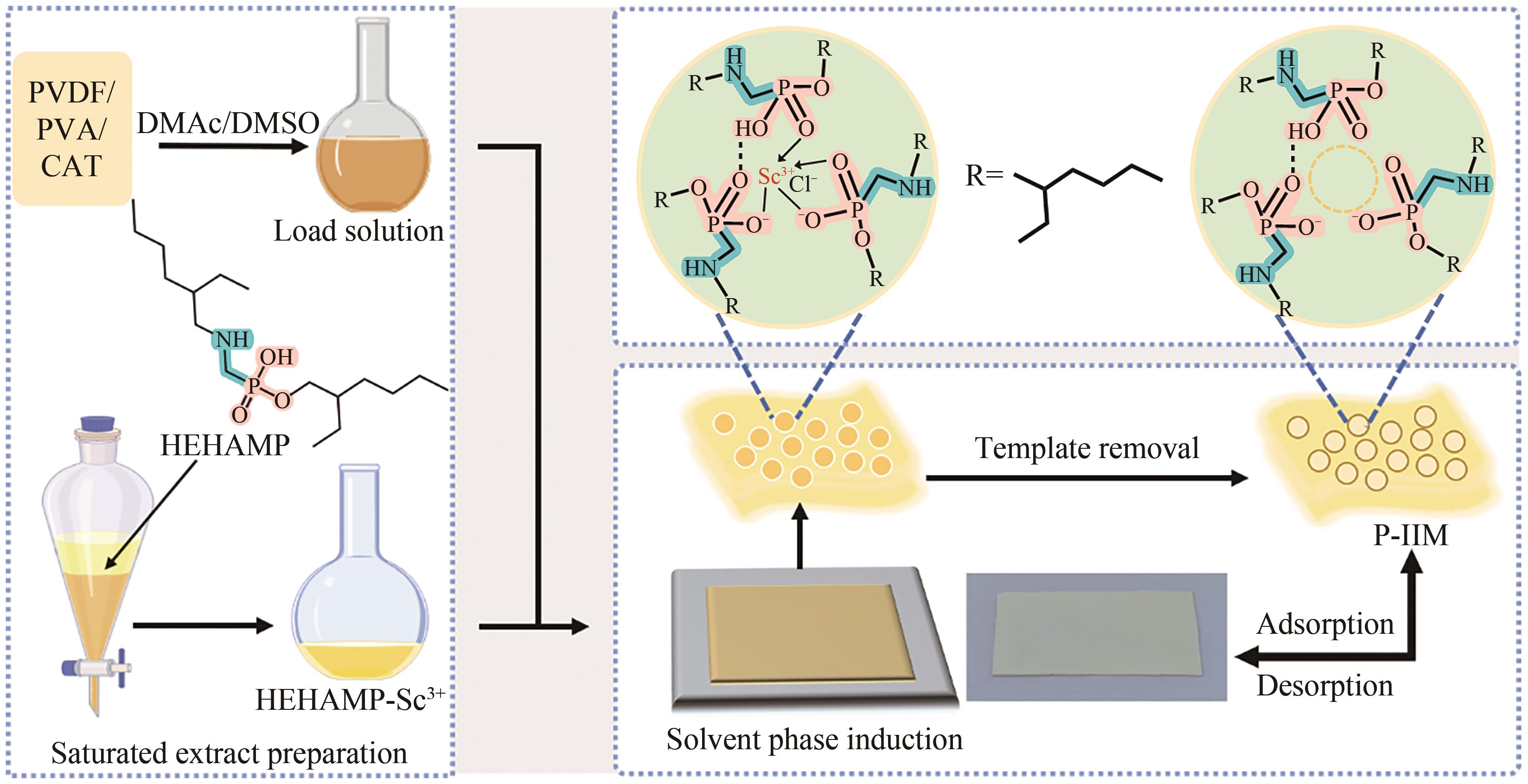
图1 P-IIM制备流程图
Fig.1 Flow chart of P-IIM preparation
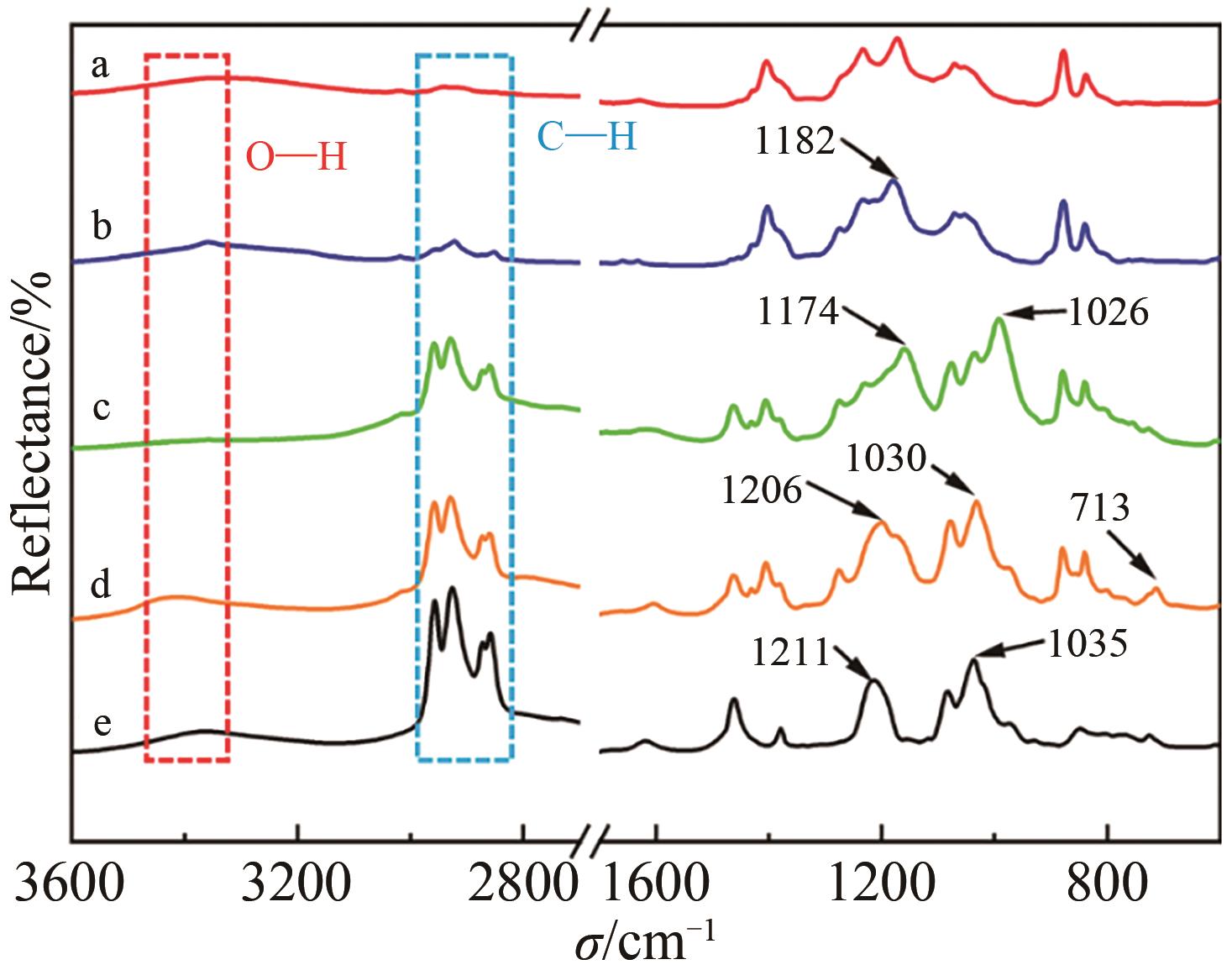
图2 (a) PVDF/PVA/CAT、(b) P-PIM、(c) P-IIM、(d) Sc3+-P-IIM和(e) HEHAMP的FT-IR谱图
Fig.2 FT-IR spectra of (a) PVDF/PVA/CAT, (b) P-PIM, (c) P-IIM, (d) Sc3+-P-IIM and (e) HEHAMP
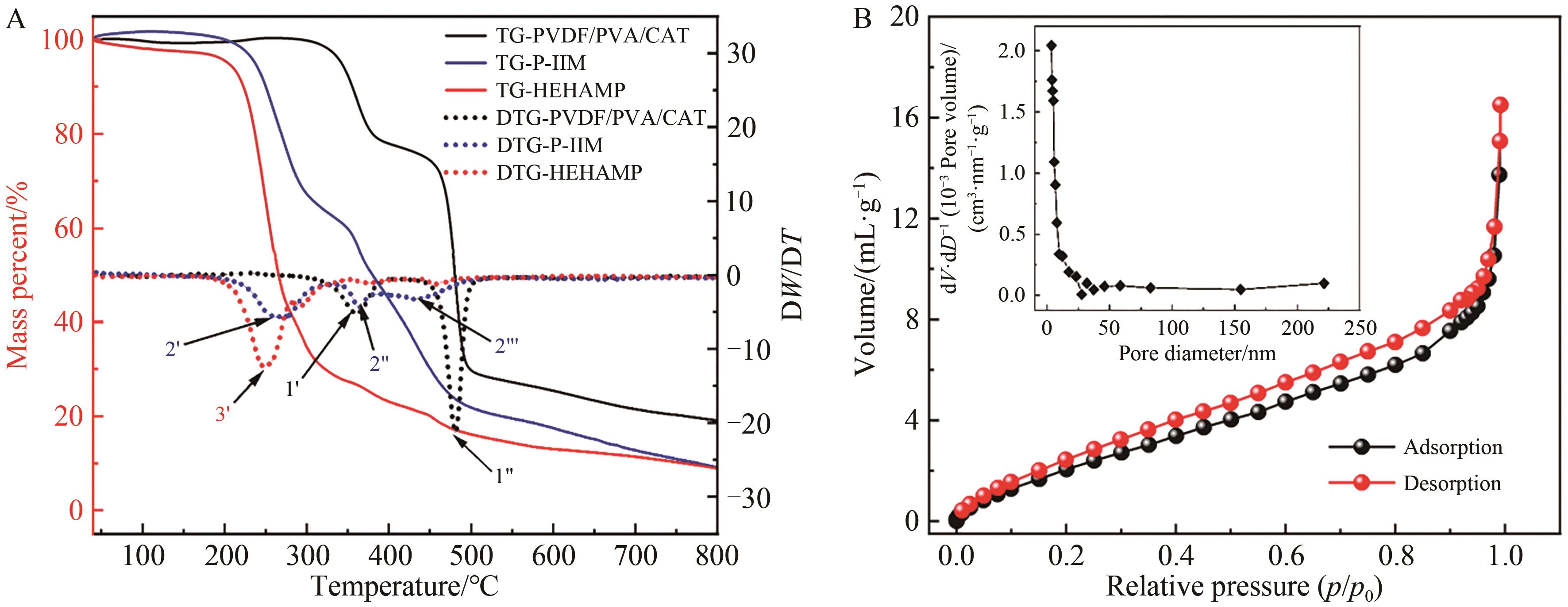
图3 PVDF/PVA/CAT和P-IIM的热重分析(A)以及P-IIM的N2吸附曲线(B)
Fig.3 Plots of the TGA-DTA results for PVDF/PVA/CAT and P-IIM (A) and N2 adsorption isotherm for P-IIM (B)
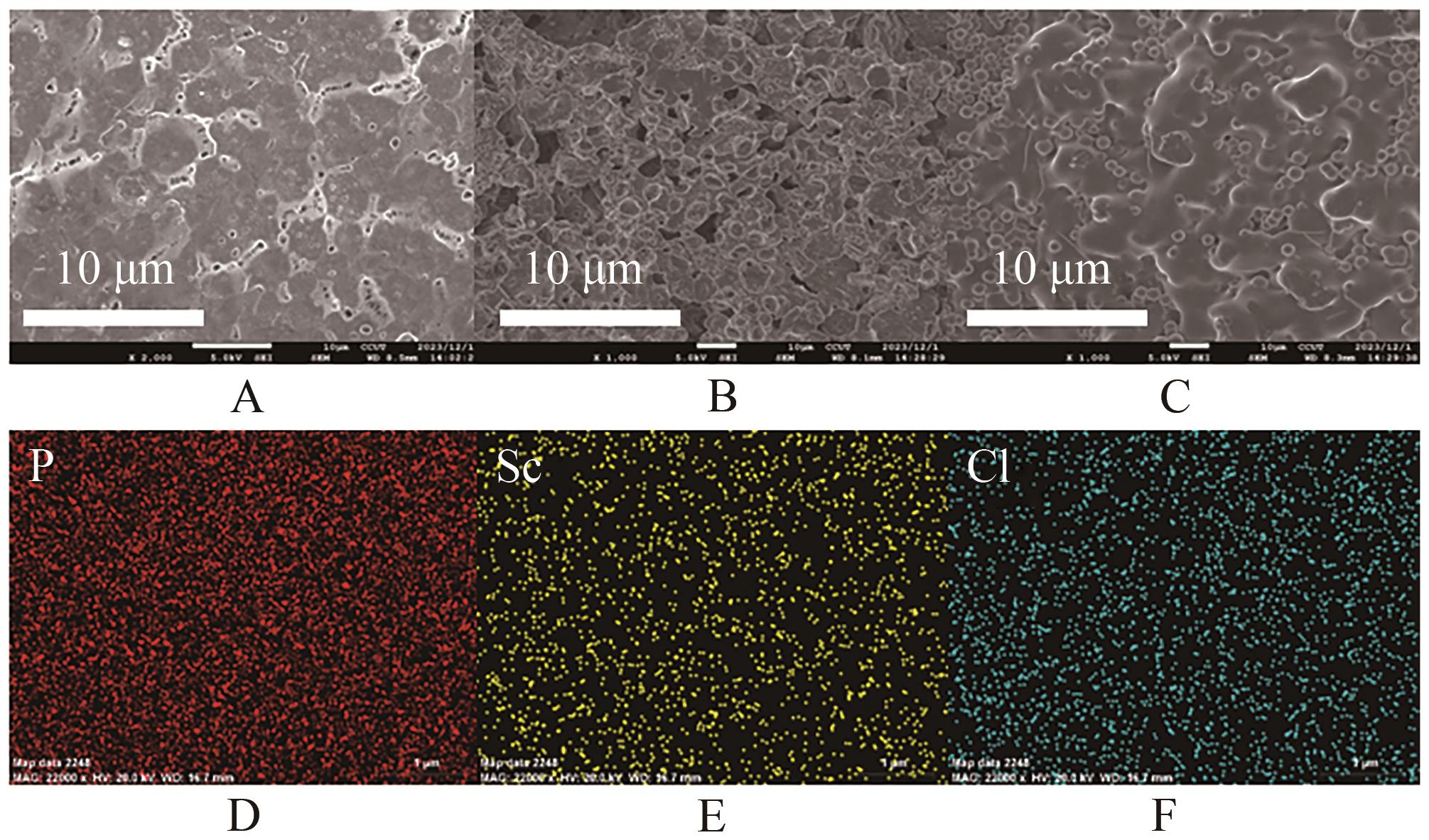
图4 (A) PVDF/PVA/CAT、(B) P-IIM和(C) Sc3+-P-IIM的SEM图像;(D-F) Sc3+-P-IIM的P、Sc和Cl的EDS mapping图像
Fig.4 SEM images of PVDF/PVA/CAT (A), P-IIM (B) and Sc3+-P-IIM (C); EDS mapping images of P, Sc and Cl of Sc3+-P-IIM (D-F)
| Serial number | m/g | nHEHAMP/mmol | a(P)/(Sc) |
|---|---|---|---|
| Ⅰ | 0.040 7 | 0.048 53 | 66.64 |
| Ⅱ | 0.208 5 | 0.033 6 | 2.70 |
| Ⅲ | 0.043 5 | 0.034 3 | 2.76 |
表1 测定不同材料中的a(P)/(Sc)比值
Table 1 Determine the a(P)/(Sc) ratio of different materials
| Serial number | m/g | nHEHAMP/mmol | a(P)/(Sc) |
|---|---|---|---|
| Ⅰ | 0.040 7 | 0.048 53 | 66.64 |
| Ⅱ | 0.208 5 | 0.033 6 | 2.70 |
| Ⅲ | 0.043 5 | 0.034 3 | 2.76 |
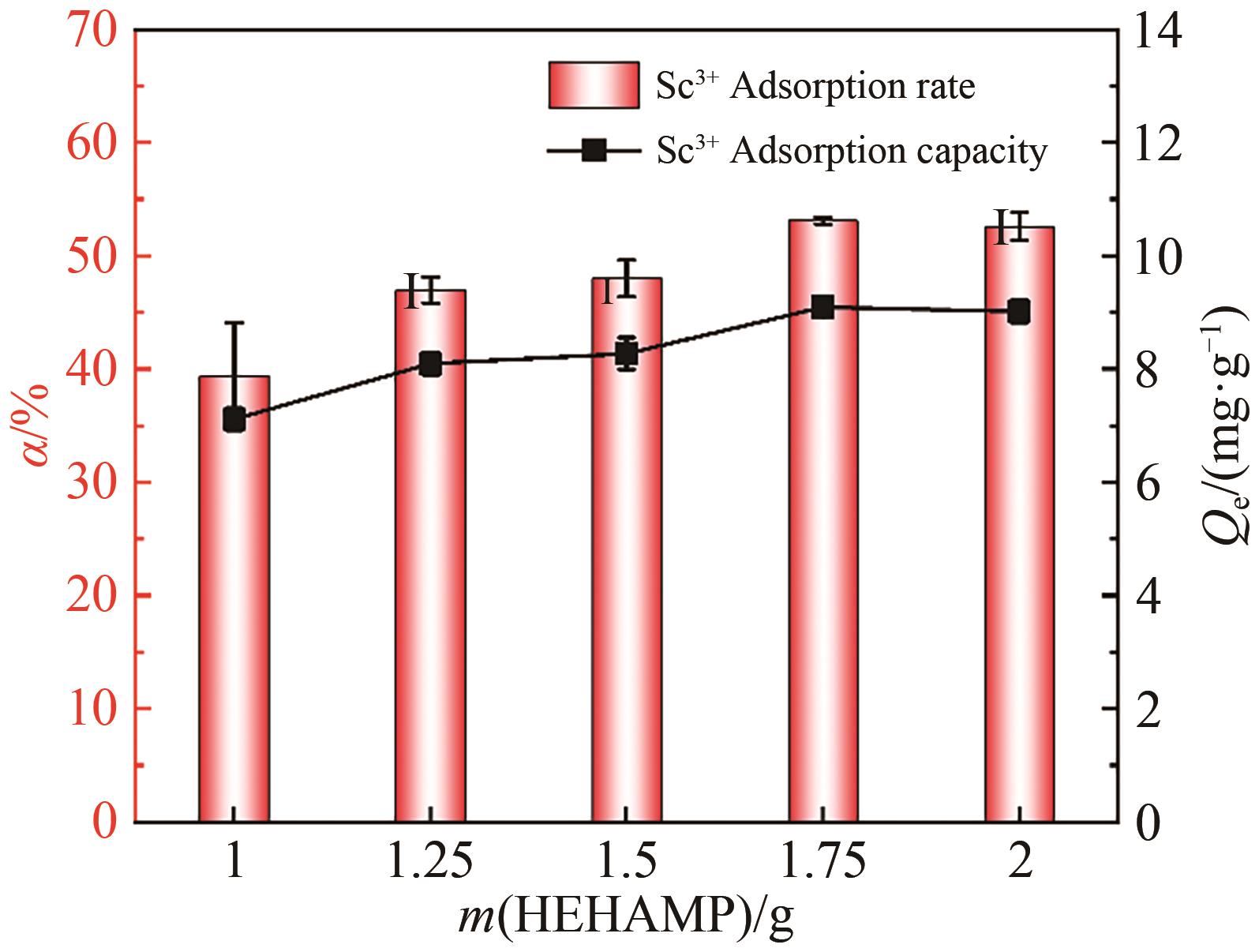
图5 HEHAMP含量对P-IIM吸附Sc3+的影响ρ(Sc3+)=50 mg/L, V=10 mL, 25 ℃, pH=2.0, m=32 mg
Fig.5 Effect of the content of HEHAMP on the Sc3+ adsorption by P-IIM
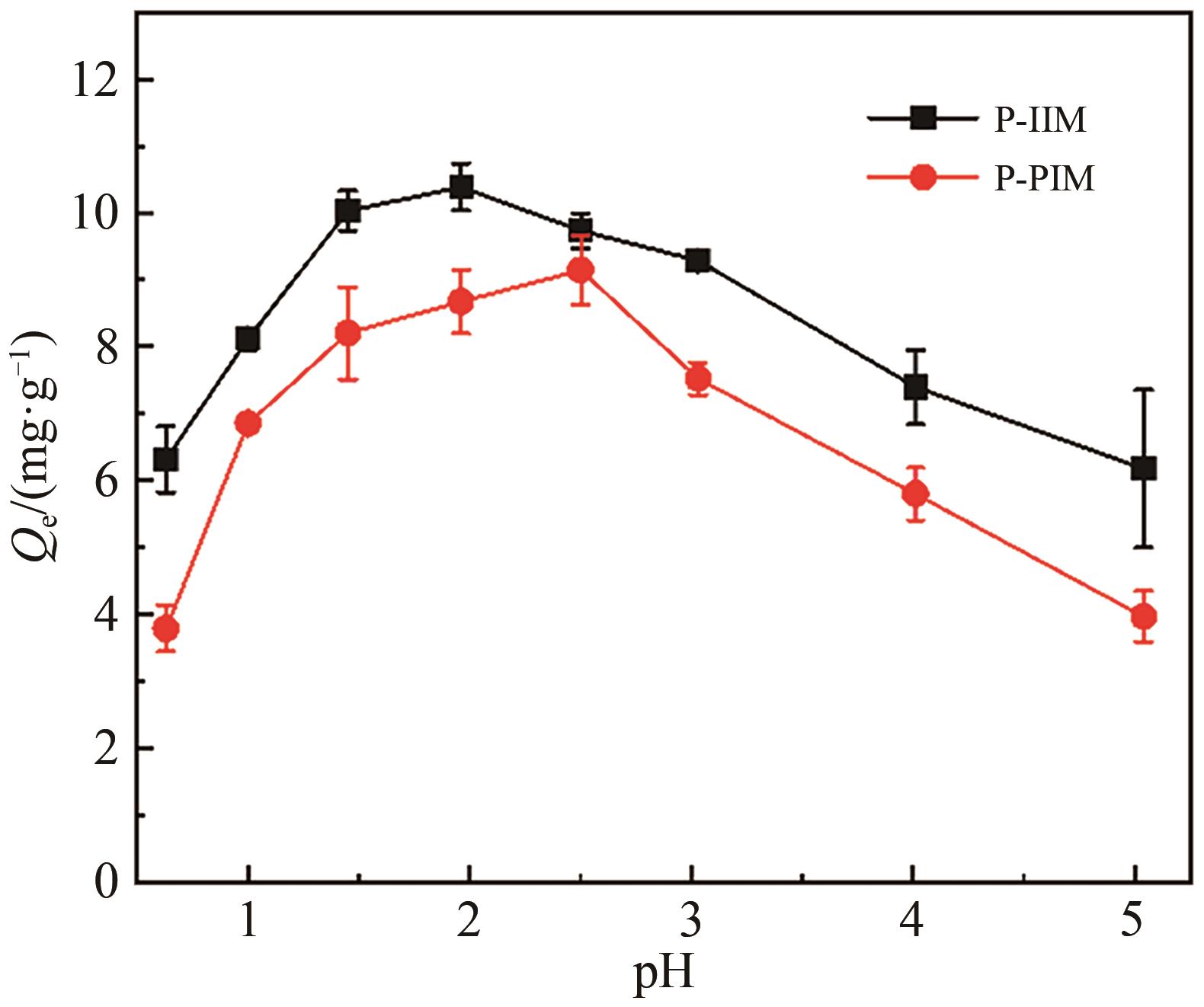
图6 溶液的初始pH值对P-PIM和P-IIM吸附Sc3+的影响ρ(Sc3+)=50 mg/L, V=10 mL, 25 ℃, m=20 mg
Fig.6 Effect of initial pH of the solution on the adsorption of Sc3+ by P-PIM and P-IIM
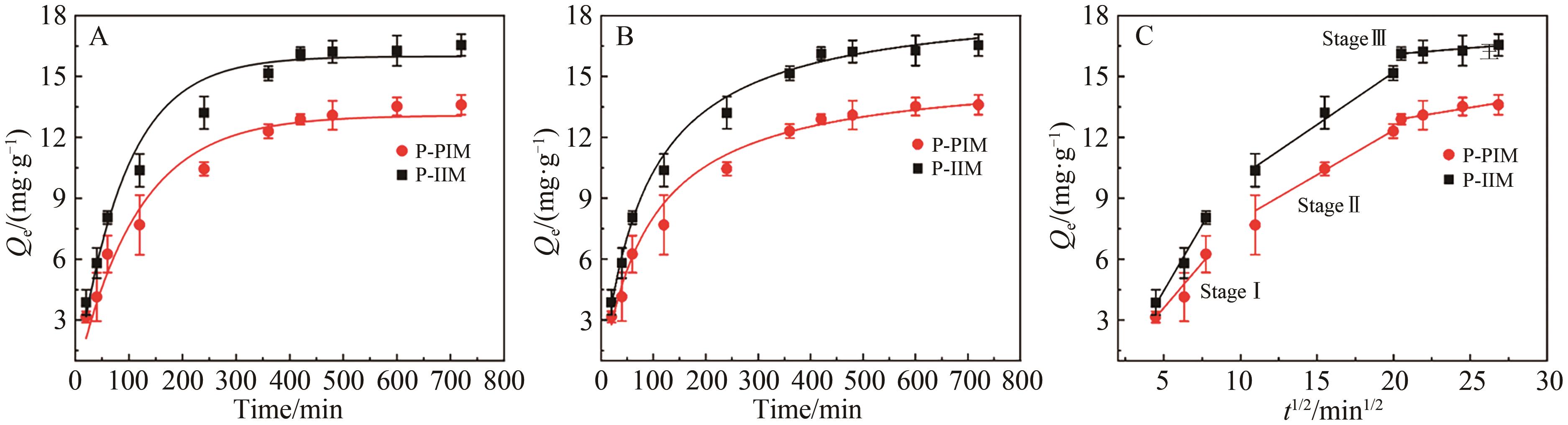
图7 吸附时间对Sc3+的吸附效果以及准一级动力学(A)、准二级动力学(B)和内扩散模型(C)拟合ρ(Sc3+)=200 mg/g, V=10 mL, 25 ℃, pH=2.0, m=32 mg, time:20~720 min
Fig.7 Effect of the adsorption time on the adsorption of Sc3+ and the fitting of quasi-first-order kinetics (A), quasi-second-order kinetics (B) and intraparticle diffusion model (C)
| Adsorbents | PFOM | PSOM | ||||
|---|---|---|---|---|---|---|
| Qe/(mg·g-1) | k1/min-1 | R2 | Qe/(mg·g-1) | k2/(g·mg-1·min-1) | R2 | |
| P-PIM | 13.08 | 0.008 7 | 0.966 3 | 15.37 | 0.000 71 | 0.993 2 |
| P-IIM | 15.99 | 0.011 0 | 0.979 9 | 18.83 | 0.000 64 | 0.990 3 |
表2 P-PIM和P-IIM对Sc3+离子吸附的动力学参数
Table 2 Kinetic parameters of Sc3+ adsorption by P-PIM and P-IIM
| Adsorbents | PFOM | PSOM | ||||
|---|---|---|---|---|---|---|
| Qe/(mg·g-1) | k1/min-1 | R2 | Qe/(mg·g-1) | k2/(g·mg-1·min-1) | R2 | |
| P-PIM | 13.08 | 0.008 7 | 0.966 3 | 15.37 | 0.000 71 | 0.993 2 |
| P-IIM | 15.99 | 0.011 0 | 0.979 9 | 18.83 | 0.000 64 | 0.990 3 |
| Adsorbents | Intraparticle diffusion model | ||||||
|---|---|---|---|---|---|---|---|
| kd1/(mg·g-1·min-1/2) | kd2/(mg·g-1·min-1/2) | kd3/(mg·g-1·min-1/2) | C/(mg·g-1) | ||||
| P-PIM | 0.885 2 | 0.438 4 | 0.124 5 | 10.35 | 0.937 2 | 0.972 5 | 0.937 4 |
| P-IIM | 1.297 3 | 0.514 4 | 0.006 2 | 14.84 | 0.985 4 | 0.985 6 | 0.928 4 |
表3 P-PIM和P-IIM对Sc3+吸附的内扩散模型参数
Table 3 Intraparticle diffusion model parameters for Sc3+ adsorption by P-PIM and P-IIM
| Adsorbents | Intraparticle diffusion model | ||||||
|---|---|---|---|---|---|---|---|
| kd1/(mg·g-1·min-1/2) | kd2/(mg·g-1·min-1/2) | kd3/(mg·g-1·min-1/2) | C/(mg·g-1) | ||||
| P-PIM | 0.885 2 | 0.438 4 | 0.124 5 | 10.35 | 0.937 2 | 0.972 5 | 0.937 4 |
| P-IIM | 1.297 3 | 0.514 4 | 0.006 2 | 14.84 | 0.985 4 | 0.985 6 | 0.928 4 |
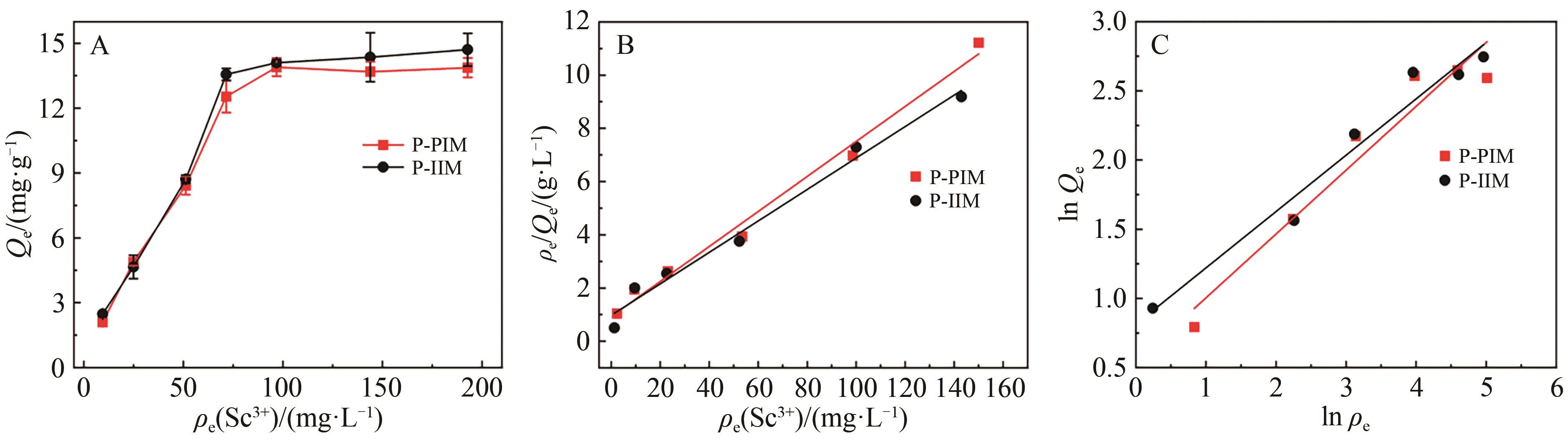
图8 初始Sc3+的浓度对P-IIM吸附的影响(A)、Langmuir等温模型(B)和Freundlich等温模型(C)拟合曲线ρ(Sc3+)=10~200 mg/L, V=10 mL, 23 ℃, pH=2.0, m=32 mg, time: 720 min
Fig.8 Influence of the initial Sc3+ concentration on P-IIM adsorption (A), fitting curves of the Langmuir isotherm model and (B), the Freundlich isotherm model (C)
| T/K | Adsorbents | Langmuir model | Freundlich model | ||||
|---|---|---|---|---|---|---|---|
| Qm/(mg·g-1) | KL/(L·mg-1) | R2 | KF/(L·mg-1) | 1/n | R2 | ||
| 301 | P-PIM | 15.21 | 0.089 6 | 0.986 0 | 1.721 | 0.461 3 | 0.922 7 |
| P-IIM | 16.92 | 0.060 5 | 0.980 1 | 2.257 | 0.407 1 | 0.954 2 | |
表4 P-PIM和P-IIM对Sc3+的吸附等温线参数
Table 4 Adsorption isotherm parameters of Sc3+ by P-PIM and P-IIM
| T/K | Adsorbents | Langmuir model | Freundlich model | ||||
|---|---|---|---|---|---|---|---|
| Qm/(mg·g-1) | KL/(L·mg-1) | R2 | KF/(L·mg-1) | 1/n | R2 | ||
| 301 | P-PIM | 15.21 | 0.089 6 | 0.986 0 | 1.721 | 0.461 3 | 0.922 7 |
| P-IIM | 16.92 | 0.060 5 | 0.980 1 | 2.257 | 0.407 1 | 0.954 2 | |
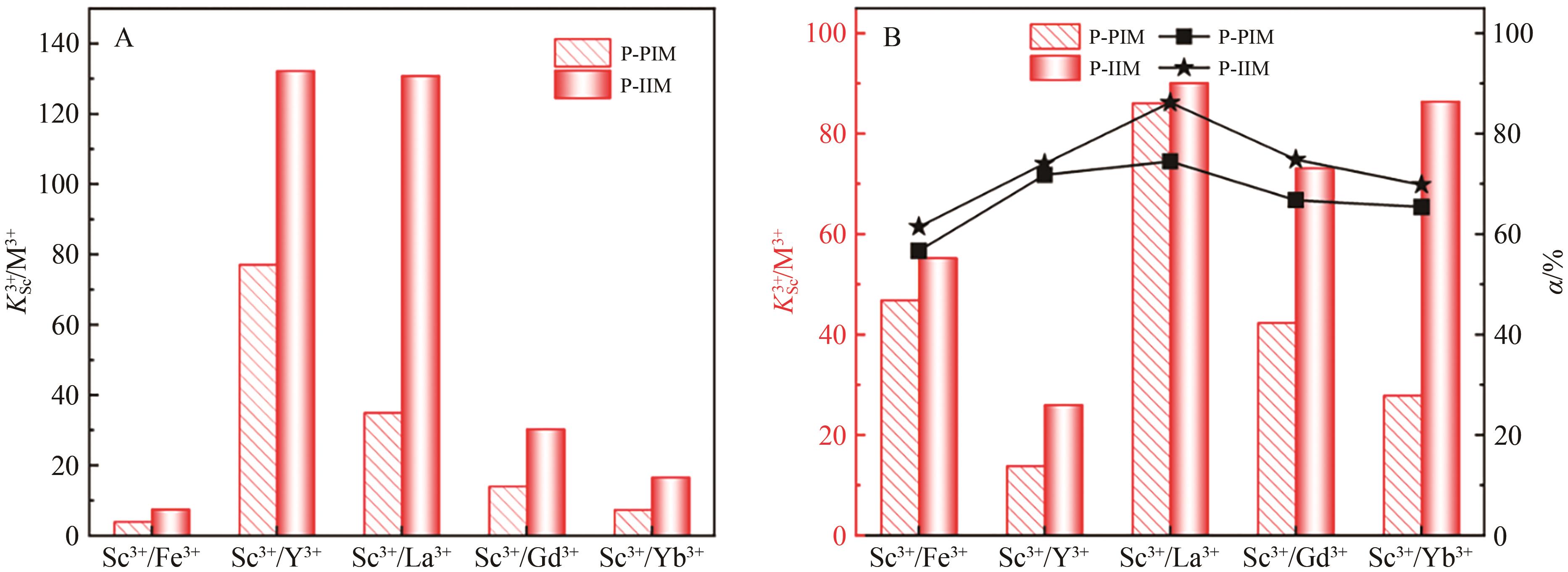
图9 共存离子与Sc3+质量浓度比1∶1(A)和1∶500(B)时对Sc3+的吸附影响A. ρ(Sc3+)=ρ(Fe3+)=ρ(M3+)=100 mg/L; B. ρ(Sc3+)=20 mg/L, ρ(Fe3+)=ρ(M3+)=10 g/L, V=10 mL, 25 ℃, pH=2.0, m=32 mg,M3+represents Fe3+, La3+, Gd3+, Y3+, Yb3+
Fig.9 Effect of coexisting ion on the adsorption of Sc3+ at a mass concentration ratio of 1∶1 (A) and 1∶500 (B)
| Adsorbents | Qe/(mg·g-1) | ρ(Sc3+)/ρ(coexisting ions) | Selectivity factor (KSc/M) of Sc3+ to coexisting ions | Ref. | |
|---|---|---|---|---|---|
| Fe3+ | La3+, Gd3+, Y3+, Yb3+ | ||||
| IIP-BT/CoFe2O4@SiO2 | 128.02 | 1∶1 | 1.740 | / | [ |
| 1∶2 | 1.632 | / | |||
| P40-750 | 20.77 | 1∶1 | 27.04 | Y3+: 208.25, Dy3+: 77.74 | [ |
| PLS MTS9580 | — | 1∶4 | 6.9 | — | [ |
| TRPO/SiO2-P | 13.3 | 1∶1 | >4 089 | Y3+>4 089, La3+>4 089, Ce3+>4 089 | [ |
| P-IIM | 16.54 | 1∶1 | 7.38 | La3+: 130.81, Gd3+: 30.27, Yb3+: 16.52, Y3+: 132.2 | This paper |
| 1∶500 | 55.2 | La3+: 90.1, Gd3+: 73.1 Yb3+: 86.4, Y3+: 26.0 | |||
表5 不同材料对Sc3+的吸附量和选择性
Table 5 Adsorption capacity and selectivity of Sc3+ by different materials
| Adsorbents | Qe/(mg·g-1) | ρ(Sc3+)/ρ(coexisting ions) | Selectivity factor (KSc/M) of Sc3+ to coexisting ions | Ref. | |
|---|---|---|---|---|---|
| Fe3+ | La3+, Gd3+, Y3+, Yb3+ | ||||
| IIP-BT/CoFe2O4@SiO2 | 128.02 | 1∶1 | 1.740 | / | [ |
| 1∶2 | 1.632 | / | |||
| P40-750 | 20.77 | 1∶1 | 27.04 | Y3+: 208.25, Dy3+: 77.74 | [ |
| PLS MTS9580 | — | 1∶4 | 6.9 | — | [ |
| TRPO/SiO2-P | 13.3 | 1∶1 | >4 089 | Y3+>4 089, La3+>4 089, Ce3+>4 089 | [ |
| P-IIM | 16.54 | 1∶1 | 7.38 | La3+: 130.81, Gd3+: 30.27, Yb3+: 16.52, Y3+: 132.2 | This paper |
| 1∶500 | 55.2 | La3+: 90.1, Gd3+: 73.1 Yb3+: 86.4, Y3+: 26.0 | |||
| Concentration of the solution | Components | |||||||
|---|---|---|---|---|---|---|---|---|
| La | Sc | Gd | Sc | Yb | Sc | Y | Sc | |
| ρbefore/(mg·L-1) | 329.7 | 2.98 | 409.6 | 4.22 | 404.0 | 3.24 | 317.0 | 3.55 |
| ρafter/(mg·L-1) | 328.0 | 0.053 | 412.0 | 0.072 | 396.4 | 0.063 | 315.6 | 0.04 |
| Removal rate/% | 0.52 | 98.22 | 0.59 | 98.29 | 1.88 | 98.87 | 0.44 | 98.06 |
表6 混合稀土溶液中金属离子的浓度和去除率
Table 6 Concentration and removal rate of metal ions from mixed rare earth solutions
| Concentration of the solution | Components | |||||||
|---|---|---|---|---|---|---|---|---|
| La | Sc | Gd | Sc | Yb | Sc | Y | Sc | |
| ρbefore/(mg·L-1) | 329.7 | 2.98 | 409.6 | 4.22 | 404.0 | 3.24 | 317.0 | 3.55 |
| ρafter/(mg·L-1) | 328.0 | 0.053 | 412.0 | 0.072 | 396.4 | 0.063 | 315.6 | 0.04 |
| Removal rate/% | 0.52 | 98.22 | 0.59 | 98.29 | 1.88 | 98.87 | 0.44 | 98.06 |
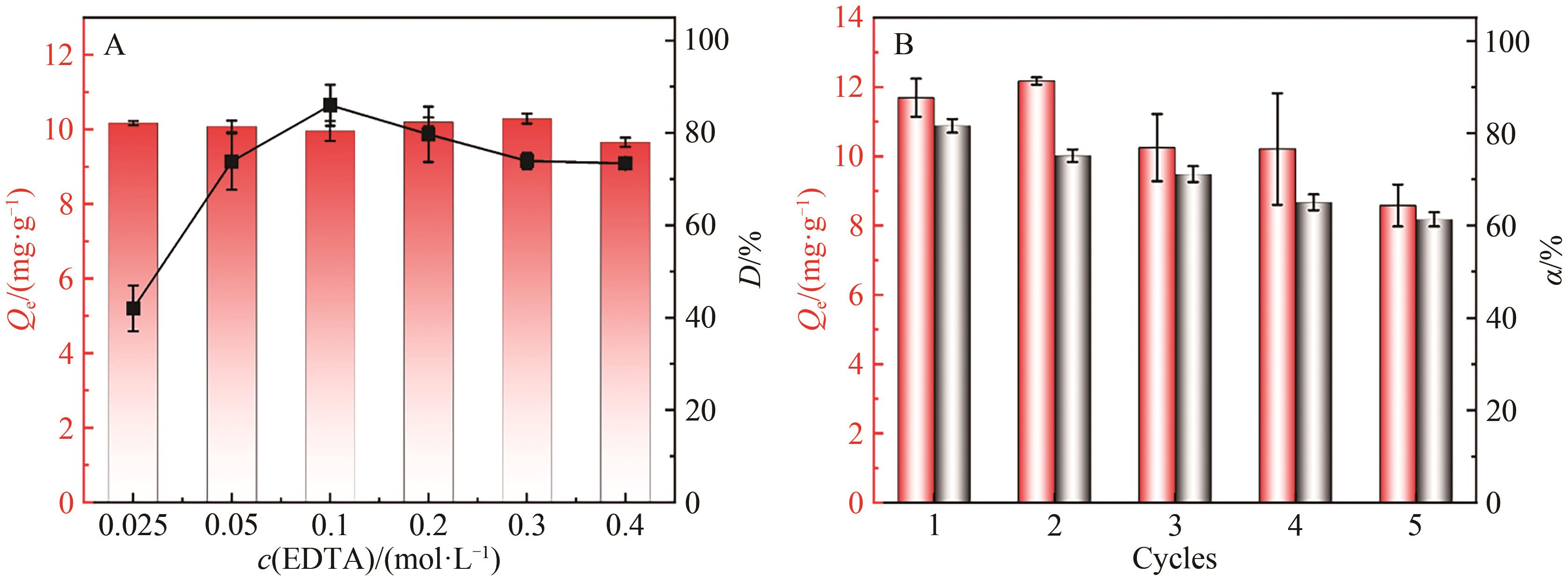
图10 不同浓度EDTA二钠盐解吸剂对Sc3+的解吸(A)和P-IIM对Sc3+的循环再生(B)ρ(Sc3+)=60 mg/L, m/V=1.0 g/L, t=24 h, 25 ℃
Fig.10 Desorption of Sc3+ by different concentrations of EDTA disodium salt (A) and the recycling and regeneration of Sc3+ by P-IIM (B)
| [1] | XUE H Y, LV G Z, ZHANG T A, et al. Review of rare earth extraction and product preparation technologies and new thinking for clean utilization[J]. Miner Eng, 2024, 215: 108796. |
| [2] | LIU J, YANG X L, CHEN H M, et al. Synthesis and application of ion-imprinted polymer particles for solid-phase extraction and determination of trace scandium by ICP-MS in different matrices[J]. Anal Methods, 2013, 5(7): 1811-1817. |
| [3] | 智文科, 王飞, 杨斌, 等. 钪的资源及提炼技术研究进展[J]. 中国稀土学报, 2022, 42(1): 13-29. |
| ZHI W K, WANG F, YANG B, et al. Progress of research on scandium resources and refining technology[J]. J Chin Soc Rare Earths, 2022, 42(1): 13-29. | |
| [4] | WANG W W, PRANOLO Y, CHENG C Y. Metallurgical processes for scandium recovery from various resources: a review[J]. Hydrometallurgy, 2011, 108(1): 100-108. |
| [5] | ALI D S, SAJA M, IGOR C, et al. Scandium recovery methods from mining, metallurgical extractive industries, and industrial wastes[J]. Materials, 2022, 15(7): 2376. |
| [6] | El OUARDI Y, GIOVE A, LANTIKAINEN M, et al. Benefit of ion imprinting technique in solid-phase extraction of heavy metals, special focus on the last decade[J]. J Environ Chem Eng, 2021, 9(6): 106548. |
| [7] | SMYSHLYAEV D, KIRILLOV E, ALINA M A, et al. Recovery and separation of Sc, Zr and Ti from acidic sulfate solutions for high purity scandium oxide production: laboratory and pilot study[J]. Hydrometallurgy, 2022, 211: 105889. |
| [8] | SALMAN A D, JUZSAKOVA T, ABDULLAH T A, et al. Synthesis and surface modification of magnetic Fe3O4@SiO2 core-shell nanoparticles and its application in uptake of scandium(Ⅲ) ions from aqueous media[J]. Environ Sci Pollut Res, 2021, 28(22): 28428-28443. |
| [9] | LE W H, KUANG S T, LIAO W P, et al. Selective extraction and recovery of scandium from sulfate medium by Cextrant 230[J]. Hydrometallurgy, 2018, 178: 54-59. |
| [10] | QIU H B, WANG M L, XIE Y M, et al. From trace to pure: recovery of scandium from the waste acid of titanium pigment production by solvent extraction[J]. Process Saf Environ Prot, 2019, 121: 118-124. |
| [11] | PASECHNIK L A, SKACHKOV V M, YATSENKO S P, et al. High purity scandium extraction from red mud by novel simple technology[J]. Hydrometallurgy, 2021, 202: 105597. |
| [12] | DAMINESCU D, DUTEAUN N, CIOPEC M, et al. Adsorption of Scandium ion by amberlite XADTHP polymeric adsorbent loaded with tri-n-octylphosphine oxide[J]. Molecules, 2024, 29(7): 1578. |
| [13] | JANCZURA M, LULINSKI P, SOBIECH M. Imprinting technology for effective sorbent fabrication: current state-of-art and future prospects[J]. Materials, 2021, 14(8): 1850. |
| [14] | SALA A, BRISSET H, MARGAILLAN A, et al. Electrochemical sensors modified with ion-imprinted polymers for metal ion detection[J]. TrAC, 2022, 148: 116536. |
| [15] | WANG C Z, ZHANG L Y, ZHOU G Z, et al. Synthesis of environmental-friendly ion-imprinted magnetic nanocomposite bentonite for selective recovery of aqueous Sc(Ⅲ)[J]. J Colloid Interface Sci, 2023, 630: 738-750. |
| [16] | ZHANG W Q, YANG X Y, HUANG Y. Covalent organic framework for highly efficient extraction of rare earth ions[J]. Matter, 2023, 6(9): 2630-2631. |
| [17] | ZHAO S F, SAMADI A R, WANG Z, et al. Ionic liquid-based polymer inclusion membranes for metal ions extraction and recovery: fundamentals, considerations, and prospects[J]. Chem Eng J, 2024, 481: 481792. |
| [18] | YOSHIDA W, KUBOTA F, BABA Y, et al. Separation and recovery of scandium from sulfate media by solvent extraction and polymer inclusion membranes with amic acid extractants[J]. ACS Omega, 2019, 4(25): 21122-21130. |
| [19] | WEI H Q, LI Y L, KUANG S T, et al. Separation of trivalent rare earths from chloride medium using solvent extraction with heptylaminomethyl phosphonic acid 2-ethylhexyl ester (HEHHAP)[J]. Hydrometallurgy, 2019, 188: 14-21. |
| [20] | ZHAO Q, ZHANG Z F, LIAO W P, et al. Solvent extraction and separation of rare earths from chloride media using α-aminophosphonic acid extractant HEHAMP[J]. Solvent Extr Ion Exch, 2018, 36(2): 136-149. |
| [21] | 苏杰. Cextrant 230及其衍生物对稀土、铁和钍的萃取[D]. 南昌: 南昌大学, 2023. |
| SU J. Extraction of rare earths, iron and thorium by Cextrant 230 and its derivatives[D]. Nanchang: Nanchang University, 2023. | |
| [22] | PANDA P K, PART K, SEO J. Development of poly(vinyl alcohol)/regenerated chitosan blend film with superior barrier, antioxidant, and antibacterial properties[J]. Prog Org Coat, 2023, 183: 107749. |
| [23] | YAO A R, YAN Y Q, HUANG S J, et al. Improvement of filtration and antifouling performance of cellulose acetate membrane reinforced by dopamine modified cellulose nanocrystals[J]. J Membr Sci, 2021, 637: 119621. |
| [24] | MA Y, LI L B, YANG P X, et al. Ionic conductivity enhancement in gel polymer electrolyte membrane with N-methyl-N-butyl-piperidine-bis(trifluoromethylsulfonyl) imide ionic liquid for lithium ion battery[J]. Colloids Surf A, 2016, 502: 130-138. |
| [25] | 文雯, 施亦东, 谭淋, 等. 醋酸纤维素纤维的醇解改性及性能研究[J]. 塑料工业, 2021, 49(10): 47-51, 105. |
| WEN W, SHI Y D, TAN L, et al. Study on the alcoholysis modification of cellulose acetate fiber and their properties[J]. Plast Ind, 2021, 49(10): 47-51, 105. | |
| [26] | CHEN L, DONG H, PAN W G, et al. Poly(vinyl alcohol-co-ethylene) (EVOH) modified polymer inclusion membrane in heavy rare earths separation with advanced hydrophilicity and separation property[J]. Chem Eng J, 2021, 426: 131305. |
| [27] | YU P P, ZHOU G Z, YANG R C, et al. Green synthesis of ion-imprinted macroporous composite magnetic hydrogels for selective removal of nickel(Ⅱ) from wastewater[J]. J Mol Liq, 2021, 344: 117963. |
| [28] | XU X C, LI Y, ZHENG X D, et al. A facile strategy toward ion-imprinted hierarchical mesoporous material via dual-template method for simultaneous selective extraction of lithium and rubidium[J]. J Cleaner Prod, 2018, 171: 264-274. |
| [29] | ZHOU G Z, WU S, YANG R C, et al. Synthesis of ion imprinted magnetic nanocomposites and application for novel selective recycling of Ni(Ⅱ)[J]. J Cleaner Prod, 2021, 314: 127999. |
| [30] | CHEN L, DONG H, PAN J M, et al. Role of natural deep eutectic solvents (NADESs) in coagulation bath for PVDF-based membranes on enhanced permeation and separation of rare earth ions[J]. J Membr Sci, 2023, 683: 127999. |
| [31] | 程玉雯. 镧、镱离子表面印迹聚合物的制备及其性能研究[D]. 南昌: 南昌大学, 2018. |
| CHENG Y W. Preparation of surface-imprinted polymers of lanthanum and ytterbium ions and study of their properties[D]. Nanchang: Nanchang University, 2018. | |
| [32] | DAI X, GUO Y X, FUJITA T, et al. Selective adsorption and recovery of scandium from red mud leachate by using phosphoric acid pre-treated pitaya peel biochar[J].Sep Purif Technol, 2022, 292: 121043. |
| [33] | NAPPOL'SKIKH J, SHOPPERT A, VALEEDV D, et al. Selective recovery of scandium (Sc) from sulfate solution of bauxite residue leaching using puromet MTS9580 ion-exchange sorption[J]. Metals, 2024, 14(2): 234. |
| [34] | YU Q, NING S Y, WEI Y Z, et al. Recovery of scandium from sulfuric acid solution with a macro porous TRPO/SiO2-P adsorbent[J]. Hydrometallurgy, 2018, 181: 74-81. |
| [1] | 张馨煜, 黄剑辉, 黄磊, 张大铭, 徐斐, 吴秀秀. 基于分子互作设计的MOF-525复合海绵用于水中新烟碱类农药吸附性去除[J]. 应用化学, 2025, 42(8): 1144-1154. |
| [2] | 王珍珠, 何争光, 和兵, 梁柯, 白亦薇, 贾宇鑫. 颗粒型钛基锂离子筛的制备及锂吸附性能[J]. 应用化学, 2025, 42(4): 552-564. |
| [3] | 杨剑峰, 李艳玲, 韩经露, 李松松, 廖伍平. (2-乙基己基胺基)甲基膦酸单-2-乙基己基酯浸渍树脂对钪的选择性吸附及应用[J]. 应用化学, 2025, 42(1): 95-106. |
| [4] | 刘汉邦, 郝文月, 郭俊辉, 刘昶, 王凤来, 彭绍忠. 高硅LTA型分子筛的合成及应用研究进展[J]. 应用化学, 2024, 41(9): 1248-1258. |
| [5] | 刘炳芹, 王艳华. 温控相转移催化新体系中α,β-不饱和酮的常压加氢反应[J]. 应用化学, 2024, 41(9): 1350-1356. |
| [6] | 王兴刚, 秦静雯, 郑晓明, 颉林, 李薇. 改性火山石对水中氨氮的去除效果分析[J]. 应用化学, 2024, 41(8): 1193-1201. |
| [7] | 任艳娇, 徐荣声, 王萍, 孙冬, 耿万东, 张海永. 乙二酸四乙酸二钠盐改性枸杞杆生物炭对亚甲基蓝吸附性能[J]. 应用化学, 2024, 41(7): 1035-1046. |
| [8] | 张建锋, 吴辉勇, 杨良嵘. 盐湖卤水萃取法提锂的研究进展[J]. 应用化学, 2024, 41(6): 800-812. |
| [9] | 张守村, 闫雪垠, 宋阳华, 李卓敏. CO2刺激响应球型水凝胶的制备及在蛋白质分离中的应用[J]. 应用化学, 2024, 41(6): 870-877. |
| [10] | 张涛, 李思莹, 李俊乐, 邵思羽, 吴传栋, 凌梅, 吕东伟, 王威. 颗粒状碳酸氧镧去除水体中氟的性能[J]. 应用化学, 2024, 41(2): 297-307. |
| [11] | 梁兴毅, 李亚, 荀京天, 张巍巍, 金长子, 王锐, 仇丹, 何宇鹏. 再生纤维素微球的制备及其吸附亚甲基蓝和叶酸负载[J]. 应用化学, 2024, 41(10): 1445-1456. |
| [12] | 徐一, 林梦瑶, 宫晓群. 多色比色法在生物传感平台的研究进展[J]. 应用化学, 2024, 41(1): 3-20. |
| [13] | 邢思阳, 于飞, 马杰. 电容去离子过渡金属基电极设计及应用研究进展[J]. 应用化学, 2023, 40(9): 1215-1232. |
| [14] | 臧志飞, 梁杰, 习本军, 彭春雪, 刘渊, 王晨晔, 王朵. 草甘膦废液处理及资源化利用研究进展[J]. 应用化学, 2023, 40(9): 1233-1244. |
| [15] | 王梦瑶, 高美珍, 石琪, 董晋湘. 基于甲苯模板合成的ZIF-93及其对1,3-丙二醇和2,3-丁二醇的吸附分离性能[J]. 应用化学, 2023, 40(9): 1302-1311. |
| 阅读次数 | ||||||
|
全文 |
|
|||||
|
摘要 |
|
|||||
