
应用化学 ›› 2026, Vol. 43 ›› Issue (2): 157-166.DOI: 10.19894/j.issn.1000-0518.250385
• 综合评述 •
李润泽1,2,3, 程丽任1,2( ), 车朝杰1,2, 李新林3, TAMILA Viachaslau4, 张洪杰1,2,5
收稿日期:2025-10-09
接受日期:2025-12-12
出版日期:2026-02-01
发布日期:2026-03-06
通讯作者:
程丽任
基金资助:
Run-Ze LI1,2,3, Li-Ren CHENG1,2(), Chao-Jie CHE1,2, Xin-Lin LI3, VIACHASLAU-A TAMILA4, Hong-Jie ZHANG1,2,5
Received:2025-10-09
Accepted:2025-12-12
Published:2026-02-01
Online:2026-03-06
Contact:
Li-Ren CHENG
About author:lrcheng@ciac.ac.cnSupported by:摘要:
挤压成型是镁合金重要的塑性加工方式,但常规镁合金挤压加工速度远低于铝合金,导致生产效率低、成本高,限制了镁合金挤压型材的大规模应用。 高速挤压技术通过高应变速率引发的绝热温升、动态再结晶(DRX)细化和过饱和固溶等效应,为提高镁合金挤压速度提供可能性。 此外,镁合金的成分对其可挤压性影响较大,只有部分镁合金体系适合高速挤压成型。 本文系统综述了应变速率、温度及合金成分对高速挤压镁合金微观组织与力学性能的协同调控机制,总结了当前的研究进展,并展望了未来发展方向,以推动该技术在工业中的大规模应用。
中图分类号:
李润泽, 程丽任, 车朝杰, 李新林, TAMILA Viachaslau, 张洪杰. 应变速率、温度及成分协同调控高速挤压镁合金的研究进展[J]. 应用化学, 2026, 43(2): 157-166.
Run-Ze LI, Li-Ren CHENG, Chao-Jie CHE, Xin-Lin LI, VIACHASLAU-A TAMILA, Hong-Jie ZHANG. Research Progress on Synergistic Regulation of Strain Rate, Temperature, and Composition in High-Speed Extruded Magnesium Alloys[J]. Chinese Journal of Applied Chemistry, 2026, 43(2): 157-166.
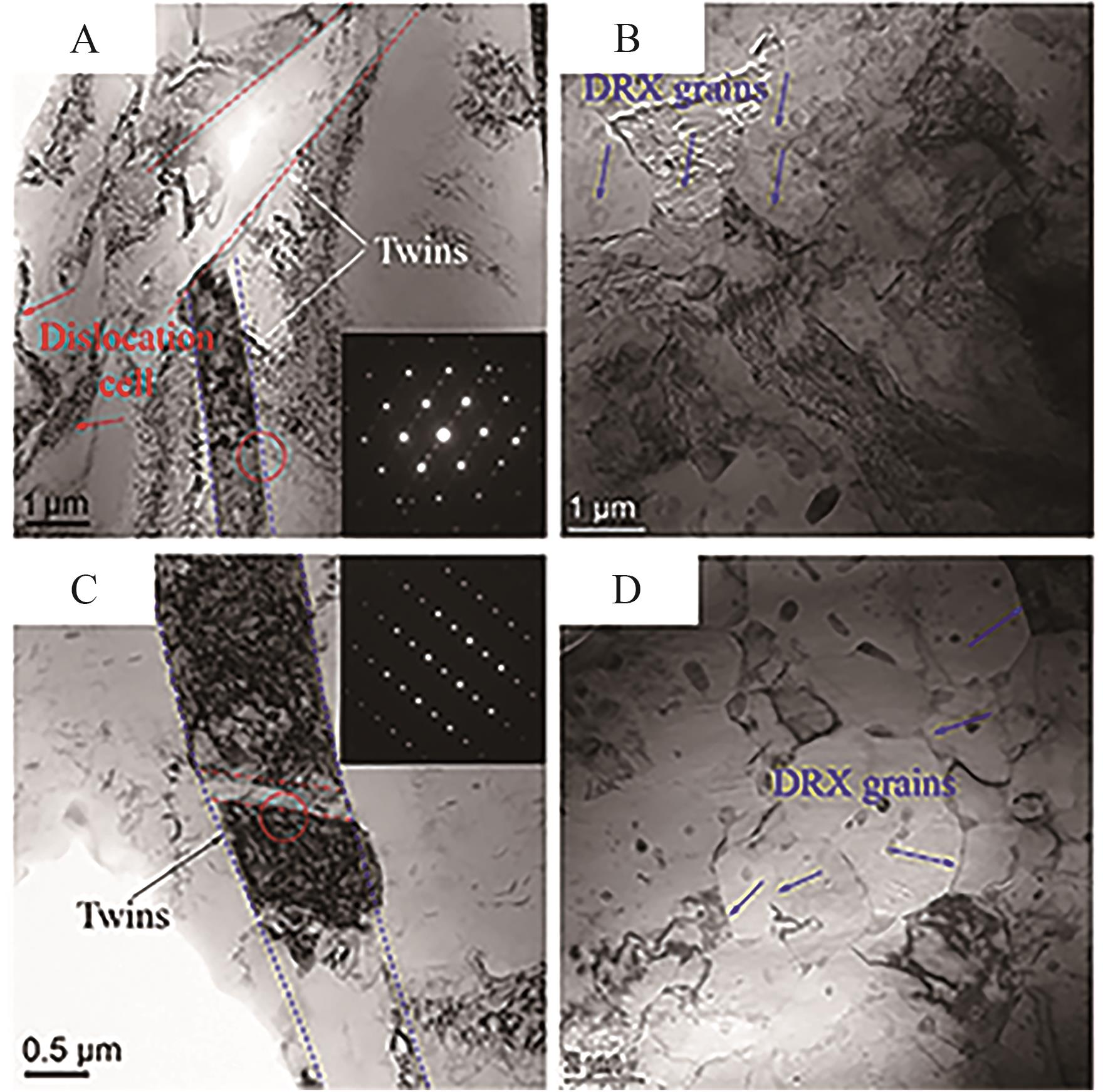
图1 WE43合金在应变速率2100 s-1和25 ℃的条件下,应变为0.325时的透射电子显微镜(TEM)图: (A、B)挤压方向; (C、D)垂直挤压方向[14]
Fig.1 TEM images of the studied WE43 alloy with a strain of 0.325 deformed at 2100 s-1 and 25 ℃: (A, B) Extrusion direction; (C, D) Extrusion radial direction[14]
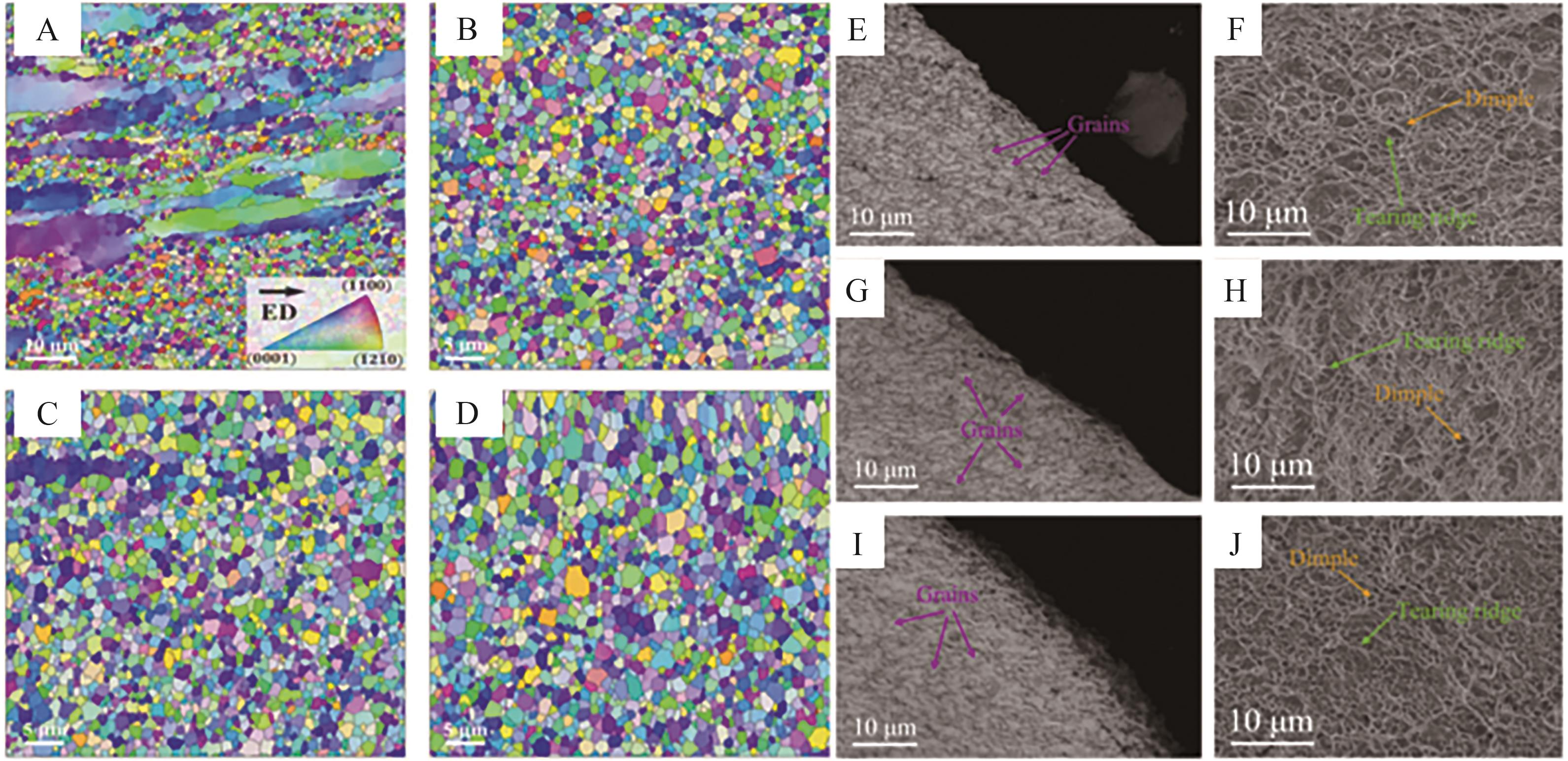
图2 (A-D)快速凝固(RS)ZK60镁合金的电子背散射衍射(EBSD)图谱; RS ZK60挤压态镁合金断口形貌的(E、G、I)光学显微镜(OM)图和(F、H、J) SEM图[19]Extrusion speed/(mm·min-1): A. without extrusion; B, E, F. 10; C, G, H. 20; D, I, J. 30
Fig.2 The EBSD maps(A-D) of RS ZK60 magnesium alloy at different conditions. The OM (E, G, I) and SEM (F, H, J) fractures topography of RS ZK60 asextruded magnesium alloys[19]
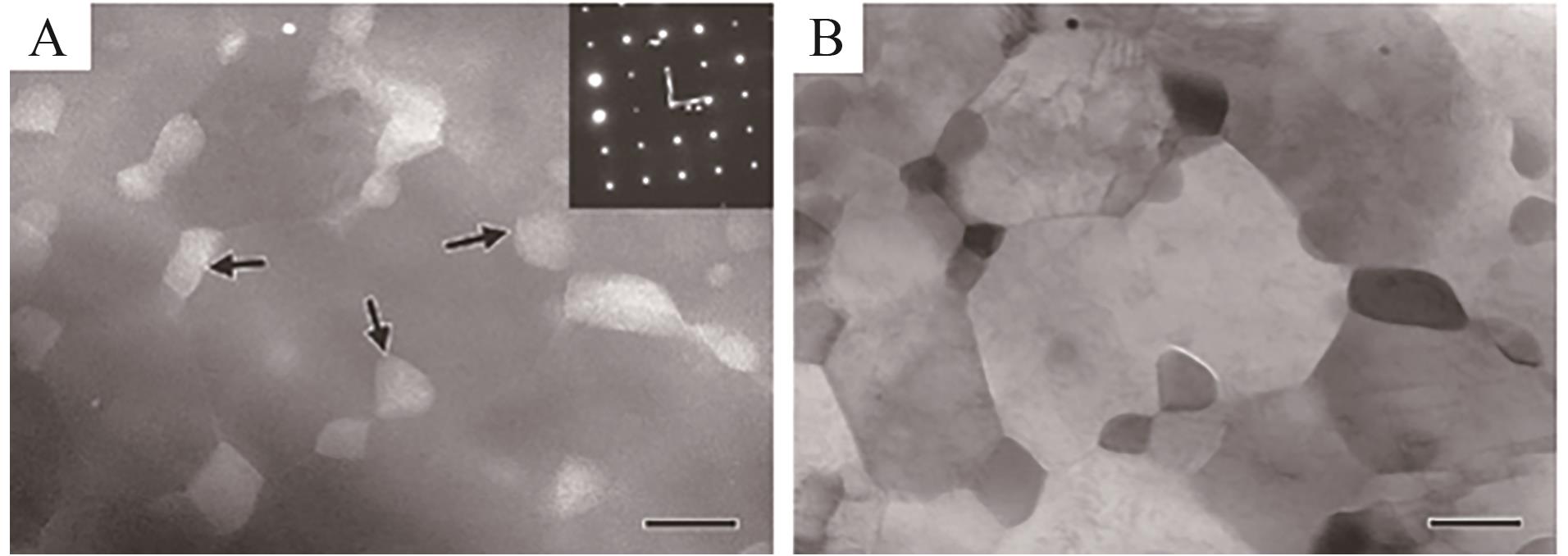
图3 经LTSS挤压的AZ80镁合金TEM图; (A)暗场像, (B)明场像(图A插图: Mg17Al12的[001]晶带轴衍射图谱)[25]
Fig.3 TEM micrographs of LTSS-extruded AZ80: (A) dark field, (B) bright field (inset in (A): Diffraction pattern of [001] Mg17Al12)[25]
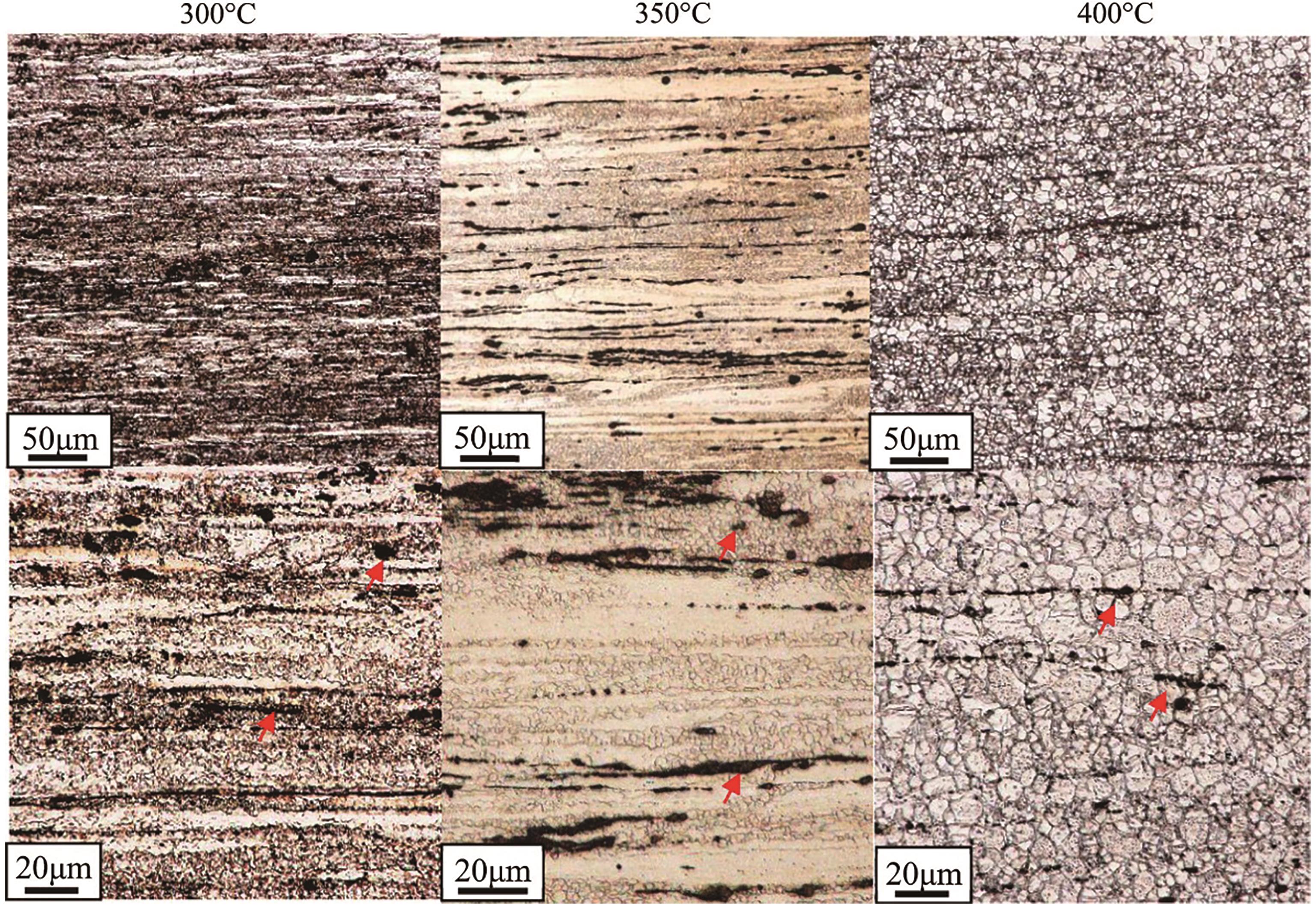
图4 不同温度下挤压合金的光学图像[20]
Fig.4 Optical images of the extruded alloys at different temperatures[20]
| Element | Mechanism of action | Examples of effects |
|---|---|---|
| Sn | Reduce SFE, promote twins, and inhibit precipitation and coarsening | DRX score improvement and grain refinement |
| Ca | Grain boundary segregation inhibits grain boundary migratio | Ultrafine crystals+nano-precipitation, YS>300 MPa |
| Bi | Regulating the precipitation size of Mg?Bi?, affects DRX | Fine precipitated phases inhibit DRX, while coarse precipitated phases promote it |
| Zn/Mn | Promote precipitation and activate non-fundamental plane slip | The synergy of strength and plasticity is enhanced |
| RE | Weaken texture, reduce CRSS, and inhibit high-temperature roughening | High-temperature strength remains, while anisotropy decreases |
表1 高速挤压中添加合金元素的作用
Table 1 Function of adding alloying elements in high-speed extrusion
| Element | Mechanism of action | Examples of effects |
|---|---|---|
| Sn | Reduce SFE, promote twins, and inhibit precipitation and coarsening | DRX score improvement and grain refinement |
| Ca | Grain boundary segregation inhibits grain boundary migratio | Ultrafine crystals+nano-precipitation, YS>300 MPa |
| Bi | Regulating the precipitation size of Mg?Bi?, affects DRX | Fine precipitated phases inhibit DRX, while coarse precipitated phases promote it |
| Zn/Mn | Promote precipitation and activate non-fundamental plane slip | The synergy of strength and plasticity is enhanced |
| RE | Weaken texture, reduce CRSS, and inhibit high-temperature roughening | High-temperature strength remains, while anisotropy decreases |
| [1] | HU J. Effect of normal load on the tribo-corrosion behavior of AZ31B magnesium alloy[J]. J Mater Engperform, 2025, 34(24): 1-10. |
| [2] | TOKUNAGA T, SOTOMOTO K, OHNO M, et al. Development of high corrosion- and wear-resistant Al-Si alloy coating on AZ80 Mg alloy by hot extrusion[J]. J Mater Eng Perform, 2020, 29(10): 6355-6362. |
| [3] | WANG D, ZHANG T A, XU J Z, et al. Current status and progress of research on vacuum method of refining magnesium[J]. J Magnesium Alloys, 2025, 13(6): 2470-2499. |
| [4] | SONG G, DIAO Z, LV X, et al. TIG and laser-TIG hybrid filler wire welding of casting and wrought dissimilar magnesium alloy[J]. J Manuf Processes, 2018, 34: 204-214. |
| [5] | 彭倩群, 毛育青, 王金锴, 等. AZ31B镁合金搅拌摩擦多道焊接头组织和性能研究[J]. 焊管, 2025, 48(5): 36-44. |
| PENG Q Q, MAO Y Q, WANG J K, et al. Study on microstructure and properties of friction stir multi-pass welded joints of AZ31B magnesium alloy[J]. Welded Pipe, 2025, 48(5): 36-44. | |
| [6] | 刘义鹤, 江洪. 镁合金在轨道交通装备中的应用和展望[J]. 新材料产业, 2018(10): 20-22. |
| LIU Y H, JIANG H. Application and prospect of magnesium alloys in rail transit equipment[J]. New Mater Ind, 2018(10): 20-22. | |
| [7] | HAN P, CAI J, QIAO K, et al. High strain rate superplasticity in ultrafine-grained Ti-4.5Al-3V-2Mo-2Fe alloy[J]. J Mater Res Technol, 2025, 36: 9257-9261. |
| [8] | JI C, ZHU L, YIN B, et al. Temperature-dependent mechanical behaviors of laser powder bed fused WE43 alloy with heterogeneous grain structure: deformation and fracture mechanisms[J]. J Alloys Compd, 2025, 1033: 181288. |
| [9] | 鲍键, 李全安, 陈晓亚, 等. 挤压镁合金的研究进展[J]. 材料导报, 2022, 36(10): 112-123. |
| BAO J, LI Q A, CHEN X Y, et al. Research progress on extruded magnesium alloys[J]. Mater Rev, 2022, 36(10): 112-123. | |
| [10] | LI X W, WANG K K, FU J L, et al. Numerical simulation of thixo-co-extrusion of 7075/AZ91D double-layer tubes[J]. Solid State Phenom, 2016, 256: 119-125. |
| [11] | QIU X, WEI K, JIANG W, et al. Microstructural refinement and corrosion resistance of low-alloyed Mg-Al-Mn-Ca thin sheets via optimized high-speed extrusion parameters[J]. J Alloys Compd, 2025, 1026: 180496. |
| [12] | XU S, WEI J, ZANG X, et al. Hot deformation flow behavior of the Cu-9Ni-6Sn alloy based on the analysis of physical modeling and microstructures characterization[J]. J Alloys Compd, 2025, 1026: 180405. |
| [13] | WANG Z, CAO G, WANG F, et al. Investigation of the microstructure and properties of extrusion-shear deformed ZC61 magnesium alloy under high strain rate deformation[J]. Mater Charact, 2021, 172: 110839. |
| [14] | GUO P, YE T, WU Y, et al. Unveiling mechanical response and deformation mechanism of extruded WE43 magnesium alloy under high-speed impact[J]. J Rare Earths, 2024, 42(12): 2303-2315. |
| [15] | WANG C, LUO T, YANG Y. Low cycle fatigue behavior of the extruded AZ80 magnesium alloy under different strain amplitudes and strain rates[J]. J Magnes Alloys, 2016, 4(3): 181-187. |
| [16] | YU J, SONG B, XIA D, et al. Dynamic tensile properties and microstructural evolution of extruded EW75 magnesium alloy at high strain rates[J]. J Magnes Alloys, 2020, 8(3): 849-859. |
| [17] | CHAI F, MA Z, HAN X, et al. Effect of strain rates on mechanical behavior, microstructure evolution and failure mechanism of extruded-annealed AZ91 magnesium alloy under room-temperature tension[J]. J Mater Res Technol, 2023, 27: 4644-4656. |
| [18] | MAO P, LIU Z, WANG C. Texture effect on high strain rates tension and compression deformation behavior of extruded AM30 alloy[J]. Mater Sci Eng A, 2012, 539: 13-21. |
| [19] | YANG C, LI Z, BAO S, et al. High-strength and high-plasticity ZK60 magnesium alloy prepared by rapid solidification and high-speed extrusion[J]. Mater Today Commun, 2024, 41: 110570. |
| [20] | HU K, LI C, XU G, et al. Effect of extrusion temperature on the microstructure and mechanical properties of low Zn containing wrought Mg alloy micro-alloying with Mn and La-rich misch metal[J]. Mater Sci Eng A, 2019, 742: 692-703. |
| [21] | 宋广胜, 姜敬前, 陈帅峰, 等. 非对称轧制AZ31镁合金板材组织与性能[J]. 稀有金属材料与工程, 2017, 46(11): 3512-3517. |
| SONG G S, JIANG J Q, CHEN S F, et al. Study on microstructure and properties of asymmetrically rolled AZ31 magnesium alloy sheets[J]. Rare Met Mater Eng, 2017, 46(11): 3512-3517. | |
| [22] | 曾崎, 王少阳, 荣鹏, 等. 高塑性纳米准晶Mg-1.92Zn-0.34Y合金的热变形行为[J]. 稀有金属材料与工程, 2025, 54(1): 184-190. |
| ZENG Q, WANG S Y, RONG P, et al. Hot deformation behavior of high-plasticity nanoquasicrystal Mg-1.92Zn-0.34Y alloy[J]. Rare Met Mater Eng, 2025, 54(1): 184-190. | |
| [23] | 潘虎成, 蒋彩霞, 张元, 等. 低温挤压Mg-Sm-Ce系合金的微观组织与力学性能研究[J]. 航空制造技术, 2024, 67(8): 14-21. |
| PAN H C, JIANG C X, ZHANG Y, et al. Study on microstructure and mechanical properties of low-temperature extruded Mg-Sm-Ce series alloy[J]. Aeronaut Manuf Technol, 2024, 67(8): 14-21. | |
| [24] | 康健伟, 刘国磊, 王利飞, 等. 挤压态Mg-0.5Bi-0.5Sn-0.5Ag合金的热变形行为、组织和织构演变[J]. 中国有色金属学报, 2024, 34(2): 388-399. |
| KANG J W, LIU G L, WANG L F, et al. Hot deformation behavior, microstructure and texture evolution of as-extruded Mg-0.5Bi-0.5Sn-0.5Ag alloy[J]. Chin J Nonferrous Met, 2024, 34(2): 388-399. | |
| [25] | YU H, PARK S H, YOU B S. Development of extraordinary high-strength Mg-8Al-0.5Zn alloy via a low temperature and slow speed extrusion[J]. Mater Sci Eng A, 2014, 610: 445-449. |
| [26] | NIU Y, SONG Z, LE Q, et al. Excellent mechanical properties obtained by low temperature extrusion based on Mg-2Zn-1Al alloy[J]. J Alloys Compd, 2019, 801: 415-427. |
| [27] | LI R G, LI H R, ZHAO D Y, et al. High strength commercial AZ91D alloy with a uniformly fine-grained structure processed by conventional extrusion[J]. Mater Sci Eng A, 2020, 780: 139193. |
| [28] | KANG X K, NIE K B, DENG K K, et al. Effect of extrusion parameters on microstructure, texture and mechanical properties of Mg-1.38Zn-0.17Y-0.12Ca (at. %) alloy[J]. Mater Charact, 2019, 151: 137-145. |
| [29] | CÉSAR P, JOSÉ V, DAVID H, et al. Superplasticity at intermediate temperatures of ZK60 magnesium alloy processed by indirect extrusion[J]. Metals, 2021, 11(4): 606. |
| [30] | 李艳辉, 李保成, 尹从娟. 挤压比和挤压温度对AZ31镁合金组织性能的影响[J]. 金属世界, 2008(3): 10-12, 22. |
| LI Y H, LI B C, YIN C J. Influence of extrusion ratio and extrusion temperature on microstructure and properties of AZ31 magnesium alloy[J]. Met World, 2008(3): 10-12, 22. | |
| [31] | LV B J, WANG S, CUI N, et al. Twinning and dynamic recrystallization of Mg-7Sn-3Zn alloy under high strain rate hot compression[J]. Mater Sci Eng A, 2021, 809: 140986. |
| [32] | 李旭东, 杜文博, 王彤, 等. 挤压温度对Mg-Gd-Er-Zn-Mn合金力学及导热性能的影响[J]. 中国有色金属学报, 2025, 35(4): 1101-1110. |
| LI X D, DU W B, WANG T, et al. Influence of extrusion temperature on mechanical and thermal conductivity properties of Mg-Gd-Er-Zn-Mn alloy[J]. Chin J Nonferrous Met, 2025, 35(4): 1101-1110. | |
| [33] | 宁俊生, 范亚夫, 彭秀峰. 镁合金在大变形和高应变率下塑性变形研究进展[J]. 材料工程, 2007(9): 67-73, 80. |
| NING J S, FAN Y F, PENG X F. Research progress on plastic deformation of magnesium alloys under large deformation and high strain rate[J]. J Mater Eng, 2007(9): 67-73, 80. | |
| [34] | MA L, MA L, CHEN M, et al. Effect of extrusion temperature on the microstructure and mechanical properties of hot-extruded ZK60 magnesium alloy[J]. Mater Res Express, 2023, 10(12): 126508. |
| [35] | XIANG C, XU Y, YANG Y, et al. Plastic deformation mechanisms and constitutive modeling of WE43 magnesium alloy at various strain rates and temperatures[J]. J Mater Res Technol, 2024, 29: 4110-4128. |
| [36] | YU J C, LIU Z, DONG Y, et al. Dynamic compressive property and failure behavior of extruded Mg-Gd-Y alloy under high temperatures and high strain rates[J]. J Magnes Alloys, 2015, 3(2): 134-141. |
| [37] | 陈燕飞, 朱政强, 汪光鑫. 基于第一性原理研究稀土Ce对镁合金的强化机制[J]. 稀有金属材料与工程, 2022, 51(10): 3762-3776. |
| CHEN Y F, ZHU Z Q, WANG G X. Study on the strengthening mechanism of rare earth Ce on magnesium alloys based on first-principles[J]. Rare Met Mater Eng, 2022, 51(10): 3762-3776. | |
| [38] | JIANG M G, XU C, YAN H, et al. Correlation between dynamic recrystallization and formation of rare earth texture in a Mg-Zn-Gd magnesium alloy during extrusion[J]. Sci Rep, 2018, 8(1): 16800. |
| [39] | LU S H, WU D, CHEN R S, et al. The effect of twinning on dynamic recrystallization behavior of Mg-Gd-Y alloy during hot compression[J]. J Alloys Compd, 2019, 803: 277-290. |
| [40] | ZHANG H, LI Y, ZHU G, et al. Crystallographic features of <1 1 - 00> axis tilt boundaries in a high strain rate deformed Mg-9Y alloy[J]. Mater Charact, 2021, 182: 111522. |
| [41] | ZHANG H, LI Y, DING Z, et al. Origin of twin-like {33 6 - 4} tilt boundary and associated solute segregation in a high strain rate deformed Mg-Y alloy[J]. Scripta Mater, 2021, 201: 113982. |
| [42] | ZOU J, CHEN J, YAN H, et al. Effects of Sn addition on dynamic recrystallization of Mg-5Zn-1Mn alloy during high strain rate deformation[J]. Mater Sci Eng A, 2018, 735: 49-60. |
| [43] | HUANG W, CHEN J, YAN H, et al. High plasticity mechanism of high strain rate rolled Mg-Ga alloy sheets[J]. J Mater Sci Technol, 2022, 101: 187-198. |
| [44] | GO J, LEE J U, YU H, et al. Influence of Bi addition on dynamic recrystallization and precipitation behaviors during hot extrusion of pure Mg[J]. J Mater Sci Technol, 2020, 44: 62-75. |
| [45] | CHENG W L, WANG M, QUE Z P, et al. Microstructure and mechanical properties of high speed indirect-extruded Mg-5Sn-(1,2,4)Zn alloys[J]. J Cent South Univ, 2013, 20(10): 2643-2649. |
| [46] | SASAKI T T, OHKUBO T, HONO K. Precipitation hardenable Mg-Bi-Zn alloys with prismatic plate precipitates[J]. Scripta Mater, 2009, 61(1): 72-75. |
| [47] | HU F, ZHAO S, GU G, et al. Strong and ductile Mg-0.4Al alloy with minor Mn addition achieved by conventional extrusion[J]. Mater Sci Eng A, 2020, 795: 139926. |
| [1] | 赵东月, 古浩, 杨强, 吕由, 邱鑫, SHELEG Valery-Konstantinovich, KRAVCHUK Marina-Anatolyevna. Mg-8Gd-0.5Zr-xAg合金的微观组织与力学性能[J]. 应用化学, 2026, 43(1): 87-95. |
| [2] | 李彧, 穆娇, 王笃金, 刘国明. 利用荧光寿命测量聚乙烯醇缩丁醛的玻璃化转变温度[J]. 应用化学, 2025, 42(10): 1323-1334. |
| [3] | 尚君, 崔祎菲, 黄巍林. 高地温环境条件下超细粉掺量对隧道衬砌混凝土抗压及抗渗性能的影响[J]. 应用化学, 2024, 41(9): 1342-1349. |
| [4] | 高军鹏, 王婷婷, 许虎, 蒋诗才, 邓华, 张宝艳. 耐空间辐射环氧树脂基碳纤维增强复合材料制备与性能[J]. 应用化学, 2024, 41(6): 899-905. |
| [5] | 贺洁为, 段绍伟, 李小川. 用于建筑节能形状稳定相变材料的设计与应用[J]. 应用化学, 2024, 41(12): 1780-1789. |
| [6] | 杨倩, 张杨, 赖明阳, 郭琳, 郏建波. 不同热解温度下制备的磁性生物炭对罗丹明B的吸附性能[J]. 应用化学, 2023, 40(2): 288-298. |
| [7] | 唐永鑫, 聂立武. 环氧树脂掺量对发光树脂透水混凝土性能的影响[J]. 应用化学, 2022, 39(11): 1665-1671. |
| [8] | 王誉程, 祁影霞, 陆熠璇, 芦洋. 石蜡/十八酸/十八醇复合材料的制备及蓄/放热性能[J]. 应用化学, 2021, 38(8): 969-975. |
| [9] | 洪卫, 王立权, 林嘉平. 高分子多级微相结构与性能的研究进展[J]. 应用化学, 2021, 38(10): 1310-1325. |
| [10] | 高丽敏, 李璐, 周光远, 王红华, 朱忠丽. 硅土/酚酞聚芳醚砜复合材料的制备及性能[J]. 应用化学, 2020, 37(5): 524-530. |
| [11] | 孙才英, 任彪彪, 董天贺, 代秋波, 肖博. γ-Al2O3催化合成聚甲基膦酸乙二醇酯的适宜活化温度的确定[J]. 应用化学, 2020, 37(3): 307-313. |
| [12] | 刘强, 赵振波, 张弨, 赵凤玉. CuZn/Al2O3催化γ-戊内酯加氢制1,4-戊二醇[J]. 应用化学, 2020, 37(11): 1285-1292. |
| [13] | 纪凡策, 刘向东, 盛德鲲, 杨宇明. 反应共混制备光触发形状记忆聚合物材料[J]. 应用化学, 2019, 36(8): 904-908. |
| [14] | 范天博,陈思,姜宇,蔡勋,亢萍,李莉,张利,刘云义. 包覆重钙粉为填充剂的橡胶加工及性能[J]. 应用化学, 2019, 36(7): 790-797. |
| [15] | 王竹梅, 马振国, 李月明, 高轶群, 宋福生, 沈宗洋, 李志科. Ca2+离子掺杂对γ-Ce2S3合成温度及热稳定性的影响[J]. 应用化学, 2019, 36(6): 683-689. |
| 阅读次数 | ||||||
|
全文 |
|
|||||
|
摘要 |
|
|||||
