
Chinese Journal of Applied Chemistry ›› 2026, Vol. 43 ›› Issue (3): 317-326.DOI: 10.19894/j.issn.1000-0518.250384
• Review •
Xiao FU1,2,3, Li-Ren CHENG1,2( ), Chao-Jie CHE1,2, Xin-Lin LI3, Marina-Anatolyevna KRAVCHUK1,4, Valery-Konstantinovich SHELEG1,4, Hong-Jie ZHANG1,2,5
Received:2025-10-09
Accepted:2025-12-12
Published:2026-03-01
Online:2026-03-26
Contact:
Li-Ren CHENG
About author:lrcheng@ciac.ac.cnSupported by:CLC Number:
Xiao FU, Li-Ren CHENG, Chao-Jie CHE, Xin-Lin LI, Marina-Anatolyevna KRAVCHUK, Valery-Konstantinovich SHELEG, Hong-Jie ZHANG. Research Progress on Cold-Sprayed Protective Coatings for Magnesium Alloy Surfaces[J]. Chinese Journal of Applied Chemistry, 2026, 43(3): 317-326.
Add to citation manager EndNote|Ris|BibTeX
URL: http://yyhx.ciac.jl.cn/EN/10.19894/j.issn.1000-0518.250384
| Type of technology | Processing features | Primary applications | Advantages | Disadvantages |
|---|---|---|---|---|
| Chemical conversion[ | Operation at room temperature, forming a thin conversion coating | Substrate for temporary protection/coating | Simple to implement and economical | Thin film layer with limited corrosion resistance |
| Electroplating[ | Metallic coating by electrodeposition | Conductive components for 3C product housings | Broad substrate compatibility and high throughput | Difficult process control, poor coating adhesion and heavy metal pollution |
| Anodic oxidation[ | Anodizing to form a dense oxide film | Aerospace/automotive/3C electronics | Excellent corrosion resistance, wear resistance and insulation | High process requirements, limited dimensional capacity and high cost |
| Micro-arc oxidation[ | Micro-arc oxidation (MAO) forming a ceramic layer | Aerospace/automotive/3C electronics | Excellent corrosion resistance, wear resistance and insulation | High energy consumption and porous coating requiring sealing |
| Thermal spraying[ | Thermal spray deposition | On-site repair of large components | Fast forming and excellent substrate compatibility | Weak adhesion, high porosity and high parameter sensitivity |
| Laser surface-modification[ | Surface modification by high-energy laser beam | Aerospace and medical implants | Enhancing wear resistance, corrosion resistance and biocompatibility | High cost, complex equipment, limited shape adaptability and difficult heat-affected zonecontrol |
| Cold spraying[ | Low-temperature solid-phase deposition(<600 ℃) | Component repair and equipment protection | Oxidation prevention, high adhesion, and material property retention | Moderately weak coating adhesion and galvanic corrosion of certain materials |
Table 1 Comparison of surface protection technologies for different types of magnesium alloys
| Type of technology | Processing features | Primary applications | Advantages | Disadvantages |
|---|---|---|---|---|
| Chemical conversion[ | Operation at room temperature, forming a thin conversion coating | Substrate for temporary protection/coating | Simple to implement and economical | Thin film layer with limited corrosion resistance |
| Electroplating[ | Metallic coating by electrodeposition | Conductive components for 3C product housings | Broad substrate compatibility and high throughput | Difficult process control, poor coating adhesion and heavy metal pollution |
| Anodic oxidation[ | Anodizing to form a dense oxide film | Aerospace/automotive/3C electronics | Excellent corrosion resistance, wear resistance and insulation | High process requirements, limited dimensional capacity and high cost |
| Micro-arc oxidation[ | Micro-arc oxidation (MAO) forming a ceramic layer | Aerospace/automotive/3C electronics | Excellent corrosion resistance, wear resistance and insulation | High energy consumption and porous coating requiring sealing |
| Thermal spraying[ | Thermal spray deposition | On-site repair of large components | Fast forming and excellent substrate compatibility | Weak adhesion, high porosity and high parameter sensitivity |
| Laser surface-modification[ | Surface modification by high-energy laser beam | Aerospace and medical implants | Enhancing wear resistance, corrosion resistance and biocompatibility | High cost, complex equipment, limited shape adaptability and difficult heat-affected zonecontrol |
| Cold spraying[ | Low-temperature solid-phase deposition(<600 ℃) | Component repair and equipment protection | Oxidation prevention, high adhesion, and material property retention | Moderately weak coating adhesion and galvanic corrosion of certain materials |
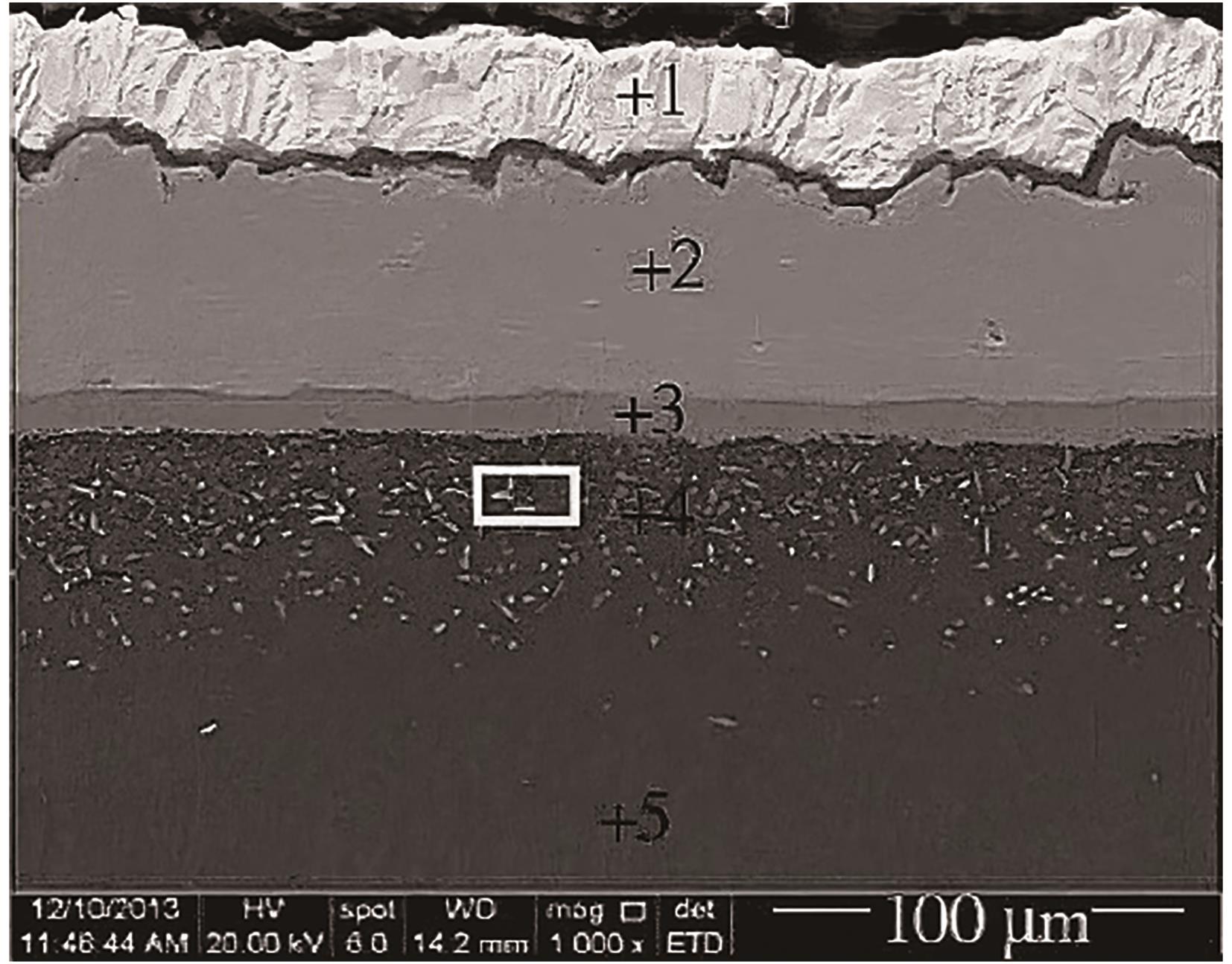
Fig.1 SEM image of cross-sectional view of the composite coatings of magnesium alloy surface[38]
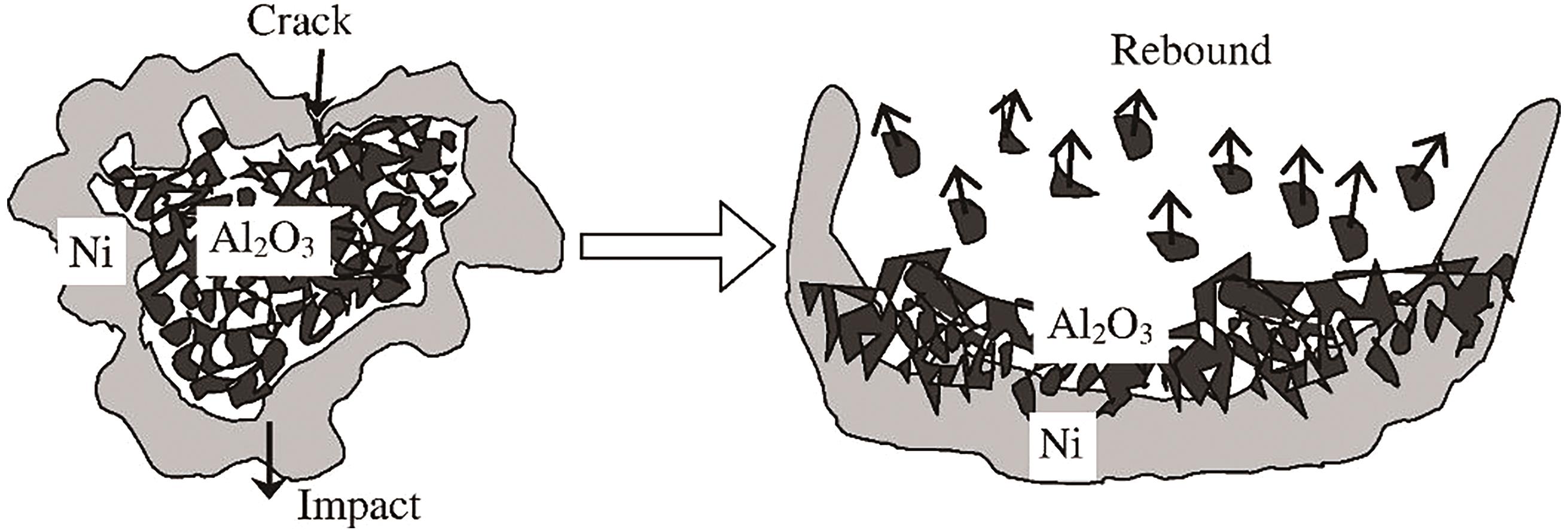
Fig.2 Schematic diagram of the rebound and embedding mechanism of Al?O? particles[40]
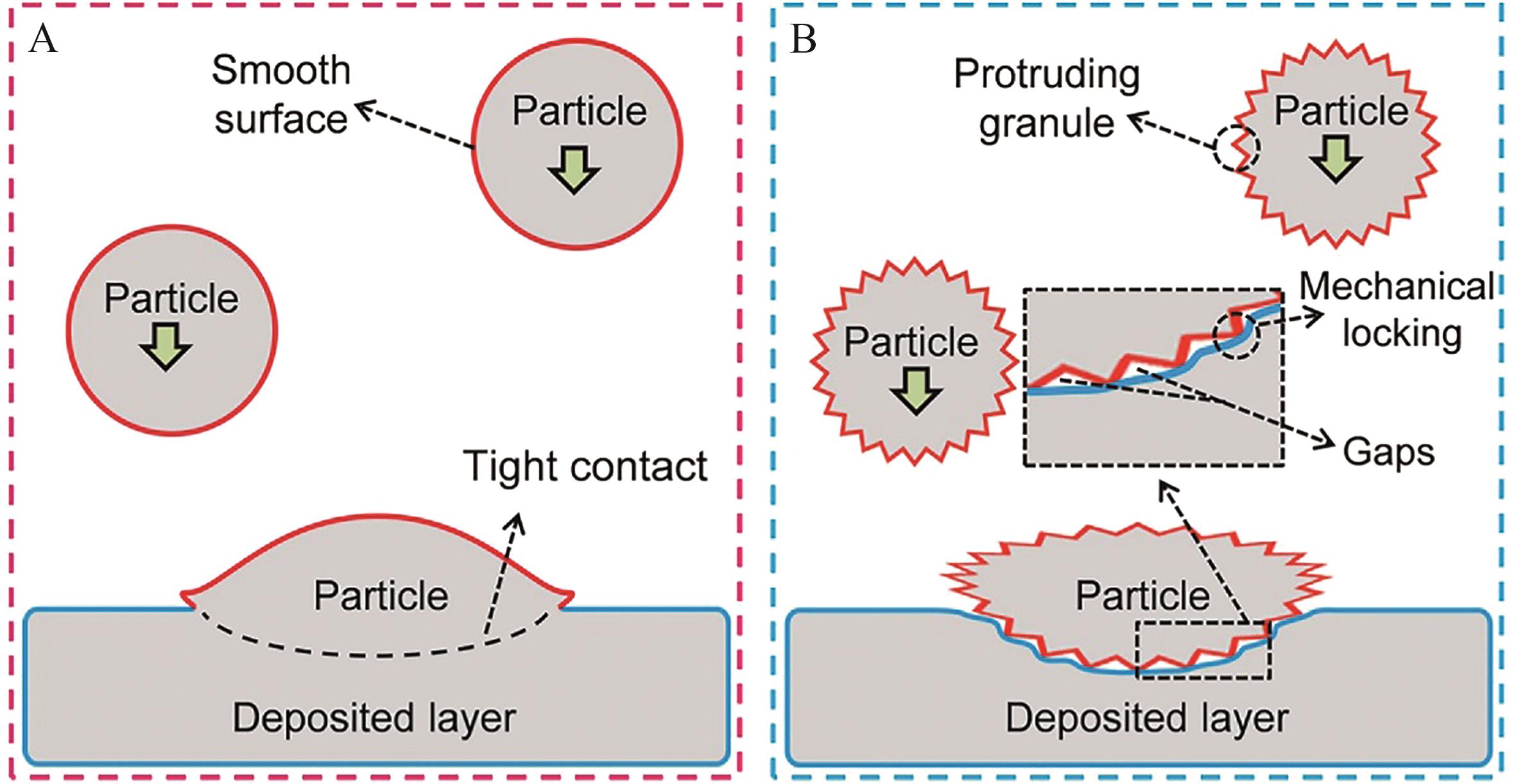
Fig.3 Schematic illustration of the effect of surface protruding granules on the inter-particle bonding quality of the deposited particles[42]
| [1] | HSIN C L, LEE T C, FU Y C, et al. Formation of porous Mg2(SiSn) by nanoparticle alloying and its thermoelectric properties[J]. Mater Res Bull, 2023, 161: 112156. |
| [2] | HUANG H, LI D, HOU L, et al. Advanced protective layer design on the surface of Mg-based metal and application in batteries: challenges and progress[J]. J Power Sources, 2022, 542: 231755. |
| [3] | LI Z Y, SUN Y J, ZHANG C C, et al. Optimizing hydrogen ad/desorption of Mg-based hydrides for energy-storage applications[J]. J Mater Sci Technol, 2023, 141: 221-235. |
| [4] | HASHEMI M, ALIZADEH R, LANGDON T G. Recent advances using equal-channel angular pressing to improve the properties of biodegradable Mg-Zn alloys[J]. J Magnesium Alloys, 2023, 11(7): 2260-2284. |
| [5] | KIM J D, JUN H U, CHEON J, et al. Effect of additional side shielding on the wire arc additive manufacturing of AZ31 magnesium alloy[J]. J Mater Res Technol, 2023, 25: 6567-6577. |
| [6] | BAHMANI A, LOTFPOUR M, TAGHIZADEH M, et al. Corrosion behavior of severely plastically deformed Mg and Mg alloys[J]. J Magnes Alloy, 2022, 10(10): 2607-2648. |
| [7] | ZHU Q, LI Y, CAO F, et al. Towards development of a high-strength stainless Mg alloy with Al-assisted growth of passive film[J]. Nat Commun, 2022, 13(1): 5838. |
| [8] | KLU E E, JIANG J, WANG G, et al. Achieving ultrahigh specific strength of an ultrafine grained Mg-9Li-1Al alloy via the combined processing of ECAP with repeated annealing and rolling[J]. J Mater Res Technol, 2023, 25: 3228-3242. |
| [9] | JI Q, ZHANG S, WU R, et al. High strength BCC magnesium-lithium alloy processed by cryogenic rolling and room temperature rolling and its strengthening mechanisms[J]. Mater Charact, 2022, 187: 111869. |
| [10] | 王华, 刘艳艳. 镁合金表面防腐蚀超疏水涂层制备研究进展[J]. 表面技术, 2023, 52(11): 1-22, 127. |
| WANG H, LIU Y Y. Research progress in the preparation of anti-corrosion superhydrophobic coatings on magnesium alloys[J]. Surf Technol, 2023, 52(11): 1-22, 127. | |
| [11] | 郑黎, 王美婷, 于宝义. 镁合金表面冷喷涂技术研究进展[J]. 中国腐蚀与防护学报, 2021, 41(1): 22-28. |
| ZHENG L, WANG M T, YU B Y. Research progress of cold spraying coating technology for Mg-alloy[J]. J Chin Soc Corros Prot, 2021, 41(1): 22-28. | |
| [12] | 肖雯心, 王叶, 马凯, 等. 镁合金表面化学转化涂层研究进展[J]. 材料导报, 2024, 38(12): 192-203. |
| XIAO W X, WANG Y, MA K, et al. Research progress on chemical conversion coatings on magnesium alloys[J]. Mater Rep, 2024, 38(12): 192-203. | |
| [13] | YANG B, XIA L, LI R, et al. Superior plating/stripping performance through constructing an artificial interphase layer on metallic Mg anode[J]. J Mater Sci Technol, 2023, 157: 154-162. |
| [14] | 王洺浩. 汽车轻量化材料镁合金的腐蚀防护技术应用现状与发展趋势[J]. 汽车实用技术, 2025, 50(9): 93-98. |
| WANG M H. Application status and development trends of corrosion protection technology for automobile lightweight material magnesium alloy[J]. Automobile Appl Technol, 2025, 50(9): 93-98. | |
| [15] | 张祥, 周亮, 贾宏耀, 等. 镁合金微弧氧化膜层性能优化研究进展[J]. 表面技术, 2023, 52(3): 122-133. |
| ZHANG X, ZHOU L, JIA H Y, et al. Research progress on performance optimization of micro-arc oxidation films on magnesium alloys[J]. Surf Technol, 2023, 52(3): 122-133. | |
| [16] | NUGROHO A, DAUD S, PURANTO P, et al. Next-generation thermal spray coatings for military use: innovations, challenges, and applications (bibliometric review 2015-2025)[J]. Digit Chem Eng, 2025, 17: 100259. |
| [17] | 刘海飞, 侯玉柏, 夏春阳, 等. 冷喷涂技术[J]. 热喷涂技术, 2025, 17(2): 65-86. |
| LIU H F, HOU Y B, XIA C Y, et al. Cold spray[J]. Therm Spray Technol, 2025, 17(2): 65-86. | |
| [18] | LUO Y, HUANG J, YU X, et al. Surface microstructure and corrosion characterization of AZ31 magnesium alloys fabricated by laser surface-modification[J]. J Alloys Compd, 2024, 994: 174708. |
| [19] | DAROONPARVAR M, BAKHSHESHI-RAD H R, SABERI A, et al. Surface modification of magnesium alloys using thermal and solid-state cold spray processes: challenges and latest progresses[J]. J Magnesium Alloys, 2022, 10(8): 2025-2061. |
| [20] | 苏贤涌, 周香林, 崔华, 等. 冷喷涂技术的研究进展[J]. 表面技术, 2007(5): 71-74. |
| SU X Y, ZHOU X L, CUI H, et al. Research progress in cold gas dynamic spray technology[J]. Surf Technol, 2007(5): 71-74. | |
| [21] | MONETTE Z, KASAR A K, DAROONPARVAR M, et al. Supersonic particle deposition as an additive technology: methods, challenges, and applications[J]. Int J Adv Manuf Technol, 2020, 106(5/6): 2079-2099. |
| [22] | ZHU J, ZHANG Y, XU M, et al. Development of low-cost high entropy alloys composite coating with gradient structures on Mg alloys manufactured by supersonic solid-state cold spray[J]. J Alloys Compd, 2025, 1021: 179699. |
| [23] | ASSADI H, KREYE H, GÄRTNER F, et al. Cold spraying-a materials perspective[J]. Acta Mater, 2016, 116: 382-407. |
| [24] | 虞思琦, 杨夏炜, 王非凡, 等. 镁合金表面冷喷涂层防护研究进展[J]. 表面技术, 2018, 47(5): 43-56. |
| YU S Q, YANG X W, WANG F F, et al. Protection for cold sprayed coatings on magnesium alloy[J]. Surf Technol, 2018, 47(5): 43-56. | |
| [25] | SUN W, CHU X, LAN H, et al. Cold spray additive manufacturing (CSAM)[M]//KAR A, ALAM Z. Solid State Additive Manufacturing. 1st ed. Boca Raton: CRC Press, 2023: 96-126. |
| [26] | ULLAH N, TARIQ N U H, DHAKAL M, et al. Ultrafine grain stabilization and corrosion studies on supersonic cold-sprayed Al-5Si/Al2O3 coating via thermal annealing[J]. J Alloys Compd, 2025, 1024: 180129. |
| [27] | ZHANG L, YANG S, LV X, et al. Wear and corrosion resistance of cold-sprayed cu-based composite coatings on magnesium substrate[J]. J Therm Spray Technol, 2019, 28(6): 1212-1224. |
| [28] | ASSADI H, GÄRTNER F, STOLTENHOFF T, et al. Bonding mechanism in cold gas spraying[J]. Acta Mater, 2003, 51(15): 4379-4394. |
| [29] | DEFORCE B S, EDEN T J, POTTER J K. Cold spray Al-5% Mg coatings for the corrosion protection of magnesium alloys[J]. J Therm Spray Technol, 2011, 20(6): 1352-1358. |
| [30] | MOHANKUMAR A, DURAISAMY T, CHIDAMBARAMSESHADRI R, et al. Enhancing the corrosion resistance of low pressure cold sprayed metal matrix composite coatings on AZ31B Mg alloy through friction stir processing[J]. Coatings, 2022, 12(2): 135. |
| [31] | WANG Q, NIU W, LI X, et al. Tuning the microstructure and mechanical properties of additive manufactured aluminum matrix composites by cold spray[J]. Surf Coat Technol, 2021, 428: 127847. |
| [32] | JI G, LIU H, YANG G J, et al. Formation of intermetallic compounds in a cold-sprayed aluminum coating on magnesium alloy substrate after friction stir-spot-processing[J]. J Therm Spray Technol, 2021, 30(6): 1464-1481. |
| [33] | MARZBANRAD B, TOYSERKANI E, JAHED H. Characterization of single- and multilayer cold-spray coating of Zn on AZ31B[J]. Surf Coat Technol, 2021, 416: 127155. |
| [34] | 杨水梅, 张留艳, 詹浩芝, 等. 掺杂镍对镁合金表面冷喷涂锌基涂层性能的影响[J]. 表面技术, 2019, 48(5): 217-224. |
| YANG S M, ZHANG L Y, ZHAN H Z, et al. Effect of mixing Ni on properties of cold sprayed Zn-based coating on Mg alloy[J]. Surf Technol, 2019, 48(5): 217-224. | |
| [35] | LI W, ZHANG J, CUI S, et al. Influence of Al contents on the long-term corrosion behaviors of cold-sprayed Zn-xAl coatings[J].Surf Coat Technol, 2024, 476: 130201. |
| [36] | CONG S, ZHOU H, LI W, et al. The corrosion behavior of novel cold-sprayed Zn-xTa coating[J]. Surf Coat Technol, 2025, 512: 132389. |
| [37] | 邵龙, 吴惠舒, 张留艳, 等. 冷喷涂铜锌合金复合涂层的腐蚀行为研究[J]. 热加工工艺, 2022, 51(14): 99-102. |
| SHAO L, WU H S, ZHANG L Y, et al. Study on corrosion behavior of copper zinc alloy composite coating prepared by cold spraying[J]. Hot Work Technol, 2022, 51(14): 99-102. | |
| [38] | 贾平平, 马捷, 王晓光, 等. 镁合金表面沉积铜钨复合涂层工艺及涂层性能研究[J]. 表面技术, 2015, 44(5): 43-47. |
| JIA P P, MA J, WANG X G, et al. Process preparation and properties of Cu/W composite coatings on the surface of Mg alloy[J]. Surf Technol, 2015, 44(5): 43-47. | |
| [39] | XUE N, LI W, SHAO L, et al. Comparison of cold-sprayed coatings of copper-based composite deposited on AZ31B magnesium alloy and 6061 T6 aluminum alloy substrates[J]. Materials, 2023, 16(14): 5120. |
| [40] | LI W Y, ZHANG C, LIAO H, et al. Characterizations of cold-sprayed nickel-alumina composite coating with relatively large nickel-coated alumina powder[J]. Surf Coat Technol, 2008, 202(19): 4855-4860. |
| [41] | TAN C, KRISHNAN K, ELUMALAI N K. Corrosion behaviourof heat-treated cold spray nickel chromium/chromium carbides[J]. Metals, 2024, 14(10): 1153. |
| [42] | WEI Y K, LUO X T, CHU X, et al. Ni coatings for corrosion protection of Mg alloys prepared by an in-situ micro-forging assisted cold spray: effect of powder feedstock characteristics[J]. Corros Sci, 2021, 184: 109397. |
| [43] | DAROONPARVAR M, KASAR A K, KHAN M U F, et al. Improvement of wear, pitting corrosion resistance and repassivationability of Mg-based alloys using high pressure cold sprayed (HPCS) commercially pure-titanium coatings[J]. Coatings, 2021, 11(1): 57. |
| [44] | DAROONPARVAR M, KHAN M U F, SAADEH Y, et al. Modification of surface hardness, wear resistance and corrosion resistance of cold spray Al coated AZ31B Mg alloy using cold spray double layered Ta/Ti coating in 3.5wt% NaCl solution[J]. Corros Sci, 2020, 176: 109029. |
| [45] | 戴宇, 马冰, 陈杰, 等. 镁合金表面冷喷涂420不锈钢涂层及其摩擦磨损性能研究[J]. 兵器材料科学与工程, 2017, 40(2): 118-121. |
| DAI Y, MA B, CHEN J, et al. Tribological properties of cold sprayed 420 stainless steel coating on inagnesium alloy[J]. Ordnance Mater Sci Eng, 2017, 40(2): 118-121. | |
| [46] | 陈杰, 宋惠, 戴宇, 等. 镁合金表面冷喷涂420不锈钢/WC-17Co涂层及其耐磨耐蚀性能[J]. 航空材料学报, 2018, 38(4): 82-86. |
| CHEN J, SONG H, DAI Y, et al. Wear and corrosion properties of cold sprayed 420 stainless steel/WC-17Co coating on magnesium alloy[J]. J Aeronaut Mater, 2018, 38(4): 82-86. |
| [1] | Run-Ze LI, Li-Ren CHENG, Chao-Jie CHE, Xin-Lin LI, VIACHASLAU-A TAMILA, Hong-Jie ZHANG. Research Progress on Synergistic Regulation of Strain Rate, Temperature, and Composition in High-Speed Extruded Magnesium Alloys [J]. Chinese Journal of Applied Chemistry, 2026, 43(2): 157-166. |
| [2] | Xue-Qiang CAO, Jia-Min ZENG, Yao SHI, Ying-Jing YUAN, Xiang FANG, Guang DU, Long-Hui DENG, Jia-Ning JIANG. Corrosion of Thermal Barrier Coatings in Atmospheric Environment [J]. Chinese Journal of Applied Chemistry, 2025, 42(7): 930-944. |
| [3] | Yuan WEN, Yan-Ru ZHUANG, Hui-Quan HONG. Preparation of Nitrate Intercalated Hydrotalcite and Its Anti-Rust Behavior on Steel Bars [J]. Chinese Journal of Applied Chemistry, 2025, 42(12): 1691-1700. |
| [4] | He LI, Gong LI, Xue GONG, Ming-Bo RUAN, Ce HAN, Ping SONG, Wei-Lin XU. Research on Performance Decay Mechanism of Pt/C Catalyst in Long‑Term ORR Test [J]. Chinese Journal of Applied Chemistry, 2022, 39(10): 1564-1571. |
| [5] | WANG Jianghui. Solving the Shutdown Corrosion Problem of Metal-Air Batteries via Kipp′s Apparatus Principle [J]. Chinese Journal of Applied Chemistry, 2020, 37(9): 1093-1098. |
| [6] | ZHANG Ping, ZHANG Guoqiang, TANG Yining, GUO Yanni. Corrosion Behavior of Typical Materials of Energy Tower in Different Coolants [J]. Chinese Journal of Applied Chemistry, 2019, 36(3): 349-357. |
| [7] | DING Hongxia, WU Ying, LIU Zhengping. Preparation of Cationic Polymerizable Imdazolium Ionic Liquid-Acrylamide Copolymers and Their Inhibition Behaviors for Carbon Steel Corrosion in Hydrochloric Acid [J]. Chinese Journal of Applied Chemistry, 2017, 34(8): 877-884. |
| [8] | ZHENG Xingwen, GONG Min, CHEN Shilin. Corrosion Inhibition of Q235 Steel by Moxifloxacin in Hydrochloric Acid Solution [J]. Chinese Journal of Applied Chemistry, 2017, 34(8): 955-964. |
| [9] | DING Hongxia, WU Ying, LIU Zhengping. Preparation of Cationic Polymerizable Imdazolium Ionic Liquid-Acrylamide Copolymers and Their Inhibition Behaviors for Carbon Steel Corrosion in Hydrochloric Acid [J]. Chinese Journal of Applied Chemistry, 2017, 34(8): 0-0. |
| [10] | SUN Yang, ZHANG Hongming, LYU Jinlong, WANG Xianhong, WANG Fosong. Ultraviolet-Thermal Double Cured Anti-corrosion Coating Based on Nano-dispersed Conducting Polyaniline [J]. Chinese Journal of Applied Chemistry, 2016, 33(5): 524-532. |
| [11] | XUE Shouqing, LIU Qinghua. Preparation of Polythiophene/Polypyrrole/TiO2 Composite Conductive Polymers by Solid-state Method and Its Anti-corrosion Properties for Stainless Steel [J]. Chinese Journal of Applied Chemistry, 2016, 33(1): 98-102. |
| [12] | YANG Jian, CHEN Buming, WANG Shuai, GUO Zhongcheng. Effects of Chloride Ion on the Properties of Al/Pb Alloy/β-PbO2 Composite Anode During Zinc Electrowinning [J]. Chinese Journal of Applied Chemistry, 2015, 32(8): 955-962. |
| [13] | ZHANG Honghong, XIE Yan, LIU Yuanwei, YANG Zhongnian. Inhibition of Mild Steel Corrosion in Hydrochloric Acid Solution by Salicylaldehyde Thiosemicarbazone [J]. Chinese Journal of Applied Chemistry, 2015, 32(6): 720-725. |
| [14] | SU Tiejuna, , LI Kehuab, LUO Yunbaic. Inhibition Behavior of 1-Phenylaminomethylbenzimidazole for Mild Steel in Hydrochloric Acid [J]. Chinese Journal of Applied Chemistry, 2015, 32(4): 464-471. |
| [15] | CAO Zhiyong, LU Chen, QU June, ZHEN Guohui, CHENG Cong, WANG Hairen. Corrosion Resistance of Dodecyltriethoxysilane/Graphene Oxide Composite Film on 430 Stainless Steel [J]. Chinese Journal of Applied Chemistry, 2015, 32(1): 93-98. |
| Viewed | ||||||
|
Full text |
|
|||||
|
Abstract |
|
|||||
