
Chinese Journal of Applied Chemistry ›› 2025, Vol. 42 ›› Issue (8): 1087-1095.DOI: 10.19894/j.issn.1000-0518.250113
• Full Papers • Previous Articles Next Articles
Xiao YANG1,2, De-Wen SUN1,2( )
)
Received:2025-03-17
Accepted:2025-06-04
Published:2025-08-01
Online:2025-08-11
Contact:
De-Wen SUN
About author:dwsun@ciac.ac.cnSupported by:CLC Number:
Xiao YANG, De-Wen SUN. Effect from Miktoarm Star-Like Chain Architectures on Nonequilibrium Self-Assembly of Block Copolymers[J]. Chinese Journal of Applied Chemistry, 2025, 42(8): 1087-1095.
Add to citation manager EndNote|Ris|BibTeX
URL: http://yyhx.ciac.jl.cn/EN/10.19894/j.issn.1000-0518.250113
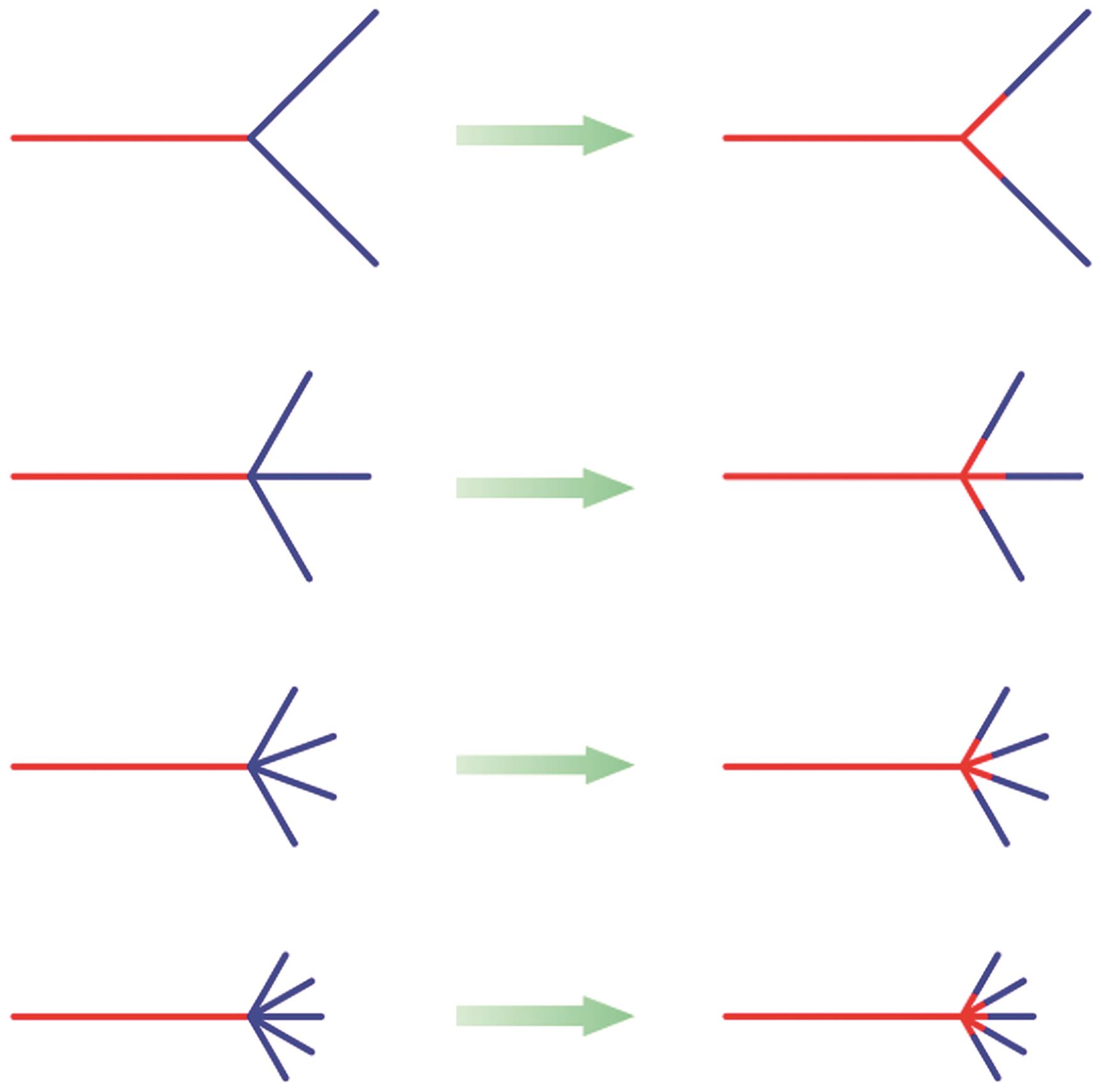
Fig.1 Miktoarm star-like A(B′B) m block copolymers before rapid-component change (left part) and miktoarm star-like A(A′B) m block copolymers after rapid-component change (right part)
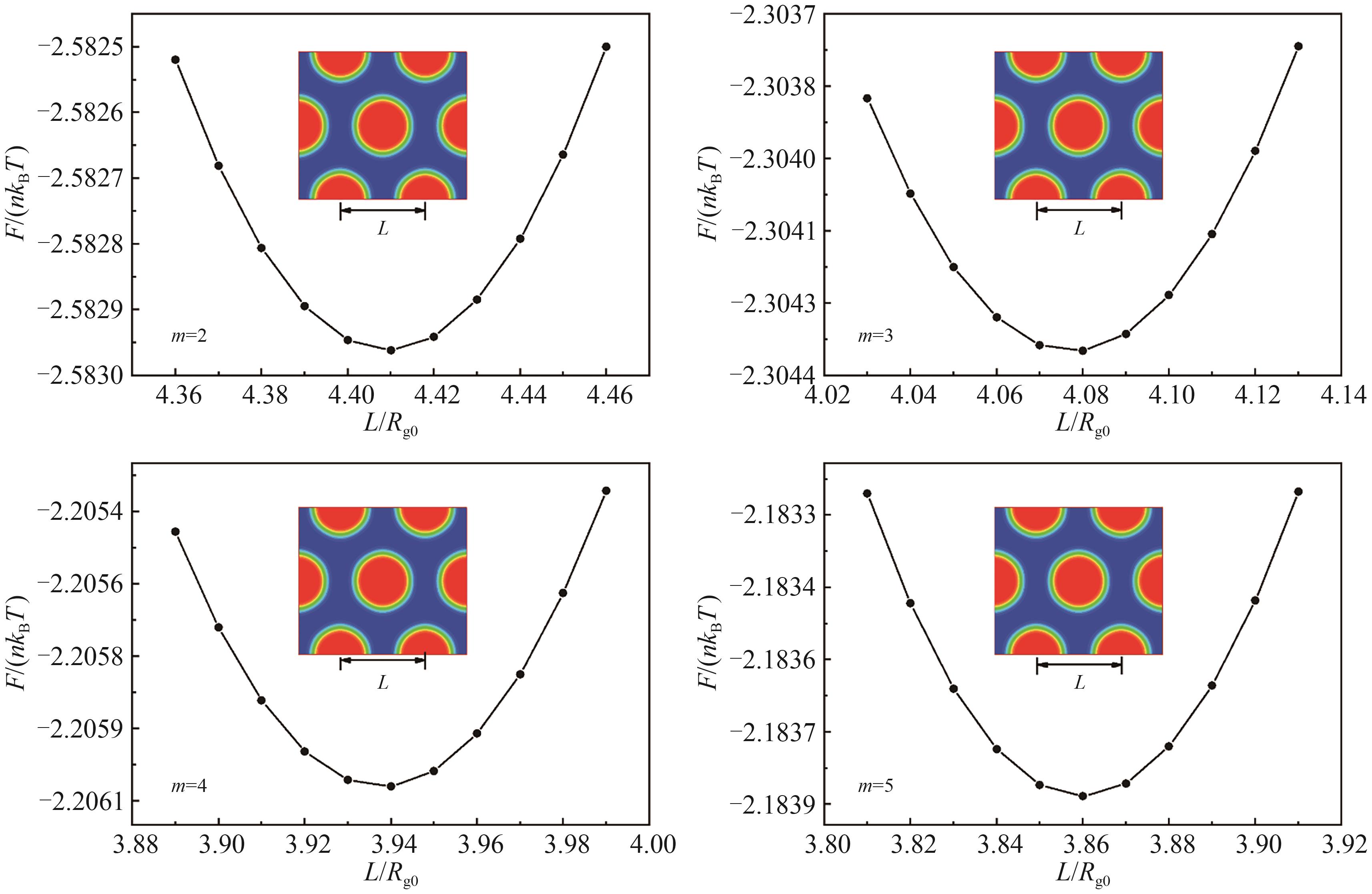
Fig.2 The effect from the size L, on the free energies of thermodynamically stable hexagonally packed cylinders in miktoarm star-like AB m block copolymers, where 2≤m≤5
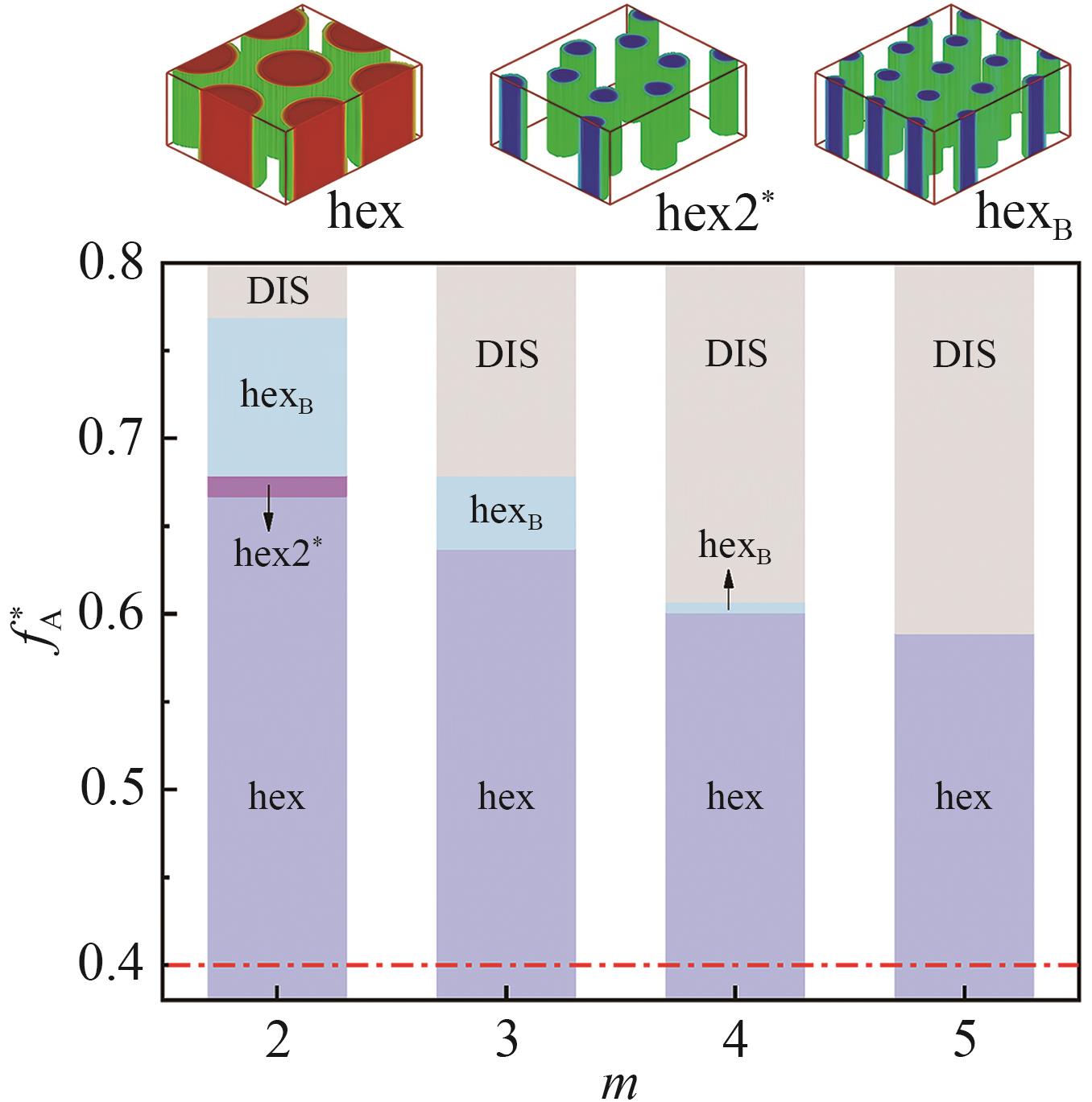
Fig.3 The diagram of states reached by the nonequilibrium self-assembly starting from the generated unstable states, where the red dashed-dotted line indicates the volume fraction fA=0.4 of A-block before the rapid component change
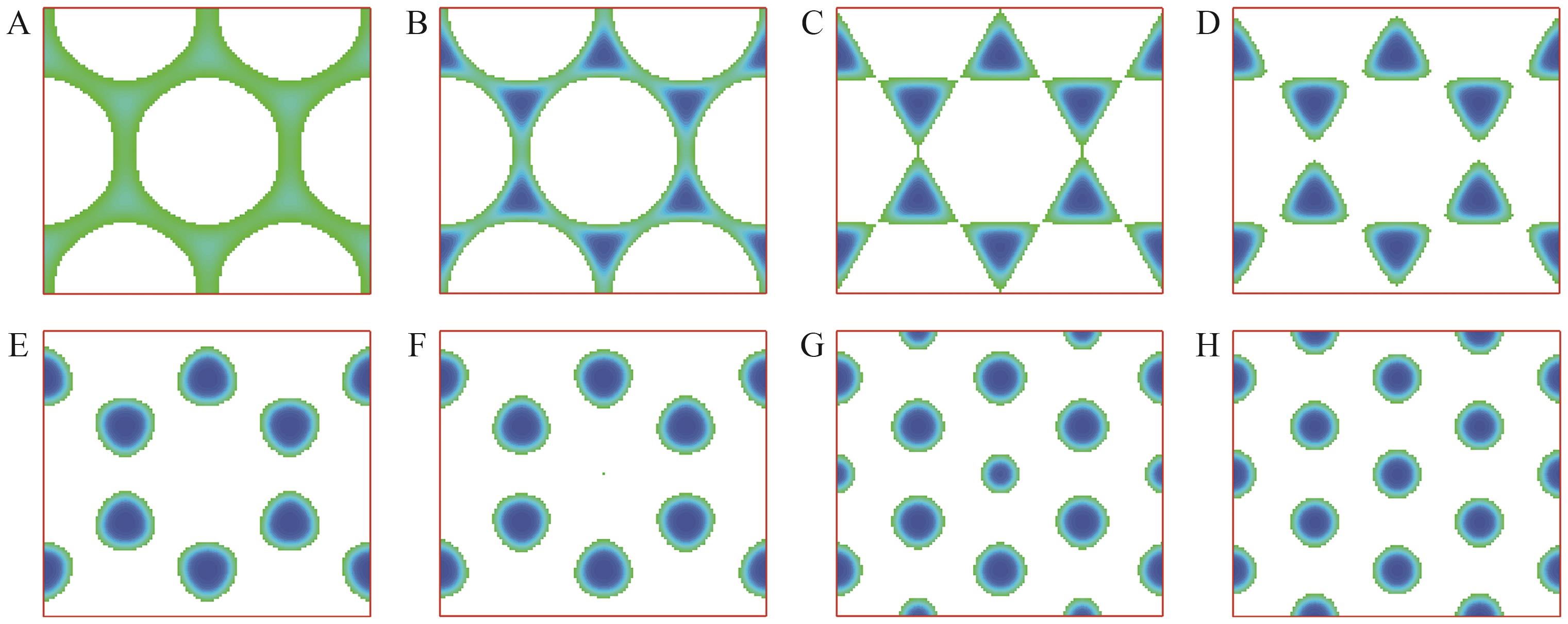
Fig.4 The nonequilibrium kinetics of structural formation of hexB when m=2 and fA*=0.682 after the rapid-component change. The blue color represents the component B, whereas the green color represents the interface between components A and B
| [1] | BATES F S, FREDRICKSON G H. Block copolymers-designer soft materials[J]. Phys Today, 1999, 52(2): 32-38. |
| [2] | BATES F S. Network phases in block copolymer melts[J]. MRS Bull, 2005, 30(7): 525-532. |
| [3] | MEULER A J, HILLMYER M A, BATES F S. Ordered network mesostructures in block polymer materials[J]. Macromolecules, 2009, 42(19): 7221-7250. |
| [4] | MATSEN M W, SCHICK M. Stable and unstable phases of a diblock copolymer melt[J]. Phys Rev Lett, 1994, 72(16): 2660-2663. |
| [5] | MATSEN M W, BATES F S. Unifying weak- and strong-segregation block copolymer theories[J]. Macromolecules, 1996, 29(4): 1091-1098. |
| [6] | TAKENAKA M, WAKADA T, AKASAKA S, et al. Orthorhombic Fddd network in diblock copolymer melts[J]. Macromolecules, 2007, 40(13): 4399-4402. |
| [7] | MATSEN M W. Fast and accurate scft calculations for periodic block-copolymer morphologies using the spectral method with anderson mixing[J]. Eur Phys J E, 2009, 30(4): 361-369. |
| [8] | MATSEN M W. Effect of architecture on the phase behavior of AB-type block copolymer melts[J]. Macromolecules, 2012, 45(4): 2161-2165. |
| [9] | ZHANG C Z, WANG Z G. Random isotropic structures and possible glass transitions in diblock copolymer melts[J]. Phys Rev E, 2006, 73(3): 031804. |
| [10] | GRASON G M, KAMIEN R D. Interfaces in diblocks: a study of miktoarm star copolymers[J]. Macromolecules, 2004, 37(19): 7371-7380. |
| [11] | XIE N, LI W H, QIU F, et al. σ phase formed in conformationally asymmetric AB-type block copolymers[J]. ACS Macro Lett, 2014, 3(9): 906-910. |
| [12] | HOU L, XU Z W, DONG Q S, et al. Stabilizing DG, DD, and DP bicontinuous network phases in pure AB-type block copolymers beyond relieving packing frustration[J]. Macromolecules, 2024, 57(5): 2165-2175. |
| [13] | MÜLLER M, SUN D W. Directing the self-assembly of block copolymers into a metastable complex network phase via a deep and rapid quench[J]. Phys Rev Lett, 2013, 111(26): 267801. |
| [14] | SUN D W, MÜLLER M. Process-accessible states of block copolymers[J]. Phys Rev Lett, 2017, 118(6): 067801. |
| [15] | KIM K, SCHULZE M W, ARORA A, et al. Thermal processing of diblock copolymer melts mimics metallurgy[J]. Science, 2017, 356(6337): 520-523. |
| [16] | CHANG C Y, MANESI G M, YANG C Y, et al. Mesoscale networks and corresponding transitions from self-assembly of block copolymers[J]. Proc Natl Acad Sci, 2021, 118(11): e2022275118. |
| [17] | SAI H, TAN K W, HUR K, et al. Hierarchical porous polymer scaffolds from block copolymers[J]. Science, 2013, 341(6145): 530-534. |
| [18] | CHANG C Y, MANESI G M, WANG W E, et al. Frank-Kasper-like network phase from self-assembly of high-χ star-block copolymers[J]. Sci Adv, 2024, 10(24): eado4786. |
| [19] | 李鸿, 孙德文. 嵌段共聚物Single plumber′s nightmare网络结构的动力学构筑方案[J]. 应用化学, 2024, 41(8): 1107-1115. |
| LI H, SUN D W. Kinetic fabrication strategy of Single plumber's nightmare network mesostructure of block copolymers[J]. Chin J Appl Chem, 2024, 41(8): 1107-1115. | |
| [20] | SUN D W, MÜLLER M. Numerical algorithms for solving self-consistent field theory reversely for block copolymer systems[J]. J Chem Phys, 2018, 149(21): 214104. |
| [21] | FRAAIJE J G E M, VLIMMEREN B A C V, MAURITS N M, et al. The dynamic mean-field density functional method and its application to the mesoscopic dynamics of quenched block copolymer melts[J]. J Chem Phys, 1997, 106(10): 4260-4269. |
| [22] | MAURITS N M, FRAAIJE J G E M. Mesoscopic dynamics of copolymer melts: from density dynamics to external potential dynamics using nonlocal kinetic coupling[J]. J Chem Phys, 1997, 107(15): 5879-5889. |
| [23] | KAWAKATSU T. Effects of changes in the chain conformation on the kinetics of order-disorder transitions in block copolymer melts[J]. Phys Rev E, 1997, 56(3): 3240-3250. |
| [24] | REISTER E, MÜLLER M, BINDER K. Spinodal decomposition in a binary polymer mixture: dynamic self-consistent-field theory and monte carlo simulations[J]. Phys Rev E, 2001, 64(4): 041804. |
| [25] | MÜLLER M, SCHMID F. Incorporating fluctuations and dynamics in self-consistent field theoriesfor polymer blends[M]//HOLM C, KREMER K. Advanced computer simulation approaches for soft matter sciences II. Berlin, Heidelberg; Springer Berlin Heidelberg, 2005: 1-58. |
| [26] | LYAKHOVA K S, ZVELINDOVSKY A V, SEVINK G J A. Kinetic pathways of order-to-order phase transitions in block copolymer films under an electric field[J]. Macromolecules, 2006, 39(8): 3024-3037. |
| [27] | MÜLLER M, DE PABLO J J. Computational approaches for the dynamics of structure formation in self-assembling polymeric materials[J]. Annu Rev Mater Res, 2013, 43: 1-34. |
| [28] | HOHENBERG P C, HALPERIN B I. Theory of dynamic critical phenomena[J]. Rev Mod Phys, 1977, 49(3): 435-479. |
| [1] | Hong LI, De-Wen SUN. Kinetic Fabrication Strategy of Single Plumber′s Nightmare Network Mesostructure of Block Copolymers [J]. Chinese Journal of Applied Chemistry, 2024, 41(8): 1107-1115. |
| [2] | HU Xiao-Hua, XIONG Shi-Sheng. Advanced Lithography: Directed Self-Assembly [J]. Chinese Journal of Applied Chemistry, 2021, 38(9): 1029-1078. |
| [3] | TIAN Xin, LAI Han-Wen, LIU Ya-Dong, JI Sheng-Xiang. Analysis of Defects in Block Copolymer Films by a Convolution Algorithm [J]. Chinese Journal of Applied Chemistry, 2021, 38(9): 1199-1208. |
| [4] | Long-Fei LUO, Yu-Jie LI, Zhi-Hao SHEN, Shi-Jun ZHENG, Xing-He FAN. Progress in Self⁃assembly and Photo⁃responsiveness of Thin Films of Azobenzene⁃Based Liquid Crystalline Block Copolymers [J]. Chinese Journal of Applied Chemistry, 2021, 38(10): 1238-1254. |
| [5] | Ai-Hua CHEN, Cheng-Yun ZHANG, Zi-Chao DENG, Ya-Lan SUN. Structure Control of Liquid Crystalline Block Copolymers in Liquid⁃Phase Self⁃assembly [J]. Chinese Journal of Applied Chemistry, 2021, 38(10): 1255-1267. |
| [6] | Zhao-Yong ZHANG, Qian LI, Da-Lin WANG, Jiang-Lin FANG, Dong-Zhong CHEN. Controlled Synthesis and Photophysical Properties of Liquid Crystalline Diblock Copolymers with Side⁃Chain Discotic Triphylene and Calamitic Azobenzene Mesogens [J]. Chinese Journal of Applied Chemistry, 2021, 38(10): 1340-1352. |
| [7] | Zhao-Yong ZHANG, Qian LI, Da-Lin WANG, Jiang-Lin FANG, Dong-Zhong CHEN. Controlled Synthesis and Photophysical Properties of Liquid Crystalline Diblock Copolymers with Side⁃Chain Discotic Triphylene and Calamitic Azobenzene Mesogens [J]. Chinese Journal of Applied Chemistry, 2021, 38(10): 0-0. |
| [8] | ZHANG Yanhui, WANG Lin, MUSLIM Arzugul, LAN Haidie. Influence of the Core Forming Block Length of Polystyrene-b-Poly(acrylic acid) Template on the Size and Properties of Polyaniline [J]. Chinese Journal of Applied Chemistry, 2020, 37(7): 764-771. |
| [9] | LI Maosheng, CHEN Jinlong, TAO Youhua. Regio- and Stereoselective Ring-Opening Metathesis Polymerization of Amino Acid Functionalized Cyclooctenes [J]. Chinese Journal of Applied Chemistry, 2020, 37(3): 280-292. |
| [10] | LIU Ning,LIU Shuilin,WU Suyun,TANG Xinde,WU Zhi,LI Aiyang. CTAB-P123-Assisted Synthesis of Orderly Mesoporous KF/Al-Ce-SBA-15 Solid Base and Its Catalytic Application [J]. Chinese Journal of Applied Chemistry, 2019, 36(11): 1294-1300. |
| [11] | ZHANG Xiaosa, JI Shengxiang. Synthesis and Directed Self-assembly of Cylinder-Forming Poly(styrene-b-lactide) Block Copolymers [J]. Chinese Journal of Applied Chemistry, 2018, 35(12): 1420-1426. |
| [12] | XU Yuzhong,TONG Yongfen,TAN Licheng,CHEN Yiwang. Block Copolymer Electrolytes for Lithium Batteries [J]. Chinese Journal of Applied Chemistry, 2017, 34(3): 245-261. |
| [13] | LI Liangui, FU Zhipeng, LI Mingchao, ZHANG Qiang, WANG Rui, WANG Guoqiang, JIANG Min. Synthesis and Characterization of Polyethylene Terephthalate-b-poly(ethylene 2,5-furandicarboxylate) Block Polyester [J]. Chinese Journal of Applied Chemistry, 2017, 34(1): 54-59. |
| [14] | ZHANG Fan, WANG Lulu, WANG Jilin, FENG Ruijiang, ZHANG Yang. Gemini-type Cationic Molecules-Styrene Block Polymer Anion Conducting Membrane Prepared by in-situ Polymerization [J]. Chinese Journal of Applied Chemistry, 2016, 33(6): 693-700. |
| [15] | ZHENG Chao, HUANG Haiying*, HE Tianbai*. Research Progress in Gradient Copolymers [J]. Chinese Journal of Applied Chemistry, 2014, 31(11): 1237-1247. |
| Viewed | ||||||
|
Full text |
|
|||||
|
Abstract |
|
|||||
