
应用化学 ›› 2025, Vol. 42 ›› Issue (10): 1386-1396.DOI: 10.19894/j.issn.1000-0518.240416
王茂旭, 赵跃刚, 王俪颖, 施威, 刘祎男, 邱智东, 董雪莲( )
)
收稿日期:2024-12-17
接受日期:2025-05-29
出版日期:2025-10-01
发布日期:2025-10-29
通讯作者:
董雪莲
基金资助:
Mao-Xu WANG, Yue-Gang ZHAO, Li-Ying WANG, Wei SHI, Yi-Nan LIU, Zhi-Dong QIU, Xue-Lian DONG()
Received:2024-12-17
Accepted:2025-05-29
Published:2025-10-01
Online:2025-10-29
Contact:
Xue-Lian DONG
About author:148047753@qq.comSupported by:摘要:
为了揭示半夏泻心汤中辛开苦降组配伍前后对大鼠能量代谢的影响,从而探究配伍后的寒热药性变化。 通过灌胃优甲乐(120 μg/kg)制备热证大鼠模型,连续造模+给药15 d,记录大鼠给药期间的体征变化(体质量、肛温),末次给药后检测大鼠热板反应阈值。 采用超高液相色谱-质谱联用技术(UPLC-MS)分析大鼠肝组织中能量代谢物的含量。 结果表明,与模型组相比,黄芩、黄连、黄芩-黄连单煎合并(或合煎)、辛开-苦降分煎合并(或合煎)、四味单煎合并组可不同程度地缓解大鼠的热证体征,延长热板反应阈值,抑制能量代谢; 半夏、干姜、半夏-干姜单煎合并(或合煎)组可维持大鼠热证体征,降低热板反应阈值,促进能量代谢。 与空白组相比,黄芩、黄连、黄芩-黄连单煎合并(或合煎)组肛降低温、热板反应阈值延长; 辛开-苦降分煎合并(或合煎)、四味单煎合并组无明显变化。 表明黄芩、黄连及两药单煎合并或合煎后均表现出寒性; 半夏、干姜及两药单煎合并或合煎后表现出热性; 辛开、苦降组经过配伍煎煮后趋于微寒(平)性,从而发挥“平调寒热”的功效。 此外,煎煮方式不改变药物配伍后的寒热属性,但可影响配伍后的寒热强度。
中图分类号:
王茂旭, 赵跃刚, 王俪颖, 施威, 刘祎男, 邱智东, 董雪莲. 基于能量代谢的半夏泻心汤辛开、苦降组寒热属性及配伍意义[J]. 应用化学, 2025, 42(10): 1386-1396.
Mao-Xu WANG, Yue-Gang ZHAO, Li-Ying WANG, Wei SHI, Yi-Nan LIU, Zhi-Dong QIU, Xue-Lian DONG. Nature of Cold and Heat and the Meaning of Compounding Within the Acrid Opening and Bitter Downbearing Groups of Banxia Xiexin Decoction Based on Energy Metabolism[J]. Chinese Journal of Applied Chemistry, 2025, 42(10): 1386-1396.
| Groups | Body mass/g | Rectal temperature/℃ | Hot plate reaction threshold/t |
|---|---|---|---|
| C | 310.54±5.62 | 37.50±0.42 | 17.60±1.48 |
| M | 274.22±6.62 b | 38.40±0.36 b | 13.67±0.38 b |
| BX | 260.78±3.95 | 37.55±0.05 | 11.55±0.4 d |
| GJ | 257.54±1.59 | 37.84±0.05 | 9.94±0.18 d |
| HQ | 285.10±2.96 d | 36.89±0.08 d | 20.18±0.57 d |
| HL | 288.20±3.17 d | 36.62±0.07 a | 21.72±0.30 d |
| CMD | 314.63±5.59 d | 37.22±0.75 d | 29.22±1.24 d |
| HMD | 278.76±15.66 | 38.04±0.32 | 10.86±0.73 d |
| CSD | 303.08±12.7 d | 36.48±0.37 | 28.82±0.89 c |
| HSD | 281.58±12.37 | 37.38±0.32 | 12.35±0.31 |
| HCSD | 315.59±15.88 d | 37.54±0.17 | 15.7±0.30 c |
| SD | 318.94±13.99 d | 37.94±0.19 | 21.6±1.62 c |
| MD | 290.78±1.64 d | 36.66±0.35 d | 18.41±0.9 d |
表1 药味及其不同组合对热证大鼠体征的影响
Table 1 Effects of medicinal flavours and their different combinations on the physical signs of rats with heat syndrome
| Groups | Body mass/g | Rectal temperature/℃ | Hot plate reaction threshold/t |
|---|---|---|---|
| C | 310.54±5.62 | 37.50±0.42 | 17.60±1.48 |
| M | 274.22±6.62 b | 38.40±0.36 b | 13.67±0.38 b |
| BX | 260.78±3.95 | 37.55±0.05 | 11.55±0.4 d |
| GJ | 257.54±1.59 | 37.84±0.05 | 9.94±0.18 d |
| HQ | 285.10±2.96 d | 36.89±0.08 d | 20.18±0.57 d |
| HL | 288.20±3.17 d | 36.62±0.07 a | 21.72±0.30 d |
| CMD | 314.63±5.59 d | 37.22±0.75 d | 29.22±1.24 d |
| HMD | 278.76±15.66 | 38.04±0.32 | 10.86±0.73 d |
| CSD | 303.08±12.7 d | 36.48±0.37 | 28.82±0.89 c |
| HSD | 281.58±12.37 | 37.38±0.32 | 12.35±0.31 |
| HCSD | 315.59±15.88 d | 37.54±0.17 | 15.7±0.30 c |
| SD | 318.94±13.99 d | 37.94±0.19 | 21.6±1.62 c |
| MD | 290.78±1.64 d | 36.66±0.35 d | 18.41±0.9 d |
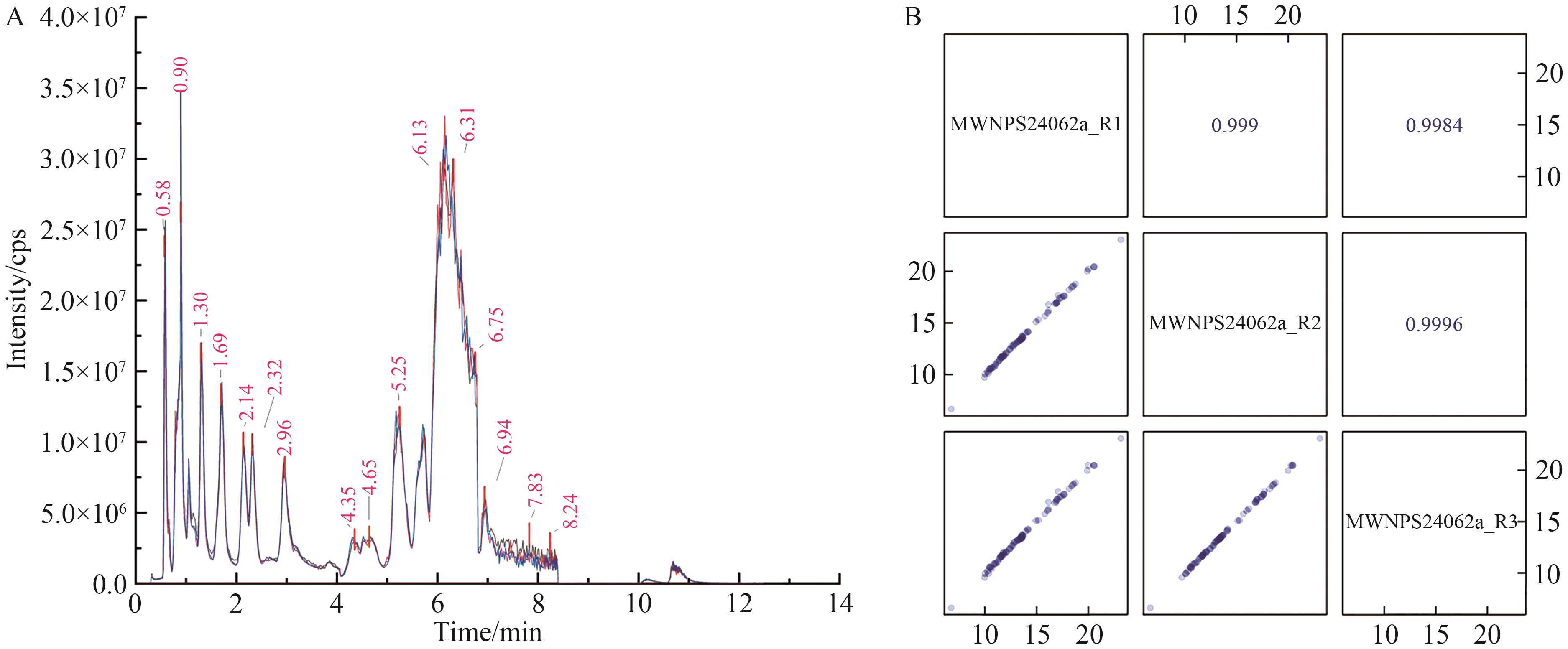
图1 QC样本分析: (A) QC样本负离子模式TIC重叠图; (B) QC样本相关性分析The diagonal squares in Fig.1B represent the QC sample names; The diagonal lower-left squares are the corresponding QC sample correlation scatter plots; And the diagonal upper-right squares are the corresponding QC sample correlation coefficients
Fig.1 QC sample analyses: (A) QC sample negative ion mode TIC overlap plot; (B) QC sample correlation analysis
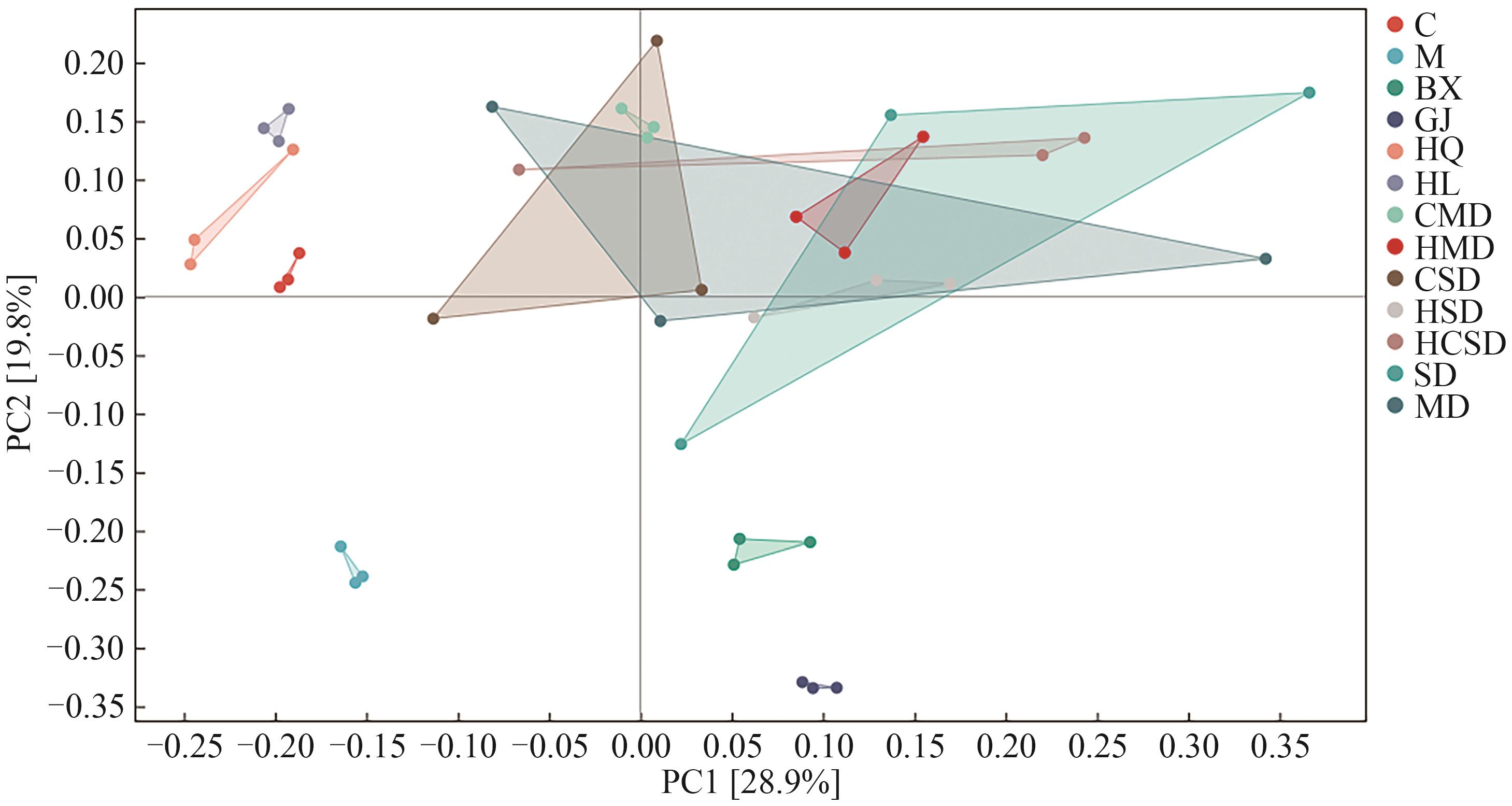
图2 不同组别的糖酵解产物含量PCA分析
Fig.2 PCA analysis of glycolysis product content in different groupsNote: PC1 denotes the first principle component along with its contribution, whereas PC2 represents the second principal component and its contribution. The contribution denotes the capacity of the principal component to elucidate the raw data, whereas the sum of the two principal components constitutes the cumulative contribution. The dots signify the samples, the region delineated by the line linking the samples constitutes the 95% confidence interval, and the separation between the confidence intervals along with the extent of overlap indicates the variability among the distinct sample groups. The proximity between samples indicates their similarity; a shorter distance signifies greater similarity, whereas a longer distance denotes lesser similarity (Figs.4 and 6 are identical)
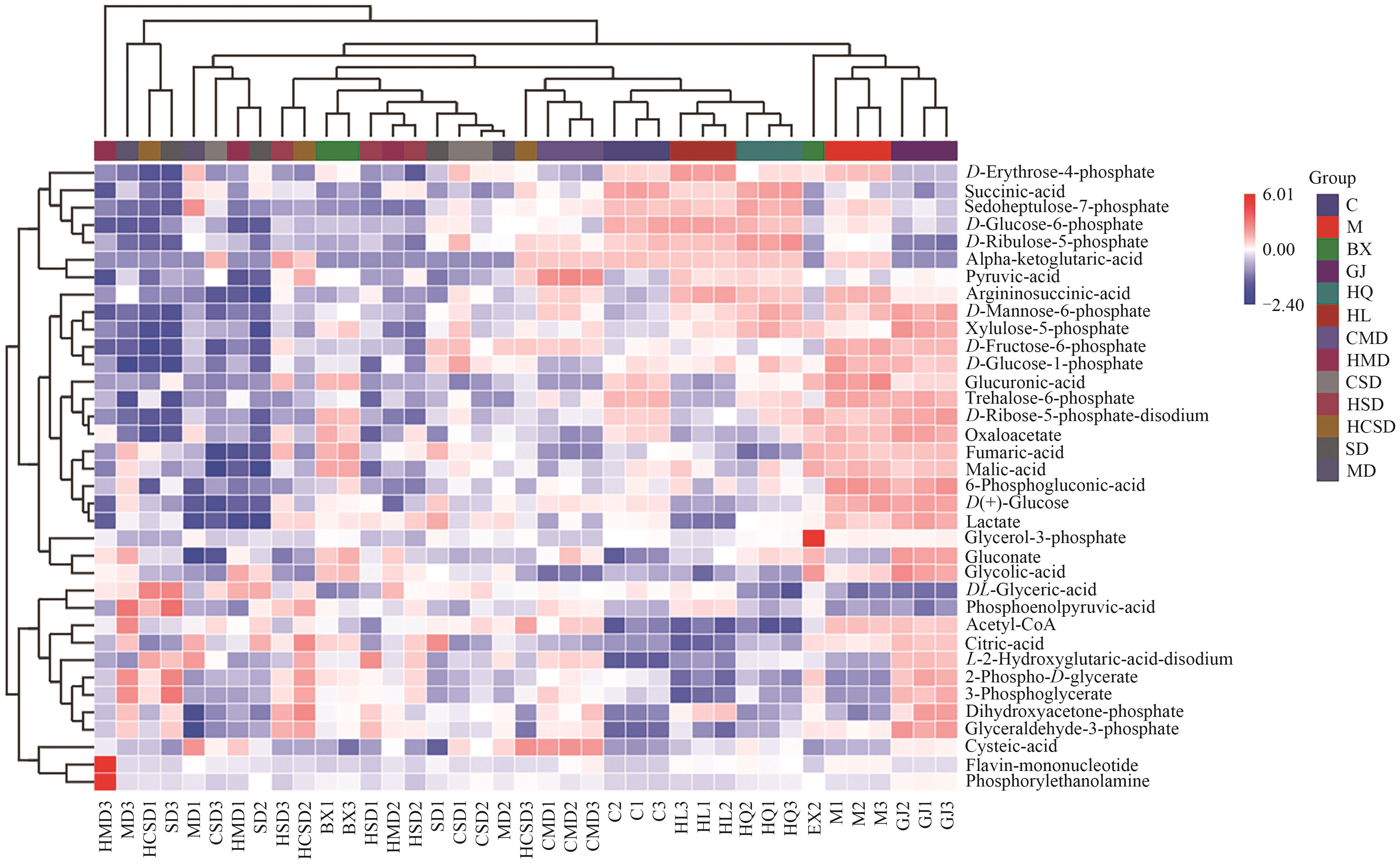
图3 不同组别的糖酵解产物含量差异热图
Fig.3 Heatmap of differential expressions of glycolytic productsNote: red represents higher levels of the relevant metabolite and blue represents lower levels of the relevant metabolite in the graph, the same below
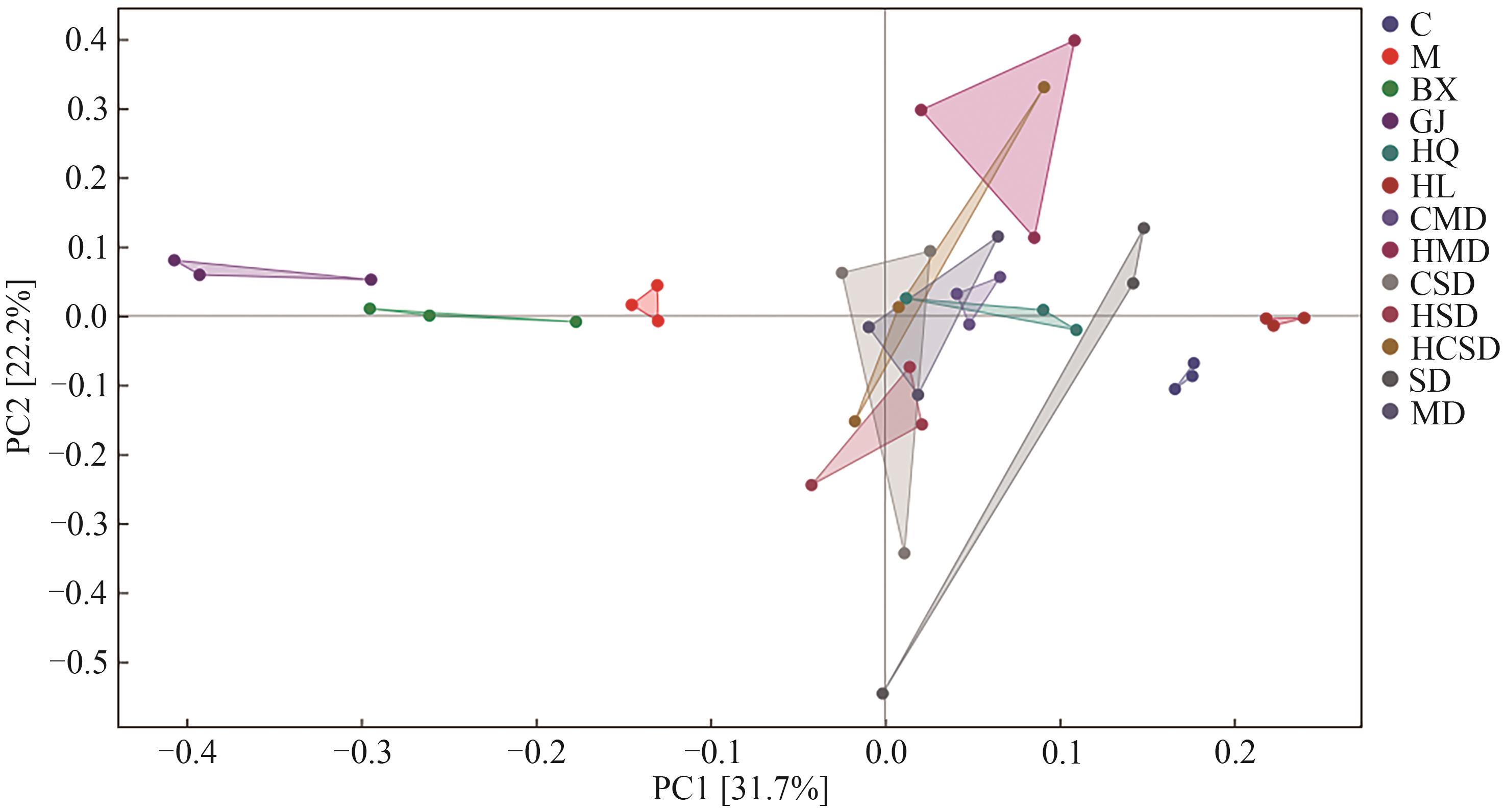
图4 不同组别的氨基酸代谢物含量PCA分析
Fig.4 PCA analysis of amino acid metabolites in different groupsNote: same comments as in Fig.2
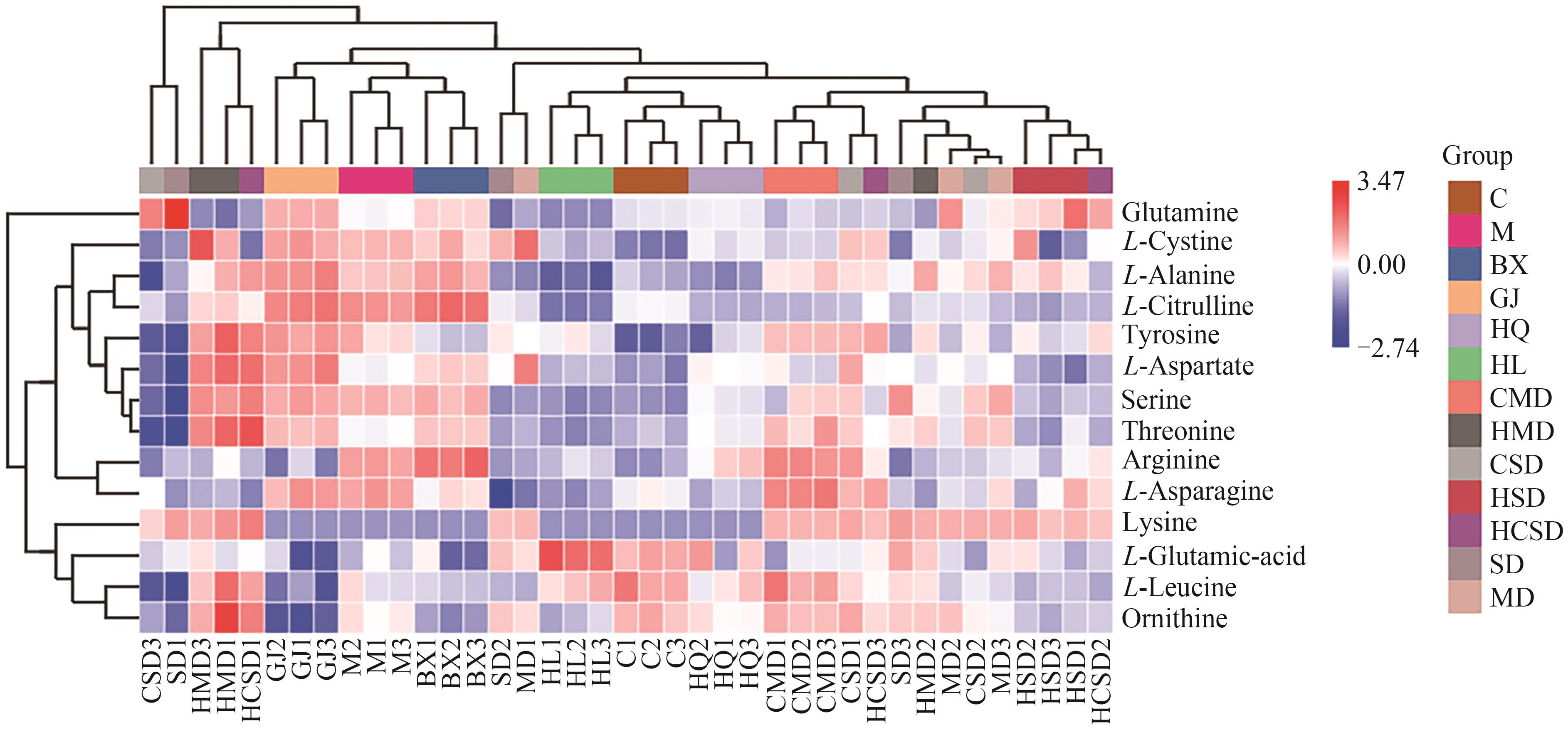
图5 不同组别的氨基酸代谢物含量差异热图
Fig.5 Heatmap of differential expressions of amino acid metabolites
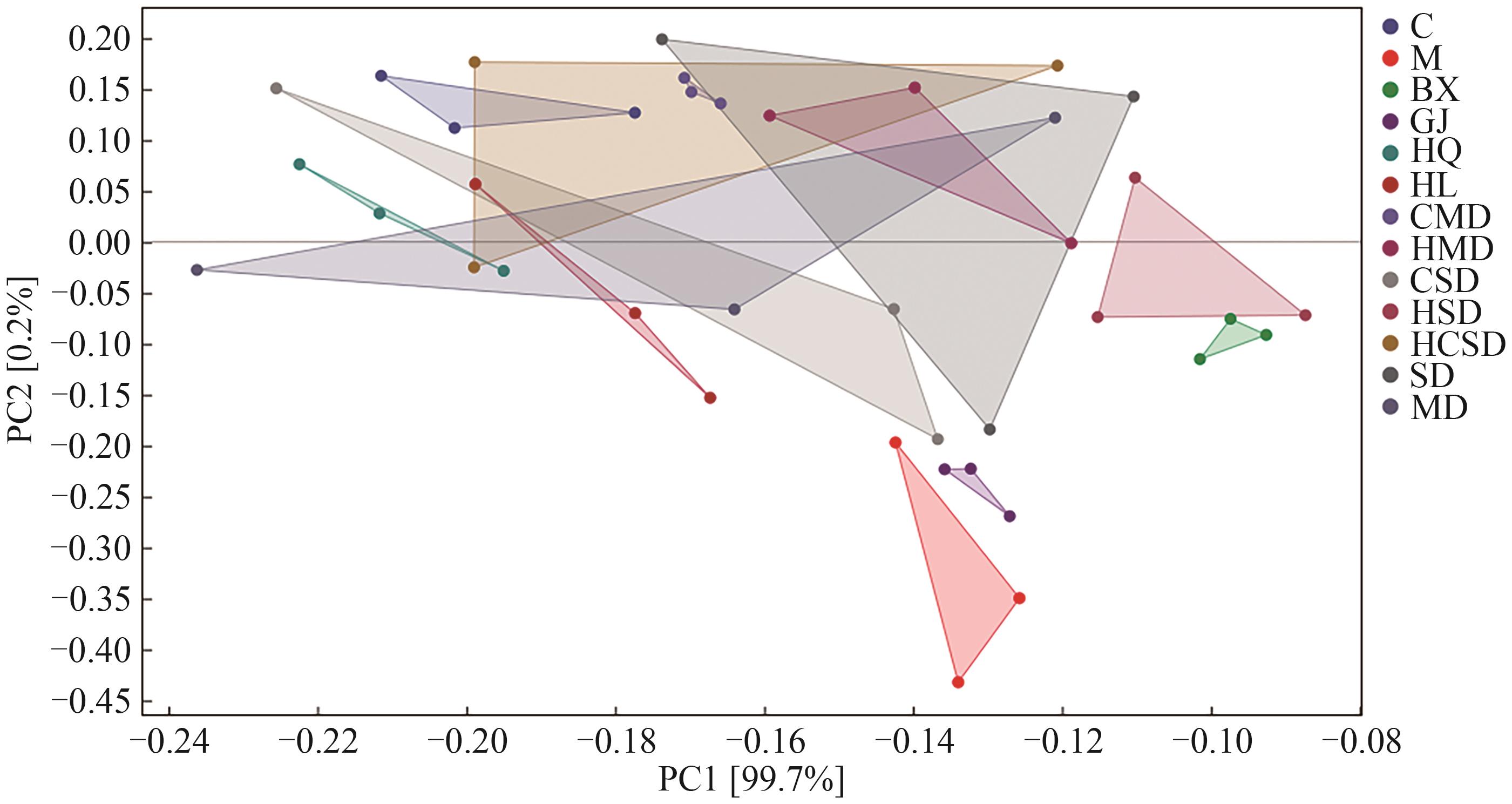
图6 不同组别的核苷酸代谢物含量PCA分析
Fig.6 PCA analysis of nucleotide metabolites in different groupsNote: same comments as in Fig.2
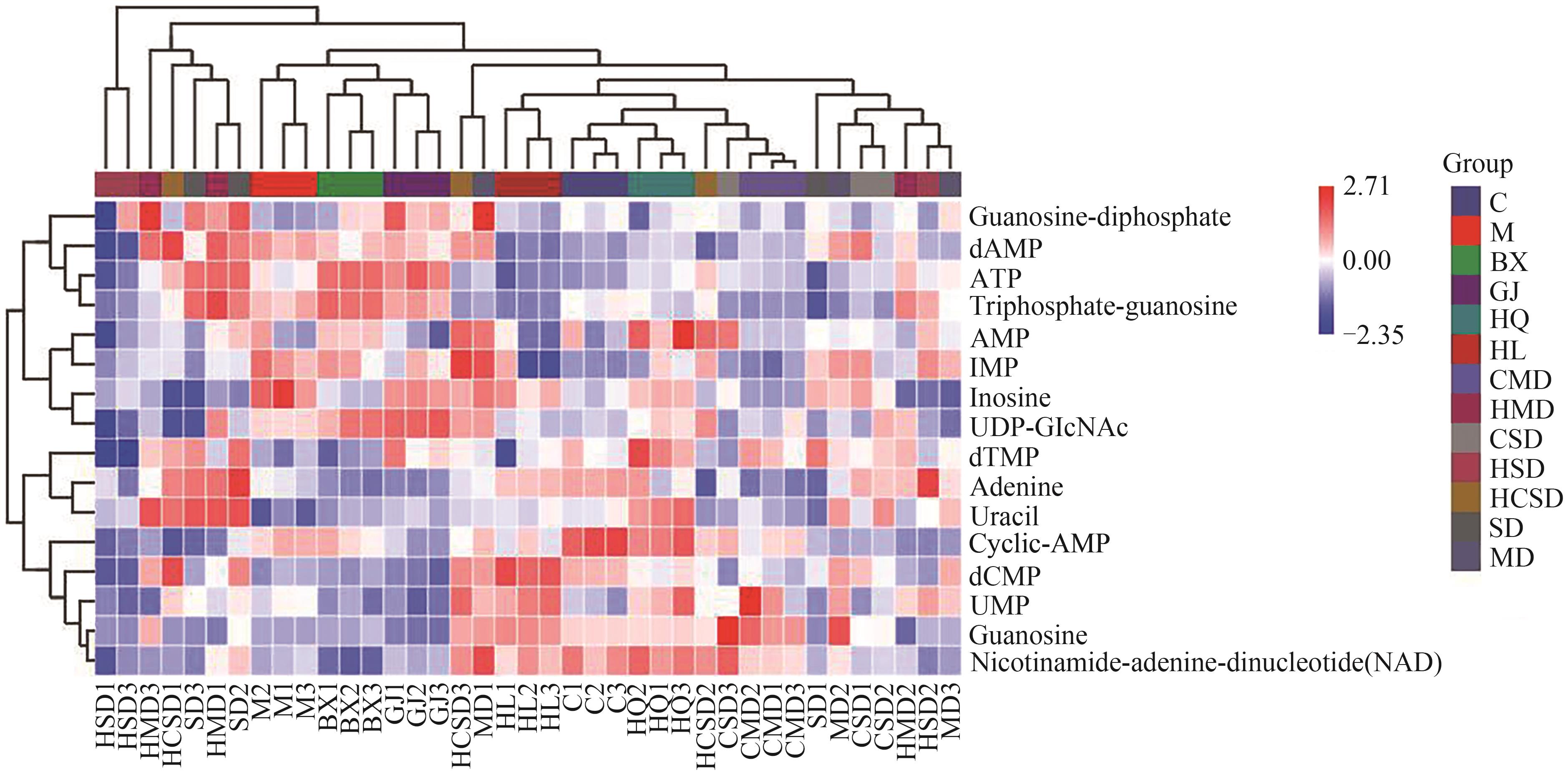
图7 不同组别的核苷酸代谢物含量差异热图
Fig.7 Heatmap of differential expression of nucleotide metabolism
| [1] | 金锐, 张冰. 复杂性科学视野下的中药药性理论——药性形成的多源性[J]. 中西医结合学报, 2012, 10: 1198-1205. |
| JIN R, ZHANG B. A complexity analysis of Chinese herbal property theory: the multiple formations of herbal property[J]. J Integr Med, 2012, 10(11): 1198-205. | |
| [2] | 金锐, 张冰. 中药药性理论复杂性特征分析[J]. 中国中药杂志, 2012, 37(21): 3340-3343. |
| JIN R, ZHANG B. Analysis on complex characteristics of traditional Chinese medicine property theory[J]. China J Chin Mater Med, 2012, 37(21): 3340-3343. | |
| [3] | 王鹏, 张永清, 商庆新, 等. 对中药药性科学内涵的再认识[J]. 陕西中医, 2012, 33(11): 1545-1547. |
| WANG P, ZHANG Y Q, SHANG Q X, et al. Re-conceptualisation of the scientific connotation of the medicinal properties of Chinese medicines[J]. Shaanxi J Tradit Chin Med, 2012, 33(11): 1545-1547. | |
| [4] | 张立平, 汤尔群. 中药药性理论源流和内容范畴分析[J]. 世界中医药, 2014, 9(8): 998-1000, 1004. |
| ZHANG L P, TANG E Q. Initial analysis on the origin and category of the theory of Chinese Herbal Nature[J]. World J Tradit Chin Med, 2014, 9(8): 998-1000, 1004. | |
| [5] | 韩金祥. 中药药性的科学内涵[J]. 中华中医药学刊, 2011, 29(9): 1937-1939. |
| HAN J X. Studying scientific connotations of traditional Chinese herbal property theory[J]. Chin Arch Tradit Chin Med, 2011, 29(9): 1937-1939. | |
| [6] | 唐怡, 秦旭华, 李祖伦. 药性理论的形成及认知方法[J]. 成都中医药大学学报, 2010, 33(3): 6-8. |
| TANG Y, QIN X H, LI Z L. Formation of the theory of medicinal properties and cognitive methods[J]. J Chengdu Univ Traditional Chin Med, 2010, 33(3): 6-8. | |
| [7] | 李学林, 高晓洁, 刘瑞新, 等. 试论中药药性理论的整体性[J]. 中华中医药杂志, 2016, 31(6): 2038-2041 . |
| LI X L, GAO X J, LIU R X, et al. Holistic for the theory of Chinese herbal medical properties[J]. China J Tradit Chin Med Pharm, 2016, 31(6): 2038-2041. | |
| [8] | 李亚格, 克迎迎, 王梦梦, 等. 基于典型热证动物模型物质能量代谢的葶苈子及其性味拆分组分药性归属探讨[J]. 中草药, 2020, 51(13): 3465-3472. |
| LI Y G, KE Y Y, WANG M M, et al. Discussion on medicinal attribution of Descurainia sophia and its nature and flavor splitting components based on typical energy metabolism of heat syndrome animal models[J]. Chin Tradit Herb Drugs, 2020, 51(13): 3465-3472. | |
| [9] | 李群. 中药药性的理论与药理作用分析[J]. 世界最新医学信息文摘, 2016, 16(27): 168. |
| LI Q. Theoretical and pharmacological analyses of the medicinal properties of Chinese medicines[J]. World Latest Med Inf, 2016, 16(27): 168. | |
| [10] | 张志强, 孟欣桐, 苗明三. 基于中药临床药理的药性理论研究[J]. 中医学报, 2017, 32(2): 237-241. |
| ZHANG Z Q, MENG X T, MIAO M S. Study on theory of drug properties based on clinical pharmacology of traditional Chinese medicine[J]. Acta Chin Med, 2017, 32(2): 237-241. | |
| [11] | 方霜霜, 独思静, 杨洋, 等. 半夏泻心汤方证述义[J]. 辽宁中医杂志, 2023, 50(9): 45-47. |
| FANG S S, DU S J, YANG Y, et al. Explanation of prescription and syndrome of Banxia Xiexin Decoction[J]. Liaoning J Tradit Chin Med, 2023, 50(9): 45-47. | |
| [12] | 梁琨, 范燕豪, 徐艳文, 等. 半夏泻心汤及不同配伍与胃肠道菌的相互作用[J]. 中华中医药杂志, 2021, 36(10):5887-5893. |
| LIANG K, FAN Y H, XU Y W, et al. Interaction between Banxia Xiexin Decoction with its different compatibility and gastrointestinal bacteria[J]. China J Tradit Chin Med Pharm, 2021, 36(10): 5887-5893. | |
| [13] | 王若玲, 霍静娴, 张辉兰, 等. 半夏泻心汤化学成分、药理作用的研究进展及质量标志物的预测[J]. 世界中医药, 2024, 19(5): 719-726. |
| WANG R L, HUO J X, ZHANG H L, et al. Research progress in the chemical components and pharmacological effects of Banxia Xiexin Decoction and predictive analysis of Q-markers[J]. World J Tradit Chin Med, 2024, 19(5): 719-726. | |
| [14] | 苏发智, 白晨曦, 张文森, 等. 基于正常及寒热证模型大鼠物质能量代谢的天南星与胆南星的药性研究[J]. 中国中药杂志, 2022, 47(17): 4682-4690. |
| SU F Z, BAI C X, ZHANG W S, et al. Study on drug properties of Arisaematis Rhizoma and Arisaema Cum Bile based on substance and energy metabolism in normal and cold/heat syndrome model rats[J]. China J Chin Mater Med, 2022, 47(17): 4682-4690. | |
| [15] | 高英鑫. 经典名方半夏泻心汤的物质基准研究[D]. 长春: 长春中医药大学, 2022. |
| GAO Y X. Study on the material benchmark of the Classic Famous Prescriptions Banxia Xiexin Decoction[D]. Changchun: Changchun University of Traditonal Chinese Medicine, 2022. | |
| [16] | 国家中医药管理局. 关于发布《古代经典名方目录(第一批)》的通知[J/OL]. 2018-04-13, https://www.gov.cn/zhengce/zhengceku/2018-12/31/content_5429153.htm. |
| NATCM. Notice on the release of the Catalogue of Ancient Classical Famous Prescriptions (First Batch)[J/OL]. 2018-04-13, https://www.gov.cn/zhengce/zhengceku/2018-12/31/content_5429153.htm. | |
| [17] | 邸松蕊, 朱映黎, 李一芃, 等. 基于药证相应探讨附子对虚寒、虚热证候一氧化氮/线粒体能量代谢信号通路的影响[J]. 中华中医药杂志, 2024, 39(8): 3996-4001. |
| DI S R, ZHU Y L, LI Y P, et al. Effects of Aconiti Lateralis Radix Praeparata via NO/mitochondrial energy metabolism signal pathway in deficiency cold and deficiency heat syndromes based on medicine-syndrome correspondence[J]. China J Tradit Chin Med Pharm, 2024, 39(8): 3996-4001. | |
| [18] | 李淑静, 曾梦楠, 张钦钦, 等. 基于正常大鼠物质能量代谢的栀子不同炮制品寒热药性研究[J]. 世界科学技术-中医药现代化, 2024, 26(2): 482-489. |
| LI S J, ZENG M N, ZHANG Q Q, et al. Study on cold and heat properties of raw gardeniae fructus, stir-baked gardeniae fructus, and gardeniae fructus praeparatus based on substance and energy metabolism in normal rats[J]. World Sci Technol Mod Tradit Chin Med, 2024, 26(2): 482-489. | |
| [19] | 徐欣, 安石安, 杨晓旭. 醋炙前后甘遂对大鼠物质能量代谢的影响[J/OL]. 特产研究, 1-7[2025-03-11]. https://doi.org/10.16720/j.cnki.tcyj.2024.098. |
| XU X, AN S A, YANG X X. Effects of Euphorbiakansui before and after Vinegar on Substance and Energy Metabolism in Rats[J/OL]. Special Wild Economic Animal Plant Research, 1-7[2025-03-11]. https://doi.org/10.16720/j.cnki.tcyj.2024.098. | |
| [20] | 张文森, 崔娜, 苏发智, 等. 基于代谢组学研究生地黄对寒证大鼠的药性[J]. 中草药, 2024, 55(7): 2237-2347. |
| ZHANG W S, CUI N, SUN F Z, et al. Medicinal properties of Rehmanniae Radix in rats with cold syndrome based on metabolomics[J]. Chin Tradit Herb Drugs, 2024, 55(7): 2237-2347. | |
| [21] | ZLACKA J, ZEMAN M. Glycolysis under circadian control[J]. Int J Mol Sci, 2021, 22(24): 13666. |
| [22] | REMESAR X, ALEMANY M. Dietary energy partition: the central role of glucose[J]. Int J Mol Sci, 2020, 21(20): 13666. |
| [23] | XIAO W, WANG R S, HANDY D E,et al. NAD(H) and NADP(H) redox couples and cellular energy metabolism[J]. Antioxid Redox Signaling, 2018, 28(3): 251-272. |
| [24] | LING Z N, JIANG Y F, RU J N, et al. Amino acid metabolism in health and disease[J]. Signal Transduct Targeted Ther, 2023, 8(1): 345. |
| [25] | TORRES N, TOBON-CORNEJO S, VELAZQUEZ-VILLEGAS L A A, et al. Amino acid catabolism: an overlooked area of metabolism[J]. Nutrients, 2023, 15(15): 3378. |
| [26] | XIAO F, GUO F. Impacts of essential amino acids on energy balance[J]. Mol Metab, 2022, 57: 101393 |
| [27] | YOO H C, YU Y C, SUNG Y, et al. Glutamine reliance in cell metabolism[J]. Exp Mol Med, 2020, 52(9): 1496-516. |
| [28] | LOPEZ-SCHENK R, COLLINS N L, SCHENK N A, et al. Integrated functions of cardiac energetics, mechanics, and purine nucleotide metabolism[J]. Compr Physiol, 2024, 14(1): 5345-5369. |
| [29] | PASCAL R, BOITEAU L. Energy flows, metabolism and translation[J]. Philos Trans Royal Soc B-Biol Sci, 2011, 366(1580): 2949-2958. |
| [30] | 清汪昂. 本草备要[M]. 北京: 人民卫生出版社, 2017. |
| QING, WANG A. Chinese compendium of herbal medicine[M]. Beijing: People's Health Publishing House, 2017. | |
| [31] | 郝近大. 增广和剂局方药性总论[M]. 北京: 中医古籍出版社, 1988. |
| HAO J D. General Introduction to the Medicinal Properties of the Augmented heji jufang[M]. Beijing: Traditional Chinese Medicine Ancient Books Publishing House, 1988. | |
| [32] | 清太医院撰. 药性通考[M]. 上海: 上海古籍出版社, 1996. |
| QING, Imperial-Institute-of-Medicine. General examination of medicinal properties[M]. Shanghai: Shanghai Ancient Books Publishing House, 1996. | |
| [33] | 张秉成. 本草便读[M]. 上海: 上海卫生出版社, 1957. |
| ZHANG B C. Herbal reading[M]. Shanghai: Shanghai Health Publishing House, 1957. |
| [1] | 汤以绫, 赵君博, 张淼, 钱小雨, 向平, 严慧. 苯二氮卓类毒品波玛唑仑的体内外代谢产物表征[J]. 应用化学, 2024, 41(12): 1770-1779. |
| [2] | 李欣, 李念, 胡健楠, 顾晶业, 段瑶, 郭亦男, 朴东, 刘子婷, 皮子凤, 越皓. 基于超高效液相色谱-四极杆-飞行时间串联质谱联用技术的荆莲核消方化学成分分析[J]. 应用化学, 2024, 41(5): 712-727. |
| [3] | 袁琳, 吴彦, 楚刘喜, 王为, 朱敏惠, 张贺, 杨瑾, 邓慧华. 头发中甲状腺激素和类固醇激素的高效液相色谱串联质谱检测[J]. 应用化学, 2022, 39(11): 1703-1715. |
| [4] | 霍颖异, 谢木西丁·买热帕提, 吴敏. 超高效液相色谱-质谱联用法同时快速测定细胞中的4种吡啶核苷酸辅酶[J]. 应用化学, 2022, 39(02): 332-339. |
| [5] | 王聪, 赵晓宇, 王海燕, 曹进, 王钢力. 高效液相色谱-三重四极杆质谱法测定动物肌肉中73种兽药残留[J]. 应用化学, 2021, 38(12): 1663-1675. |
| [6] | 王为, 吴彦, 楚刘喜, 袁琳, 朱敏惠, 杨瑾, 邓慧华. HIV感染者头发中糖皮质激素和内源性大麻素的高效液相-串联质谱检测[J]. 应用化学, 2021, 38(11): 1521-1530. |
| [7] | 张慧娥, 侯剑峰, 王经元, 朱爽, 杜连云, 叶萍, 魏琨, 陈长宝, 李光, 王恩鹏. 人参不同部位提取物体外抗氧化活性及成分差异[J]. 应用化学, 2021, 38(11): 1531-1540. |
| [8] | 王文华, 马君, 臧文生, 张宏周, 巩玉荣, 戚峰立, 苏济功, 万剑锋, 樊洪凯. 气相色谱-串联质谱法测定螺旋霉素中的N-亚硝基二甲胺[J]. 应用化学, 2021, 38(8): 1007-1013. |
| [9] | 罗策, 颜燕, 李剑, 刘婷, 白焕焕, 卢凡, 冯婧. 甲烷动态反应-电感耦合等离子体质谱标准加入测定高纯钛中痕量铁[J]. 应用化学, 2021, 38(7): 874-880. |
| [10] | 闫伊萌, 岳可心, 刘玉生, 陈革, 田涵雯, 刘忠英, 刘志强, 宋凤瑞, 皮子凤. 基于超高效液相色谱-四极杆-飞行时间串联质谱联用技术的黄英咳喘糖浆化学成分分析[J]. 应用化学, 2021, 38(3): 276-288. |
| [11] | 张楠, 李铁, 杨光, 黄鑫, 越皓, 王洋, 刘俊潼, 刘淑莹, 王富春. 短暂性脑缺血的尿液代谢标志物筛选[J]. 应用化学, 2021, 38(3): 305-314. |
| [12] | 越皓, 周东月, 张美玉, 张琰, 戴雨霖, 郑飞, 朱英豪. 红参中原人参三醇型皂苷组在肠道菌群中体外转化及对肠道菌群的作用[J]. 应用化学, 2021, 38(3): 323-330. |
| [13] | 姜涛, 杜连云, 朱爽, 王欢, 战宇, 俞萍, 张哲, 王恩鹏, 陈长宝. 实时直接分析电离质谱法快速检测化妆品中的3种成分[J]. 应用化学, 2020, 37(11): 1333-1339. |
| [14] | 曹慧慧, 彭敬东, 张蕾. 老鼠血清中苯扎贝特的HPLC-MS法测定[J]. 应用化学, 2012, 29(05): 591-596. |
| [15] | 李小丽, 刘宝峰, 谢文兵, 邓建成, 徐经伟. 内蒙和吉林马勃的产地对比分析[J]. 应用化学, 2012, 29(04): 477-482. |
| 阅读次数 | ||||||
|
全文 |
|
|||||
|
摘要 |
|
|||||
