
Chinese Journal of Applied Chemistry ›› 2026, Vol. 43 ›› Issue (1): 67-76.DOI: 10.19894/j.issn.1000-0518.250190
• Full Papers • Previous Articles Next Articles
Cong ZENG1,2,3, Jia-Long HU1,2,3, Shi-Yu FENG1,2,3( ), Wei-Guo HUANG1,2,3()
Received:2025-05-09
Accepted:2025-09-30
Published:2026-01-01
Online:2026-01-26
Contact:
Shi-Yu FENG,Wei-Guo HUANG
About author:whuang@fjirsm.ac.cnSupported by:CLC Number:
Cong ZENG, Jia-Long HU, Shi-Yu FENG, Wei-Guo HUANG. Pyridine-Induced Multifunctional Fluorescent Probes for Latent Fingerprint Imaging and Photoprinting Applications[J]. Chinese Journal of Applied Chemistry, 2026, 43(1): 67-76.
Add to citation manager EndNote|Ris|BibTeX
URL: http://yyhx.ciac.jl.cn/EN/10.19894/j.issn.1000-0518.250190
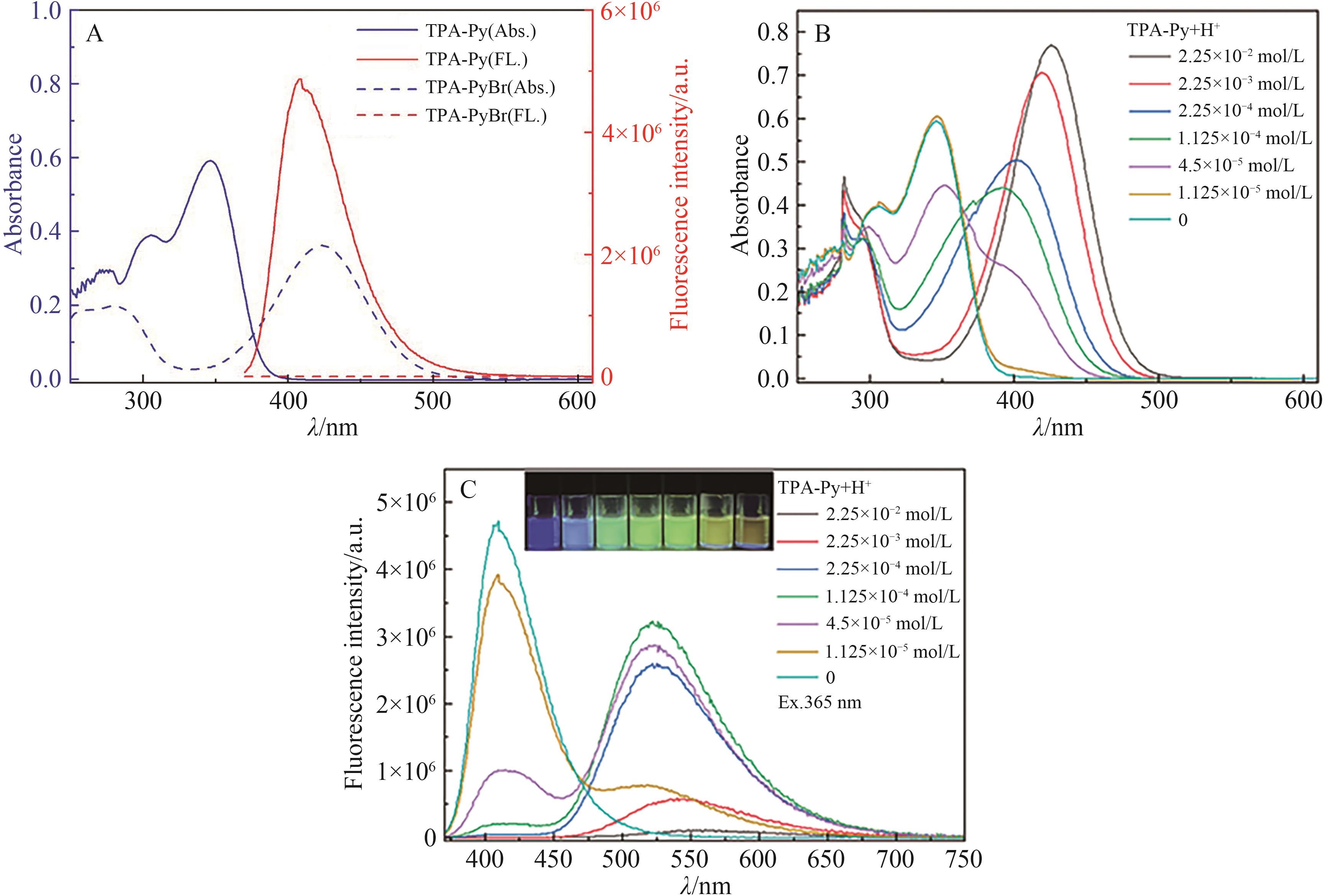
Fig.1 (A) Emission and absorption spectra of TPA-Py and TPA-PyBr; (B) Absorption spectra of TPA-Py at varying acid concentrations; (C) Emission spectra and fluorescence images of TPA-Py at varying acid concentrations
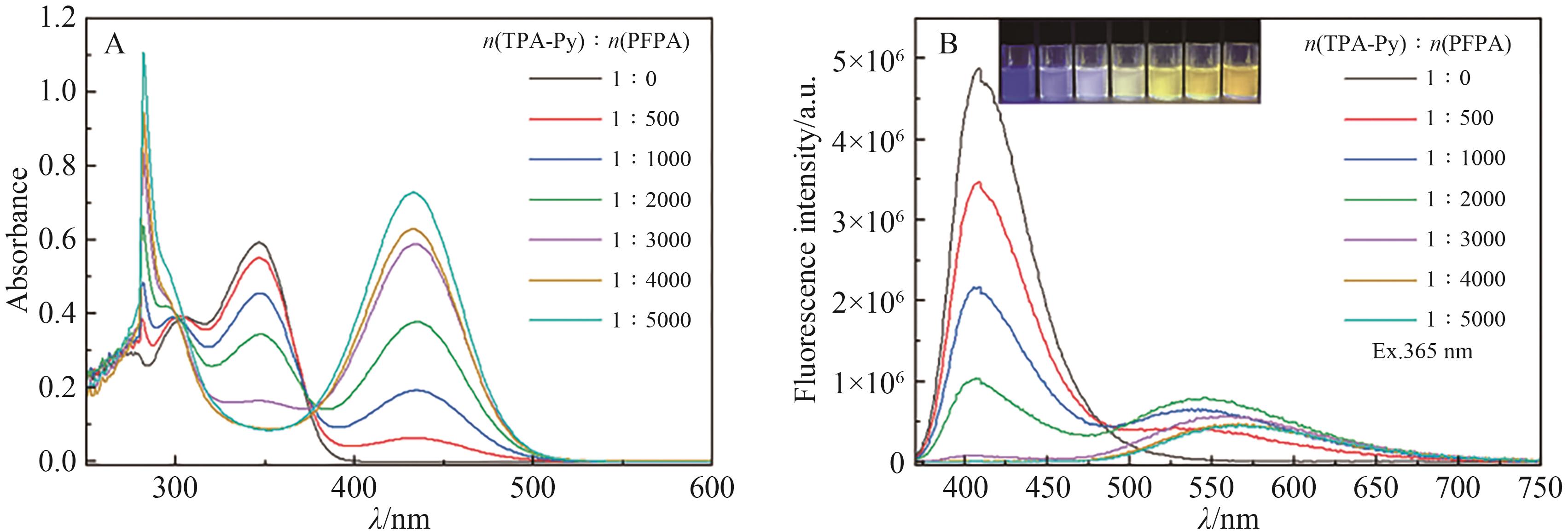
Fig.2 (A) Absorption spectra of TPA-Py in toluene as a function of pPFPA concentration; (B) Emission spectra of TPA-Py in toluene as a function of pPFPA concentration, along with the corresponding fluorescence images
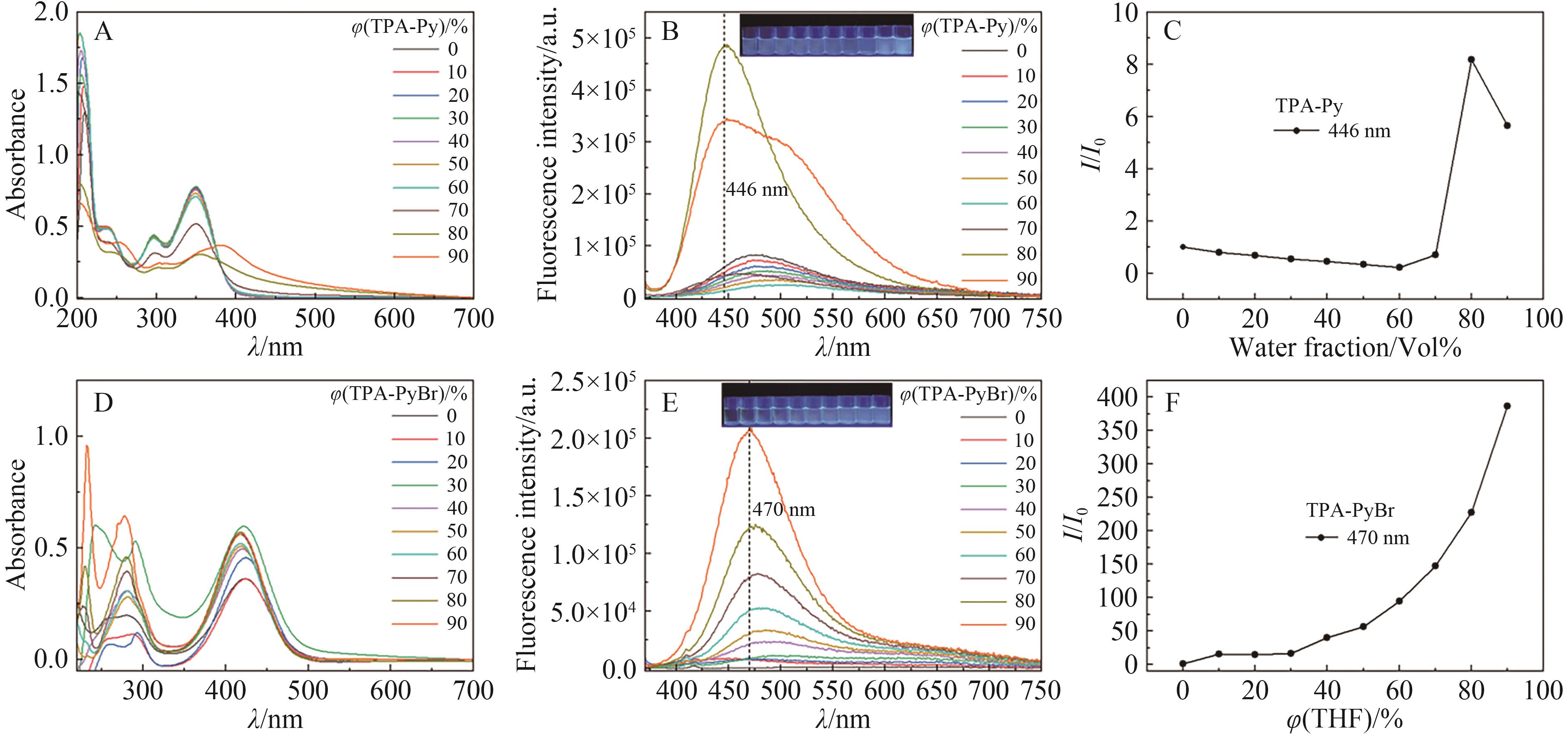
Fig.3 (A) Absorption and (B) emission spectra of TPA-Py in methanol/water mixtures with varying water fractions; (D) Absorption and (E) emission spectra of TPA-PyBr in water/THF mixtures with varying THF fractions. Plots of relative fluorescence intensity (I/I0) versus φw and φTHF at different emission wavelengths for (C) TPA-Py and (F) TPA-PyBr
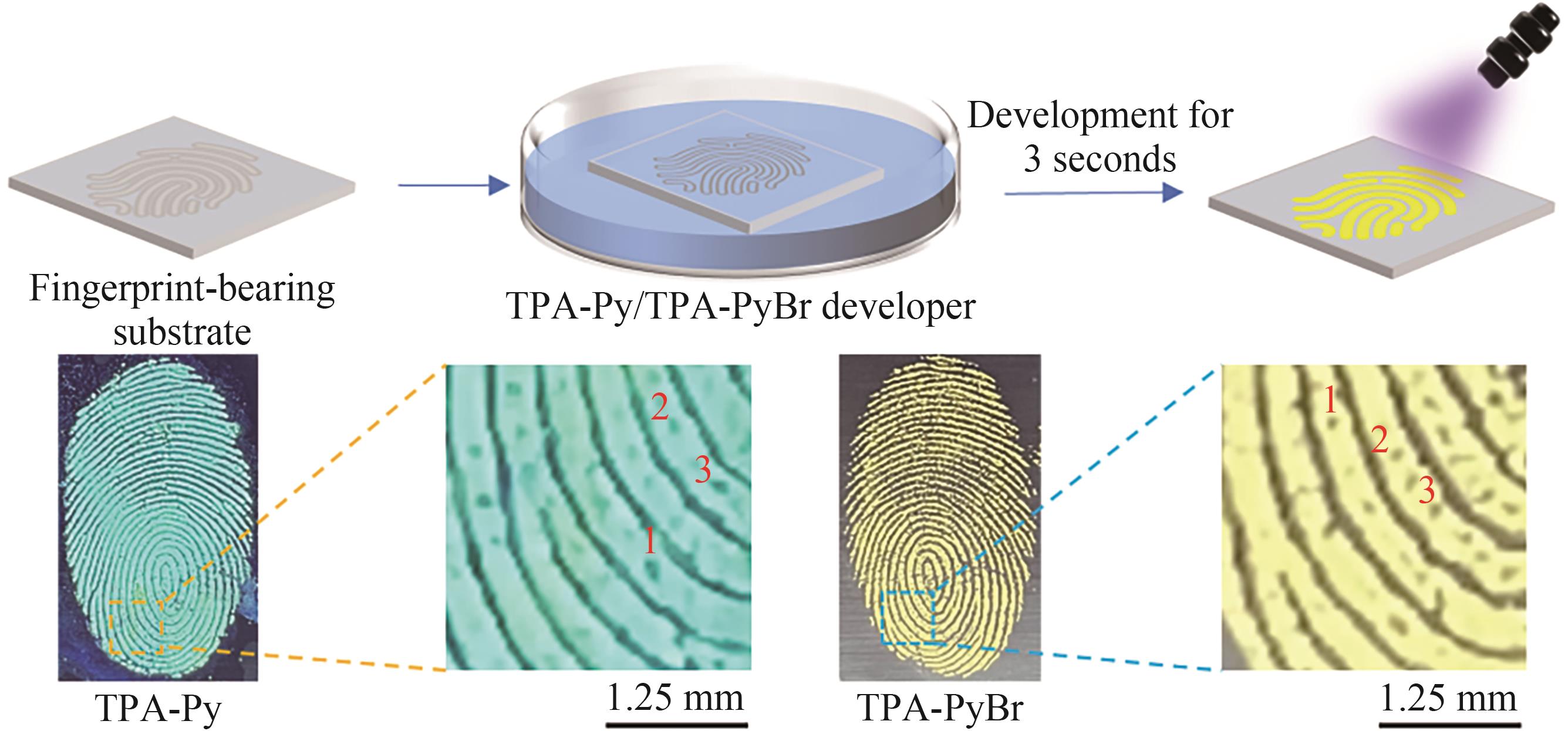
Fig.4 Schematic diagram of the fingerprint visualization mechanism and fluorescence images of fingerprints developed with different developing agents on aluminum foil
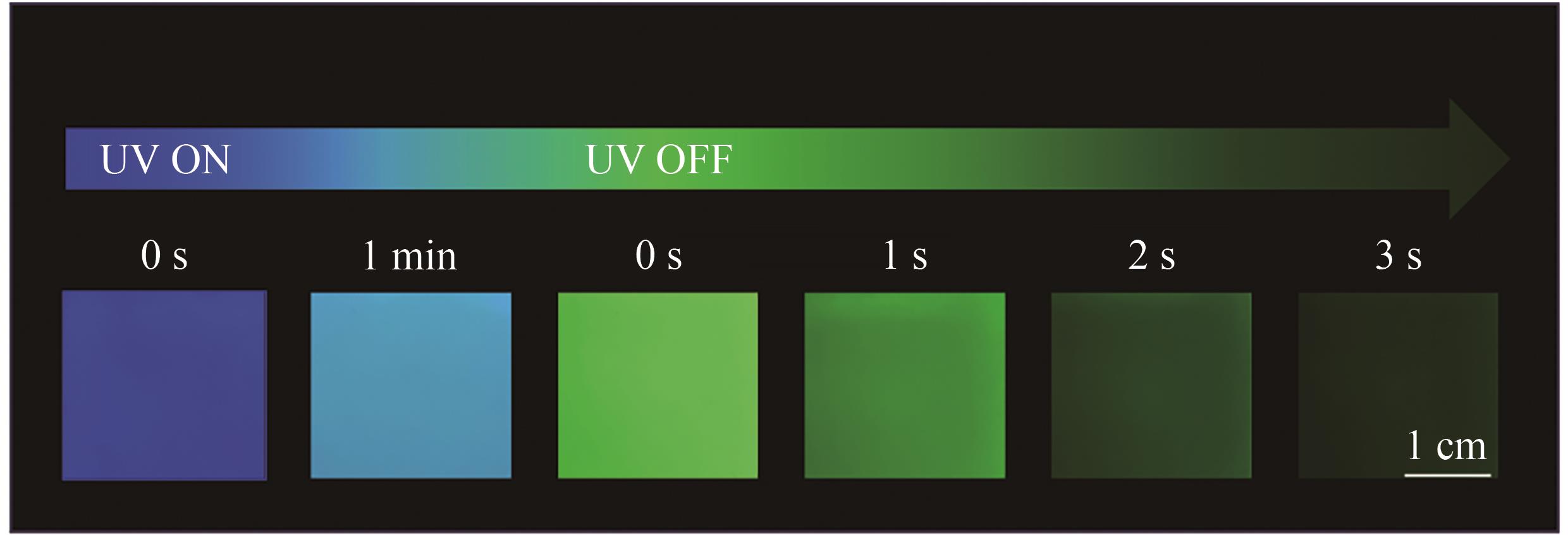
Fig.5 Photoactivable RTP phenomenon of TPA-Py@PMMA film
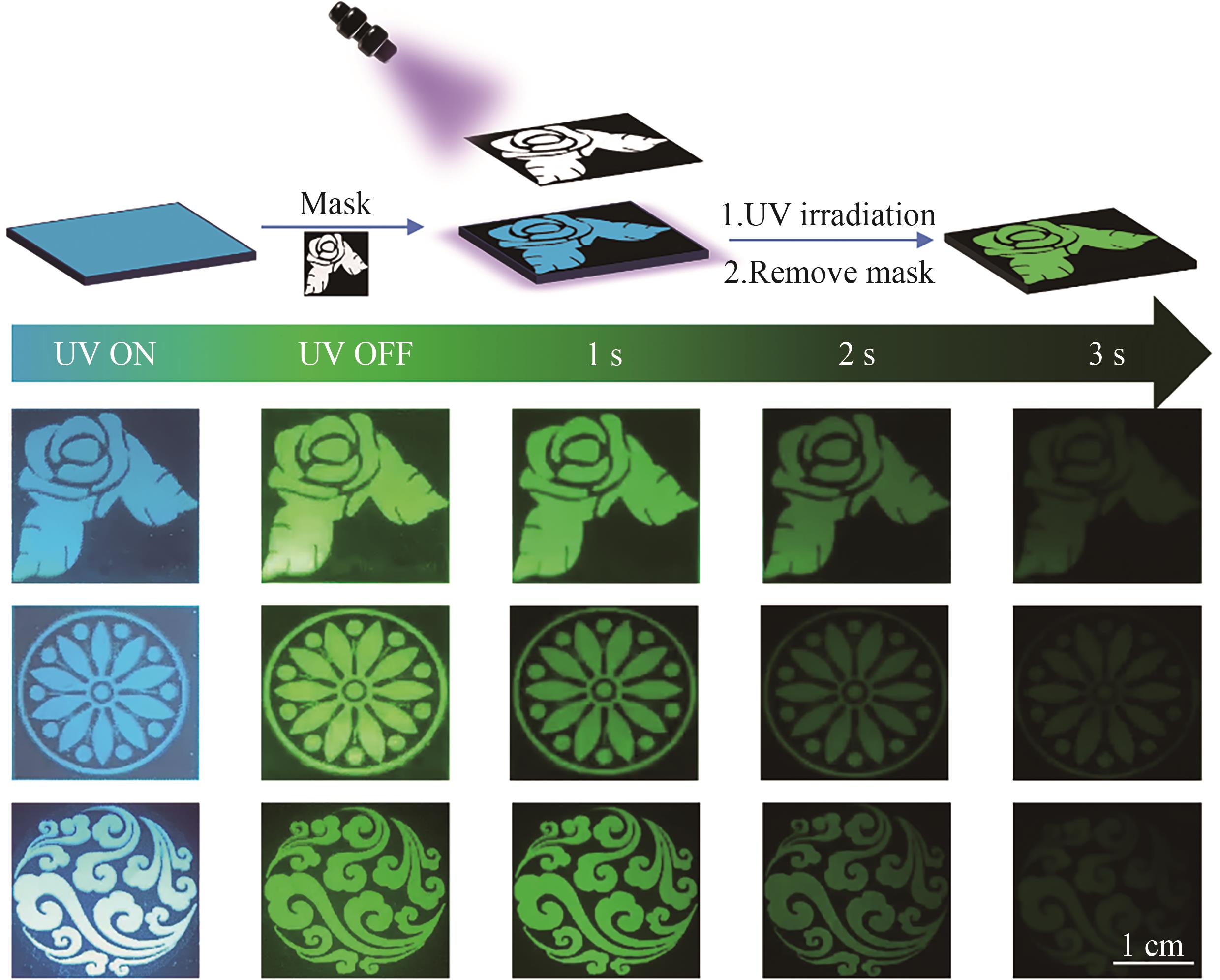
Fig.6 Erasable photoprinted phosphorescent patterns of TPA-Py@PMMA films
| [1] | SHEN Y, LE X X, WU Y, et al. Stimulus-responsive polymer materials toward multi-mode and multi-level information anti-counterfeiting: recent advances and future challenges[J]. Chem Soc Rev, 2024, 53(2): 606-623. |
| [2] | DONG Y, FENG S Y, HUANG W G, et al. Algorithm in chemistry: molecular logic gate-based data protection[J]. Chem Soc Rev, 2025, 54(8): 3681-3735. |
| [3] | HUANG W, FENG S Y, LIU J, et al. Configuration-induced multichromism of phenanthridine derivatives: a type of versatile fluorescent probe for microenvironmental monitoring[J]. Angew Chem Int Ed, 2023, 62(9): e202219337. |
| [4] | 陈虹蓉, 伍亚男, 陈仕焰, 等. 2-羟基萘甲醛苯甲酰腙衍生物对Al3+的裸眼识别和荧光传感[J]. 应用化学, 2016, 33(5): 599-605. |
| CHEN H R, WU Y N, CHEN S Y, et al “Naked-eye” and fluorescence “turn-on” recognition of Al3+ based on 2-hydroxy-naphthalene-formaldehyde benzoyl-hydrazone derivatives[J]. Chin J Appl Chem, 2016, 33(5): 599-605. | |
| [5] | 周佳, 倪赟, 张承武, 等. 嘧啶基双光子荧光染料的设计合成与生物成像[J]. 应用化学, 2017, 34(12): 1450-1456. |
| ZHOU J, NI B, ZHANG C W, et al. Design and synthesis of pyrimidine based two-photon fluorescence probe and its application in bioimaging[J]. Chin J Appl Chem, 2017, 34(12): 1450-1456. | |
| [6] | KUMAR A P, JIN D, LEE Y I. Recent development on spectroscopic methods for chiral analysis of enantiomeric compounds[J]. Appl Spec Rev, 2009, 44(4): 267-316. |
| [7] | IM H, YOON J, CHOI J, et al. Chaotic organic crystal phosphorescent patterns for physical unclonable functions[J]. Adv Mater, 2021, 33(44): 2102542. |
| [8] | JI Y M, LIU G J, LI C Y, et al. Water soluble glucosamine-coated AIE active fluorescent organic nanoparticles: design, synthesis and assembly for specific detection of heparin based on carbohydrate-carbohydrate interactions[J]. Chem Asian J, 2019, 14(19): 3295-3300. |
| [9] | CHAI X Y, ZHU W W, MENG Q G, et al. Si-rhodamine based water-soluble fluorescent probe for bioimaging of Cu+[J]. Chin Chem Lett, 2021, 32(1): 210-213. |
| [10] | QIAN Y X, LIU H M, TAN H J, et al. A novel water-soluble fluorescence probe with wash-free cellular imaging capacity based on AIE characteristics[J]. Macromol Rapid Commun, 2017, 38(10): 1600684. |
| [11] | 高长江, 黄鑫, 田亚洋, 等. 一种近红外快速响应型硫化氢荧光探针的合成及细胞成像[J]. 应用化学, 2025, 42(2): 192-200. |
| GAO C J, HUANG X, TIAN Y Y, et al. Synthesis and cell imaging of a near-infrared fast responsive hydrogen sulfide fluorescent probe[J]. Chin J Appl Chem, 2025, 42(2): 192-200. | |
| [12] | 蔡丰泽, 徐永玲, 周乐, 等. 一种红光发射的粘度荧光探针[J]. 应用化学, 2020, 37(4): 440-446. |
| CAI F Z, XU Y L, ZHOU L, et al. Synthesis and properties of red-emitting fluorescence probe for viscosity detection[J]. Chin J Appl Chem, 2020, 37(4): 440-446. | |
| [13] | MITRA A, RAMANUJAM B, RAO C P. 1-(D-Glucopyranosyl-2′-deoxy-2′-iminomethyl)-2-hydroxynaphthalene as chemo-sensor for Fe3+ in aqueous HEPES buffer based on colour changes observable with the naked eye[J]. Tetra Lett, 2009, 50(7): 776-780. |
| [14] | ERDEMIR S, MALKONDU S. Visual and quantitative detection of CN- ion in aqueous media by an HBT-Br and thiazolium conjugated fluorometric and colorimetric probe: real samples and useful applications[J]. Talanta, 2021, 221(1): 121-639. |
| [15] | LIU Y, MENG F F, LIN W Y. Single fluorescent probe for reversibly detecting copper ions and cysteine in a pure water system[J]. RSC Adv, 2016, 6(37): 30951-30955. |
| [16] | ZHANG Q J, LIAO M Y, XIAO K R, et al. A water-soluble fluorescence probe based on perylene diimide for rapid and selective detection of perfluorooctane sulfonate in 100% aqueous media[J]. Sens Actuators B, 2022, 350: 130851. |
| [17] | YANG Q Z, WEN Y J, XU J, et al. An HBT-based fluorescent dye with enhanced quantum yield in water system and its application for constructing NQO1 fluorescent probe[J]. Talanta, 2020, 216: 120982. |
| [18] | ZUO M D, ZENG C, LIU J, et al. Pyridine-based rigidochromic fluorescent security ink[J]. Chin J Chem, 2025, 43(12): 1405-1416. |
| [19] | CHEN Y Y, CHEN J M, WU H C, et al. Dynamically securing the data by 1O2 sensitization of fluorescent composites with a high latency and uncrackable features[J]. Chin J Chem, 2024, 42(14): 1651-1658. |
| [20] | HE B Z, HUANG J C, ZHANG J, et al. In-situ generation of poly(quinolizine)s via catalyst-free polyannulations of activated diyne and pyridines[J]. Sci China Chem, 2022, 65(4): 789-795. |
| [21] | LETHESH K C, EVJEN S, RAJ J J, et al. Hydroxyl functionalized pyridinium ionic liquids: experimental and theoretical study on physicochemical and electrochemical properties[J]. Front Chem, 2019, 7: 625. |
| [22] | CHEN G, LI W B, ZHOU T R, et al. Conjugation-induced rigidity in twisting molecules: filling the gap between aggregation-caused quenching and aggregation-induced emission[J]. Adv Mater, 2015, 27(30): 4496-4501. |
| [23] | CHEN S, HUANG W, YANG K, et al. Constructing versatile hydrophilic surfaces via in-situ aminolysis[J]. Chin J Struct Chem, 2021, 40(11): 1525-1534. |
| [24] | FENG S Y, ZHU L J, WANG D H, et al. Rigidity-tuned full-Color emission: uncommon luminescence change from polymer free-volume variations[J]. Adv Mater, 2022, 34(24): 2201337. |
| [25] | LING Y, LIU J, DONG Y, et al. Conventional non-fluorescent polymers: unconventional security inks for data storage and multidimensional photonic cryptography[J]. Adv Mater, 2023, 35(39): 2303641. |
| [26] | DONG Y, WU H C, LIU J, et al. Multicolor photochemical printing inside polymer matrices for advanced photonic anticounterfeiting[J]. Adv Mater, 2024, 36(26): 2401294. |
| [27] | CHEN J M, CHEN Y Y, LIU J, et al. In Situ optical detection of amines at a parts-per-quadrillion level by severing the through-space conjugated supramolecular domino[J]. J Am Chem Soc, 2024, 146(4): 2604-2614. |
| [28] | CHEN Y, LI A S, LI X N, et al. Multi-stimuli-responsive amphiphilic pyridinium salt and its application in the visualization of level 3 details in latent fingerprints[J]. Adv Mater, 2023, 35(20): 2401294. |
| [29] | 陈艳, 张春静, 高东梅, 等.潜指纹显现方法研究进展[J]. 应用化学, 2011, 28(10): 1099-1107. |
| CHEN Y, ZHANG C J, GAO D M, et al. Development of visualization of latent fingerprints[J]. Chin J Appl Chem, 2011, 28(10): 1099-1107. | |
| [30] | 李冲, 陈颖, 谢诺华, 等. 亲水性二芳基乙烯荧光分子开关的研究进展[J]. 应用化学, 2017, 34(12): 1379-1402. |
| LI C, CHEN Y, XIE N H, et al. Research progress on hydrophilic photoswitchable fluorescent diarylethenes[J]. Chin J Appl Chem, 2017, 34(12): 1379-1402. | |
| [31] | XIONG S D, XIONG Y, WANG D L, et al. Achieving tunable organic afterglow and UV-irradiation-responsive ultralong room-temperature phosphorescence from pyridine-substituted triphenylamine derivatives[J]. Adv Mater, 2023, 35(28): 2301874. |
| [32] | MA F L, WU B, ZHANG S W, et al. Lone pairs-mediated multiple through-space interactions for efficient room-temperature phosphorescence[J]. J Am Chem Soc, 2025, 147(12): 10803-10814. |
| [1] | Xin-Xin HUANG, You-Sheng SHI, Tao DENG, Chun CAI. Research Progress of Fluorescent Probes Based on Aggregation-Induced Emission for Detection of Biomarkers [J]. Chinese Journal of Applied Chemistry, 2025, 42(8): 1035-1056. |
| [2] | Zhen-Zhen MENG, Jin-Feng YANG, Yu-Kang YAN. Application of Near Infrared Aggregation-Induced Emission Fluorescence Probe with Benzopyranitrile in Viscosity Detection and Cell Imaging [J]. Chinese Journal of Applied Chemistry, 2025, 42(7): 971-981. |
| [3] | Zhen-Cao WANG, Ning LYU, Liang-Fang CHEN, Yue-Feng RAO. Research Progress of Aggregation-Induced Emission Molecules for Fluorescence Imaging Therapy [J]. Chinese Journal of Applied Chemistry, 2025, 42(6): 741-756. |
| [4] | Da-Wei TONG, Ming KONG, Yu-Bin XIANG. Synthesis, Photophysical Properties, Theoretical Calculation and Cell Imaging of a Tetraphenylethene Imidazole Compound with Methoxy Group [J]. Chinese Journal of Applied Chemistry, 2023, 40(9): 1322-1329. |
| [5] | Yue YANG, Shi-Wen HUANG, Yue TONG, Ze-Da CHEN, Ben-Hua MA, Chuan-Dong DOU. Donor-Acceptor Type Chiral Tetracoordinate Organoboranes and Their Optical Properties [J]. Chinese Journal of Applied Chemistry, 2023, 40(5): 743-748. |
| [6] | CHENG Jinhua, JIANG Hongji. Study on Self-assembly Behaviors of an Amphiphilic Block Polymer by Terminally Grafting Tetraphenylethene-Based Aggregation-Induced Emission Active Moietys [J]. Chinese Journal of Applied Chemistry, 2019, 36(4): 440-450. |
| [7] | WANG Tao,MA Lamaocao,MA Hengchang. Research Progress on Cell Imaging Based on the Aggregation-induced Emission Fluorescent Probes [J]. Chinese Journal of Applied Chemistry, 2018, 35(10): 1155-1165. |
| Viewed | ||||||
|
Full text |
|
|||||
|
Abstract |
|
|||||
