
应用化学 ›› 2025, Vol. 42 ›› Issue (9): 1196-1208.DOI: 10.19894/j.issn.1000-0518.240289
翟好英, 杨琴, 吴毅, 蒋洪洋, 周文俊( )
)
收稿日期:2024-09-04
接受日期:2025-07-16
出版日期:2025-09-01
发布日期:2025-09-28
通讯作者:
周文俊
基金资助:
Hao-Ying ZHAI, Qin YANG, Yi WU, Hong-Yang JIANG, Wen-Jun ZHOU()
Received:2024-09-04
Accepted:2025-07-16
Published:2025-09-01
Online:2025-09-28
Contact:
Wen-Jun ZHOU
About author:zhwj84@126.comSupported by:摘要:
在强光照射下,CdS量子点易发生光腐蚀现象,通过金属掺杂和复合的方式可以提高CdS的光催化性能和光稳定性。 采用水热法合成了Zn掺杂CdS/g-C3N4复合纳米材料(Zn-CdS/g-C3N4)。利用扫描电子显微镜(SEM)、透射电子显微镜(TEM)、X射线衍射(XRD)、X射线光电子能谱(XPS)和傅里叶变换红外光谱(FT-IR)等手段对Zn-CdS/g-C3N4复合材料的形貌、结构和组成等进行了表征。 结果表明,Zn-CdS纳米颗粒附着在g-C3N4表面上,从而形成Zn-CdS/g-C3N4复合材料,且复合后材料带隙减小,光生电子-空穴复合率降低。 在500 W Xe灯照射下,研究了Zn-CdS/g-C3N4对罗丹明B(RhB)的光催化降解性能。 在最优条件下,光照40 min后,所制备的Zn-CdS/g-C3N4对RhB的光催化降解效率达99%。 此外,所合成的Zn-CdS/g-C3N4复合材料光稳定性较高、可再生性好。 这归因于Zn和Cd的协同作用以及与g-C3N4的复合,促进了光生载流子的分离和转移。
中图分类号:
翟好英, 杨琴, 吴毅, 蒋洪洋, 周文俊. Zn掺杂CdS/g-C3N4复合材料的制备及其光催化性能[J]. 应用化学, 2025, 42(9): 1196-1208.
Hao-Ying ZHAI, Qin YANG, Yi WU, Hong-Yang JIANG, Wen-Jun ZHOU. Preparation and Photocatalytic Properties of Zn-CdS/g-C3N4 Composites[J]. Chinese Journal of Applied Chemistry, 2025, 42(9): 1196-1208.
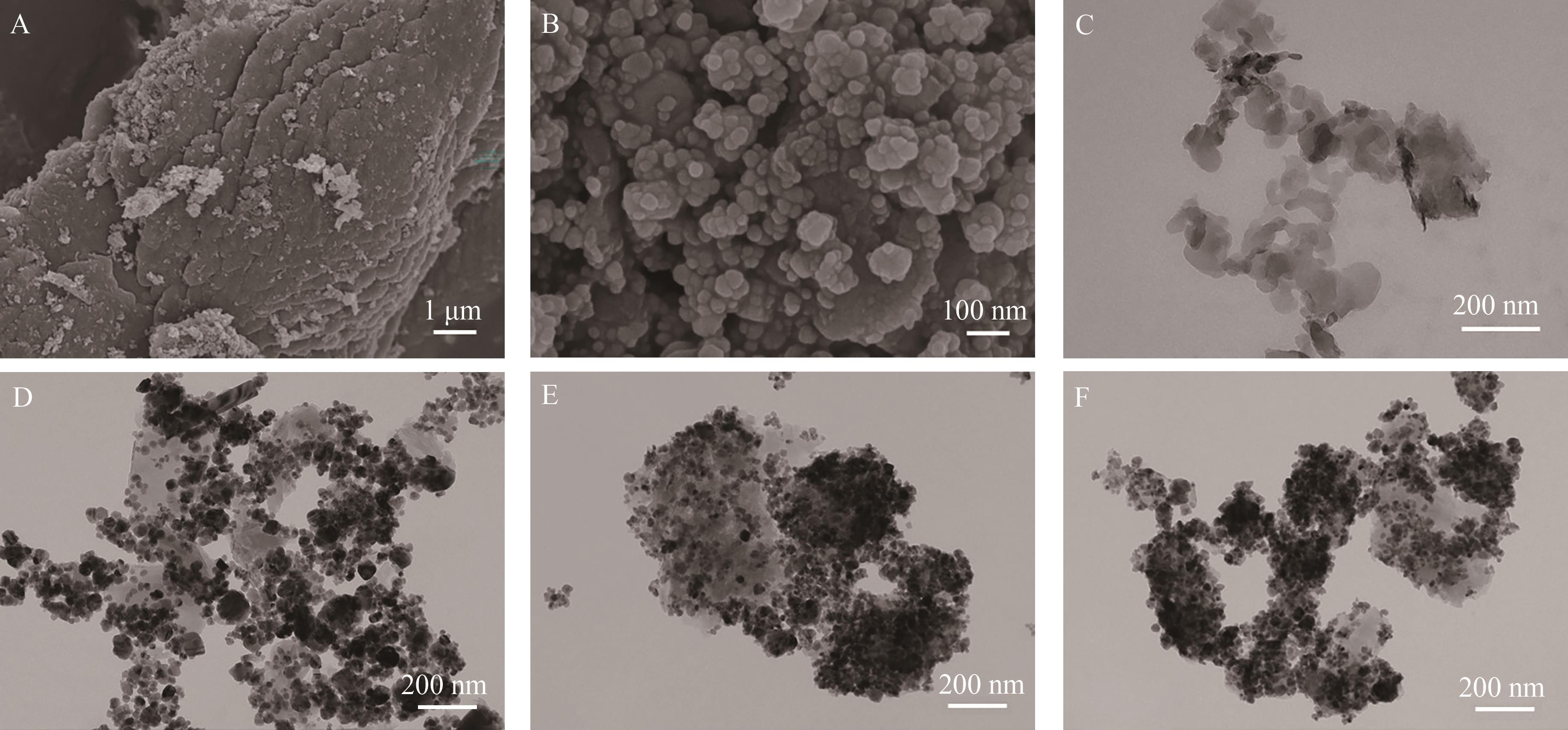
图1 g-C3N4(A)和Zn-CdS/g-C3N4(B)的SEM图; g-C3N4 (C)、Zn-CdS/g-C3N4 (D)、Zn-CdS/g-C3N4循环1次(E)和4次后(F)的TEM图
Fig.1 SEM images of g-C3N4 (A) and Zn-CdS/g-C3N4 (B); TEM images of g-C3N4 (C), Zn-CdS/g-C3N4 (D), Zn-CdS/g-C3N4 after one (E) and four cycles (F)
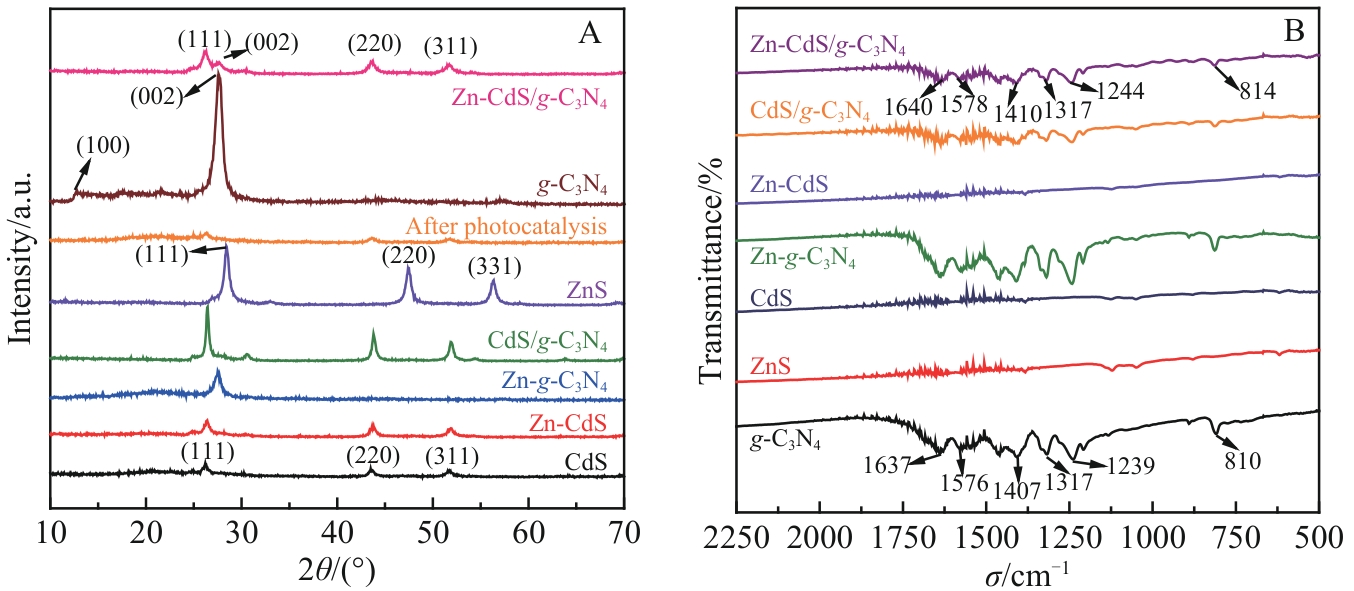
图2 光催化材料的XRD(A)和FT-IR谱图(B)
Fig.2 XRD (A) and FT-IR (B) patterns of different photocatalytic materials
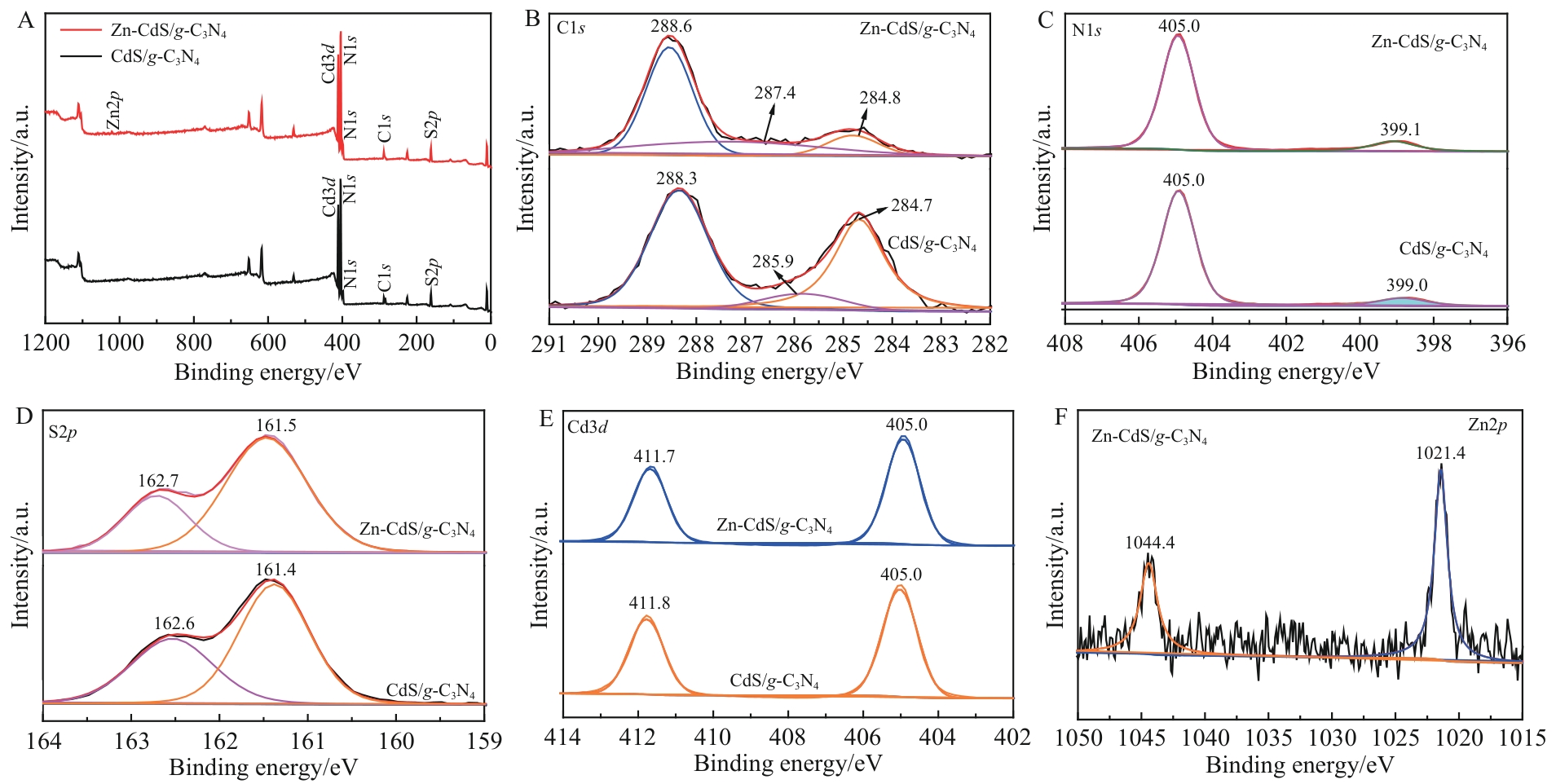
图3 Zn-CdS/g-C3N4和CdS/g-C3N4的全图(A)、C1s (B)、N1s (C)、S2p (D)、Cd3d (E)和Zn2p (F)的XPS图
Fig.3 XPS images of overall (A), C1s (B), N1s (C), S2p (D), Cd3d (E) and Zn2p (F) of Zn-CdS/g-C3N4 and CdS/g-C3N4
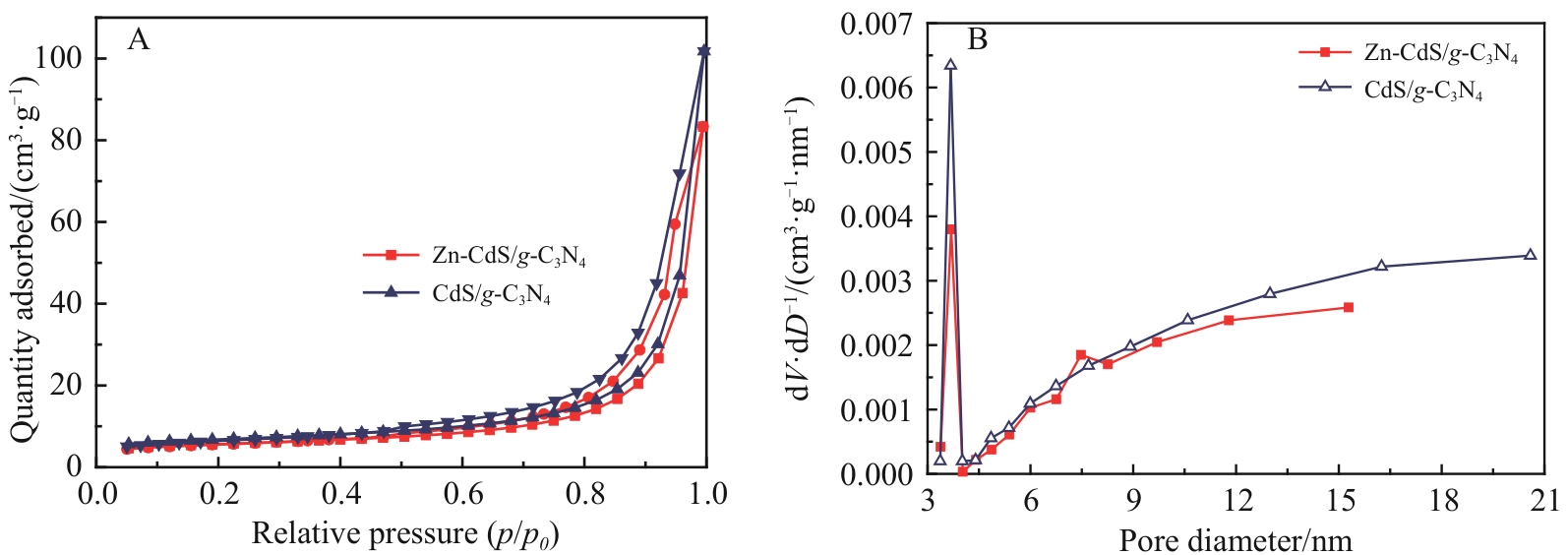
图4 N2吸附-脱附等温线(A)和孔径分布图(B)
Fig.4 N2 adsorption-desorption isotherms (A) and pore size distribution curves (B)
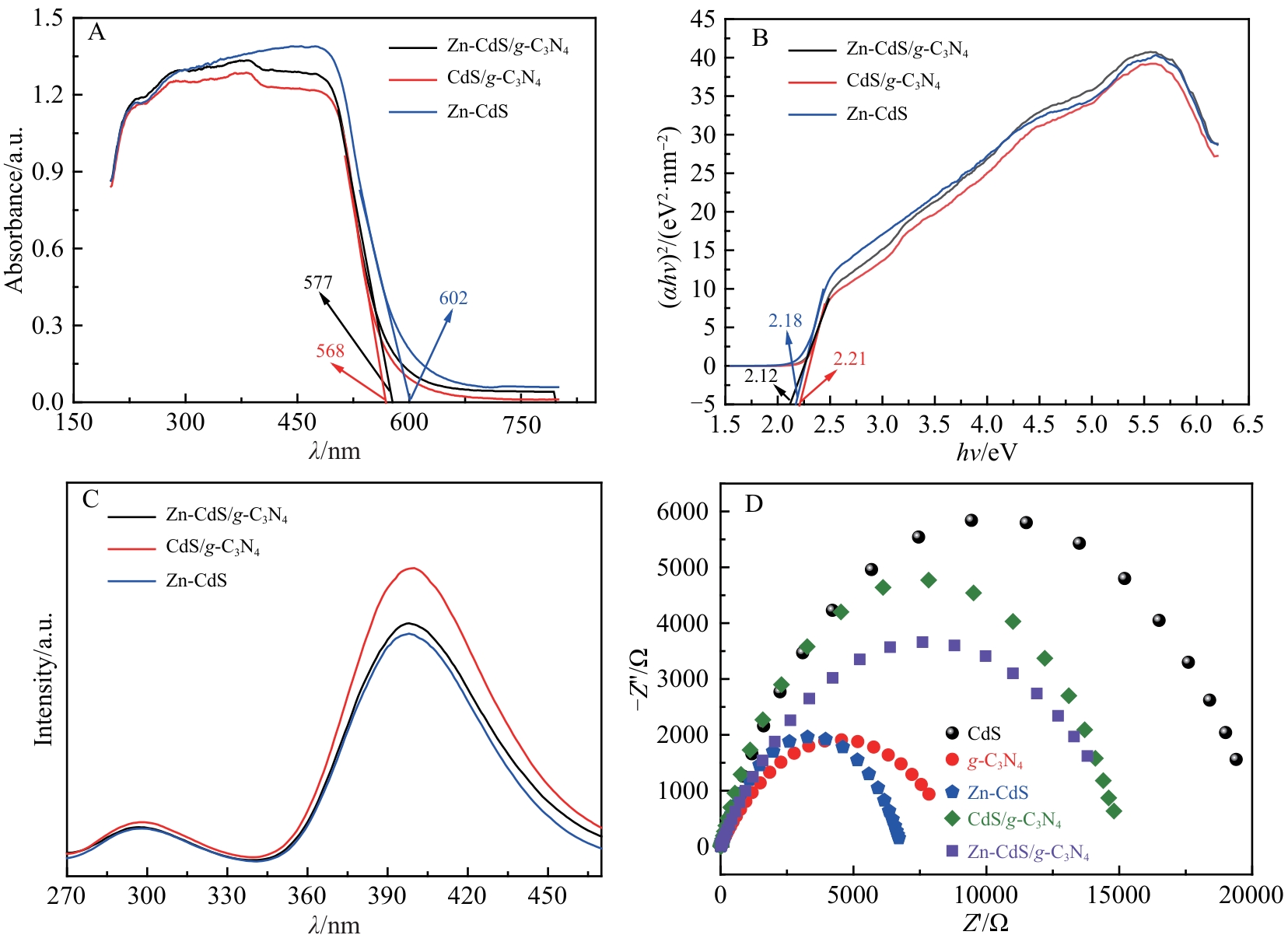
图5 Zn-CdS/g-C3N4、 CdS/g-C3N4和Zn-CdS的紫外-可见吸收光谱(A)、(αhv)2与光子能量(hv)的图(B)、光致发光光谱(C)和电化学阻抗谱图(D)
Fig.5 UV-Vis absorption spectra (A), the plot of (αhv)2 and photon energy (hv) (B), PL spectra (C) and EIS spectra (D) of Zn-CdS/g-C3N4, CdS/g-C3N4 and Zn-CdS
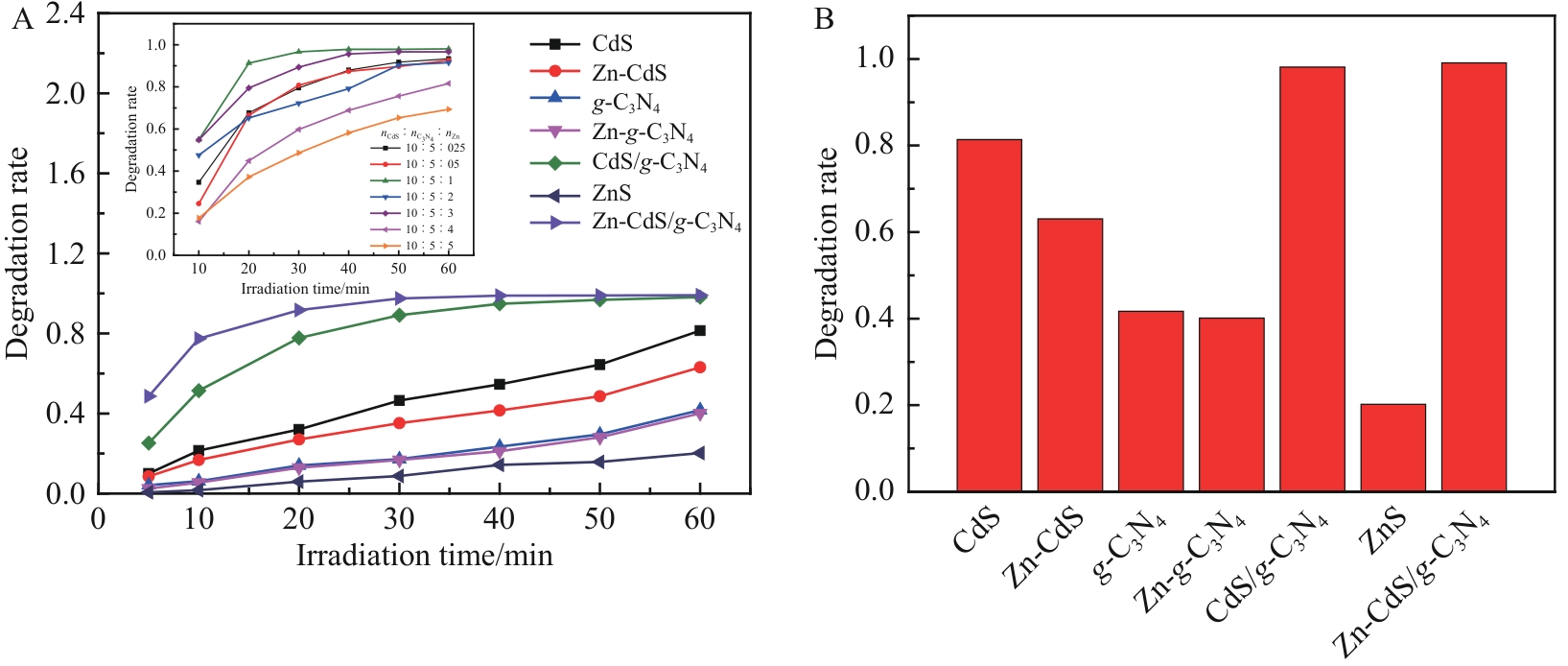
图6 不同光催化剂对RhB的降解(A) (插图: Zn2+掺杂量对光降解RhB的影响)和光照60 min后对RhB的降解(B)
Fig.6 Degradation of RhB by the different photocatalysts (A) (Inset: influence of Zn2+ doping amount) and degradation of RhB after 60 min irradiation (B)
| Material | Degradation efficiency/% | Time/min | Dye | Source light | Ref. |
|---|---|---|---|---|---|
| CdS/g-C3N4/MOF | 90.2 | 90 | RhB | Visible | [ |
| Zn doped CdS | 93 | 135 | RhB | Visible | [ |
| CdS/ZnS | 83 | 60 | MO | UV | [ |
| CdS/g-C3N4 | 95 | 150 | RhB | Visible | [ |
| CdS-ZnS-BiPO4 | 95 | 150 | MB | Visible | [ |
| CuS@ZnS | 65 | 90 | MB | UV | [ |
| T-CN/CdS | 100 | 60 | RhB | Visible | [ |
| P25/Zn0.15Cd0.85S 1-5 | 100 | 60 | RhB | Visible | [ |
| Zn-CdS/g-C3N4 | 99 | 40 | RhB | Visible | This work |
表1 本研究结果与相关文献结果的比较
Table 1 Comparison of the results of the present study with those of related literatures
| Material | Degradation efficiency/% | Time/min | Dye | Source light | Ref. |
|---|---|---|---|---|---|
| CdS/g-C3N4/MOF | 90.2 | 90 | RhB | Visible | [ |
| Zn doped CdS | 93 | 135 | RhB | Visible | [ |
| CdS/ZnS | 83 | 60 | MO | UV | [ |
| CdS/g-C3N4 | 95 | 150 | RhB | Visible | [ |
| CdS-ZnS-BiPO4 | 95 | 150 | MB | Visible | [ |
| CuS@ZnS | 65 | 90 | MB | UV | [ |
| T-CN/CdS | 100 | 60 | RhB | Visible | [ |
| P25/Zn0.15Cd0.85S 1-5 | 100 | 60 | RhB | Visible | [ |
| Zn-CdS/g-C3N4 | 99 | 40 | RhB | Visible | This work |
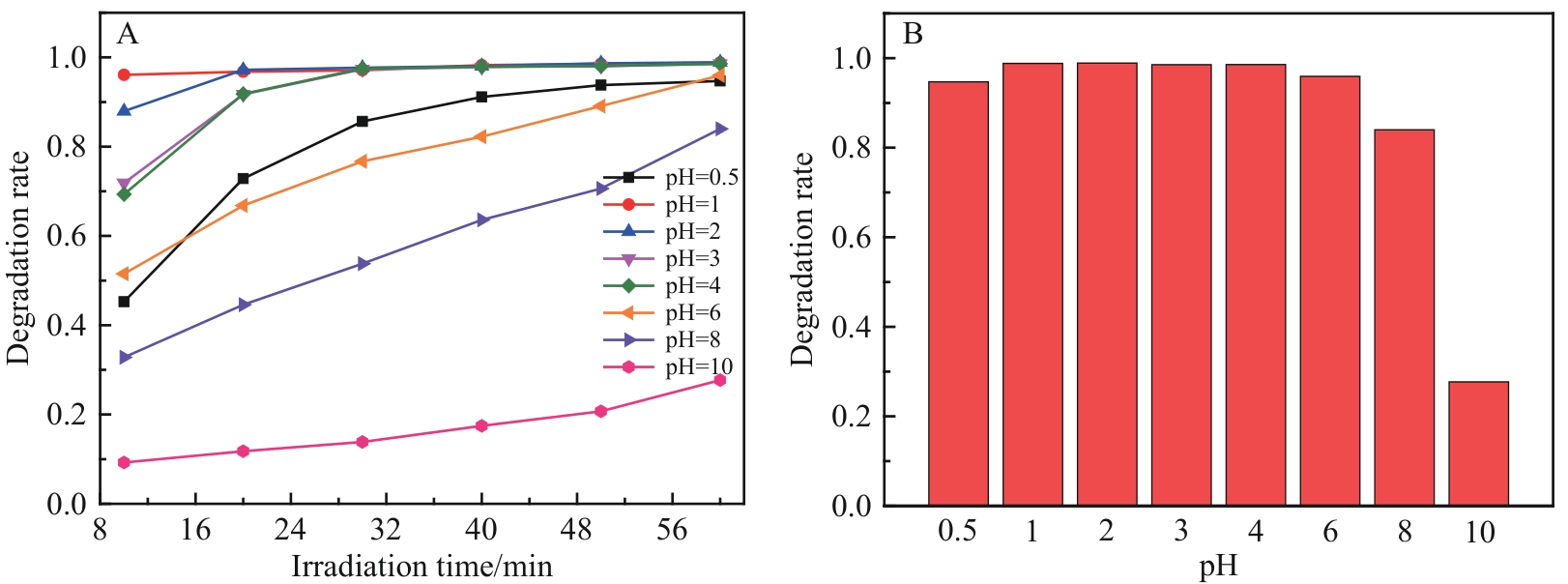
图7 pH值对Zn-CdS/g-C3N4降解RhB的影响(A)和Zn-CdS/g-C3N4在不同pH值光照60 min后对RhB的降解(B)
Fig.7 Influence of pH values on the degradation of RhB by Zn-CdS/g-C3N4 (A) and degradation of RhB by Zn-CdS/g-C3N4 after 60 min irradiation at different pH values (B)
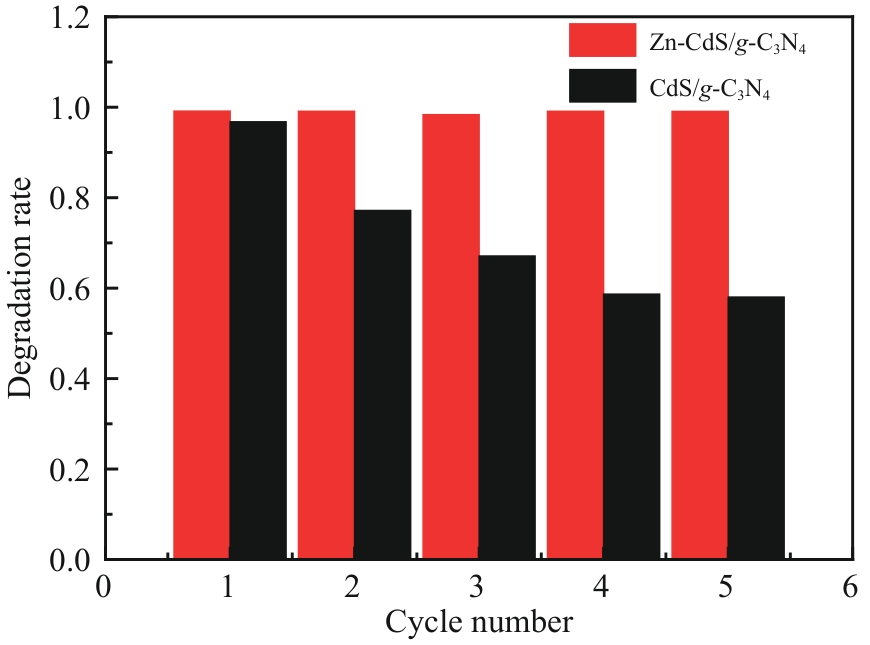
图8 Zn-CdS/g-C3N4和CdS/g-C3N4的循环性
Fig.8 Cyclability of Zn-CdS/g-C3N4 and CdS/g-C3N4
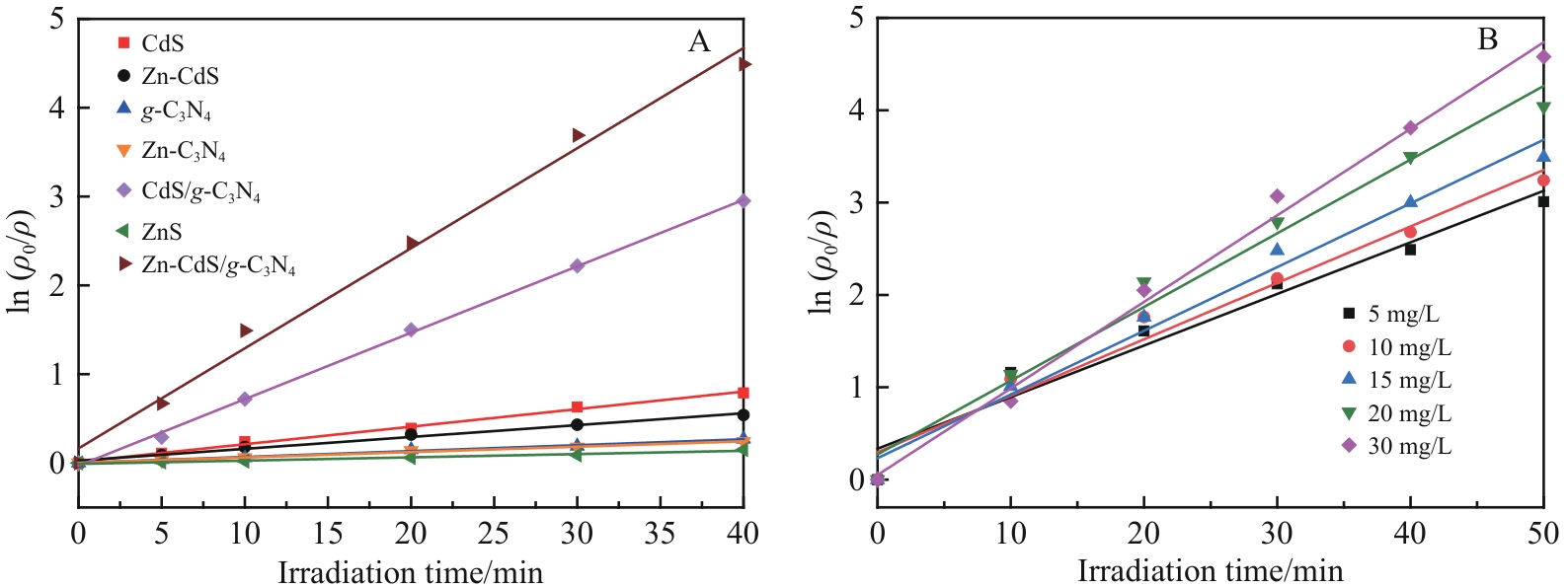
图9 不同材料光催化降解RhB (A)和Zn-CdS/g-C3N4光降解不同浓度RhB的动力学(B)
Fig.9 Photocatalytic kinetics of photocatalytic degradation of RhB by different photocatalytic materials (A) and RhB at different concentrations by Zn-CdS/g-C3N4 (B)
| Material | Kinetic equation | Apparent rate constant(k)/min-1 | Correlation coefficient(R2) |
|---|---|---|---|
| CdS | ln (ρ0/ρ)=0.01975t+0.01442 | 0.019 75 | 0.995 43 |
| Zn-CdS | ln (ρ0/ρ)=0.01335t+0.02642 | 0.013 35 | 0.989 50 |
| g-C3N4 | ln (ρ0/ρ)=0.00663t+0.00228 | 0.006 63 | 0.991 28 |
| Zn-g-C3N4 | ln (ρ0/ρ)=0.00604t+0.0026 | 0.006 04 | 0.992 42 |
| CdS/g-C3N4 | ln (ρ0/ρ)=0.07482t-0.02937 | 0.074 82 | 0.999 23 |
| ZnS | ln (ρ0/ρ)=0.00368t-0.00947 | 0.003 68 | 0.973 92 |
| Zn-CdS/g-C3N4 | ln (ρ0/ρ)=0.11267t+0.16488 | 0.112 67 | 0.991 59 |
表2 不同材料光降解RhB的动力学方程和表观速率常数
Table 2 Kinetic equations and apparent rate constants of photodegradation RhB by different materials
| Material | Kinetic equation | Apparent rate constant(k)/min-1 | Correlation coefficient(R2) |
|---|---|---|---|
| CdS | ln (ρ0/ρ)=0.01975t+0.01442 | 0.019 75 | 0.995 43 |
| Zn-CdS | ln (ρ0/ρ)=0.01335t+0.02642 | 0.013 35 | 0.989 50 |
| g-C3N4 | ln (ρ0/ρ)=0.00663t+0.00228 | 0.006 63 | 0.991 28 |
| Zn-g-C3N4 | ln (ρ0/ρ)=0.00604t+0.0026 | 0.006 04 | 0.992 42 |
| CdS/g-C3N4 | ln (ρ0/ρ)=0.07482t-0.02937 | 0.074 82 | 0.999 23 |
| ZnS | ln (ρ0/ρ)=0.00368t-0.00947 | 0.003 68 | 0.973 92 |
| Zn-CdS/g-C3N4 | ln (ρ0/ρ)=0.11267t+0.16488 | 0.112 67 | 0.991 59 |
| ρ(RhB)/(mg?L-1) | Kinetic equation | Apparent rate constant(k)/min-1 | Correlation coefficient(R2) |
|---|---|---|---|
| 5 | ln (ρ0/ρ)=0.05586t+0.33524 | 0.055 86 | 0.957 85 |
| 10 | ln (ρ0/ρ)=0.06111t+0.29714 | 0.061 11 | 0.970 57 |
| 15 | ln (ρ0/ρ)=0.06897t+0.23238 | 0.068 97 | 0.982 06 |
| 20 | ln (ρ0/ρ)=0.07980t+0.27333 | 0.079 80 | 0.980 74 |
| 30 | ln (ρ0/ρ)=0.09371t+0.05048 | 0.093 71 | 0.993 22 |
表3 Zn-CdS/g-C3N4光降解不同浓度RhB动力学方程和表观速率常数
Table 3 Kinetic equations and apparent rate constants of photodegradation RhB at different concentrations
| ρ(RhB)/(mg?L-1) | Kinetic equation | Apparent rate constant(k)/min-1 | Correlation coefficient(R2) |
|---|---|---|---|
| 5 | ln (ρ0/ρ)=0.05586t+0.33524 | 0.055 86 | 0.957 85 |
| 10 | ln (ρ0/ρ)=0.06111t+0.29714 | 0.061 11 | 0.970 57 |
| 15 | ln (ρ0/ρ)=0.06897t+0.23238 | 0.068 97 | 0.982 06 |
| 20 | ln (ρ0/ρ)=0.07980t+0.27333 | 0.079 80 | 0.980 74 |
| 30 | ln (ρ0/ρ)=0.09371t+0.05048 | 0.093 71 | 0.993 22 |
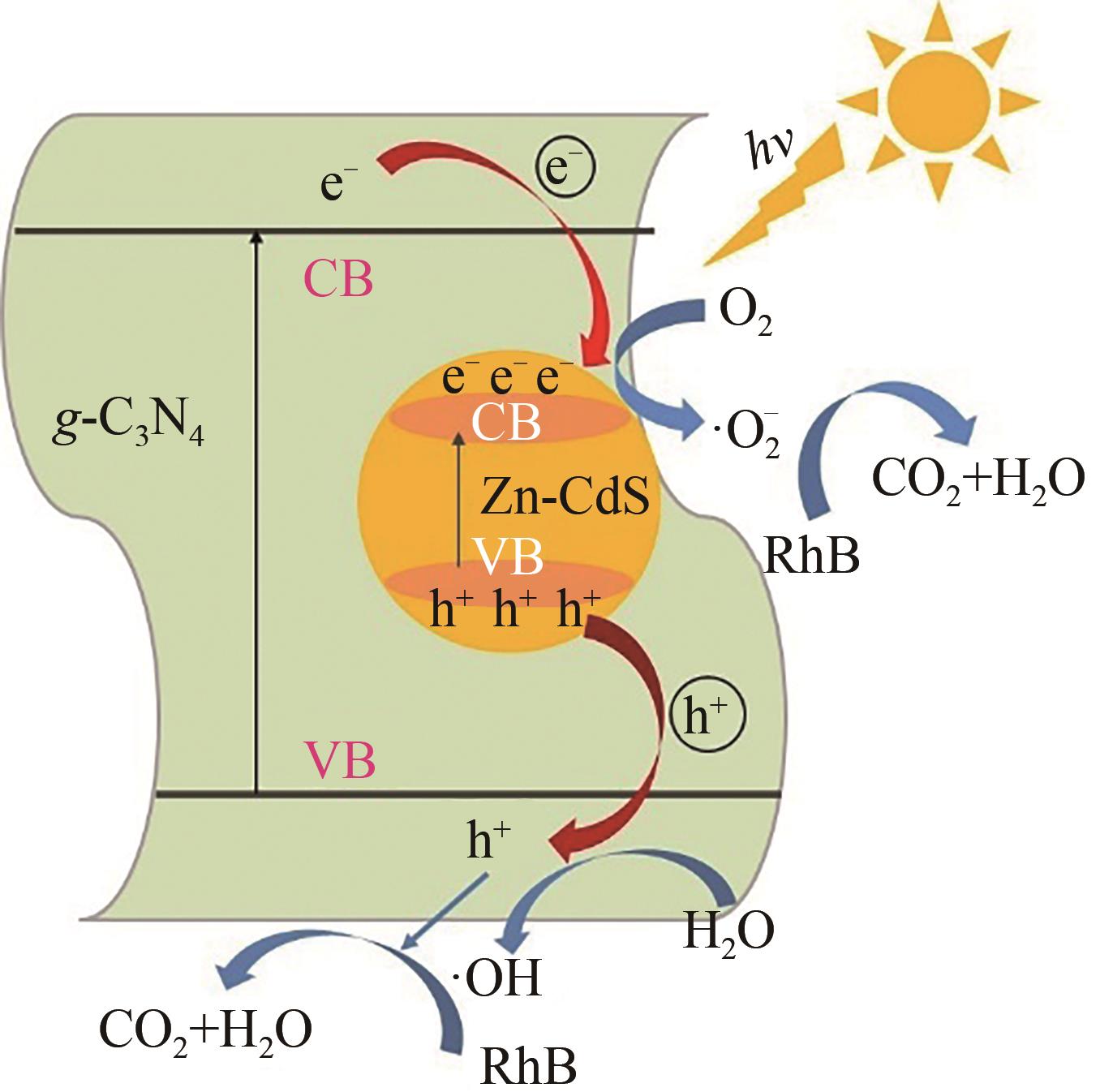
图10 Zn-CdS/g-C3N4光催化降解水中RhB的机理示意图
Fig.10 Proposed mechanism for photocatalytic degradation of RhB in water by Zn-CdS/g-C3N4
| [1] | AMEEN S, MURTAZE M, ARSHAD M, et al. Perovskite LaNiO3/Ag3PO4 heterojunction photocatalyst for the degradation of dyes[J]. Front Chem, 2022, 10: 969698. |
| [2] | 邹明, 丁颖, 刘海涛, 等. 纳米CdS/rGO的表征与光催化性能研究[J]. 化工新型材料, 2024, 52(7): 148-152, 156. |
| ZOU M, DING Y, LIU H T, et al. Characterization of nano CdS/rGO and its photocatalytic performance[J]. New Chem Mater, 2024, 52(7): 148-152, 156. | |
| [3] | SHARMA R, THAKUR P, KUMAR M, et al. Nanomaterials for high frequency device and photocatalytic applications: Mg-Zn-Ni ferrites[J]. J Alloy Compd, 2018, 746: 532-539. |
| [4] | CUI H, DONG S Y, WANG K K, et al. Synthesis of a novel type-Ⅱ In2S3/Bi2MoO6 heterojunction photocatalyst: excellent photocatalytic performance and degradation mechanism for rhodamine B[J]. Sep Purif Technol, 2020, 255: 117758. |
| [5] | ALI A, AHMED A, USMAN M, et al. Synthesis of visible light responsive Ce0.2Co0.8Fe2O4/g-C3N4 composites for efficient photocatalytic degradation of rhodamine B[J]. Diam Relat Mater, 2023, 133: 109721. |
| [6] | LIU T Q, ANIAGOR C O, EJIMOFOR M I, et al. Recent developments in the utilization of modified graphene oxide to adsorb dyes from water: a review[J]. J Ind Eng Chem, 2023, 117: 21-37. |
| [7] | LUO X H, CHEN L, HU Y Y. Comparison of different enhanced coagulation methods for azo dye removal from wastewater[J]. Sustainability, 2019, 11(17): 4760. |
| [8] | LONG J, XIE Z F, XUE S S, et al. Highly stable and permeable graphene oxide membrane modified by carbohydrazide for efficient dyes separation[J]. Sep Purif Technol, 2022, 298: 121586. |
| [9] | KUMAR V, THAKUR C, CHAUDHARI P K. Anaerobic biological treatment of dye bearing water in anaerobic sequencing batch reactor: performance and kinetics studies[J]. J Indian Chem Soc, 2022, 99(10): 100673. |
| [10] | DUČIĆ M J, KRSTIĆ A, ZDOLŠEK N, et al. Low-cost graphene-based composite electrodes for electrochemical oxidation of phenolic dyes[J]. Crystals, 2023, 13(1): 125. |
| [11] | QAZI U Y, IFTIKHAR R, IKHLAQ A, et al. Application of Fe-RGO for the removal of dyes by catalytic ozonation process[J]. Environ Sci Pollut R, 2022, 29(59): 89485-89497. |
| [12] | LI J N, CHEN X L, ZHANG Q, et al. Fabrication of Z-scheme heterojunctions of CDs@WO3/g-C3N4 nanocomposite photocatalyst with enhanced visible-light photocatalytic degradation of malachite green[J]. J Mater Sci Mater El, 2024, 35(8): 598. |
| [13] | SINGH V, BANSAL P. Fabrication and characterization of needle shaped CuO nanoparticles and their application as photocatalyst for degradation of organic pollutants[J]. Mater Lett, 2020, 261: 126929. |
| [14] | XU L, ZHANG S Z, ZHANG Z H, et al. Visible-light-mediated oxidative amidation of aldehydes using a magnetic CdS quantum dot as photocatalyst[J]. Chem Eur J, 2021, 27(17): 5483-5491. |
| [15] | WAKERLEY D W, KUEHNEL M F, ORCHARD K L, et al. Solar-driven reforming of lignocellulose to H2 with a CdS/CdOx photocatalyst[J]. Nat Energy, 2017, 2: 17021. |
| [16] | ZHU C, LIU C G, ZOU Y J, et al. Carbon dots enhance the stability of CdS for visible-light-driven overall water splitting[J]. Appl Catal B: Environ, 2017, 216: 114-121. |
| [17] | QI S Y, ZHANG R Y, ZHANG Y M, et al. Construction and photocatalytic properties of the Zn doping on CdS[J]. Appl Phys A Mater, 2022, 128: 353. |
| [18] | MADDI L, VINUKONDA K, GURUGUBELLI T R, et al. One-step, in situ hydrothermal fabrication of cobalt-doped ZnO/CdS nanosheets for optoelectronic applications[J]. Electronics, 2023, 12: 1245. |
| [19] | SAXENA N, SONDHI H, SHARMA R, et al. Equimolar ZnO-CdS nanocomposite for enhanced photocatalytic performance[J]. Chem Phys Impact, 2022, 5: 100119. |
| [20] | 熊波, 黎泰华, 周武平, 等. 一步热聚合法制备Cu2O/CuO-g-C3N4吸附剂及其对甲基橙吸附的性能[J]. 应用化学, 2023, 40(3): 420-429. |
| XIONG B, LI T H, ZHOU W P, et al. Preparation of Cu2O/CuO-g-C3N4 adsorbent by one-step thermal polymerization and adsorption properties for methyl orange[J]. Chin J Appl Chem, 2023, 40(3): 420-429. | |
| [21] | SONG R X, YAO L T, SUN C P, et al. Electrospun membranes anchored with g-C3N4/MoS2 for highly efficient photocatalytic degradation of aflatoxin B1 under visible light[J]. Toxins, 2023, 15(2): 133. |
| [22] | ZHAO Y F, SUN Y P, YIN X, et al. The 2D porous g-C3N4/CdS heterostructural nanocomposites with enhanced visible-light-driven photocatalytic activity[J]. J Nanosci Nanotechnol, 2020, 20: 1098-1108. |
| [23] | CHONG B, CHEN L, HAN D Z, et al. CdS-modified one-dimensional g-C3N4 porous nanotubes for efficient visible-light photocatalytic conversion[J]. Chin J Catal, 2019, 40: 959-968. |
| [24] | CIRENA Z G, YU N, LI Y F, et al. Fe doped g-C3N4 composited ZnIn2S4 promoting Cr(Ⅵ) photoreduction[J]. Chin Chem Lett, 2023, 34(4): 107726. |
| [25] | Al-MAMARI S, SULIMAN F E, KIM Y H, et al. Three-dimensional maple leaf CdS/g-C3N4 nanosheet composite for photodegradation of benzene in water[J]. Adv Powder Technol, 2023, 34(6): 104026. |
| [26] | LIU Q Y, QI Y L, ZHENG Y F, et al. Synthesis and enhanced photocatalytic activity of g-C3N4 hybridized CdS nanoparticles[J]. Bull Mater Sci, 2017, 40: 1329-1333. |
| [27] |
ZHANG Y, WU Y X, WAN L, et al. Double Z-scheme g-C3N4/BiOI/CdS heterojunction with  /I- pairs for enhanced visible light photocatalytic performance[J]. Green Energy Environ, 2022, 77(6): 1377-1389. /I- pairs for enhanced visible light photocatalytic performance[J]. Green Energy Environ, 2022, 77(6): 1377-1389.
|
| [28] | YANG J, ZHANG X Q, XIE C F, et al. Preparation of g-C3N4 with high specific surface area and photocatalytic stability[J]. J Electron Mater, 2021, 50(3): 1067-1074. |
| [29] | ZHU W L. Phosphotungstic acid passivated enhanced photocatalytic performance of ZnS nanoparticles under solar light[J]. Solid State Sci, 2021, 118: 106406. |
| [30] | QIAO Q, HUANG W Q, LI Y Y, et al. In-situ construction of 2D direct Z-scheme g-C3N4/g-C3N4 homojunction with high photocatalytic activity[J]. J Mater Sci, 2018, 53(23): 15882-15894. |
| [31] | MA D N, MENG L X, QING W X, et al. Preparation of g-C3N4 nanosheets/CuO with enhanced catalytic activity on the thermal decomposition of ammonium perchlorate[J]. Eur J Inorg Chem, 2021, 2021(10): 982-988. |
| [32] | CHEN X, HU T P, ZHANG J F, et al. Diethylenetriamine synergistic boosting photocatalytic performance with porous g-C3N4/CdS-diethylenetriamine 2D/2D S-scheme heterojunction[J]. J Alloy Compd, 2021, 863: 158068. |
| [33] | ZHANG R Y, NIU S Y, ZHANG X C, et al. Combination of experimental and theoretical investigation on Ti-doped g-C3N4 with improved photo-catalytic activity[J]. Appl Surf Sci, 2019, 489: 427-434. |
| [34] | CHEN Y, LI A, FU X L, et al. One-step calcination to gain exfoliated g-C3N4/MoO2 composites for high-performance photocatalytic hydrogen evolution[J]. Molecules, 2022, 27(21): 7178. |
| [35] | CHEN M X, UMER K, LI B N, et al. Metalloporphyrin based MOF-545 coupled with solid solution ZnxCd1- xS for efficient photocatalytic hydrogen production[J]. J Colloid Interface Sci, 2024, 653: 380-389. |
| [36] | LIU T Y, WANG B J, WANG T, et al. One-pot synthesis of Zn-CdS@C nanoarchitecture with improved photocatalytic performance toward antibiotic degradation[J]. Chemosphere, 2022, 300: 134621. |
| [37] | ZHU Y J, WANG L, XU W T, et al. ZnO/Cu2O/g-C3N4 heterojunctions with enhanced photocatalytic activity for removal of hazardous antibiotics[J]. Heliyon, 2022, 8(12): 12644. |
| [38] | MA Y L, TAO Y Y. Preparation of CdS/g-C3N4 heterojunction photocatalyst with high activity sites by acid treatment[J]. Chalcogenide Lett, 2023, 20(2): 153-164. |
| [39] | YAN X, JIN Z L, ZHANG Y P, et al. Sustainable and efficient hydrogen evolution over a noble metal-free WP double modified ZnxCd1- xS photocatalyst driven by visible-light[J]. Dalton T, 2019, 48(29): 11122-11135. |
| [40] | SABZEHMEIDANI M M, KARIMI H, GHAEDI M. CeO2 nanofibers-CdS nanostructures n-n junction with enhanced visible-light photocatalytic activity[J]. Arab J Chem, 2020, 13(11): 7583-7597. |
| [41] | FENG C, CHEN Z Y, JING J P, et al. Band structure and enhanced photocatalytic degradation performance of Mg-doped CdS nanorods[J]. Phys B, 2020, 594: 412363. |
| [42] | ELGORBAN A M, Al-KHERAIF A A, SYED A. Construction of Ag2WO4 decorated CoWO4 nano-heterojunction with recombination delay for enhanced visible light photocatalytic performance and its antibacterial applications[J]. Colloid Surface A, 2021, 629: 127416. |
| [43] | LIU J, KE J, LI Y, et al. Co3O4 quantum dots/TiO2 nanobelt hybrids for highly efficient photocatalytic overall water splitting[J]. Appl Catal B: Environ, 2018, 236: 396-403. |
| [44] | DIARMAND-KHALILABAD H, HABIBI-YANGJEH A, SEIFZADEH D, et al. g-C3N4 nanosheets decorated with carbon dots and CdS nanoparticles: novel nanocomposites with excellent nitrogen photofixation ability under simulated solar irradiation[J]. Ceram Int, 2019, 45(2): 2542-2555. |
| [45] | ZUO M X, LI X Y, LIANG Y S, et al. Modification of sulfur doped carbon nitride and its application in photocatalysis[J]. Sep Purif Technol, 2023, 308: 122875. |
| [46] | CHEN Y, ZHAI B Y, LIANG Y N, et al. Preparation of CdS/g-C3N4/MOF composite with enhanced visible-light photocatalytic activity for dye degradation[J]. J Solid State Chem, 2019, 274: 32-39. |
| [47] | SINGH A, SINGH D, AHMED B, et al. Sun/UV-light driven photocatalytic degradation of rhodamine B dye by Zn doped CdS nanostructures as photocatalyst[J]. Mater Chem Phys, 2022, 277: 125531. |
| [48] | BORO P, BHATTACHARJEE S. Photocatalytic activity in PVA capped CdS/ZnS core/shell nanocomposites[J]. Indian J Pure Appl Phys, 2024, 62(6): 478-489. |
| [49] | ZHANG N, LI X F, YANG J H, et al. Two-step self-assembly CdS/g-C3N4 heterostructure composites with higher photocatalytic performance under visible light irradiation[J]. Phys Status Solidi A, 2019, 216: 1800978. |
| [50] | TSAI H C, PENG Y H, WEN P Y, et al. Enhanced visible light photocatalytic degradation of methylene blue by CdS-ZnS-BiPO4 nanocomposites prepared by a solvent-assisted heating method[J]. Catal, 2021, 11: 1095. |
| [51] | YEPSEU A P, NGOUDJOU L E T, TIGWERE G A, et al. Hot injection synthesis of CuS decorated CdS and ZnS nanomaterials from metal thiosemicarbazone complexes as single source precursors: application in the photocatalytic degradation of methylene blue[J]. Inorg Chem Commun, 2024, 166: 112650. |
| [52] | ALOMAR M, LIU Y L, CHEN W. Surface decorated Zn0.15Cd0.85S nanoflowers with P25 for enhanced visible light driven photocatalytic degradation of Rh-B and stability[J]. Appl Sci, 2018, 8: 327. |
| [53] | ZHU M, CHEN H M, DAI Y, et al. Novel n-p-n heterojunction of AgI/BiOI/UiO-66 composites with boosting visible light photocatalytic activities[J]. Appl Organomet Chem, 2021, 35: e6186. |
| [54] | 朱禹, 罗伟奇, 候冬梅, 等. BiOI负载MIL-101(Fe)@BiOI衍生BiFeO3@Fe2O3及其增强光催化性能[J]. 无机化学学报, 2023, 39(7): 1415-1428. |
| ZHU Y, LUO W Q, HOU D M, et al. Decorated BiOI on MIL-101(Fe)@BiOI derived BiFeO3@Fe2O3 for improved photocatalytic performance[J]. Chin J Inorg Chem, 2023, 39(7): 1415-1428. | |
| [55] | LIU X Y, SAYED M, BIE C B, et al. Hollow CdS-based photocatalysts[J]. J Materiomics, 2021, 7(3): 419-439. |
| [56] | IQBAL M, IBRAR A, ALI A, et al. Facile synthesis of Zn-doped CdS nanowires with efficient photocatalytic performance[J]. Environ Technol, 2022, 43(12): 1783-1790. |
| [57] | JIAO Z Y, ZHANG J L, LIU Z D, et al. Ag/AgCl/Ag2MoO4 composites for visible light-driven photocatalysis[J]. J Photoch Photobio A, 2019, 371: 67-75. |
| [58] | XU H Y, WU L C, JIN L G, et al. Combination mechanism and enhanced visible-light photocatalytic activity and stability of CdS/g-C3N4 heterojunctions[J]. J Mater Sci Technol, 2017, 33(1): 30-38. |
| [1] | 王静, 李喜兰, 郭秀芬. 五氧化二铌光催化剂的制备及其光催化性能[J]. 应用化学, 2024, 41(3): 415-421. |
| [2] | 杨倩, 张杨, 赖明阳, 郭琳, 郏建波. 不同热解温度下制备的磁性生物炭对罗丹明B的吸附性能[J]. 应用化学, 2023, 40(2): 288-298. |
| [3] | 刘盛杰, 叶永杰, 刘银怡, 林淑满, 谢浩源, 刘文婷, 许伟钦. 基于泡沫铜的多孔碳均匀负载Cu3P纳米颗粒的制备及其光催化降解染料性能[J]. 应用化学, 2022, 39(7): 1090-1097. |
| [4] | 张晓丽, 彭玉美, 王庆伟, 秦利霞, 刘肖霞, 康诗钊, 李向清. 纳米Ag/TiO2纳米管阵列基底构建及表面增强拉曼散射光谱检测与降解盐酸四环素[J]. 应用化学, 2022, 39(7): 1147-1156. |
| [5] | 徐一鑫, 王爽, 全静, 高婉婷, 宋天群, 杨梅. 二硫化钼量子点/还原氧化石墨烯复合材料的制备及其光催化降解有机染料、四环素和Cr(VI)[J]. 应用化学, 2022, 39(5): 769-778. |
| [6] | 赵星鹏, 王娅乔, 高生旺, 朱建超王国英, 夏训峰, 王洪良, 王书平. BiOBr/CeO2复合材料的制备及光催化降解磺胺异恶唑[J]. 应用化学, 2021, 38(4): 422-430. |
| [7] | 霍朝晖, 杨晓珊, 陈晓丽, 张刚, 尹伟, 曹曼丽, 史蕾, 邱燕璇. 纳米银/二维石墨相氮化碳/还原氧化石墨烯复合材料的制备及其光催化降解抗生素[J]. 应用化学, 2020, 37(4): 471-480. |
| [8] | 吕文强, 孟凡晋, 徐经伟. 水热法简单高效合成三聚氰酸[J]. 应用化学, 2020, 37(2): 155-159. |
| [9] | 黑嘉慧, 杨莉宁, 李珺. 噻吩醛缩乙二胺席夫碱及其配合物的合成与光催化性能[J]. 应用化学, 2019, 36(8): 949-957. |
| [10] | 李桂水, 胡旭敏, 程丽君, 郝亮. 表面活性剂修饰碳酸氧铋的制备及光催化性能[J]. 应用化学, 2018, 35(6): 692-699. |
| [11] | 王翠, 张飞云, 吕荣文, 张淑芬. 金纳米颗粒表面能量转移及巯基化合物的检测[J]. 应用化学, 2018, 35(1): 60-67. |
| [12] | 谭育慧, 古志峰, 刘艺, 杨昌善, 王宾, 唐云志. 3-羧基-1,2,4-三氮唑MnⅡ配合物的合成、结构及荧光性质[J]. 应用化学, 2017, 34(3): 354-360. |
| [13] | 王松, 李阳, 李飞, 程晓红. 不同形貌氧化锌的微波水热法制备及其光催化性能[J]. 应用化学, 2017, 34(2): 220-224. |
| [14] | 黄齐, 宋昊翰, 王晓, 庞兰芳, 周艳梅. 一种2-乙酰基吡嗪-罗丹明B衍生物的合成及其对Ni2+的识别[J]. 应用化学, 2017, 34(12): 1468-1473. |
| [15] | 李进, 冯勋, 郭辉. 纳米棒组装的WO3·0.33H2O及其光催化性能改善[J]. 应用化学, 2017, 34(1): 60-70. |
| 阅读次数 | ||||||
|
全文 |
|
|||||
|
摘要 |
|
|||||
