应用化学 ›› 2025, Vol. 42 ›› Issue (11): 1550-1558.DOI: 10.19894/j.issn.1000-0518.250289

• 化学教学与实验创新 • 上一篇    下一篇

科教融合科研训练实验设计:晶体场理论下的钇铁石榴石热致变色

吴小峰1, 王珊2, 袁龙2,3(), 侯长民1   

  1. 1.吉林大学无机合成与制备化学全国重点实验室,长春 130012
    2.吉林师范大学功能材料物理与化学教育部重点实验室,长春 130103
    3.吉林师范大学宽禁带半导体材料制备与器件应用吉林省重点实验室,长春 130103
  • 收稿日期:2025-07-17 接受日期:2025-10-09 出版日期:2025-11-01 发布日期:2025-12-05
  • 通讯作者: 袁龙
  • 基金资助:
    吉林大学2024年研究生教育教学改革研究项目(2024JGY017);吉林省高等教育教学改革研究课题(JLJY202329642179)

Integrating Science and Education in a Scientific Research Training Experiment: Thermochromism of Yttrium Iron Garnet under the Framework of Crystal Field Theory

Xiao-Feng WU1, Shan WANG2, Long YUAN2,3(), Chang-Min HOU1   

  1. 1.State Key Laboratory of Inorganic Synthesis & Preparative Chemistry,Jilin University,Changchun 130012,China
    2.Key Laboratory of Functional Materials Physics and Chemistry of the Ministry of Education,Jilin Normal University,Changchun 130103,China
    3.Jilin Provincial Key Laboratory of Wide Bandgap Semiconductor Material Growth and Device Applications,Jilin Normal University,Changchun 130103,China
  • Received:2025-07-17 Accepted:2025-10-09 Published:2025-11-01 Online:2025-12-05
  • Contact: Long YUAN
  • About author:Email: yuanlong@jlnu.edu.cn
  • Supported by:
    Jilin University 2024 Graduate Education Reform Research Project(2024JGY017);Jilin Province Higher Education Teaching Reform Research Project(JLJY202329642179)

摘要:

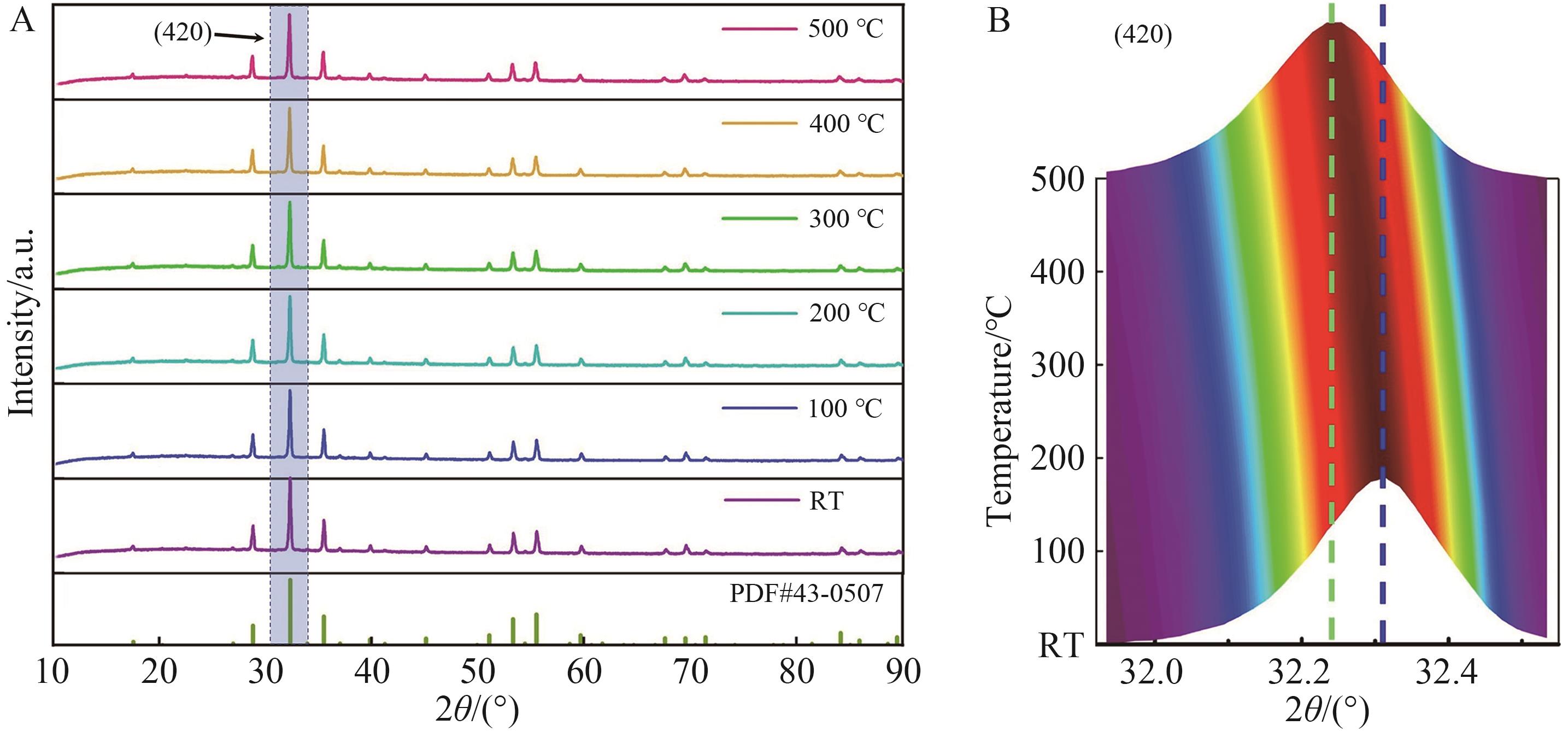
晶体场理论是理解和研究过渡金属化合物丰富的物理化学性质的重要基础,其教学内容偏重于对配位结构和原子轨道的阐述,内容较为抽象,为此,提出一种科教融合的科研训练实验,结合热诱导的晶格变化与直观的视觉冲击,引导学生从无机材料的热致变色现象去分析晶体场,加深学生对理论本质的认识,促进其对无机化学知识框架的构建。 利用溶胶-凝胶法制备石榴石结构氧化物Y3Fe5O12纳米粉末,分别用扫描电子显微镜(SEM)、变温X射线粉末衍射(XRD)、X射线光电子能谱(XPS)和变温紫外可见吸收光谱(UV-Vis)对样品进行表征,结合对预置图案中可逆热致变色现象的趣味性观测和定量化分析,建立温度与晶胞参数的依赖关系,明晰结构调变对d-d跃迁和电荷转移的影响,进而总结其不同温度下呈现特定颜色的内部机制,形成对晶体场理论及相关概念更加系统具象化的认识,帮助学生深入融会结构决定性质的这一化学核心理念。 与已有变色实验设计相比,创新在于用晶格膨胀动态地呈现可逆热致变色现象,选用的石榴石模型兼具四面体和八面体结构发色基团且变色机制同时包含d-d跃迁和电荷转移,此外,将变色颜料嵌入陶瓷具有测温、示温等应用前景,学以致用,乐教乐学,可激发学生的探索热情和创新潜力。

关键词: 晶体场理论, 热致变色, 电荷转移, d-d跃迁, 石榴石结构

Abstract:

Crystal field theory serves as an important foundation for understanding and investigating the rich physicochemical properties of transition metal compounds. Its teaching content often focuses on the explanation of coordination structures and atomic orbitals, which tends to be highly abstract. Here, a scientific research training experimental integrating science and education is proposed, it combines the heat induced lattice changes and intuitive visual impact, guiding students to analyze the crystal field from the thermochromic phenomenon of inorganic materials, deepening their understanding of the theoretical essence and promoting the construction of their inorganic chemistry knowledge framework. Y3Fe5O12 nanopowder with a garnet structure was synthesized via the sol-gel method, and then characterized by using scanning electron microscopy (SEM), variable-temperature X-ray powder diffraction (XRD), X-ray photoelectron spectroscopy (XPS) and ultraviolet-visible absorption spectroscopy (UV-Vis). Combined with the interesting observation and quantitative analysis of reversible thermochromic phenomena in pre-patterned ceramic plate, the temperature dependence of the unit cell parameters was established and further elucidated how structural modulation affects d-d transitions and charge transfer, thereby summarizing the generation mechanism of the specific colors presented at different temperatures. This process fosters a more systematic and concrete understanding of crystal field theory and related concepts, ultimately enabling students to deeply internalize the core chemical principle of “structure determines properties”. Compared with existing color-display experiments, the innovation lies in dynamically presenting the reversible thermochromism through lattice expansion, the selected garnet model has both tetrahedral and octahedral structural units, and its color-changing mechanism involves both d-d transitions and charge transfer. Moreover, embedding the thermochromic pigment in ceramics has application prospects such as temperature measurement and indication. This approach of “applying learning to practice” aims to enhance teaching and learning enjoyment, potentially stimulating students' innovative potential and enthusiasm for exploration.

Key words: Crystal field theory, Thermochromism, Charge transfer, d-d transitions, Garnet structure

中图分类号: