
Chinese Journal of Applied Chemistry ›› 2026, Vol. 43 ›› Issue (1): 41-52.DOI: 10.19894/j.issn.1000-0518.250128
• Full Papers • Previous Articles Next Articles
Peng GAO1, Shu-Jie WANG1, Yuan-Yuan SONG2( ), Wen-Juan SHAN1()
Received:2025-03-28
Accepted:2025-11-03
Published:2026-01-01
Online:2026-01-26
Contact:
Yuan-Yuan SONG,Wen-Juan SHAN
About author:wenjuanshan@lnnu.edu.cnSupported by:CLC Number:
Peng GAO, Shu-Jie WANG, Yuan-Yuan SONG, Wen-Juan SHAN. Mn-Cu/γ-Al2O3 Catalyst for NO x -Assisted Soot Catalytic Combustion[J]. Chinese Journal of Applied Chemistry, 2026, 43(1): 41-52.
Add to citation manager EndNote|Ris|BibTeX
URL: http://yyhx.ciac.jl.cn/EN/10.19894/j.issn.1000-0518.250128
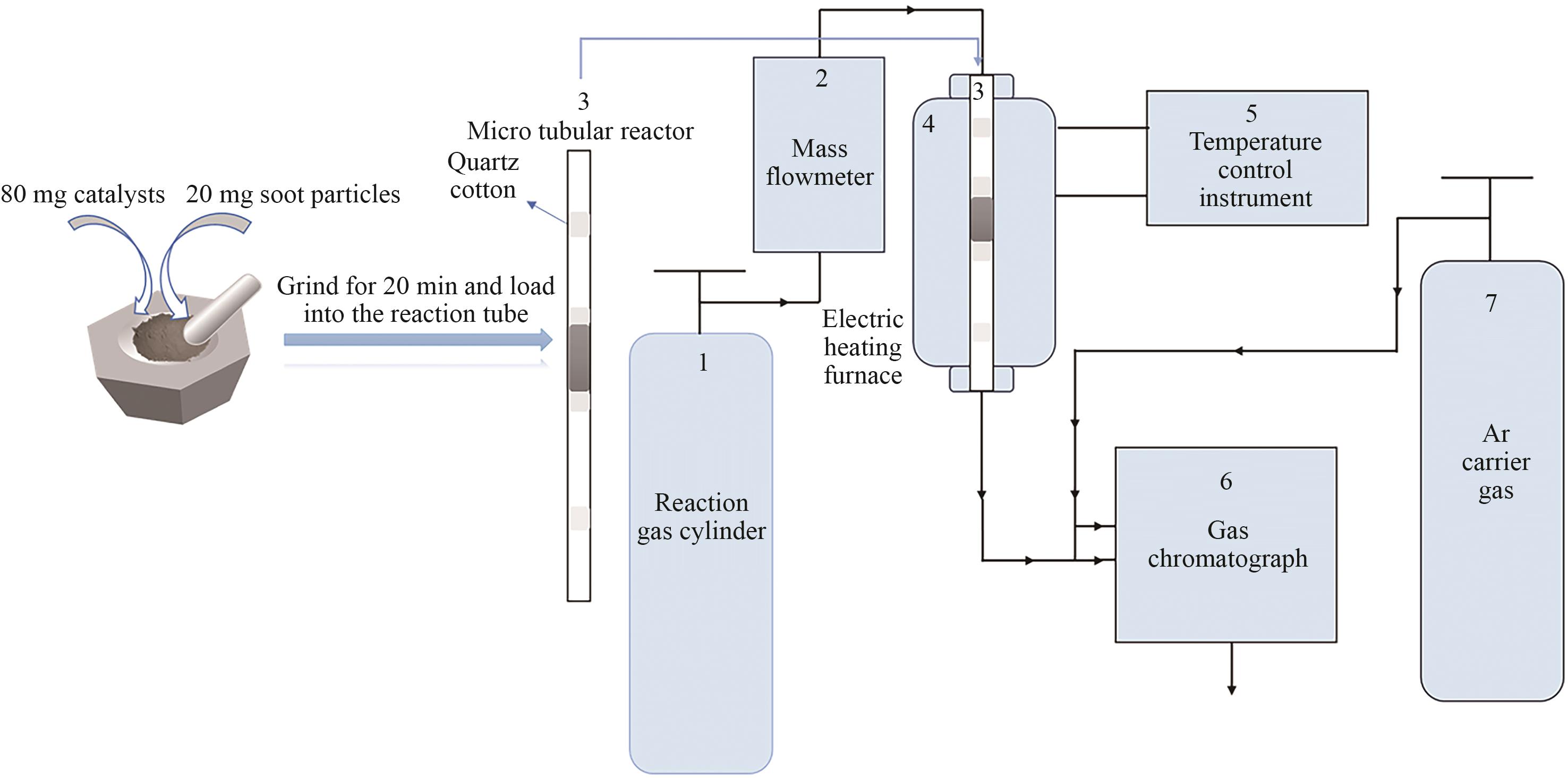
Fig.1 Flowchart of the reaction device
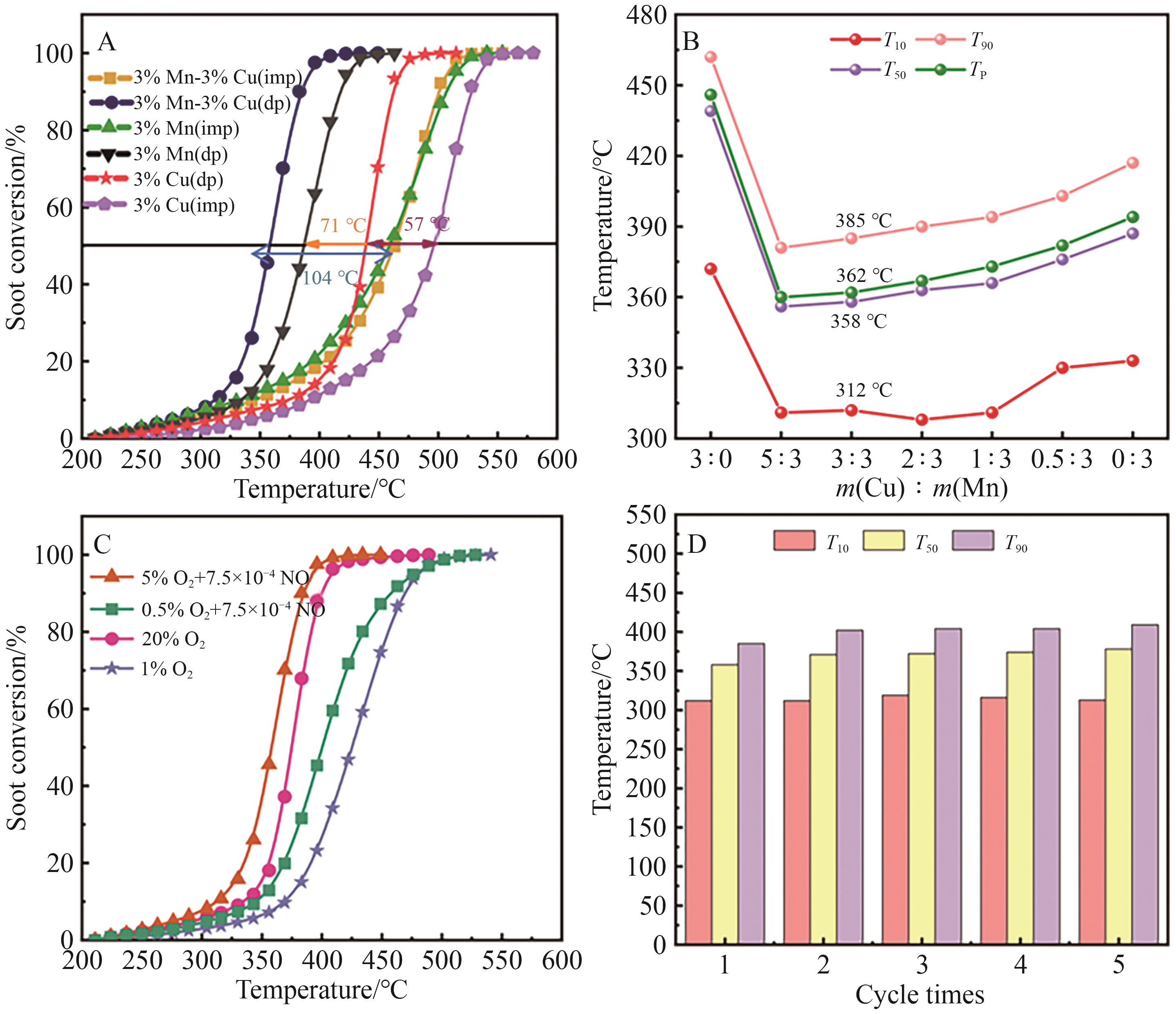
Fig.2 (A) Catalytic activity of the catalysts under 5% O2, 7.5×10⁻⁴ NO atmosphere; (B) Catalytic activity data of the x% Mn-y% Cu/γ-Al2O3(dp) catalysts under 5% O2, 7.5×10⁻⁴ NO atmosphere; (C) Catalytic activity of 3% Mn-3% Cu/γ-Al2O3(dp) catalyst under different atmospheres; (D) Cyclic stability test of 3% Mn-3% Cu/γ-Al2O3(dp) under 5% O2, 7.5×10⁻⁴ NO atmosphere
| Mn-based catalysts | Reaction conditions | T50/℃ | Contact mode between the catalyst and soot | Ref. |
|---|---|---|---|---|
| PrMnO3-1 | 5% O2, 1.0×10⁻³ NO m(cat)∶m(soot)=9∶1 | 377 | Tight | [ |
| Mn3O4-HNS | 5% O2, 2.5×10⁻³ NO m(cat)∶m(soot)=10∶1 | 407.7 | Loose | [ |
| FSP-Mn3O4 | 10% O2, 90% N2 m(cat)∶m(soot)=15∶1 | 305 | Tight | [ |
| MnO x -900 | 10% O2, 1.0×10⁻³ NO m(cat)∶m(soot)=10∶1 | 394 | Loose | [ |
| FMO-500 | 5% O2, 2.0×10⁻³ NO m(cat)∶m(soot)=10∶1 | 365 | Loose | [ |
| r-4Mn1Cu | 10% O2, 10% H2O m(cat)∶m(soot)=10∶1 | 358 | Tight | [ |
| Ce0.7K0.3Co3 | 5% O2, 1.0×10⁻³ NO m(cat)∶m(soot)=10∶1 | 392 | Loose | [ |
| Pt@MnO x /Al2O3-1 | 5% O2, 2.0×10⁻³ NO m(cat)∶m(soot)=10∶1 | 351 | Loose | [ |
| 3% Mn-3% Cu/γ-Al2O3(dp) | 5% O2, 7.5×10⁻⁴ NO m(cat)∶m(soot)=4∶1 | 358 | Tight | This work |
Table 1 The catalytic activity of some Mn-based catalysts for soot combustion
| Mn-based catalysts | Reaction conditions | T50/℃ | Contact mode between the catalyst and soot | Ref. |
|---|---|---|---|---|
| PrMnO3-1 | 5% O2, 1.0×10⁻³ NO m(cat)∶m(soot)=9∶1 | 377 | Tight | [ |
| Mn3O4-HNS | 5% O2, 2.5×10⁻³ NO m(cat)∶m(soot)=10∶1 | 407.7 | Loose | [ |
| FSP-Mn3O4 | 10% O2, 90% N2 m(cat)∶m(soot)=15∶1 | 305 | Tight | [ |
| MnO x -900 | 10% O2, 1.0×10⁻³ NO m(cat)∶m(soot)=10∶1 | 394 | Loose | [ |
| FMO-500 | 5% O2, 2.0×10⁻³ NO m(cat)∶m(soot)=10∶1 | 365 | Loose | [ |
| r-4Mn1Cu | 10% O2, 10% H2O m(cat)∶m(soot)=10∶1 | 358 | Tight | [ |
| Ce0.7K0.3Co3 | 5% O2, 1.0×10⁻³ NO m(cat)∶m(soot)=10∶1 | 392 | Loose | [ |
| Pt@MnO x /Al2O3-1 | 5% O2, 2.0×10⁻³ NO m(cat)∶m(soot)=10∶1 | 351 | Loose | [ |
| 3% Mn-3% Cu/γ-Al2O3(dp) | 5% O2, 7.5×10⁻⁴ NO m(cat)∶m(soot)=4∶1 | 358 | Tight | This work |
| Samples | T10/℃ | T50/℃ | T90/℃ | ΔT/℃ | Tp/℃ |
|---|---|---|---|---|---|
| 1% Na-3% Mn-3% Cu/γ-Al2O3 | 334 | 433 | 470 | 136 | 454 |
| 3% Na-3% Mn-3% Cu/γ-Al2O3 | 308 | 383 | 415 | 107 | 397 |
| 5% Na-3% Mn-3% Cu/γ-Al2O3 | 308 | 368 | 398 | 90 | 378 |
| 7% Na-3% Mn-3% Cu/γ-Al2O3 | 308 | 367 | 396 | 88 | 374 |
Table 2 Soot combustion activity of x% Na-3% Mn-3% Cu/γ-Al2O3 catalysts
| Samples | T10/℃ | T50/℃ | T90/℃ | ΔT/℃ | Tp/℃ |
|---|---|---|---|---|---|
| 1% Na-3% Mn-3% Cu/γ-Al2O3 | 334 | 433 | 470 | 136 | 454 |
| 3% Na-3% Mn-3% Cu/γ-Al2O3 | 308 | 383 | 415 | 107 | 397 |
| 5% Na-3% Mn-3% Cu/γ-Al2O3 | 308 | 368 | 398 | 90 | 378 |
| 7% Na-3% Mn-3% Cu/γ-Al2O3 | 308 | 367 | 396 | 88 | 374 |
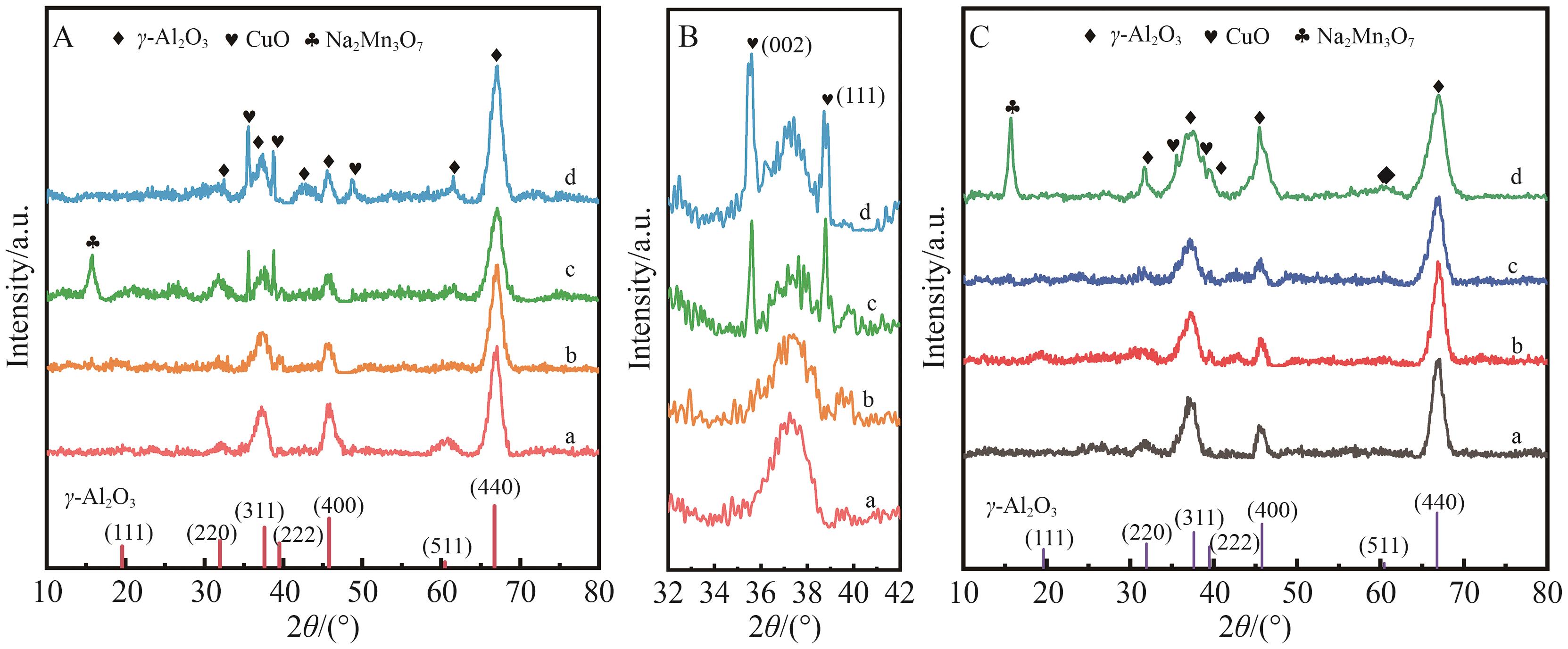
Fig.3 (A, B) XRD patterns of x% Mn-y% Cu/γ-Al2O3 series catalysts ((a) 3% Mn-3% Cu/γ-Al2O3(imp), (b) 3% Mn/γ-Al2O3(dp), (c) 3% Mn-3% Cu/γ-Al2O3(dp), (d) 3% Cu/γ-Al2O3(dp)); (C) XRD patterns of x% Na-3% Mn-3% Cu/γ-Al2O3 catalysts ((a) 1% Na, (b) 3% Na, (c) 5% Na, (d) 7% Na)
| Samples | da /nm | ab /nm |
|---|---|---|
| 3% Mn/γ-Al2O3(dp) | 10.35 | 0.788 0 |
| 3% Cu/γ-Al2O3(dp) | 7.26 | 0.784 7 |
| 3% Mn-3% Cu/γ-Al2O3(dp) | 8.21 | 0.784 4 |
| 3% Mn-3% Cu/γ-Al2O3(imp) | 9.69 | 0.788 0 |
Table 3 Particle size and cell parameters of γ-Al2O3 in x% Mn-y% Cu/γ-Al2O3 series catalysts
| Samples | da /nm | ab /nm |
|---|---|---|
| 3% Mn/γ-Al2O3(dp) | 10.35 | 0.788 0 |
| 3% Cu/γ-Al2O3(dp) | 7.26 | 0.784 7 |
| 3% Mn-3% Cu/γ-Al2O3(dp) | 8.21 | 0.784 4 |
| 3% Mn-3% Cu/γ-Al2O3(imp) | 9.69 | 0.788 0 |
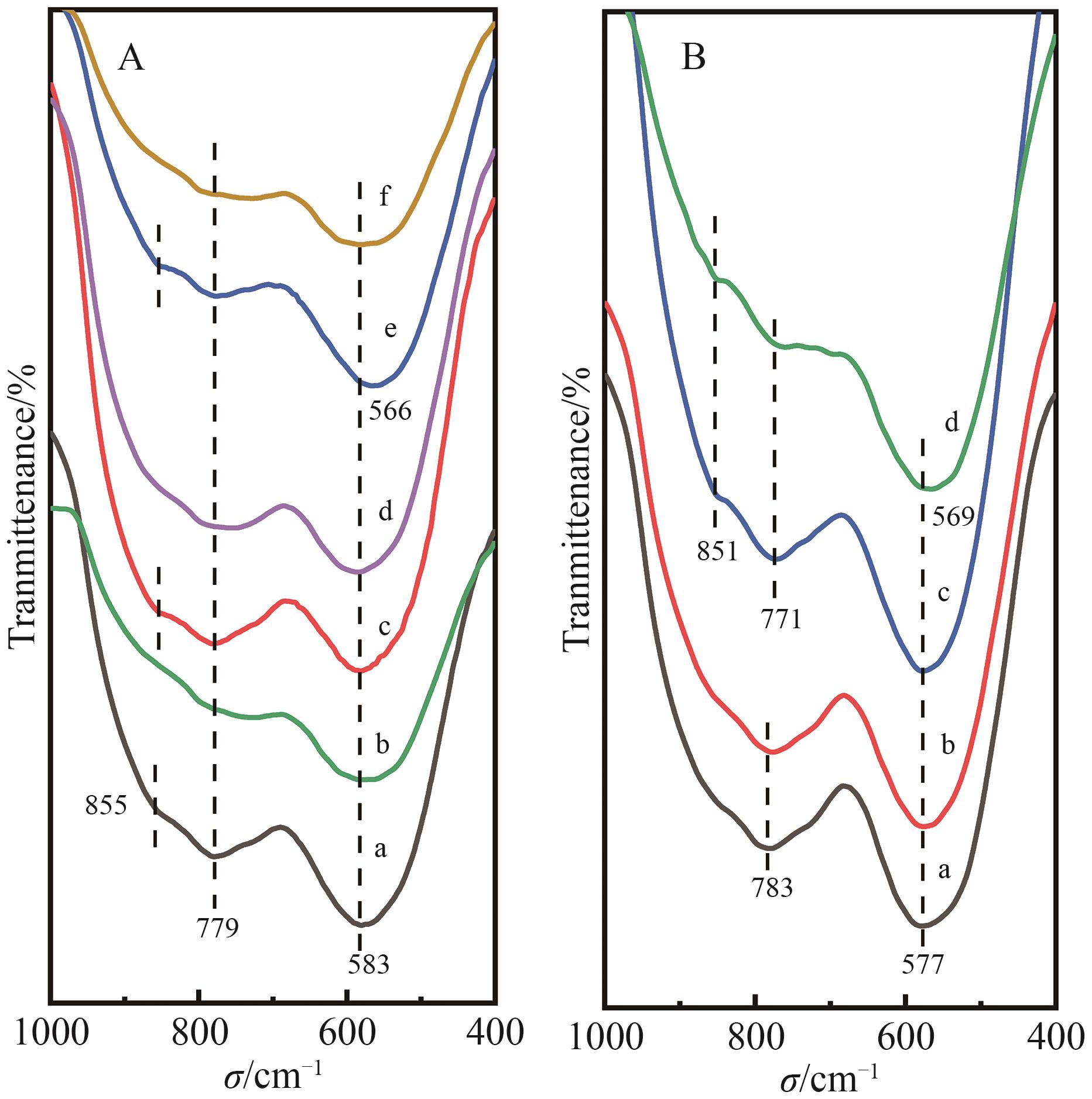
Fig.4 (A) FT-IR spectra of x% Mn-y% Cu/γ-Al2O3 series catalysts ((a) 3% Mn/γ-Al2O3(dp), (b) 3% Mn/γ- Al2O3(imp), (c) 3% Cu/γ-Al2O3(dp), (d) 3% Cu/γ-Al2O3(imp), (e) 3% Mn-3% Cu/γ-Al2O3(dp), (f) 3% Mn-3% Cu/γ- Al2O3(imp)); (B) FT-IR spectra of x% Na-3% Mn-3% Cu/γ-Al2O3 catalysts ((a) 1% Na, (b) 3% Na, (c) 5% Na, (d) 7% Na)
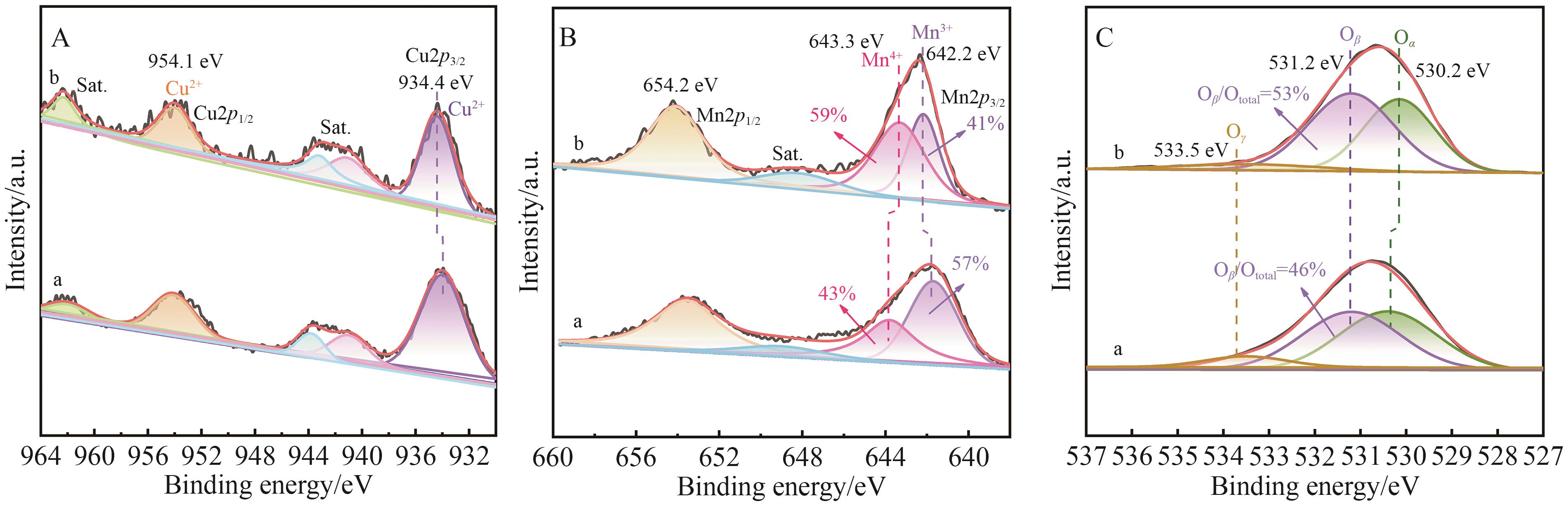
Fig.5 XPS spectra of (a) 3% Mn-3% Cu/γ-Al2O3(imp) and (b) 3% Mn-3% Cu/γ-Al2O3(dp) catalyst
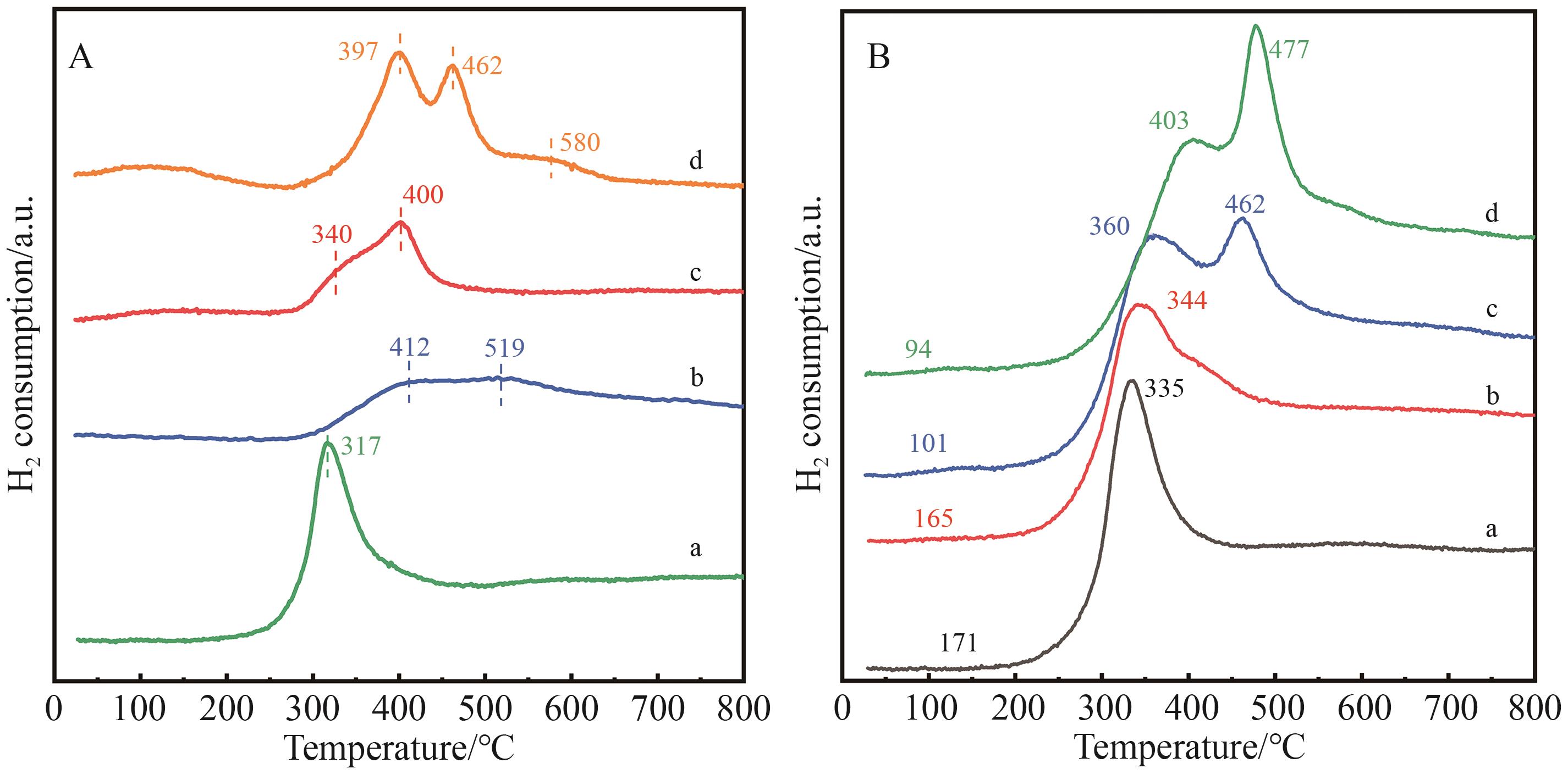
Fig.6 (A) H2-TPR profiles of x% Mn-y% Cu/γ-Al2O3 series catalysts ((a) 3% Mn-3% Cu/γ-Al2O3(imp), (b) 3% Mn/γ-Al2O3(dp), (c) 3% Cu/γ-Al2O3(dp), (d) 3% Mn-3% Cu/γ-Al2O3(dp)); (B) H2-TPR profiles of x% Na-3% Mn-3% Cu/γ-Al2O3 catalysts ((a) 1% Na, (b) 3% Na, (c) 5% Na, (d) 7% Na)
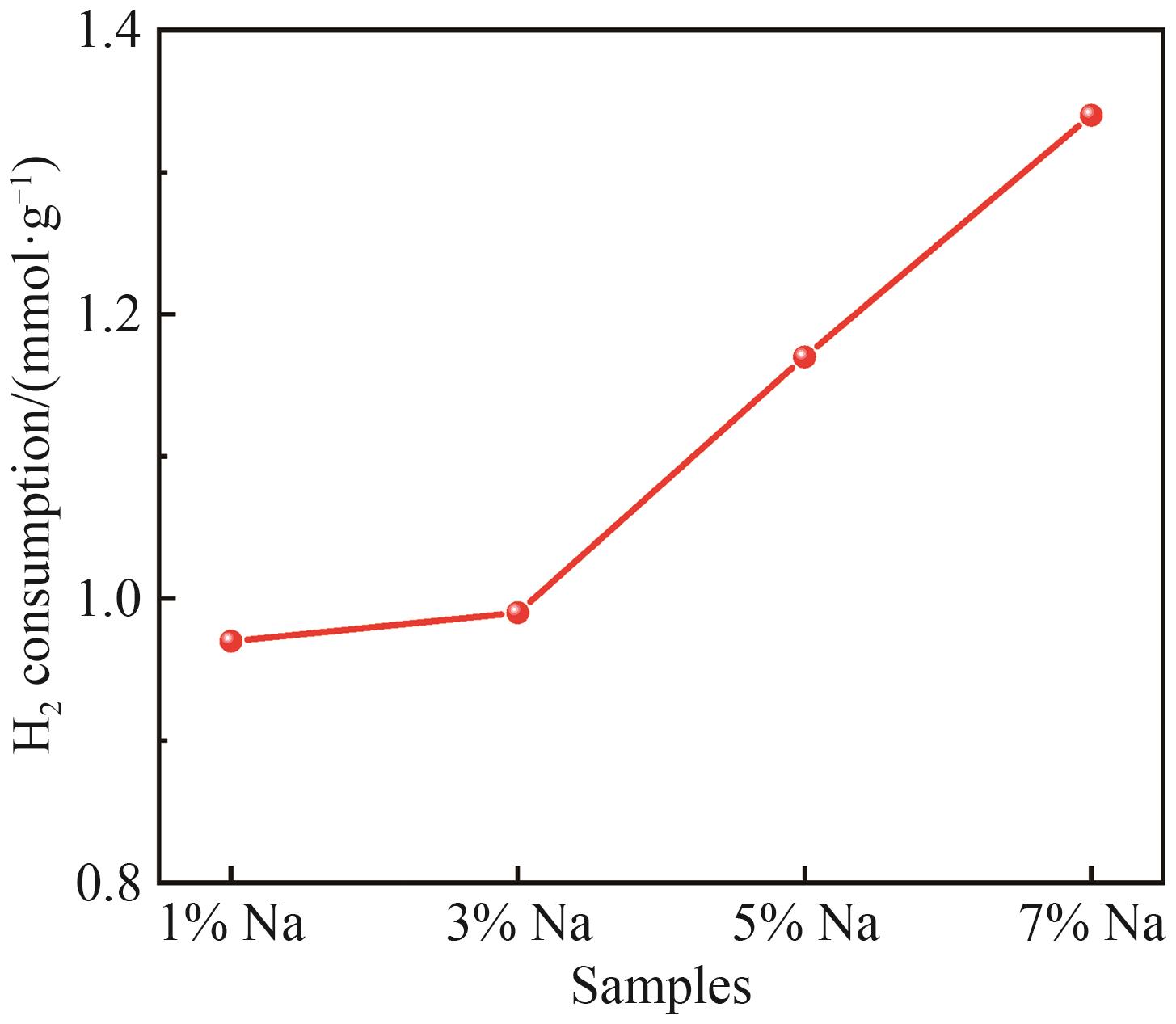
Fig.7 H2 consumption of x% Na-3% Mn-3% Cu/γ-Al2O3 catalysts
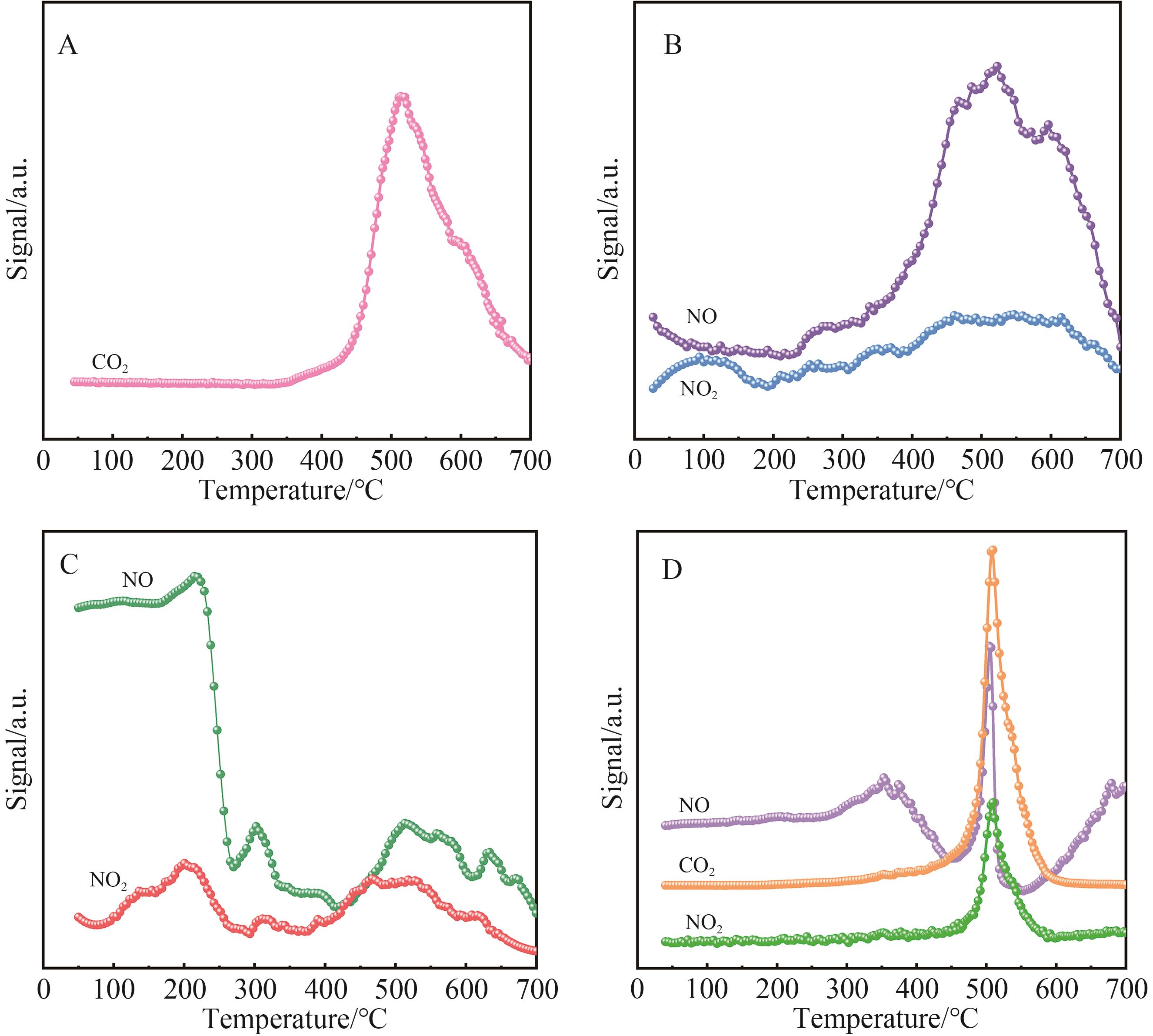
Fig.8 (A) soot-TPR, (B) NO-TPD, (C) NO-O2-TPSR and (D) soot-NO-O2-TPSR data of 3% Mn-3% Cu/γ-Al2O3(dp) catalyst
| [1] | 张丞, 李兆强, 王艳, 等. 柴油车后处理催化技术及集成系统进展[J]. 金属功能材料, 2020, 27(5): 20-27. |
| ZHANG C, LI Z Q, WANG Y, et al. Development of catalytic technology and integrated system for diesel vehicles aftertreatment[J]. Met Funct Mater, 2020, 27(5): 20-27. | |
| [2] | YANG H, YANG X C, XIAO J Y, et al.Silver-modified NiCo2O4 nanosheets monolithic catalysts used for catalytic soot elimination[J]. Fuel, 2022, 326: 125036. |
| [3] | KUEAHARA Y, FUJIBAYASHI A, UEHARA H, et al. Catalytic combustion of diesel soot over Fe and Ag-doped manganese oxides: role of heteroatoms in the catalytic performances[J]. Catal Sci Technol, 2018, 8(7): 1905-1914. |
| [4] | LIU J X, YANG Z, ZHAI Y J, et al. High performance of PrMnO3 perovskite catalysts for low-temperature soot oxidation[J]. Sep Purif, 2025, 354: 129227. |
| [5] | 邓湘玲, 叶松寿, 曹志凯, 等. Ag/Ce0.75Zr0.25O2催化剂中Ag的负载量对碳烟燃烧活性的影响[J]. 化工学报, 2017, 68(8): 3064-3070. |
| DENG X L, YE S S, CAO Z K, et al. Effect of Ag loading on soot oxidation for Ag/Ce0.75Zr0.25O2 catalysts[J]. J Ind Eng Chem, 2017, 68(8): 3064-3070. | |
| [6] | LEE J H, JO D Y, CHOUNG J, et al. Roles of noble metals (M=Ag, Au, Pd, Pt and Rh) on CeO2 in enhancing activity toward soot oxidation: active oxygen species and DFT calculations[J]. J Hazard Mater, 2021, 403: 124085. |
| [7] | FREY K, IABLOKOV V, SÁFRÁN G, et al. Nanostructured MnOx as highly active catalyst for CO oxidation[J]. J Catal, 2012, 287: 30-36. |
| [8] | KIM S C, SHIM W G. Catalytic combustion of VOCs over a series of manganese oxide catalysts[J]. Appl Catal B, 2010, 98(3/4): 180-185. |
| [9] | MANE R, KIM H, HAN K, et al. Pivotal role of MnOx physicochemical structure in soot oxidation activity[J]. Fuel, 2023, 346: 128287. |
| [10] | TAN J B WEI Y C, SUN Y Q, et al. Simultaneous removal of NOx and soot particulates from diesel engine exhaust by 3DOM Fe-Mn oxide catalysts[J]. Ind Eng Chem, 2018, 63: 84-94. |
| [11] | 冯爱虎, 于洋, 于云, 等. 沸石分子筛及其负载型催化剂去除VOCs研究进展[J]. 化学学报, 2018, 76(10): 757-773. |
| FENG A H, YU Y, YU Y, et al. Recent progress in the removal of volatile organic compounds by zeolite and its supported catalysts[J]. Acta Chim Sin, 2018, 76(10): 757-773. | |
| [12] | 付名利, 王克亮, 于润芃, 等. 共沉淀法制备的MnOx-CeO2在含NO气氛中氧化碳烟的研究[J]. 无机化学学报, 2012, 28(8): 1593-1600. |
| FU M L, WANG K L, YU R F, et al. Soot oxidation in NO atmosphere via MnOx-CeO2 prepared with co-precipitation[J]. Chin J Inorg Chem, 2012, 28(8): 1593-1600. | |
| [13] | WANG H P, LU Y Y, HAN Y X, et al. Enhanced catalytic toluene oxidation by interaction between copper oxide and manganese oxide in Cu-O-Mn/γ-Al2O3 catalysts[J]. Appl Surf Sci, 2017, 420: 260-266. |
| [14] | KIM H J, CHOI S W, LEE C S, et al. Oxidation of toluene on γ-Al2O3 supported copper-manganese catalysts[J]. Environ Eng Sci, 2011, 28(12): 827-833. |
| [15] | SAQER S M, KONDARIDES D I, VERYKIOS X E. Catalytic oxidation of toluene over binary mixtures of copper, manganese and cerium oxides supported on γ-Al2O3[J]. Appl Catal B, 2011, 103(3/4): 275-286. |
| [16] | DOGGALI P, TERAOKA Y, MUUNGSE P, et al. Combustion of volatile organic compounds over Cu-Mn based mixed oxide type catalysts supported on mesoporous Al2O3, TiO2 and ZrO2[J]. J Mol Catal A: Chem, 2012, 358: 23-30. |
| [17] | WANG X B, HE M, WANG P, et al. Alkali metal-enhanced cerium manganese-based three-dimensional ordered macroporous catalyst for NO oxidation and soot combustion[J]. J Mater Chem A, 2024, 12(37): 24947-24954. |
| [18] | LEGUTTKO P, STELMACHOWSKI P, YU X H, et al. Catalytic soot combustion-general concepts and alkali promotion[J]. ACS Catal, 2023, 13(5): 3395-3418. |
| [19] | 李杨. 氧化锰负载Ag基催化剂用于碳黑催化燃烧的研究[D]. 大连: 辽宁师范大学, 2018. |
| LI Y. Study on catalytic combustion of soot with manganese oxide supported on Ag-based catalyst[D]. Dalian: Liaoning Normal University, 2018. | |
| [20] | JI F, MEN Y, WANG J G, et al. Promoting diesel soot combustion efficiency by tailoring the shapes and crystal facets of nanoscale Mn3O4[J]. Appl Catal B, 2019, 242: 227-237. |
| [21] | WAGLOEHNER S, NITZER-NOSKI M, KURETI S. Oxidation of soot on manganese oxide catalysts[J]. Chem Eng J, 2015, 259: 492-504. |
| [22] | WANG M, WANG J Y, ZHANG Y, et al. High-temperature calcination enhances the activity of MnOx catalysts for soot oxidation[J]. Catal Sci Technol, 2024, 14(21): 6278-6285. |
| [23] | NIU R H, ZHANG C S, LIU P P, et al. Constructing asymmetric active Fe3+-Ov-Mn4+ sites at the Fe2O3-MnO2 interface for low-temperature soot combustion[J]. Appl Catal B, 2024, 358: 124365. |
| [24] | WANG J, ZHANG C S, WANG Y H, et al. The effect of synthesis methods on active oxygen species of MnOx-CuO in soot combustion[J].Catal Lett, 2021, 151: 3261. |
| [25] | WANG M T, HAN Z T, LIU Y B, et al. The influence of partial substitution of Ce with K in CeMO3 (M=Mn, Fe, Co, Ni, Cu) perovskite catalysts on soot combustion performance[J]. J Environ Chem Eng, 2023, 11(5): 110850. |
| [26] | XIONG J, LI Z G, ZHANG P, et al. Optimized Pt-MnOx interface in Pt-MnOx/3DOM-Al2O3 catalysts for enhancing catalytic soot combustion[J]. Chin Chem Lett, 2021, 32(4): 1447-1450. |
| [27] | ZHU Y, CHEN Z, LI H M, et al. Effect of oxygen vacancy and highly dispersed MnOx on soot combustion in cerium manganese catalyst[J].Sci Rep, 2023, 13(1): 3386. |
| [28] | YU D, YU X H, ZHANG C L, et al. Layered Na2Mn3O7 decorated by cerium as the robust catalysts for efficient low temperature soot combustion[J]. Appl Catal B, 2023, 338: 123022. |
| [29] | MORALES M R, BAEBERO B P, CADUS L E. Evaluation and characterization of Mn-Cu mixed oxide catalysts for ethanol total oxidation: influence of copper content[J]. Fuel, 2008, 87(7): 1177-1186. |
| [30] | 张楠, 雷海凤, 白丽军, 等. La-Pd/γ-Al2O3对蒽加氢饱和性能的影响[J]. 应用化学, 2024, 41(12): 1732-1741. |
| ZHANG N, LEI H F, BAI L J, et al. Influence of La-Pd/γ-Al2O3 on the performance for hydrogenation saturation of anthracene[J]. Chin J Appl Chem, 2024, 41(12): 1732-1741. | |
| [31] | ZHANG Y, LIN Y L, HUANG Z W, et al. CuMnAl-O catalyst synthesized via pyrolysis of a layered double hydroxide precursor attains enhanced performance for benzene combustion[J]. Energy Fuels, 2020, 35(1): 743-751. |
| [32] | XU C R, DONG S W, CHEN T H, et al. Low-temperature catalytic performance of toluene oxidation over Cu-Mn oxide catalysts derived from LDH precursor[J]. Fuel, 2023, 347: 128401. |
| [33] | XU X L, LIU X Q, MA L F, et al. Construction of surface synergetic oxygen vacancies on CuMn2O4 spinel for enhancing NO reduction with CO[J]. ACS Catal, 2024, 14: 3028-3040. |
| [34] | WEI F J, LIU L F, WANG C, et al. Cu (Mn) MgAl mixed oxides with enhanced performance for simultaneous removal of NOx and toluene: insight into the better collaboration of CuO and MnOx via layered double hydroxides (LDHs) precursor template[J]. Chem Eng J, 2023, 462: 142150. |
| [35] | WANG Z Q, JIA H Z, ZHENG T, et al. Promoted catalytic transformation of polycyclic aromatic hydrocarbons by MnO2 polymorphs: synergistic effects of Mn3+ and oxygen vacancies[J]. Appl Catal B, 2020, 272: 119030. |
| [36] | PAN J, DU W T, LIU Y J, et al. Lanthanum-doped CuMn composite oxide catalysts for catalytic oxidation of toluene[J]. J Rare Earths,2019, 37(6): 602-608. |
| [37] | YANG W H, SU Z A, XU Z H, et al. Comparative study of α-, β-, γ- and δ-MnO2 on toluene oxidation: oxygen vacancies and reaction intermediates[J]. Appl Catal B, 2020, 260: 118150. |
| [38] | LI M Y, ZHANG W L, ZHANG X W, et al. Influences of different surface oxygen species on oxidation of toluene and/or benzene and their reaction pathways over Cu-Mn metal oxides[J]. Colloid Interface Sci, 2023, 630: 301-316. |
| [39] | ZHAO H, ZHOU X X, PAN L Y, et al. Facile synthesis of spinel Cu1.5Mn1.5O4 microspheres with high activity for the catalytic combustion of diesel soot[J]. RSC Adv, 2017, 7(33): 20451-20459. |
| [40] | GAO S Y, FU Y H, ZHANG X Y, et al. Hierarchical porous NaxCoyCeOδ catalysts: facile preparation and excellent catalytic performance for soot combustion[J]. Appl Catal B, 2025, 365: 124919. |
| [41] | WANG P, LI Z L, AO C C, et al. Interactive effects of NOx synergistic and hydrothermal aging on soot catalytic combustion in Ce-based catalysts[J]. Combust Flame, 2022, 245: 112289. |
| [42] | XU J N, LU G Z, GUO Y, et al. A highly effective catalyst of Co-CeO2 for the oxidation of diesel soot: the excellent NO oxidation activity and NOx storage capacity[J]. Appl Catal A, 2017, 535: 1-8. |
| [43] | HUO Z B, CHEN Y P, ZHAO P, et al. Promoting the generation of active oxygen species on 3DOM K/LaMnO3 interface by introducing CeO2 to boost the NOx-assisted soot combustion[J]. Fuel, 2022, 317: 123405. |
| [1] | Fan WU, He-Yuan TIAN, Peng LIU, Li-Wei SUN, Yi-Bo ZHANG, Xiang-Guang YANG. Spinel Mangane-Based Catalysts with High Oxygen Vacancy Used for NH3-SCR Reaction at Low Temperature [J]. Chinese Journal of Applied Chemistry, 2023, 40(5): 697-707. |
| [2] | MA Jun, ZHU Na*. Effects of Loaded Sodium on the Structure of Cu-ZnO/Na-SiO2 Catalysts and the Dehydrogenation of 2-Butanol [J]. Chinese Journal of Applied Chemistry, 2011, 28(12): 1397-1401. |
| Viewed | ||||||
|
Full text |
|
|||||
|
Abstract |
|
|||||
