
Chinese Journal of Applied Chemistry ›› 2025, Vol. 42 ›› Issue (6): 776-784.DOI: 10.19894/j.issn.1000-0518.250068
• Full Papers • Previous Articles Next Articles
Yue QU1,2, Hong-Mei ZHAN2( ), Chen-Yang ZHAO2, Yan-Xiang CHENG1,2, Chuan-Jiang QIN1,2()
Received:2025-02-22
Accepted:2025-05-07
Published:2025-06-01
Online:2025-07-01
Contact:
Hong-Mei ZHAN,Chuan-Jiang QIN
About author:cjqin@ciac.ac.cnSupported by:CLC Number:
Yue QU, Hong-Mei ZHAN, Chen-Yang ZHAO, Yan-Xiang CHENG, Chuan-Jiang QIN. Effect of Chiral Ligand Structure on Red Quasi-2D Perovskites Circularly Polarized Electroluminescence Performance[J]. Chinese Journal of Applied Chemistry, 2025, 42(6): 776-784.
Add to citation manager EndNote|Ris|BibTeX
URL: http://yyhx.ciac.jl.cn/EN/10.19894/j.issn.1000-0518.250068
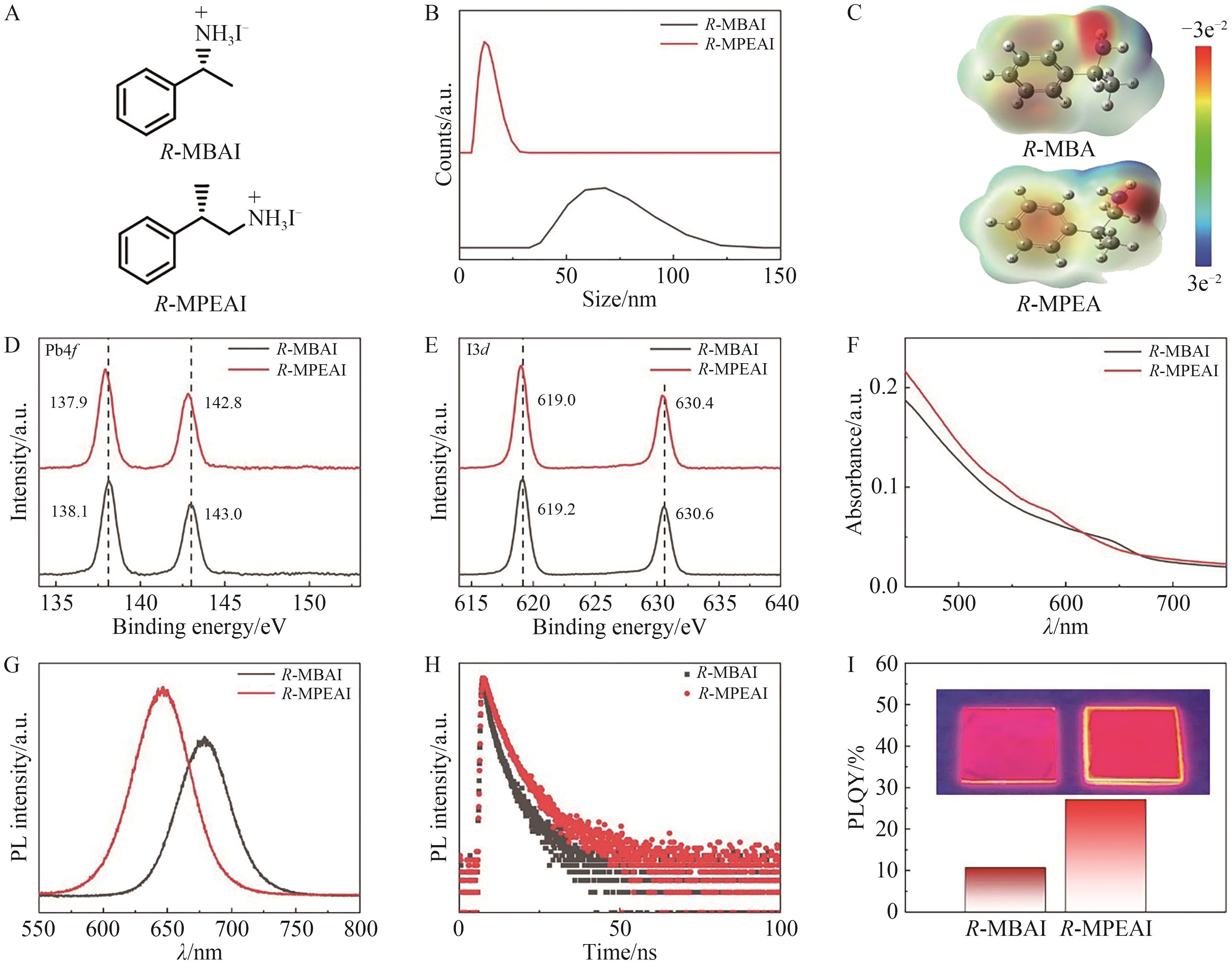
Fig.1 (A) Molecular structures of R-MBAI and R-MPEAI; (B) Micelle size distributions of R-MBAI and R-MPEAI perovskite precursors; (C) Electrostatic potential surfaces of R-MBA and R-MPEA; XPS spectra of (D) Pb4f and (E) I3d for R-MBAI and R-MPEAI perovskite films; (F) UV-Vis absorbance, (G) PL, (H) TRPL spectra of perovskite films; (I) PLQY and light emitting intensity under UV light for R-MBAI and R-MPEAI perovskite films
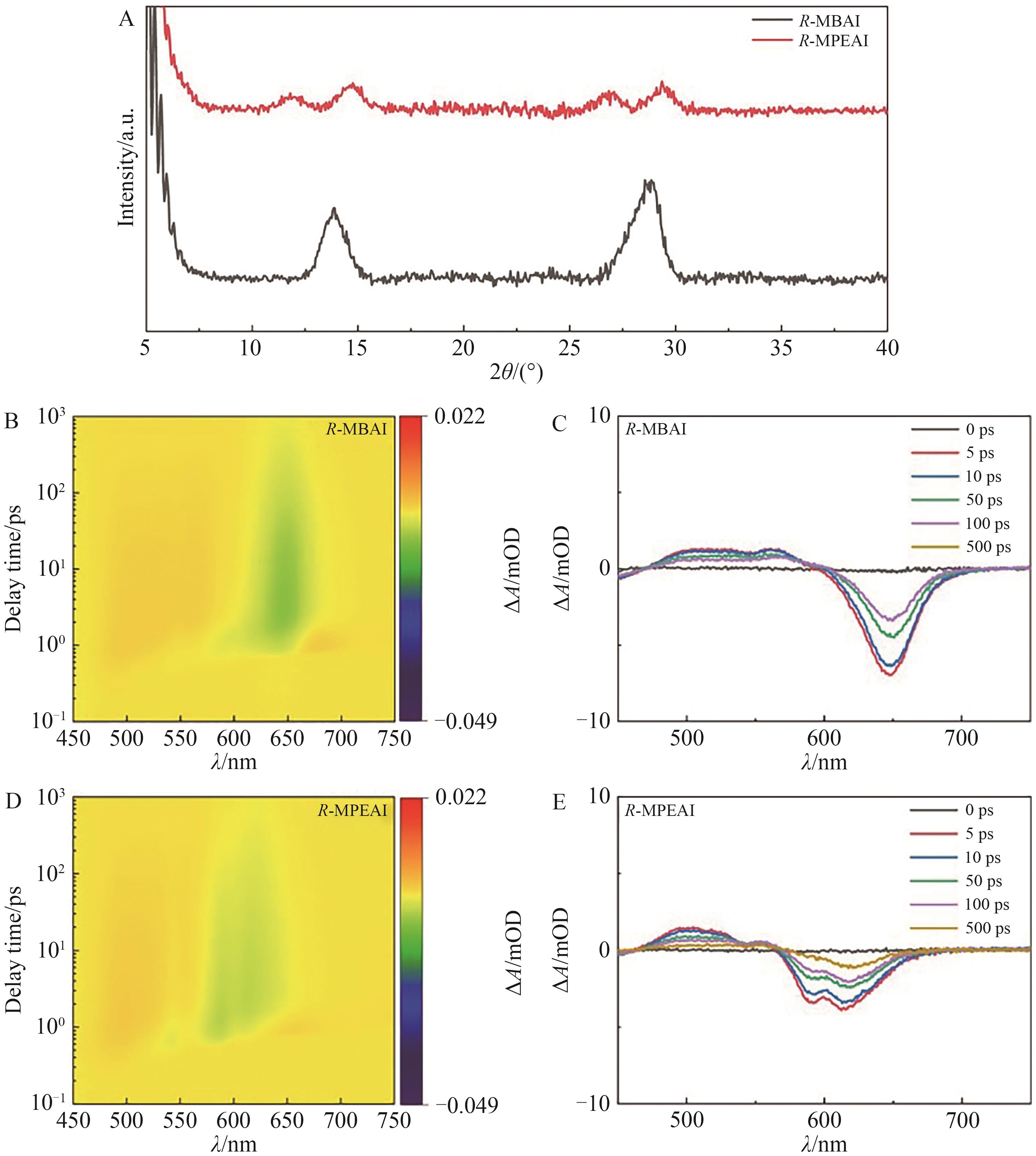
Fig.2 (A) XRD patterns of R-MBAI and R-MPEAI perovskite films; (B) TA spectrum color map of R-MBAI perovskite film; (C) TA spectra of R-MBAI perovskite films at different decay; (D) TA spectrum color map of R-MPEAI perovskite films; (E) TA spectra of R-MPEAI perovskite films at different decay times
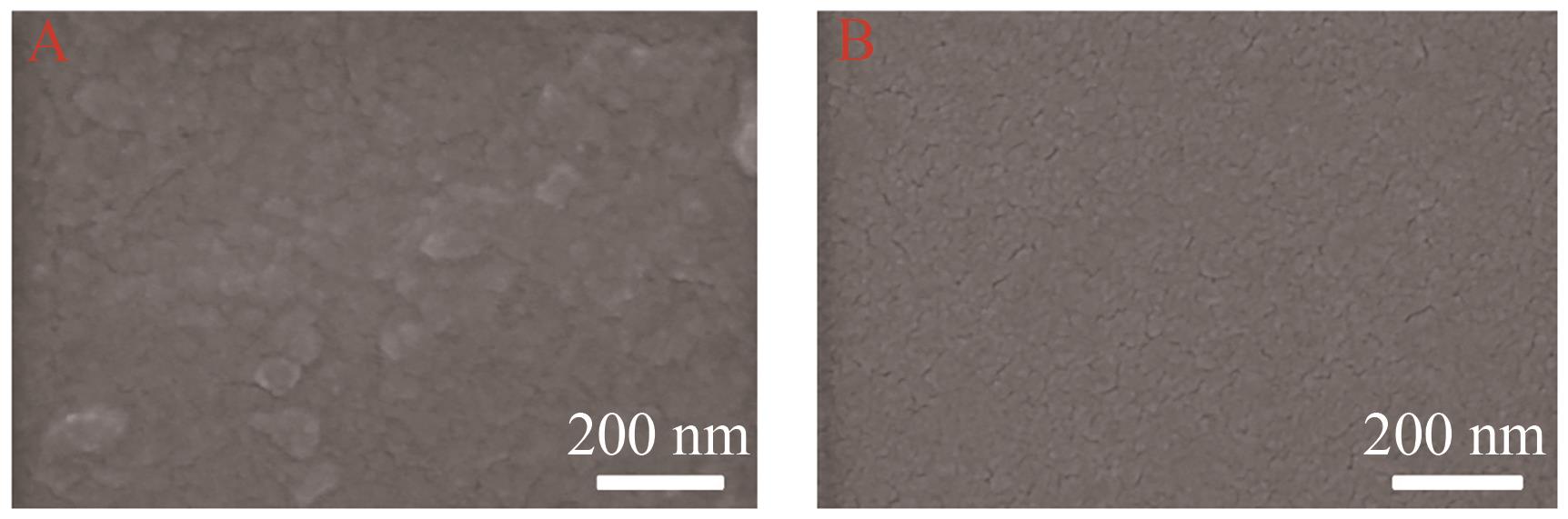
Fig.3 SEM images of (A) R-MBAI and (B) R-MPEAI perovskite films
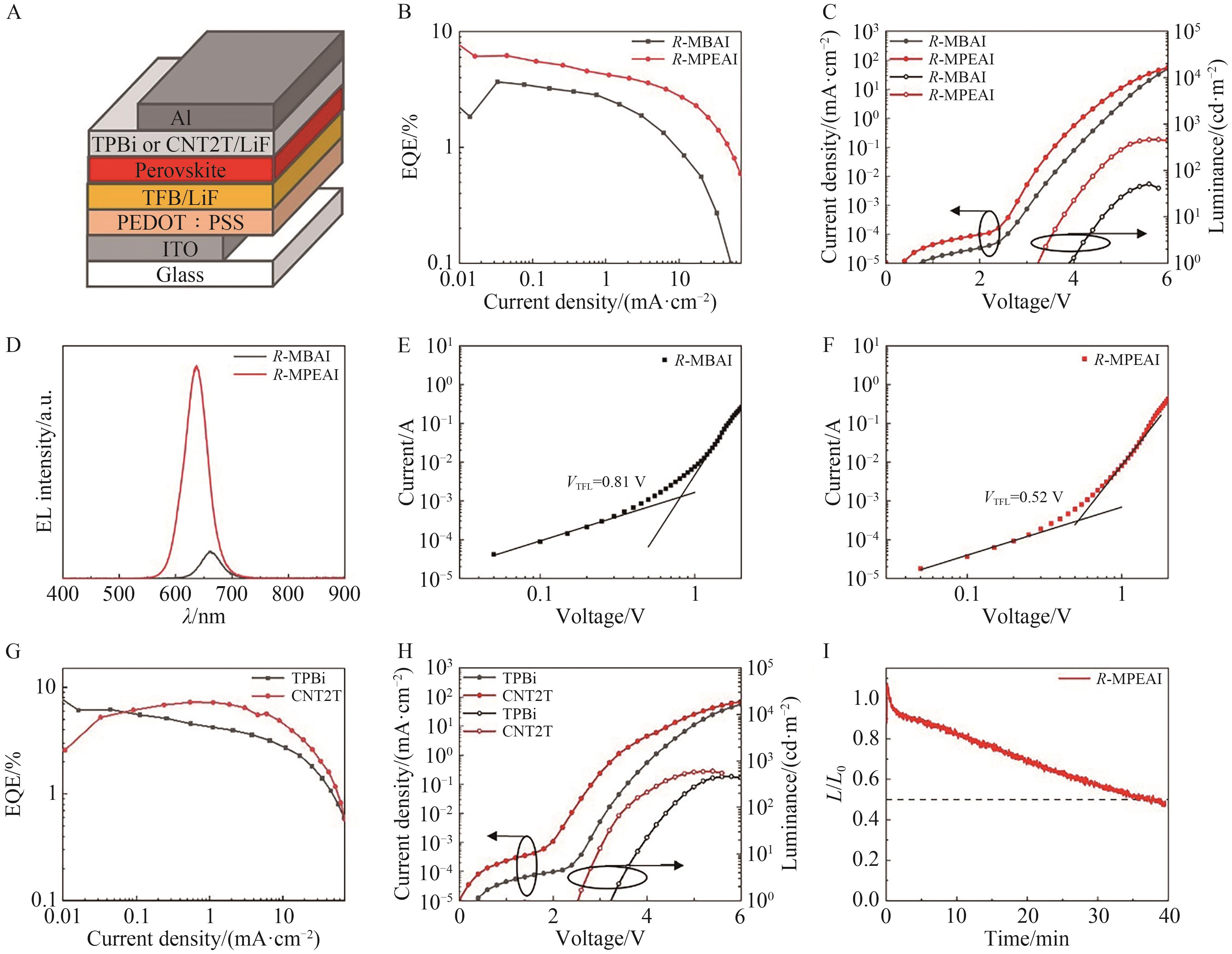
Fig.4 (A) Device structure of PeLEDs; (B) Maximum external quantum efficiency-current density curves, (C) current density-voltage-luminance curves and (D) EL spectra of R-MBAI and R-MPEAI PeLEDs; Current-voltage curves of hole-only devices based on (E) R-MBAI and (F) R-MPEAI; (G) Maximum external quantum efficiency-current density curves and (H) current density-voltage-luminance curves of R-MPEAI PeLEDs based on different electron-transport layers; (I) Operating lifetime T50 of R-MPEAI PeLEDs
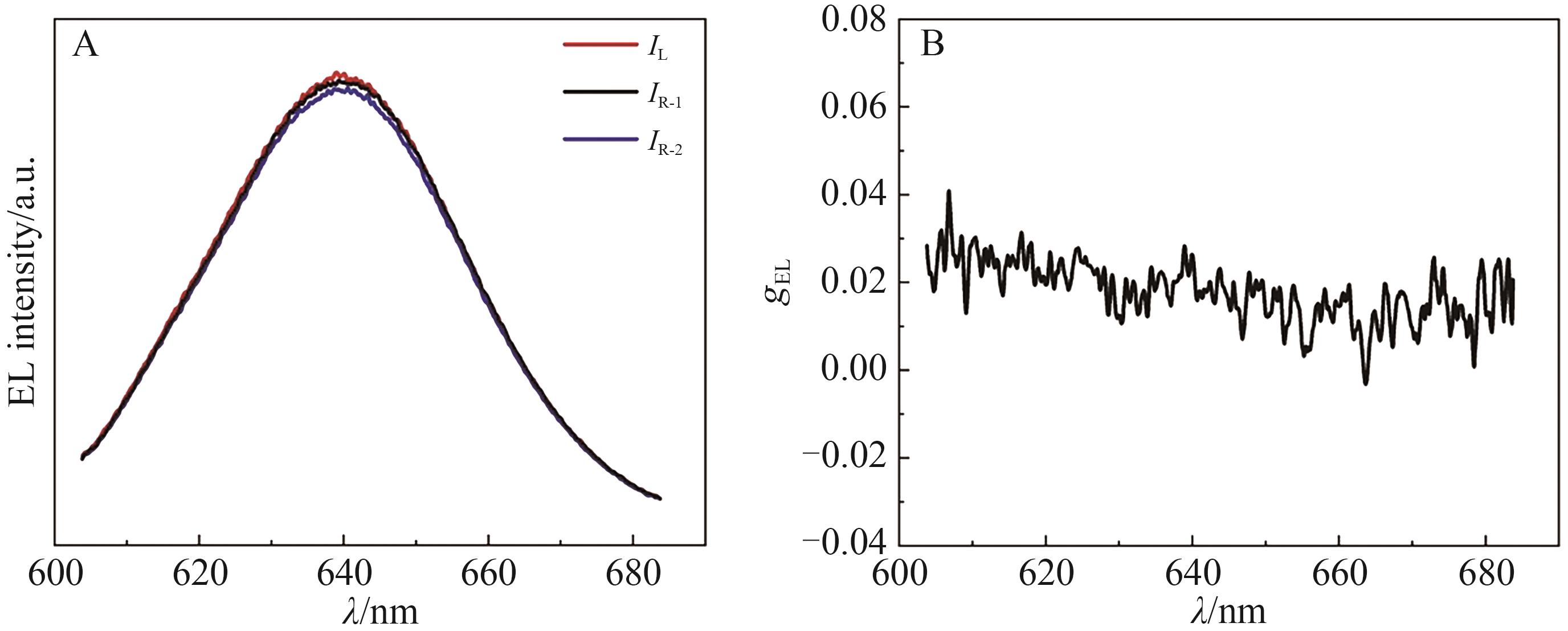
Fig.5 (A) CP-EL emission spectra and (B) gEL-wavelength curve of R-MPEAI PeLED
| Sample | Von/V | EQE/% | Lmax/(cd·m-2) | EL/nm | CIE(x, y) | gEL/% |
|---|---|---|---|---|---|---|
| R-MBAI∶NMAI(TPBi) | 4.0 | 3.68 | 51.2 | 659 | (0.687, 0.313) | - |
| R-MPEAI∶NMAI(TPBi) | 3.4 | 6.19 | 463.4 | 641 | (0.698, 0.302) | - |
| R-MPEAI∶NMAI(CNT2T) | 2.6 | 7.25 | 604.6 | 641 | (0.703, 0.297) | 2.86 |
Table 1 Parameters of different PeLEDs device performance
| Sample | Von/V | EQE/% | Lmax/(cd·m-2) | EL/nm | CIE(x, y) | gEL/% |
|---|---|---|---|---|---|---|
| R-MBAI∶NMAI(TPBi) | 4.0 | 3.68 | 51.2 | 659 | (0.687, 0.313) | - |
| R-MPEAI∶NMAI(TPBi) | 3.4 | 6.19 | 463.4 | 641 | (0.698, 0.302) | - |
| R-MPEAI∶NMAI(CNT2T) | 2.6 | 7.25 | 604.6 | 641 | (0.703, 0.297) | 2.86 |
| 1 | DANG Y Y, LIU X L, CAO B Q, et al. Chiral halide perovskite crystals for optoelectronic applications[J]. Matter, 2021, 4(3): 794-820. |
| 2 | LU H P, VARDENY Z V, BEARD M C. Control of light, spin and charge with chiral metal halide semiconductors[J]. Nat Rev Chem, 2022, 6(7): 470-485. |
| 3 | FURLAN F, MORENO J M, GASPARINI N, et al. Chiral materials and mechanisms for circularly polarized light-emitting diodes[J]. Nat Photonics, 2024, 18(7): 658-668. |
| 4 | WANG J Y, MAO B R, VARDENY Z V, et al. Chirality induced spin selectivity in chiral hybrid organic-inorganic perovskites[J]. J Chem Phys, 2023, 159(9): 091002. |
| 5 | SU W, YUAN F L. Opportunities and challenges of chiral perovskites for spin-LEDs[J]. Trends Chem, 2022, 4(11): 965-968. |
| 6 | KIM Y H, ZHAI Y X, LU H P. Chiral-induced spin selectivity enables a room-temperature spin light-emitting diode[J]. Science, 2021, 371(6534): 1129-1133. |
| 7 | JANG G, YEON J D, SUNIHL M, et al. Core-shell perovskite quantum dots for highly selective room-temperature spin light-emitting diodes[J]. Adv Mater, 2023, 36(5): 2309335. |
| 8 | YE C Y, JIANG J W, ZOU S L, et al. Core-shell three-dimensional perovskite nanocrystals with chiral-induced spin selectivity for room-temperature spin light-emitting diodes[J]. J Am Chem Soc, 2022, 144(22): 9707-9714. |
| 9 | YAN X Y, CAO R, ZHANG R X, et al. Mixed-ligand chiral quasi-2D perovskites for standard and deep blue CP‐LEDs[J]. Adv Funct Mater, 2024, 34(51): 2410012. |
| 10 | YANG C H, XIAO S B, XIAO H, et al. Efficient red-emissive circularly polarized electroluminescence enabled by quasi-2D perovskite with chiral spacer cation[J]. ACS Nano, 2023, 17(8): 7830-7836. |
| 11 | YAO J W, WANG Z Y, HUANG Y L, et al. Efficient green spin light-emitting diodes enabled by ultrafast energy- and spin-funneling in chiral perovskites[J]. J Am Chem Soc, 2024, 146(20): 14157-14165. |
| 12 | LI B H, LI Y, YUAN W, et al. Chiral quasi‐2D perovskites based single junction spin-light-emitting diodes[J]. Adv Funct Mater, 2024, 35(7): 2415433. |
| 13 | LIANG C, GU H, XIA Y D, et al. Two-dimensional ruddlesden-popper layered perovskite solar cells based on phase-pure thin films[J]. Nat Energy, 2020, 6(1): 38-45. |
| 14 | YAN K Y, LONG M Z, ZHANG T K, et al. Hybrid halide perovskite solar cell precursors: colloidal chemistry and coordination engineering behind device processing for high efficiency[J]. J Am Chem Soc, 2015, 137(13): 4460-4468. |
| 15 | LIU Z, PENG X M, XING S Y, et al. Deep-red perovskite light-emitting diodes with external quantum efficiency exceeding 21% enabled by ligand-modulated dimensionality control[J]. Adv Opt Mater, 2022, 10(20): 2201123. |
| 16 | RUI H S, WU X, QIU Y, et al. Bifunctional bidentate organic additive toward high brightness pure red quasi-2D perovskite light-emitting diodes[J]. Adv Funct Mater, 2023, 33(52): 2308147. |
| 17 | ZHANG L, SUN C J, HE T W, et al. High-performance quasi-2D perovskite light-emitting diodes: from materials to devices[J]. Light: Sci Appl, 2021, 10(1): 61. |
| 18 | YU Y, TANG Y Y, WANG B F, et al. Red perovskite light-emitting diodes: recent advances and perspectives[J]. Laser Photonics Rev, 2022, 17(2): 2200608. |
| 19 | KYEONG C J, PRIYABRATA S, MIN M J. High-performance pure red perovskite light-emitting diodes utilizing conformational transformation of ionic liquid additive[J]. Nano Energy, 2024, 120: 109228. |
| 20 | LIU S P, KEPENEKIAN M, BODNAR S, et al. Bright circularly polarized photoluminescence in chiral layered hybrid lead-halide perovskites[J]. Sci Adv, 2023, 9(35): 5038. |
| 21 | WEI K Y, LIANG B, SUN C J, et al. Metal halide perovskites for red-emission light-emitting diodes[J]. Small Struct, 2022, 3(10): 2200063. |
| 22 | LIU S W, ZHAN H M, QIN C L, et al. Suppressing high-order phase for efficient pure red quasi-2D perovskite light-emitting diodes[J]. J Phys Chem Lett, 2022, 14(1): 73-79. |
| 23 | ZHANG D L, CHAO L F, JIN G R, et al. Highly efficient red perovskite light-emitting diodes with reduced efficiency roll-off enabled by manipulating crystallization of quasi-2D perovskites[J]. Adv Funct Mater, 2022, 32(36): 2205707. |
| 24 | LIU S W, ZHAN H M, QIN C L, et al. Controlling of precursor micelle size by ternary co-spacer cations for efficient pure red quasi-2D PeLEDs with recommendation 2020 color coordinates[J]. Chem Eng J, 2024, 479: 147886. |
| 25 | LIANG X F, LIU Z, ZHANG J B, et al. Promoting energy transfer between quasi-2D perovskite layers toward highly efficient red light-emitting diodes[J]. Small, 2022, 18(49): 2204638. |
| 26 | ADE K, CHIEN L C, JOHAN I, et al. Optimization of a triazine-based acceptor (CN-T2T) as the electron transport layer for highly efficient near-infrared perovskite light-emitting diodes[J]. J Mater Chem C, 2023, 11(34): 11564-11570. |
| 27 | LIANG T Z, CHIEN C L, WEI C L, et al. Aggregation control, surface passivation, and optimization of device structure toward near-infrared perovskite quantum-dot light-emitting diodes with an EQE up to 15.4%[J]. Adv Mater, 2022, 34(18): 2109785. |
| 28 | ZHAO F, WEI D H, NAN L S, et al. Iodotrimethylsilane as a reactive ligand for surface etching and passivation of perovskite nanocrystals toward efficient pure-red to deep-red LEDs[J]. Angew Chem Int Ed, 2023, 62(46): 202311089. |
| 29 | XI Z R, FEI T Y, YING Y C, et al. Efficient quasi-2D perovskite spin light-emitting diodes based on chiral-induced spin selectivity[J]. Chem Mater, 2024, 36(8): 3812-3819. |
| [1] | Guan-Zhong WANG, Shi-Ping SONG, Hong-Zhen PENG, Yu ZHANG, Ying ZHU, Jing CHEN. Research Progress in OLEDs Emissive Materials Based on Cu(Ⅰ) Complexes [J]. Chinese Journal of Applied Chemistry, 2024, 41(6): 783-799. |
| [2] | Li-Yan CHEN, Zi-Ming ZHAO, Jin-Qi TAO, Yu-Zhen ZHANG, Gang CHENG, Yun-Jun SHEN. Synthesis of Mono- and Binuclear Disulfur-Chelated Organoplatinum(Ⅱ) Complexes and Its OLEDs Application [J]. Chinese Journal of Applied Chemistry, 2023, 40(2): 236-244. |
| [3] | Dan MENG, Kai-Yuan ZHENG, Shan-Shan CHEN, Zhao-Long ZHUO, Li-Li WANG. Preparation and Luminescence Properties of Silicon and Nitrogen Co⁃doped Carbon Dots Phosphors [J]. Chinese Journal of Applied Chemistry, 2022, 39(11): 1766-1773. |
| [4] | WANG Sen, PANG Ran, LI Da, LI Cheng-Yu, ZHANG Hong-Jie. Synthesis and Luminescence Properties of a Single-Phase White-Emitting and Tunable Color Phosphor Na3Sc2(PO4)3∶Tm3+,Dy3+ [J]. Chinese Journal of Applied Chemistry, 2021, 38(11): 0-0. |
| [5] | WANG Sen, PANG Ran, LI Da, LI Cheng-Yu, ZHANG Hong-Jie. Synthesis and Luminescence Properties of a Single-Phase White-Emitting and Tunable Color Phosphor Na3Sc2(PO4)3∶Tm3+,Dy3+ [J]. Chinese Journal of Applied Chemistry, 2021, 38(11): 1469-1478. |
| [6] | LIU Weiqiang,CUI Rongzhen,WU Ruixia,LI Yunhui,YANG Xiuyun,ZHOU Liang. Recent Progress on Blue Delayed Fluorescent Materials and Devices [J]. Chinese Journal of Applied Chemistry, 2019, 36(1): 1-9. |
| [7] | SHAO Shiyang, DING Junqiao, WANG Lixiang. Recent Advances on Thermally Activated Delayed Fluorescence Polymers [J]. Chinese Journal of Applied Chemistry, 2018, 35(9): 993-1004. |
| [8] | YUAN Ting,MENG Ting,LI Shuhua,FAN Louzhen. Recent Development of Electroluminescent Diodes Based on Phosphorescent Materials [J]. Chinese Journal of Applied Chemistry, 2018, 35(8): 871-880. |
| [9] | DAI Yanfeng,ZHANG Zhiqiang,LIU Yipeng,MA Dongge. High Efficiency Fluorescent/Phosphorescent Hybrid White Organic Light-Emitting Diodes Without Spacer Structure [J]. Chinese Journal of Applied Chemistry, 2015, 32(10): 1139-1145. |
| [10] | LV Jianhong1,2, MA Zhihua1, DING Junqiao1*, WANG Lixiang1*. Synthesis and Characterization of a Green-Emitting Iridium Complex Based on Fluorinated Benzoimidazole Ligand [J]. Chinese Journal of Applied Chemistry, 2014, 31(10): 1177-1184. |
| [11] | YANG Junwei1,2, WANG Shumeng1,2, DING Junqiao1*, WANG Lixiang1*. Synthesis and Properties of Poly(spirobifluorene-co-2,8-dibenzothiophene-S,S-dioxide)s [J]. Chinese Journal of Applied Chemistry, 2014, 31(10): 1156-1163. |
| [12] | SHI Changsheng, CHEN Jiangshan*, MA Dongge*. Ultrathin Al/Li2CO3 Modified Indium Tin Oxide Cathode for Blue Phosphorescent Inverted Bottom-emission Organic Light-emitting Diodes [J]. Chinese Journal of Applied Chemistry, 2012, 29(12): 1412-1416. |
| Viewed | ||||||
|
Full text |
|
|||||
|
Abstract |
|
|||||
