
应用化学 ›› 2025, Vol. 42 ›› Issue (11): 1510-1523.DOI: 10.19894/j.issn.1000-0518.250115
吴秀秀1, 刘志敏1, 杨栋1, 毛顺1, 王焱鑫1, 郭德华2( ), 徐斐1()
收稿日期:2025-03-15
接受日期:2025-06-16
出版日期:2025-11-01
发布日期:2025-12-05
通讯作者:
郭德华,徐斐
基金资助:
Xiu-Xiu WU1, Zhi-Min LIU1, Dong YANG1, Shun MAO1, Yan-Xin WANG1, De-Hua GUO2(), Fei XU1()
Received:2025-03-15
Accepted:2025-06-16
Published:2025-11-01
Online:2025-12-05
Contact:
De-Hua GUO,Fei XU
About author:xufei8135@126.comSupported by:摘要:
蔬菜和水果中的拟除虫菊酯类农药的残留会对人体健康造成危害。 建立了表面增强拉曼光谱(SERS)结合深度学习模型快速定量检测菠菜中氯氰菊酯农药的方法。 首先,Ag/ZnO纳米花作为SERS基底。 然后,对采集到的SERS光谱数据进行增强,并分别对增强后的光谱数据进行Savitzky-Golay(S-G)和均值中心化(MC)预处理,后将2种预处理算法联用。 分别对原始增强光谱和3种方法预处理后的增强光谱建立了反向传播(BP)神经网络深度学习模型,用于实际样品菠菜中氯氰菊酯的预测。 结果表明,基于原始增强光谱的BP神经网络深度学习模型具有优异的预测性能。 其测试集的复相关系数RP=0.9902,均方根误差RMSEP=0.102,检出限为20 μg/L,双尾配对t检验表明,标准方法液相色谱-质谱联用(LC-MS)与该方法之间的检测结果无显著差异。 将SERS光谱输入到训练好的模型后,5~10 min即可完成检测。 建立了一种基于Ag/ZnO纳米花的SERS方法与BP神经网络模型相结合,用于菠菜中氯氰菊酯农药残留的快速定量检测的方法。
中图分类号:
吴秀秀, 刘志敏, 杨栋, 毛顺, 王焱鑫, 郭德华, 徐斐. 基于表面增强拉曼光谱结合深度学习模型快速定量检测菠菜中的氯氰菊酯[J]. 应用化学, 2025, 42(11): 1510-1523.
Xiu-Xiu WU, Zhi-Min LIU, Dong YANG, Shun MAO, Yan-Xin WANG, De-Hua GUO, Fei XU. Rapid and Quantitative Detection of Cypermethrin in Spinach Based on Surface-Enhanced Raman Spectroscopy Combined with Deep Learning Model[J]. Chinese Journal of Applied Chemistry, 2025, 42(11): 1510-1523.
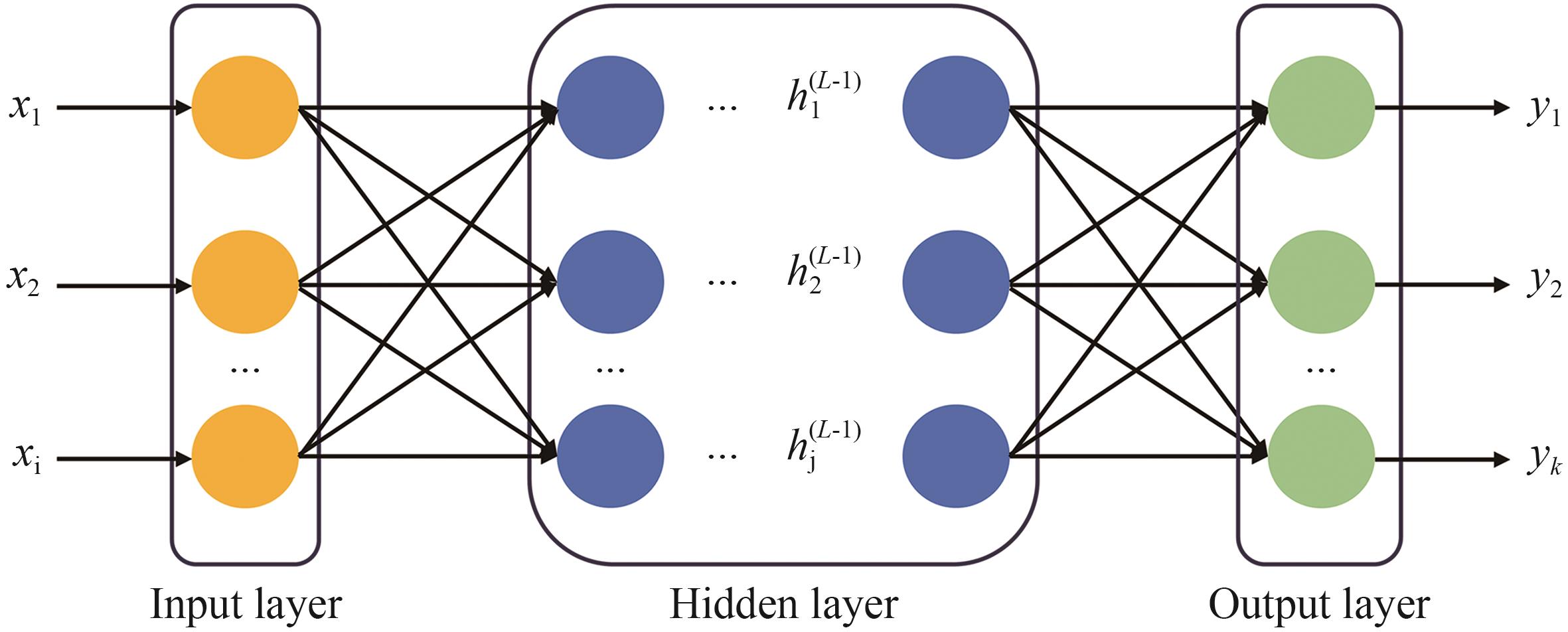
图1 BP神经网络示意图
Fig.1 BP neural network schematic diagram
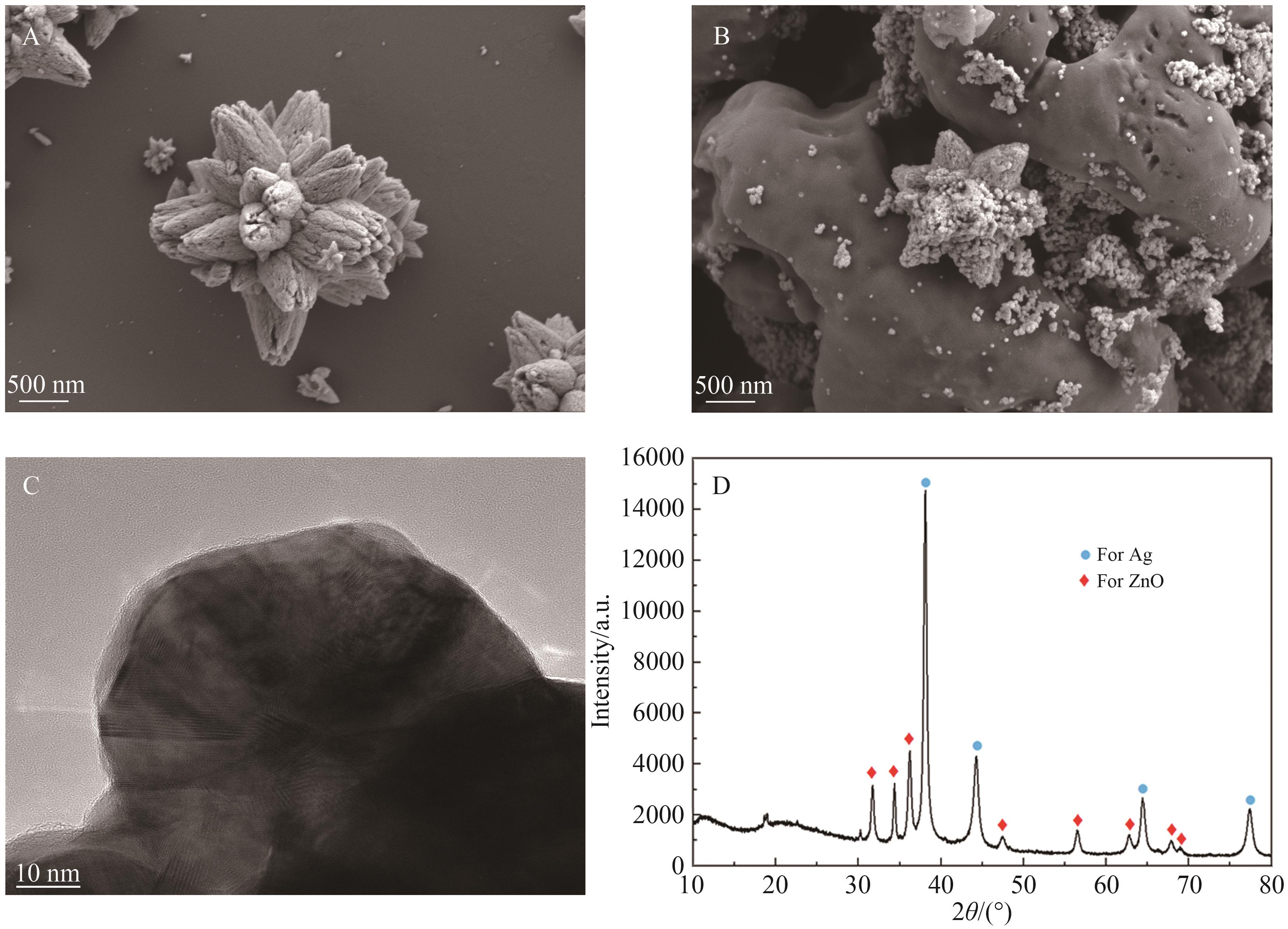
图2 (A) ZnO NFs的SEM图; (B) Ag/ZnO NFs的SEM图; (C) AgNPs锚定在NFs上的TEM图; (D) Ag/ZnO NFs的XRD图
Fig.2 (A) SEM image of ZnO NFs; (B) SEM of Ag/ZnO NFs; (C) TEM image of AgNPs anchored on NFs; (D) XRD image of Ag/ZnO NFs
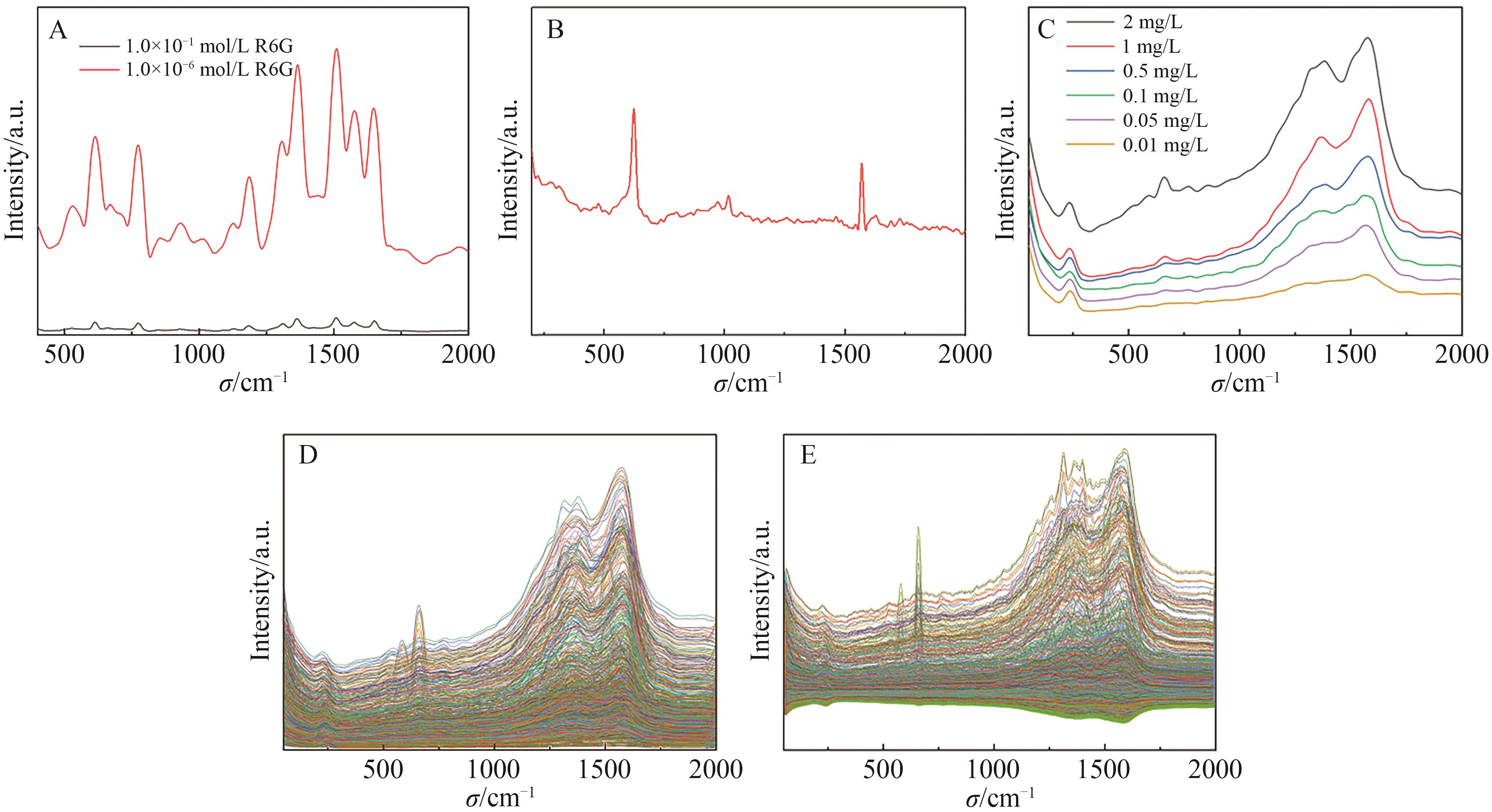
图3 (A) R6G溶液的SERS光谱; (B)氯氰菊酯标准品的拉曼光谱; (C) 6个浓度梯度的平均光谱样本; (D) S-G处理后的增强光谱; (E) MC处理后的增强光谱
Fig.3 (A) Collected SERS spectrum of R6G solution; (B) Raman spectra of cypermethrin standard; (C) The average spectra samples with six concentration gradients; (D) Enhanced spectral data after S-G; (E) Enhanced spectral data after MC
| Methods | Model | Calibration set | Prediction set | ||
|---|---|---|---|---|---|
| RC | RMSEC/(mg·L-1) | RP | RMSEP/(mg·L-1) | ||
| None | BP | 0.995 9 | 0.067 | 0.990 2 | 0.102 |
| PLSR | 0.800 7 | 0.426 | 0.807 4 | 0.419 | |
| RFR | 0.972 2 | 0.172 | 0.886 2 | 0.329 | |
| SVR | 0.991 1 | 0.126 | 0.874 6 | 0.359 | |
| S-G | BP | 0.995 9 | 0.067 | 0.985 7 | 0.123 |
| PLSR | 0.822 9 | 0.404 | 0.823 5 | 0.403 | |
| RFR | 0.983 8 | 0.115 | 0.929 5 | 0.244 | |
| SVR | 0.991 1 | 0.126 | 0.874 6 | 0.359 | |
| MC | BP | 0.995 9 | 0.067 | 0.985 7 | 0.123 |
| PLSR | 0.850 5 | 0.374 | 0.811 5 | 0.426 | |
| RFR | 0.983 6 | 0.132 | 0.937 2 | 0.249 | |
| SVR | 0.991 1 | 0.126 | 0.874 6 | 0.359 | |
| S-G+MC | BP | 0.985 9 | 0.119 | 0.984 9 | 0.123 |
| PLSR | 0.836 9 | 0.389 | 0.834 2 | 0.392 | |
| RFR | 0.988 3 | 0.112 | 0.931 3 | 0.259 | |
| SVR | 0.991 4 | 0.123 | 0.882 4 | 0.349 | |
表1 4种模型在不同预处理方法下对菠菜中氯氰菊酯的预测
Table 1 Prediction of cypermethrin in spinach by four models under different pretreatment methods
| Methods | Model | Calibration set | Prediction set | ||
|---|---|---|---|---|---|
| RC | RMSEC/(mg·L-1) | RP | RMSEP/(mg·L-1) | ||
| None | BP | 0.995 9 | 0.067 | 0.990 2 | 0.102 |
| PLSR | 0.800 7 | 0.426 | 0.807 4 | 0.419 | |
| RFR | 0.972 2 | 0.172 | 0.886 2 | 0.329 | |
| SVR | 0.991 1 | 0.126 | 0.874 6 | 0.359 | |
| S-G | BP | 0.995 9 | 0.067 | 0.985 7 | 0.123 |
| PLSR | 0.822 9 | 0.404 | 0.823 5 | 0.403 | |
| RFR | 0.983 8 | 0.115 | 0.929 5 | 0.244 | |
| SVR | 0.991 1 | 0.126 | 0.874 6 | 0.359 | |
| MC | BP | 0.995 9 | 0.067 | 0.985 7 | 0.123 |
| PLSR | 0.850 5 | 0.374 | 0.811 5 | 0.426 | |
| RFR | 0.983 6 | 0.132 | 0.937 2 | 0.249 | |
| SVR | 0.991 1 | 0.126 | 0.874 6 | 0.359 | |
| S-G+MC | BP | 0.985 9 | 0.119 | 0.984 9 | 0.123 |
| PLSR | 0.836 9 | 0.389 | 0.834 2 | 0.392 | |
| RFR | 0.988 3 | 0.112 | 0.931 3 | 0.259 | |
| SVR | 0.991 4 | 0.123 | 0.882 4 | 0.349 | |
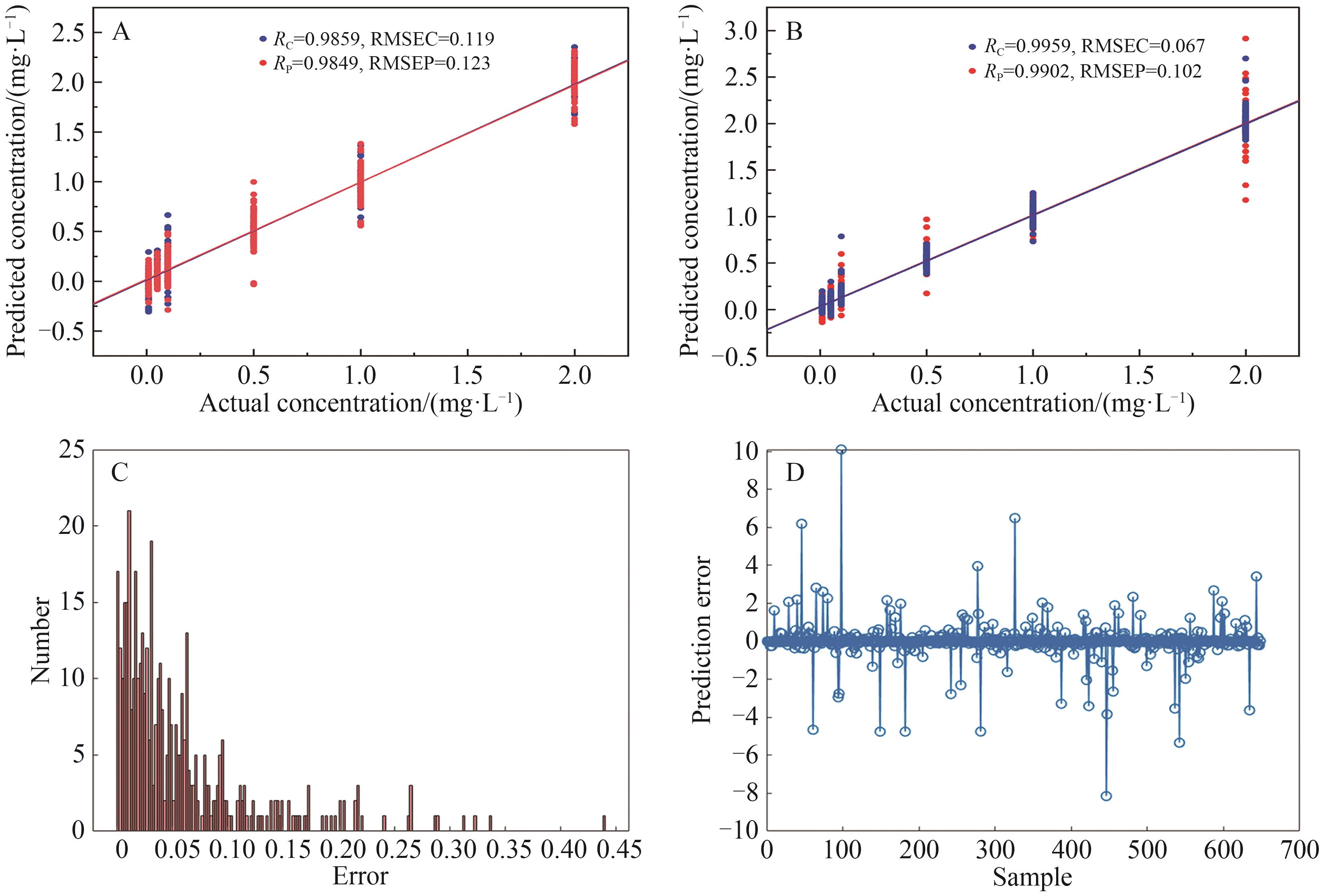
图4 (A)原始增强数据和(B)S-G+MC处理数据的BP神经网络模型结果; (C)测试集误差分布; (D)BP模型预测误差百分比
Fig.4 BP neural network model results of (A) original enhanced data and (B) S-G+MC processed data; (C) Test set error distribution; (D) Prediction error percentage of BP model
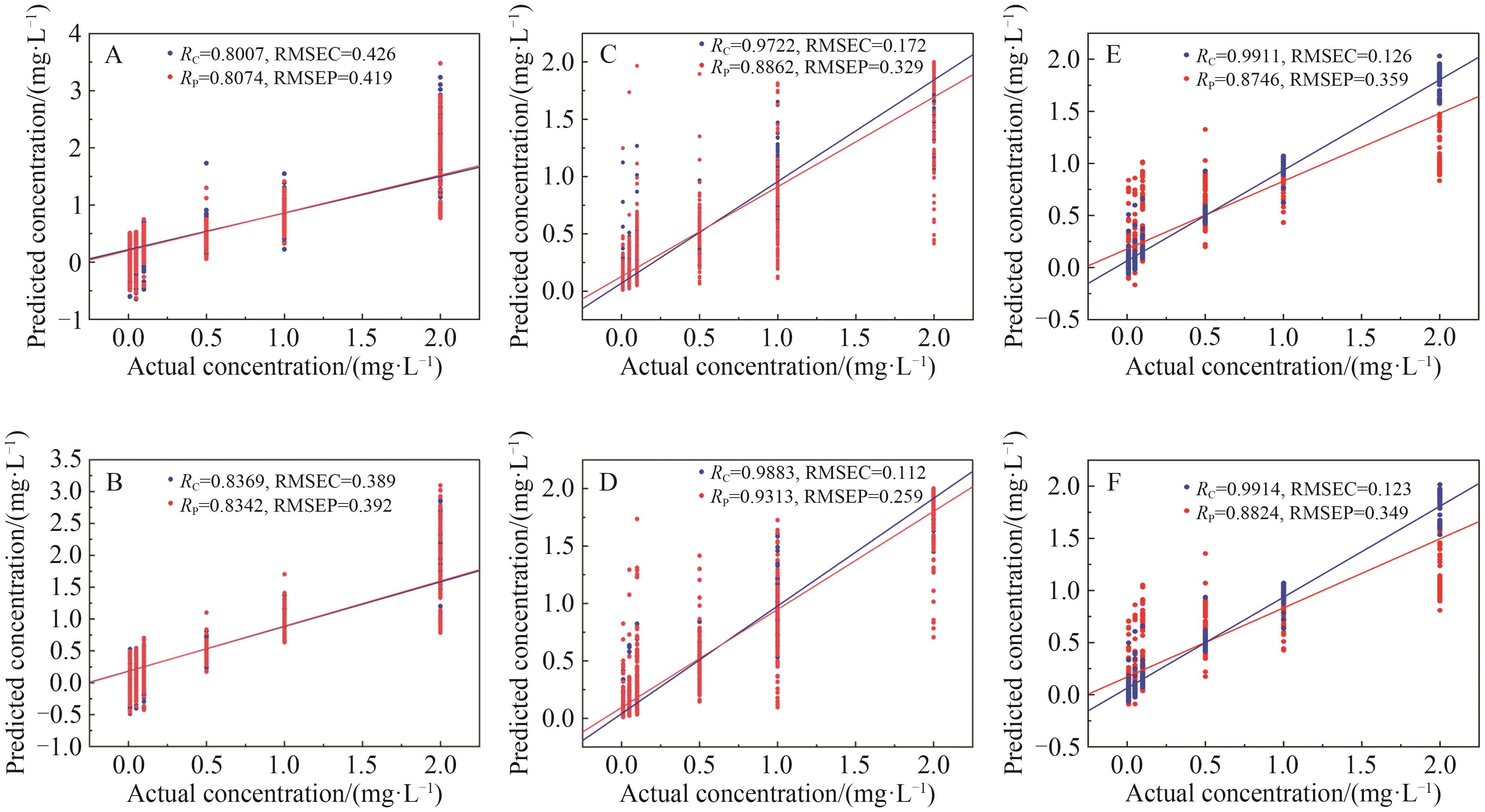
图5 (A)原始增强数据和(B)S-G+MC处理数据的PLSR模型结果; (C)原始增强数据和(D)S-G+MC处理数据的RFR模型结果; (E)原始增强数据和(F)S-G+MC处理数据的SVR模型结果
Fig.5 PLSR model results of (A) original enhanced data and (B) S-G+MC processed data; RFR model results of (C) original enhanced data and (D) S-G+MC processed data; SVR model results of (E) original enhanced data and (F) S-G+MC processed data
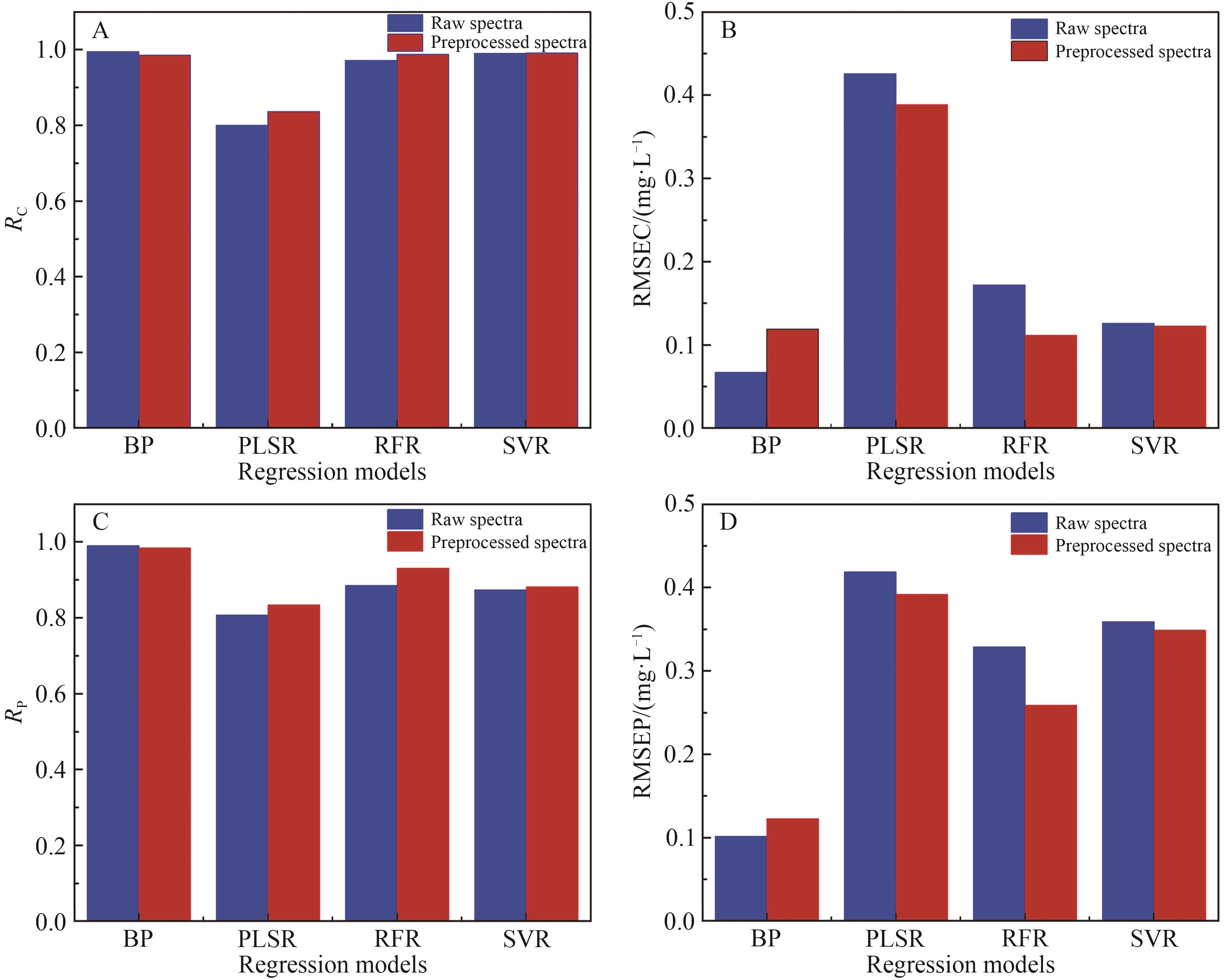
图6 各种模型评价指标的变化趋势A. RC; B. RMSEC; C. RP; D. RMSEP
Fig.6 Trends of various model evaluation metrics
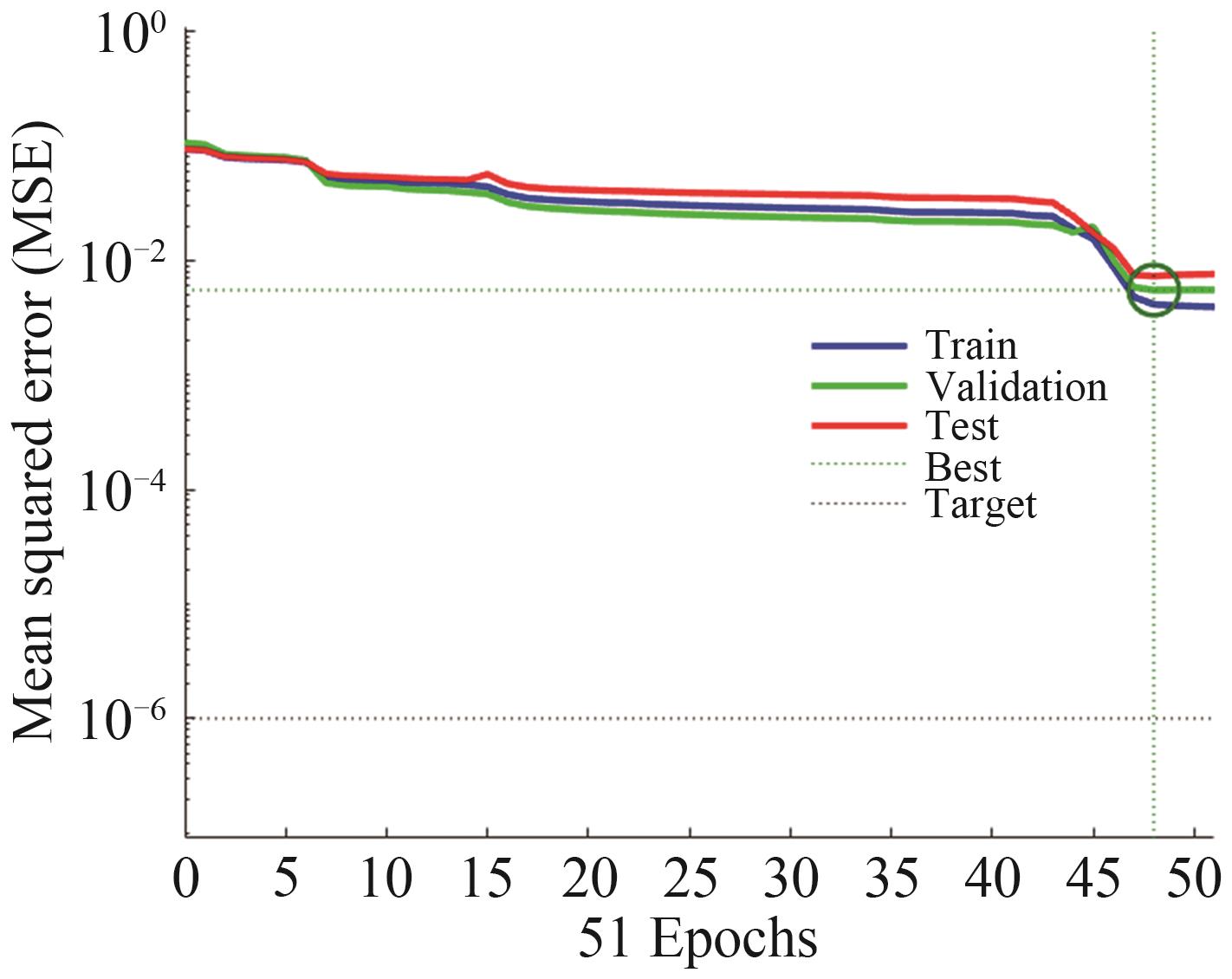
图7 训练过程中MSE的变化
Fig.7 Changes of MSE during training
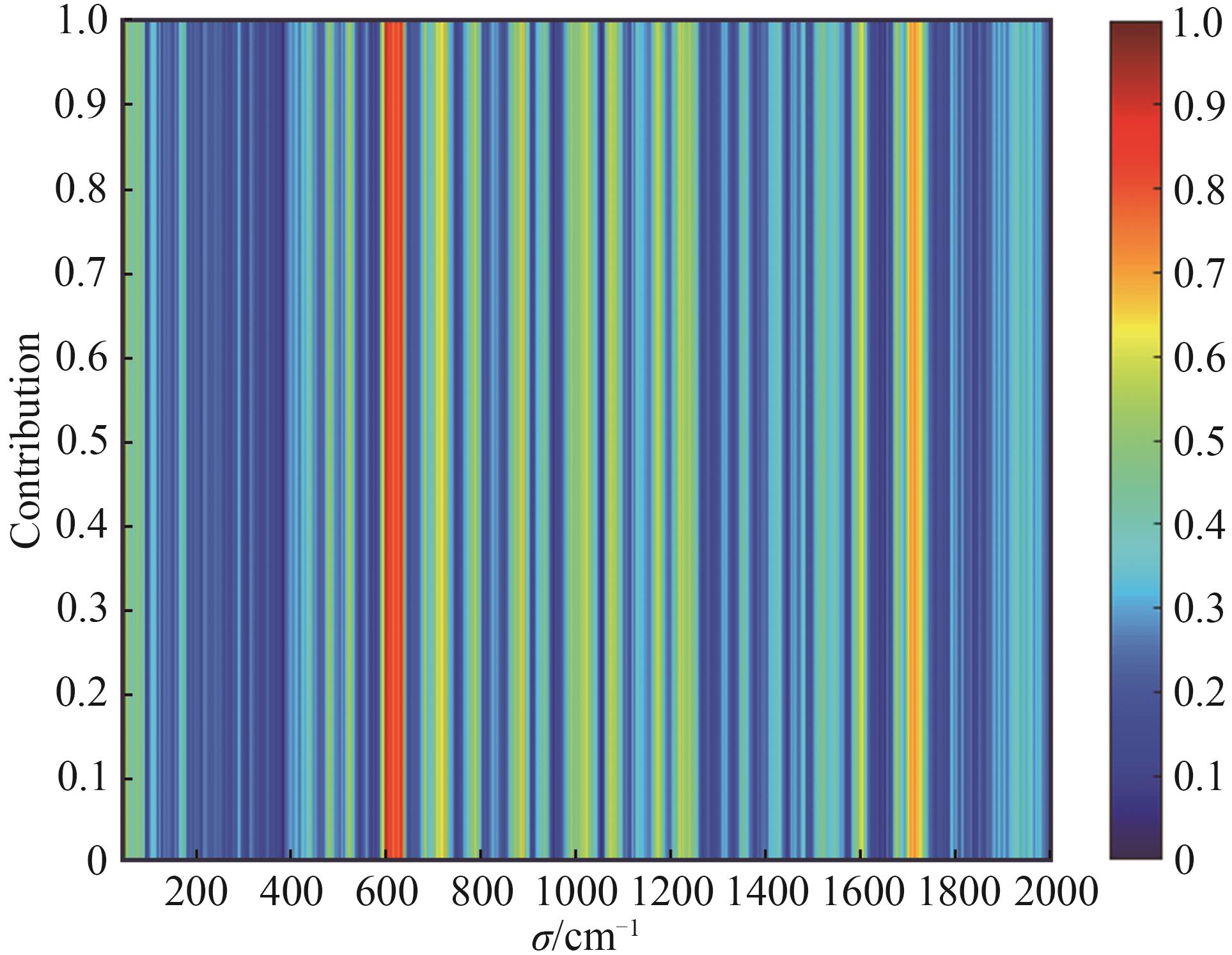
图8 特征波长对BP模型预测的贡献
Fig.8 Contribution of characteristic wavelength to BP model prediction
| Actual concentration/(mg·L-1) | Detected concentration/(mg·L-1) | Recovery ratio/% | RSD/% | |||
|---|---|---|---|---|---|---|
| Proposed method | HPLC-MS | Proposed method | HPLC-MS | Proposed method | HPLC-MS | |
| 0.08 | 0.076±0.005 | 0.080±0.001 | 95.0 | 100.0 | 6.6 | 1.3 |
| 0.6 | 0.580±0.030 | 0.589±0.017 | 96.7 | 98.2 | 5.2 | 2.9 |
| 0.8 | 0.853±0.055 | 0.829±0.022 | 106.6 | 103.6 | 6.4 | 2.7 |
| 1.5 | 1.638±0.024 | 1.466±0.036 | 109.2 | 97.7 | 1.5 | 2.5 |
| 2.5 | 2.262±0.170 | 2.507±0.021 | 90.5 | 100.3 | 7.5 | 0.8 |
表2 菠菜中氯氰菊酯的检测方法
Table 2 Detection of cypermethrin in spinach by the proposed method
| Actual concentration/(mg·L-1) | Detected concentration/(mg·L-1) | Recovery ratio/% | RSD/% | |||
|---|---|---|---|---|---|---|
| Proposed method | HPLC-MS | Proposed method | HPLC-MS | Proposed method | HPLC-MS | |
| 0.08 | 0.076±0.005 | 0.080±0.001 | 95.0 | 100.0 | 6.6 | 1.3 |
| 0.6 | 0.580±0.030 | 0.589±0.017 | 96.7 | 98.2 | 5.2 | 2.9 |
| 0.8 | 0.853±0.055 | 0.829±0.022 | 106.6 | 103.6 | 6.4 | 2.7 |
| 1.5 | 1.638±0.024 | 1.466±0.036 | 109.2 | 97.7 | 1.5 | 2.5 |
| 2.5 | 2.262±0.170 | 2.507±0.021 | 90.5 | 100.3 | 7.5 | 0.8 |
| Methods | Pesticides | LOD/(μg·L-1) | Ref. |
|---|---|---|---|
| Banded immunoassay | Fenpropathrin | 62 | [ |
| Colorimetric sensor | Fenvalerate | 4053 | [ |
| Enzyme linked immunosorbent assay | Cypermethrin | 300 | [ |
| Lateral flow immunoassay | Cypermethrin | 50 | [ |
| Fluorescence sensor | Fenpropathrin | 0.24 | [ |
| Electrochemical sensor | Fenpropathrin | 4.63×10⁻³ | [ |
| SERS combined with BP | Cypermethrin | 20 | This work |
表3 拟除虫菊酯类农药LOD与其他检测方法的比较
Table 3 Comparison of LOD with other detection methods for pyrethroid pesticides
| Methods | Pesticides | LOD/(μg·L-1) | Ref. |
|---|---|---|---|
| Banded immunoassay | Fenpropathrin | 62 | [ |
| Colorimetric sensor | Fenvalerate | 4053 | [ |
| Enzyme linked immunosorbent assay | Cypermethrin | 300 | [ |
| Lateral flow immunoassay | Cypermethrin | 50 | [ |
| Fluorescence sensor | Fenpropathrin | 0.24 | [ |
| Electrochemical sensor | Fenpropathrin | 4.63×10⁻³ | [ |
| SERS combined with BP | Cypermethrin | 20 | This work |
| [1] | GOURGOUTA M, RUMBOS C I, ATHANASSIOU C G. Residual toxicity of a commercial cypermethrin formulation on grains against four major storage beetles[J]. J Stored Prod Res, 2019, 83: 103-109. |
| [2] | SUN X, ZHAO Y, LIU L, et al. Visual whole-process monitoring of pesticide residues: an environmental perspective using surface-enhanced Raman spectroscopy with dynamic borohydride-reduced silver nanoparticles[J]. J Hazard Mater, 2024, 465: 133338 . |
| [3] | YAO T, LIU A, LIU Y, et al. Ratiometric fluorescence sensor for organophosphorus pesticide detection based on opposite responses of two fluorescence reagents to MnO[J]. Biosens Bioelectron, 2019, 145: 111705. |
| [4] | WU X, HUANG L, YANG Q, et al. Effective extraction of pyrethroid pesticides from cabbages using Fe3O4@NU-1000 and adsorption mechanism: an experimental and theoretical study[J]. Microchem J, 2024, 204: 110979. |
| [5] | JIAO T, HASSAN M M, ZHU J, et al. Quantification of deltamethrin residues in wheat by Ag@ZnO NFs-based surface-enhanced Raman spectroscopy coupling chemometric models[J]. Food Chem, 2020, 337: 127652. |
| [6] | EL-SHEIKH E S A, LI D, HAMED I, et al. Residue analysis and risk exposure assessment of multiple pesticides in tomato and strawberry and their products from markets[J]. Foods, 2023, 12(10): 1936. |
| [7] | FERREIRA A Q, SONIA C N. Multiresidue method for determination of pesticides in coconut (Cocos nucifera Linn.) endosperm by using GC-MS/MS and UHPLC-MS/MS analysis[J]. J Food Composition Anal, 2021, 97(1): 103764. |
| [8] | LI H, SHENG W, HASSAN M M, et al. Quantification of antibiotics in food by octahedral gold-silver nanocages-based SERS sensor coupling multivariate calibration[J]. Spectrochimica Acta Part A: Mol Biomol Spectrosc, 2024, 320: 124595. |
| [9] | ADADE S Y S S, LIN H, HARUNA S A, et al. SERS-based sensor coupled with multivariate models for rapid detection of palm oil adulteration with Sudan II and IV dyes[J]. J Food Compos Anal, 2022, 114: 104834. |
| [10] | ALAWADHI H, ALNAQBI M A, RAMACHANDRAN K, et al. Trace-level sensing of food toxins by flexible and cost-effective SERS sensors fabricated by pulsed-laser-deposition of gold nanoparticles on polycarbonate matrix[J]. Surf Interfaces, 2023, 40: 103016. |
| [11] | BARVEEN Y H L, WANG T, CHANG Y, et al. Ultrasensitive and reusable SERS probe for the detection of synthetic dyes in food industry through hybrid flower-shaped ZnO@Ag nanostructures[J]. J Alloys Compd, 2021, 861(1): 157952. |
| [12] | CHUESIANG P, RYU V, SIRIPATRAWAN U, et al. Aptamer-based surface enhanced Raman spectroscopy (SERS) for the rapid detection of Salmonella Enteritidis contaminated in ground beef[J]. Food Sci Technol, 2021(150): 111937. |
| [13] | XU L, XIE Y, LIN J, et al. Advancements in SERS-based biological detection and its application and perspectives in pancreatic cancer[J]. View, 2023, 5(1): 20230070. |
| [14] | WANG S, PAN R, HE W, et al. In situ surface-enhanced Raman scattering detection of biomolecules in the deep ocean[J]. Appl Surf Sci, 2023, 620: 156854. |
| [15] | QIN C, ZHANG D, WU Z, et al. Construction of an efficient molecular enrichment and magnetic separation flow with Fe3O4@Ag@COF for ratiometric SERS detection of methamidophos[J]. Chem Eng J, 2024, 496: 154177. |
| [16] | LAI H, DAI H, LI G, et al. Rapid determination of pesticide residues in fruit and vegetable using Au@AgNPs decorated 2D Ni-MOF nanosheets as efficient surface-enhanced Raman scattering substrate[J]. Sens Actuators B, 2022, 369: 132360. |
| [17] | MA L, HAN E, YIN L, et al. Simultaneous detection of mixed pesticide residues based on portable Raman spectrometer and Au@Ag nanoparticles SERS substrate[J]. Food Control, 2023, 153: 109951. |
| [18] | LIU X, PANT U, LOGAN N, et al. Non-linear responses via agglomeration and aggregation of gold nanoparticles for surface-enhanced Raman spectroscopy (SERS) coupled with chemometric analysis for chlorpyrifos detection[J]. Food Chem, 2024, 455: 139944. |
| [19] | LEE S, ZHAO Q, LEE S, et al. Two-and three-dimensional Ag-Au nanoalloying: heterogeneous building blocks enhancing near-field focusing[J]. ACS Nano, 2024, 18(43): 29880-29890. |
| [20] | GU Y, LI Y, QIU H, et al. Recent progress on noble-free substrates for surface-enhanced Raman spectroscopy analysis[J]. Coord Chem Rev, 2023, 497: 215425 . |
| [21] | LI H, GENG W, HASSAN M, et al. Rapid detection of chloramphenicol in food using SERS flexible sensor coupled artificial intelligent tools[J]. Food Control, 2021, 128(1): 108186. |
| [22] | HAJIKHANI M, HEGDE A, SNYDER J, et al. Integrating transformer-based machine learning with SERS technology for the analysis of hazardous pesticides in spinach[J]. J Hazard Mater, 2024, 470: 134208. |
| [23] | ZHAO Z P, LI Q F, ZHANG Z X, et al. Combining a parallel 2D CNN with a self-attention Dilated Residual Network for CTC-based discrete speech emotion recognition[J]. Neural Networks, 2021, 141: 52-60. |
| [24] | DENG Y, XIAO H, XU J, et al. Prediction model of PSO-BP neural network on coliform amount in special food[J]. Saudi J Biol Sci, 2019, 26(6): 1154-1160. |
| [25] | XING W, LIU X, XU C, et al. Application of artificial neural network to predict benzo[a]pyrene based on multiple quality of smoked sausage[J]. Food Sci Technol, 2022, 163: 113571. |
| [26] | WU X, YAN H, CAO Y, et al. Prediction acrylamide contents in fried dough twist based on the application of artificial neural network[J]. Food Chem: X, 2024, 24: 102007. |
| [27] | HUANG X, YOU Y, ZENG X, et al. Back propagation artificial neural network (BP-ANN) for prediction of the quality of gamma-irradiated smoked bacon[J]. Food Chem, 2024, 437: 137806. |
| [28] | JIAO T, KUTSANEDZIE F, XU J, et al. SERS-signal optimised AgNPs-plated-ZnO nanoflower-like structure synthesised for sensing applications[J]. Phys Lett A, 2019, 383(12): 1312-1317. |
| [29] | ZHU J, JIANG X, RONG Y, et al. Label-free detection of trace level zearalenone in corn oil by surface-enhanced Raman spectroscopy (SERS) coupled with deep learning models[J]. Food Chem, 2023, 414: 135705. |
| [30] | HAO T, ZHAO L, WANG D, et al. The OED-BO-RFR model for predicting CBM pressure during the pre-drainage process[J]. Geomat Nat Haz Risk, 2024, 15(1): 2399924. |
| [31] | ZHAO G, PAN X, YAN H, et al. Predicting engineering properties of controlled low-strength material made from waste soil using optimized SVR models[J]. Case Stud Constr Mater, 2024, 20: e03325. |
| [32] | LI W, LU B T, CHEN F F, et al. Host-guest complex of cypermethrin with β-cyclodextrin: a spectroscopy and theoretical investigation[J]. J Mol Struct, 2011, 990(1/2/3): 244-252. |
| [33] | CHEN X, LIU L, KUANG H, et al. A strip-based immunoassay for rapid determination of fenpropathrin[J]. Anal Methods, 2013, 5(21): 6234-6239. |
| [34] | ZHU J, YIN X, ZHANG W, et al. Simultaneous and sensitive detection of three pesticides using a functional poly(sulfobetaine methacrylate)-coated paper-based colorimetric sensor[J]. Biosensors, 2023, 13(3): 309. |
| [35] | HUANG L, ZHANG F, LI F, et al. Development of Ic-ELISA and colloidal gold lateral flow immunoassay for the determination of cypermethrin in agricultural samples[J]. Biosensors, 2022, 12(11): 1058. |
| [36] | YAO J, XU X, LIU L, et al. Gold nanoparticle-based immunoassay for the detection of bifenthrin in vegetables[J]. Food Addit Contam: Part A, 2022, 39(3): 531-541. |
| [37] | LIU M, ZHANG L, JIANG S. A facile luminescence resonance energy transfer method for detecting cyano-containing pesticides in herbal medicines[J]. Microchem J, 2020, 152(1): 104451. |
| [38] | SUN Z, LU J, ZHANG X, et al. Electrospun nanofibres containing Zn-MOF for electrochemiluminescent determination of fenpropathrin residues in fruit juices[J]. Food Chem, 2023, 405: 134950. |
| [1] | 蔡云帆, 许克惠, 赵耀, 李之婷, 夏凌云, 王晨语, 罗志晓, 牛丽娜. 表面增强拉曼光谱的基底设计及其血液检测研究进展[J]. 应用化学, 2025, 42(1): 1-13. |
| [2] | 裴佳欢, 齐小花, 邹明强, 金涌, 汪德颖, 罗云敬. 表面增强拉曼光谱在动物源性食品兽药残留检测的研究进展[J]. 应用化学, 2024, 41(4): 459-471. |
| [3] | 刘振邦, 张硕, 包宇, 马英明, 梁蔚淇, 王伟, 何颖, 牛利. 深度学习在化学信息学中的应用研究进展[J]. 应用化学, 2023, 40(3): 360-373. |
| [4] | 刘志浩, 谭晓晴, 梁永鹏, 夏超, 孟建新, 李风煜. 仿生视觉色度识别的浓度快速测定[J]. 应用化学, 2022, 39(1): 196-204. |
| [5] | 秦思楠, 唐录华, 高文惠. 三氟氯氰菊酯分子印迹电化学传感器的制备及性能研究与应用[J]. 应用化学, 2019, 36(8): 958-967. |
| [6] | 朱越洲,张月皎,李剑锋,任斌,田中群. 表面增强拉曼光谱:应用和发展[J]. 应用化学, 2018, 35(9): 984-992. |
| [7] | 王鹏, 江树人, 周志强. 反式氯氰菊酯对映异构体的分离[J]. 应用化学, 2004, 21(1): 96-97. |
| [8] | 孙芳, 李晓伟, 周耀国, 季媛, 郑军伟. 银纳米粒子有序结构中电荷转移的表面增强拉曼光谱[J]. 应用化学, 2003, 20(8): 736-739. |
| [9] | 徐群杰, 周国定, 陆柱, 田中群, 林昌健. 苯并三氮唑及其衍生物在NaCl溶液中对铜缓蚀作用的表面增强拉曼光谱[J]. 应用化学, 2002, 19(4): 390-392. |
| [10] | 洪法水, 魏正贵, 赵贵文. 菠菜叶绿素的浸提和协同萃取反应[J]. 应用化学, 2001, 18(7): 532-535. |
| [11] | 钟起玲, 黄群健, 刘峰名, 姚建林, 王仲权, 熊丽华, 田中群. 烯丙基硫脲与支持电解质阴离子在银电极上共吸附的拉曼光谱[J]. 应用化学, 1997, 0(6): 13-17. |
| 阅读次数 | ||||||
|
全文 |
|
|||||
|
摘要 |
|
|||||
