反气相色谱法测定有机溶剂在离子液体1-丁基-3-甲基咪唑六氟磷酸盐中的热力学参数
田洛阳a,b, 陈亚丽c, 王强a,b,*
a新疆大学理化测试中心 乌鲁木齐 830046
b新疆大学化学化工学院 煤化工重点实验室 乌鲁木齐 830046
c中国科学院新疆生态与地理研究所 乌鲁木齐 830046
通讯联系人:王强,副教授; Tel/Fax:0991-85829966; E-mail:xjuwq@sina.com; 研究方向:离子液体的研究与应用
摘要

在343.15~373.15 K温度范围内,采用反气相色谱法(IGC)测试了18种有机溶剂在离子液体1-丁基-3-甲基咪唑六氟磷酸盐([BMIM]PF6)中的热力学参数。在测试温度范围内计算了有机溶剂与[BMIM]PF6之间的摩尔吸收焓、质量分数活度系数、Flory-Huggins相互作用参数、偏摩尔混合焓和无限稀释活度系数等热力学参数。结果表明,所选的有机溶剂中,正构烷烃、环己烷、四氢呋喃、乙醚和四氯化碳为[BMIM]PF6的不良溶剂。 相比之下,苯、甲苯、间二甲苯、二氯甲烷、丙酮、氯仿、乙酸乙酯、乙酸甲酯、乙醇和甲醇是[BMIM]PF6的良溶剂。

关键词: 反气相色谱法; 离子液体; Flory-Huggins相互作用参数; 无限稀释活度系数
中图分类号:O642.4 文献标志码:A 文章编号:1000-0518(2017)07-0824-09
Determination of Thermodynamic Parameters of Organic Solvents in Ionic Liquid 1-Butyl-3-methylimidazolium Hexafluorophosphate by Inverse Gas Chromatography
TIAN Luoyanga,b, CHEN Yalic, WANG Qianga,b
aCenter for Physical and Chemical Analysis,Xinjiang University,Urumqi 830046,China
bKey Laboratory of Coal Cleaning Conversion and Chemical Engineering Process,Xinjiang Uyghur Autonomous Region,College of Chemistry and Chemical Engineering,Xinjiang University,Urumqi 830046,China
cService Center of Public Technology Xinjiang Institute of Ecology and Geography CAS,Urumqi 830046,China
Corresponding author:WANG Qiang, associate professor; Tel/Fax:0991-85829966; E-mail:xjuwq@sina.com; Research interests:the research and application of ionic liquids
Abstract

Thermodynamic parameters of eighteen kinds of organic solvents in ionic liquid 1-butyl-3-methylimidazolium hexafluorophosphate([BMIM]PF6) were determined by inverse gas chromatography(IGC) from 343.15 to 373.15 K. The molar enthalpy of sorption, mass fraction activity coefficient, Flory-Huggins interaction parameter, partial molar enthalpy of mixing, and activity coefficient at infinite dilution, were calculated to determine the interactions between [BMIM]PF6 and selected solvents at the indicated temperature range. n-Alkanes, cyclohexane, tetrahydrofuran, ether, and carbon tetrachloride were found to be poor solvents for [BMIM]PF6, while benzene, toluene, m-xylene, dichloromethane, acetone, chloroform, ethyl acetate, methyl acetate, ethanol, and carbinol were favorable solvents for this ionic liquid.
Keyword: inverse gas chromatography; ionic liquid; Flory-Huggins interaction parameter; activity coefficient at infinite dilution

Ionic liquids(ILs) are liquid ionic compounds at ambient conditions. They are composed of asymmetric organic cations with either inorganic or organic anions[1]. ILs have attracted much academic interests, such as solvent extraction and separation process[2] and as a chromatographic stationary phase for chemical separation[3]. The industrial values of ILs are enhanced by new technology and funding[4]. The increasing popularity of ILs stems from their unique properties, namely, excellent chemical stability, low vapor pressure, high thermal stability, wide liquid range, and strong solvation[5]. Furthermore, their physicochemical properties can be simply adjusted by modifying the structure of the cation or the anion for specific application.

The thermodynamic properties are of great importance to design a reliable IL for specific application. The corresponding thermodynamic parameters will provide better understanding of IL's behavior in mixtures depending on ionic structures and the interaction between molecules. Determination of the activity coefficient at infinite dilution has attracted particular attention for liquid-liquid extraction process. The experimental activity coefficient at infinite dilution describes the extreme case in which only solute-solvent interactions contribute to non-ideal conditions, which provides considerable information on the strength of the interaction of IL with organic solvents[6]. The thermodynamic parameter, Flory-Huggins interaction parameter, is frequently used to predict the thermodynamic state of a mixture and estimates interactions between molecules in mixtures. Since Smidsrod and Guillet[7] developed IGC, this process has been proved to be a versatile and very useful tool in obtaining physicochemical properties in various fields such as in polymers, glass, pharmaceutical powders, carbon fibers, and solid foods. Numerous data, such as molar heat of enthalpy, surface free energy, activity coefficient, and solubility parameter, can be obtained for investigated materials. The IGC involves the measurement of chromatographic retention times of solvents with known properties passing through a chromatographic column packed with materials having unknown properties under test. It is based on the interaction between the molecule and the stationary phase. The obtained retention data for tested solvents are further used to calculate parameters that characterize the examined materials.

One of the most important and promising class of ILs is based on 1-alkyl-3-methylimidazolium cation([C nmim]+). Numerous studies on these ILs have recently been performed. At the same time, our laboratory has determined some thermodynamic parameters of 1-alkyl-3-methylimidazolium ionic liquids[8]. Among ILs with 1-alkyl-3-methylimidazolium cation, [BMIM]PF6 is an attractive one because of its unique properties and wide application. Hou et al[9] investigated [BMIM]PF6 as plasticizers for polyvinyl chloride paste resin. Dou et al[10] discussed the melting transition of [BMIM]PF6 crystal confined in nanopores. Fandary et al[11]found that [BMIM]PF6 is one of the few ILs that exhibit both extractive capacity and high selectivity to extract aromatics from alkanes. Safamirzaei et al[12] used a neural network molecular modeling to correlate and predict Henry's gas law constants in [BMIM]PF6. However, the information on thermodynamic parameters concerning [BMIM]PF6 is scarce, which limit their further applications.

This study was performed to determine thermodynamic parameters of [BMIM]PF6 with different solvents by IGC technology. The molar enthalpy of sorption, mass fraction activity coefficient, Flory-Huggins interaction parameter, partial molar enthalpy of mixing, and the activity coefficient at infinite dilution were determined. These physicochemical data will provide considerable amount of information for further studies.

1 Experimental
1.1 Chemicals

[BMIM]PF6, with mass fraction purity greater than 0.99, was obtained from Chengjie Chemical Co. Ltd.(Shanghai, China). The compound was further purified by vacuum evaporation to remove volatile chemicals and water before use. A homologous series of n-alkanes, which included n-C6, n-C7, n-C8, n-C9, cyclohexane, benzene, toluene, m-xylene, dichloromethane, acetone, chloroform, ethyl acetate, tetrahydrofuran, ether, carbon tetrachloride, methyl acetate, ethanol, and carbinol, were used as solvents. All chemicals were analytically pure and used without further purification.

1.2 Procedure

The IGC experiments were performed using a commercial Hewlett-Packard 6890(made by Agilent, the USA) gas chromatograph equipped with a flame ionization detector. Chemstation software(Ver. A.06.01) was used to directly record detector signals. The injector and detector temperatures were maintained at 523.15 K in all experiments. Methane was used to determine the column hold-up time to calculate specific retention times of other probe solvents. Nitrogen was used as carrier gas with a flow rate of approximately 10 mL/min measured at the end of the column using a soap bubble flow meter with an uncertainty of 0.1 mL/min. The oven temperature ranged from 343.15 to 373.15 K in 10 K increments. The column temperature was maintained at a constant value within 0.02 K. The inlet pressure was 5.81 kPa, which was measured with a pressure gauge installed in the gas chromatograph with an uncertainty of 0.1 kPa, and the outlet pressure was 101 kPa, which was measured with an uncertainty of 0.05 kPa. Each experiment was repeated at least twice to ensure the reproducibility. Retention times were generally reproducible in the range from 0.01 to 0.03 min.

The empty column was U-shaped to facilitate the adjustment of the injector, and the column was packed with stationary phase by suction method. The stationary phase used in experiments was prepared by dissolving a weighed sample of [BMIM]PF6 in dichloromethane, followed by solution deposition onto a weighed amount of silicon alkylation 102 monomer support(0.18~0.25 mm, Shanghai No.1 Reagent Factory, China). The mixture was dried slowly under a rotary evaporator and stirred to ensure a homogeneous mixture. The coated support was packed into 60-cm-long stainless steel columns with 0.2 cm inner diameter and subsequently conditioned at 453.15 K under nitrogen for 8 h prior to use. The mass of the stationary phase was calculated from the mass of packed and empty column and was determined with a precision of 0.2 mg. The stationary phases consisted of 10% mass fraction of [BMIM]PF6.

The overall uncertainties in obtained thermodynamic parameter were estimated by error propagation to be less than 3% considering uncertainties in experiments.

1.3 Theoretical Background

1.3.1 IGC Theory The specific retention volume of solvents, Vg0, which is used to describe elution behavior of solvents, can be determined experimentally using following equation[13,14]:

Vg0=237.15mTaFp0-pwp0(tr-t0)32(pi/p0)2-1(pi/p0)3-1(1)

where m is the mass of, F is the flow rate of carrier gas measured at room temperature, Ta is column temperature, tr is the retention time of the probe, t0 is the retention time of the non-interacting probe(such as methane), pw is saturated vapor pressure of water at ambient temperature, and pi and p0 are the inlet and outlet pressures, respectively.

1.3.2 Thermodynamic Parameter According to IGC technique, specific retention volume, Vg0, can be used for the calculation of thermodynamic parameters. The weight fraction activity coefficient, Ω1, and molar enthalpy of sorption, Δ H1S, of the probe absorbed by ionic liquid are given by following equations[15,16]:

ln1=ln273.15RO10Vg0M1-p10RT(B11-V1)(2)

ΔHSl=-RlnVg0/(1/T)(3)

where T is column temperature, R is gas constant, M1 is molecular mass of the probe, P10 is saturated vapor pressure of the probe at temperature T, and B11 is the second virial coefficient of the probe in gaseous state at temperature T. Moreover, B11/ Vc=0.430-0.886( Tc/ T)-0.694( Tc/ T)2-0.0375( n- 1)( Tc/ T)4.5, where Vc and Tc are critical molar volume and critical temperature of the probe, respectively. V1 represents molar volume of the probe, and n is the number of carbon atoms in the probe.

From obtained mass fraction activity coefficient values, molar enthalpy of sorption Δ H1S, partial molar enthalpy of mixing at infinite dilution, Δ Hl, and molar enthalpy of vaporization, Δ Hν, can be calculated according to following thermodynamic relations[17,18]:

ΔHl=-RlnΩl/(1/T)(4)

ΔHV=ΔHl-ΔlS(5)

From the retention data determined by IGC experiments, activity coefficients at infinite dilution for probe 1 in IL 2, γ120, can be calculated using following expression[19,20]:

lnγ12=ln(n2RTVnRl0)-pl0(B11-V10RT)+(2B13-VlRT)Jp0(6)

where n2 is the moles of IL within the column, B13 is mutual virial coefficient between solvents and carrier gas, where “1” is the probe, “3” is carrier gas nitrogen. Partial molar volumes of solvents at infinite dilution V1were assumed to be equal to V10.

1.3.3 Flory-Huggins Interaction Parameter According to the Flory-Huggins theory, interaction parameter, γ12, at infinite dilution, which reflects the strength of the interaction between [BMIM]PF6 and solvents, can be calculated from following equation[21,22]:

χ12=ln(273.15RV2/p10Vg0V1)-1-p10(B11-V1)/RT(7)

where R and V2 are gas constant and specific volume of IL, respectively. V1 represents molar volume of the probe. p10 is saturated vapor pressure of the probe at the column temperature.

2 Results and Discussion

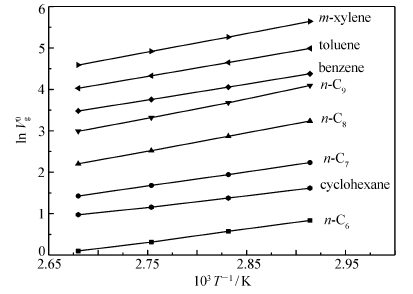
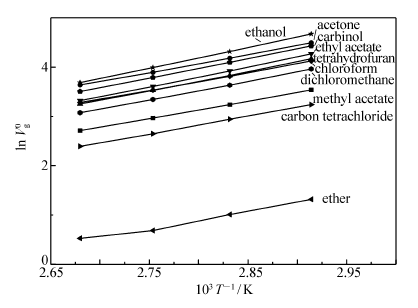
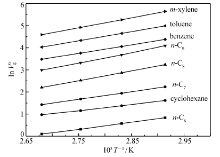
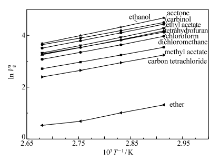
Specific retention volumes, Vg0, of eithteen kinds of solvents on [BMIM]PF6 were experimentally obtained at 343.15 to 373.15 K and were calculated according to Eq.(1). Specific retention volume data is essential for the determination of physicochemical properties of IL. Specific retention volumes of solvents on [BMIM]PF6 varied for each probe with reciprocal temperatures and decreased with increasing temperatures(Fig.1 and Fig.2). Generally, a linear relationship was obtained within experimental range for the polar and non-polar solvents working on [BMIM]PF6. This phenomenon suggests that equilibrium between solvents and [BMIM]PF6 have been achieved.

Fig.1 Plots of ln Vg0 versus 1/ T for hydrocarbon solvents

Fig.2 Plots of ln Vg0 versus 1/ T for non-hydrocarbon solvents

Δ H1swas obtained from the slope of ln Vg0versus 1/ T using Eq.(3), and Δ H1was obtained from the slope of ln Ω1versus 1/ T using Eq.(4).Table 1 shows experimentally obtained values for Δ Hls, Δ Hl, and Δ Hν, from 343.15 to 373.15 K. Δ Hν of the sorption process depended on chemical nature and the interaction between [BMIM]PF6 and solvents, in particular. Each probe had a distinct number of CH2 groups, and different enthalpies of the sorption process depended on the interaction between each probe and IL. The number of CH2 groups of n-alkanes series affected the value of Δ H1s(Table 1). The Δ H1svalues of solvents increased with the number of CH2 groups in the probe molecule. Increasing the amount of CH2 groups in solvents resulted in more exothermic heat of sorption. Specifically, CH2 groups of solvents exhibited dispersive forces during interaction with CH2 groups of [BMIM]PF6, whereas polar groups had dipole-dipole forces during interaction with polar groups of [BMIM]PF6. The Δ Hν values for n-alkanes increased with the number of CH2 groups in the probe molecules. Similarly, the Δ Hν values for dichloromethane, chloroform, and tetrachloromethane increased with the number of Cl atoms in probe molecules.

Table 1 The molar enthalpy of probe's absorption, Δ H1s, partial molar enthalpy of mixing at infinite dilution, Δ H1, and molar enthalpy of vaporization, Δ Hν, between solvents and [BMIM]PF6

Ω1and the Flory-Huggins interaction parameter between [BMIM]PF6 and solvents, χ12, were calculated based on Eq.(2) and Eq.(7) at investigated temperatures as listed inTable 2 and Table 3, respectively. The value of mass fraction activity coefficient at infinite dilution is especially important because it describes the extreme case in which only solute-solvent interaction contributes to non-ideality. FromTable 2, the values of Ω1for n-alkanes decreased with the elongation of the alkyl chain, which is apparently connected with the strength of the van der Waals interactions between IL and probe molecules. The Ω1values have been proposed to evaluate compatibility. According to Guillet[23], the solvent is good if Ω1<5. Otherwise, the solvent is poor if Ω1>10. The values between 5 and 10 indicate the solvent is moderate.Table 2 shows that the values of Ω1among n-C6, n-C7, n-C8, n-C9, cyclohexane, toluene, m-xylene, carbon tetrachloride, ethanol, carbinol decreased with temperature increasing from 343.15 to 373.15 K. However, the values of Ω1in the midst of benzene, dichloromethane, acetone, chloroform, ethyl acetate, tetrahydrofuran, ether, methyl acetate increased with temperature increasing from 343.15 to 373.15 K.

Table 2 Mass fraction activity coefficients, Ω1, of solvents at various temperatures

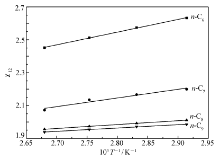
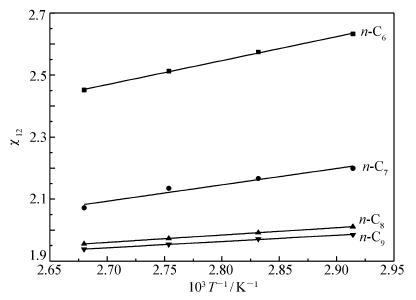
The parameter χ12characterizes the interaction between the vapor-phase of the probe and the IL stationary phase. Decreasing χ12for n-alkanes was observed with increasing temperature(Fig.3). The χ12value can also be used as a criterion to analyze the compatibility of an IL-solvent pair. Moreover, the χ12values are smaller for most polar solvents compared with non-polar solvents in IL stationary phase because of dipolar interaction[25]. A low χ12will result in high compatibility, and higher χ12reflects poor compatibility. The values of χ12confirmed the evaluations on the values of Ω1, given that χ12<0.5 indicates good solubility, and χ12>1 indicates poor solubility[24].Table 3 shows that n-C6, n-C7, n-C8, n-C9, cyclohexane, tetrahydrofuran, ether, and m-xylene are poor solvents for [BMIM]PF6. While benzene, toluene, carbon tetrachloride, ethanol, and carbinol are moderate solvents. By contrast, dichloromethane, acetone, chloroform, ethyl acetate, and methyl acetate are shown to be good solvents(stronger interactions) for [BMIM]PF6.

Table 3 The Flory Huggins interaction parameter, χ12, between solvents and [BMIM]PF6 at various temperatures

Fig.3 Plots of χ12 versus 1/ T for the solvents of n-C6, n-C7, n-C8, n-C9

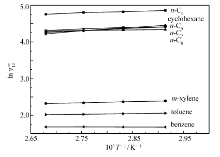
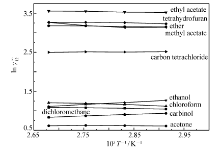
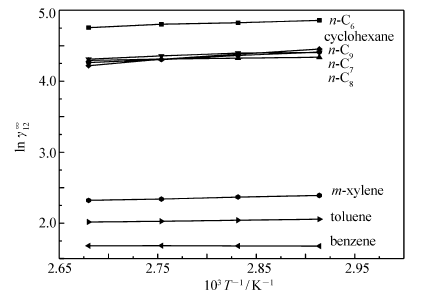
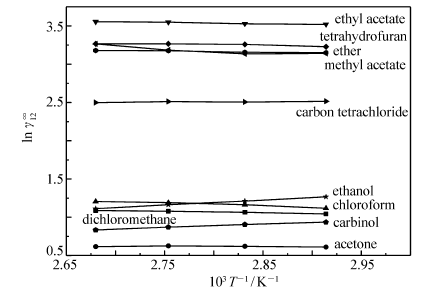
Considering molar masses of all solutes and ionic liquid [BMIM]PF6, γ12could also be calculated based on Eq.(6). Increased temperature resulted in decreased γ12values for n-alkanes, tetrahydrofuran, ether, cyclohexane, benzene, toluene, m-xylene alcohol, and carbinol. However, the opposite trend was observed for some solvents, especially for dichloromethane, acetone, chloroform, ethyl acetate, carbon tetrachloride, and methyl acetate(Table 4 and Fig.4 and Fig.5). The high γ12values of n-alkanes indicated their low solubility in ILs. Cyclic alkane reduced the value of γ12compared with that of the corresponding linear alkanes. The γ12values of n-hexane were higher than those of cyclohexane, which indicated that the cyclohexane has a stronger interaction with [BMIM]PF6 than the corresponding n-hexane. In the series of chloromethanes, γ12values strongly increased from dichloromethane to tetrachloromethane. This behavior may indicate that polar compounds have better solubility in ILs. In the case of alcohols, the lone pair of electrons on oxygen atom could interact with the cation of IL. Thus, the γ12values for the alcohols are relatively small. Consequently, cyclohexane, n-C6, n-C7, n-C8, n-C9, tetrahydrofuran, ether, carbon tetrachloride, and ethyl acetate, methyl acetate, had high values of γ12, which indicated very small interaction between solvents and [BMIM]PF6. Small values of γ12were observed for benzene, m-xylene, toluene, dichloromethane, acetone, chloroform, ethanol, and carbinol, which indicated that these types of compounds strongly interact with [BMIM]PF6. All the results were consistent with the Ω1values.

Table 4 Activity coefficients at infinite dilution, γ12, of probe-[BMIM]PF6 systems at various temperatures

Fig.4 Plots of ln γ12 versus 1/ T for hydrocarbon solvents

Fig.5 Plots of ln γ12 versus 1/ T for non-hydrocarbon solvents

3 Conclusions

The thermodynamic parameters for characterization of [BMIM]PF6-solvent system were determined using inverse gas chromatography(IGC). This technique was successfully used to determine IL-solvent interaction. Thermodynamic parameters obtained in the study revealed practical information about the compatibility between [BMIM]PF6 and solvents. In particular, IGC proved to be a versatile and useful technique to determine thermodynamic properties of [BMIM]PF6-solvent system. The mass fraction activity coefficient and Flory-Huggins interaction parameter between solvents and [BMIM]PF6 indicated that benzene, toluene, m-xylene, dichloromethane, acetone, chloroform, ethyl acetate, methyl acetate, ethanol, and carbinol were excellent solvents for [BMIM]PF6. By contrast, n-C6, n-C7, n-C8, n-C9, cyclohexane, tetrahydrofuran, ether, and carbon tetrachloride were poor solvents for [BMIM]PF6 at experimental temperatures.

参考文献
[1] Ghasemian E, Najafi M, Rafati A A, et al. Effect of Electrolytes on Surface Tension and Surfaceadsorption of 1-Hexyl-3-Methylimidazolium Chloride Iionic Lliquid in Aqueous Solution[J]. J Chem Thermodyn, 2010, 42(8): 962-966. [本文引用:1]
[2] Berthod A, Ruiz-Angel M, Carda-Broch S. Ionic Liquids in Separation Techniques[J]. J Chromatogr A, 2008, 1184(1/2): 6-18. [本文引用:1]
[3] Schmarr H G, Slabizki P, Muntnich S, et al. Ionic Liquids as Novel Stationary Phases in Gas Liquid Chromatography: Inverse or Normal Isotope Effect?[J]. J Chromatogr A, 2012, 1270(24): 310-317. [本文引用:1]
[4] Plechkova N V, Seddon K R. Applications of Ionic Liquids in the Chemical Industry[J]. Chem Soc Rev, 2008, 37(1): 123-150. [本文引用:1]
[5] Mutelet F, Moise J C, Skrzypczak A. Evaluation of the Performance of Trigeminal Tricationic Ionic Liquids for Separation Problems[J]. J Chem Eng Data, 2012, 57(3): 918-927. [本文引用:1]
[6] Domanska U, Zolek-Tryznowska Z. Thermodynamic Properties of Hyperbranched Polymer, Boltorn U3000, Using Inverse Gas Chromatography[J]. J Phys Chem B, 2009, 113(46): 15312-15321. [本文引用:1]
[7] Smidsr d O, Guillet J. Study of Polymer-Solute Interactions by Gas Chromatography[J]. Macromolecules, 1969, 2(3): 272-277. [本文引用:1]
[8] Li X P, Wang Q, Li L, et al. Determination of the Thermodynamic Parameters of Ionic Liquid 1-Hexyl-3-methylimiadzolium Tetrafluorborate by Inverse Gas Chromatography[J]. Chinese J Chromatogr, 2015, 33(1): 58-64. [本文引用:1]
[9] Hou L X, Wang S. Study on Ionic Liquid [bmim]PF6 and [hmim]PF6 as Plasticizer for PVC Paste Resin[J]. Polym Bull, 2011, 67(7): 1273-1283. [本文引用:1]
[10] Dou Q, Sha M L, Fu H Y, et al. Melting Transition of Ionic Liquid [bmim][PF6] Crystal Confined in Nanopores: A Molecular Dynamics Simulation[J]. J Phys Chem C, 2011, 115(39): 18946-18951. [本文引用:1]
[11] Fandary M S, Alkhaldi K H A E, Al-Jimaz A S, et al. Evaluation of [bmim][PF6] as an Ionic Solvent for the Extraction of Propylbenzene from Aliphatic Compounds[J]. J Chem Thermodyn, 2012, 54(54): 322-329. [本文引用:1]
[12] Safamirzaei M, Modarress H. Application of Neural Network Molecular Modeling for Correlating and Predicting Henry's Law Constants of Gases in [bmim][PF6] at Low Pressures[J]. Fluid Phase Equilib, 2012, 332: 165-172. [本文引用:1]
[13] Desty D, Swanton W. Gas-Liquid Chromatography-Some Selective Stationary Phases for Hydrocarbon Seprations[J]. J Phys Chem, 1961, 65(5): 766-774. [本文引用:1]
[14] Parcher J F, Weiner P H, Hussey C L, et al. Specific Retention Volumes and Limiting Activity Coefficients of C4-C8 Alkane Solutes in C22-C36 n-Alkane Solvents[J]. J Chem Eng Data, 1975, 20(2): 145-151. [本文引用:1]
[15] Domanska U, Zolek-Tryznowska Z. Mass Fraction Activity Coefficients at Infinite Dilution Measurements for Organic Solutes in the Dendritic Polymer PAMAM-C12 Using Inverse Gas Chromatography[J]. J Chem Eng Data, 2010, 55(11): 4976-4981. [本文引用:1]
[16] Yazici O, Sakar D, Cankurtaran O, et al. Thermodynamical Study of Poly(n-hexyl methacrylate) with Some Solvents by Inverse Gas Chromatography[J]. J Appl Polym Sci, 2011, 122(3): 1815-1822. [本文引用:1]
[17] Chen Y L, Wang Q, Zhang Z F, et al. Determination of the Solubility Parameter of Ionic Liquid 1-Hexyl-3-methylimidazolium Hexafluorophosphate by Inverse Gas Chromatography[J]. Ind Eng Chem Res, 2012, 51: 15293-15298. [本文引用:1]
[18] Cakar F, Cankurtaran O. Determination of Secondary Transitions and Thermodynamic Interaction Parameters of Poly(ether imide) by Inverse Gas Chromatography[J]. Polym Bull, 2005, 55(1): 95-104. [本文引用:1]
[19] Everett D. Effect of Gas Imperfection on G. L. C. Measurements: A Refined Method for Determining Activity Coefficients and Second Virial Coefficients[J]. Trans Faraday Soc, 1965, 61: 1637-1645. [本文引用:1]
[20] Cruickshank A G B, Gainey B W, Hicks C P, et al. Gas-Liquid Chromatographic Determination of Cross-Term Second Virial Coefficients Using Gglycerol[J]. Trans Faraday Soc, 1969, 65(556): 1014-1031. [本文引用:1]
[21] Kong X H, Silveira M D L V, Zhao L Y, et al. A Pseudo Equation-of-State Approach for the Estimation of Solubility Parameters of Polyethylene by Inverse Gas Chromatography[J]. Macromolecules, 2002, 35(22): 8586-8590. [本文引用:1]
[22] Hudson G. H, McCoubrey J C. Intermolecular Forces Between Unlike Molecules[J]. Trans Faraday Soc, 1960, 56(56): 761-766. [本文引用:1]
[23] Du Q G, Chen W J. Inverse Gas Chromatography. 8. Apparent Probe Dependence of Χ23' for a Ply(vinyl chloride)-Poly(tetramethylene glycol) Blend[J]. Macromolecules, 1999, 32(5): 1514-1518. [本文引用:1]
[24] Li X P, Wang Q, Li L, et al. Determination of the Thermodynamic Parameters of Ionic Liquid 1-Hexyl-3-methylimidazolium Chloride by Inverse Gas Chromatography[J]. J Mol Liq, 2014, 200(1): 139-144. [本文引用:1]
[25] Yazici D T, Askin A, Butun V. GC Investigation of the Solubility Parameters of Water-soluble Homopolymers and Double-hydrophilic Diblock Copolymers[J]. Chromatographia, 2008, 67(9): 741-747. [本文引用:1]